You need a pharmacology or toxicology partner who can read the data, not just the regulations. These five consultancies each bring a different lens to nonclinical review, omics analysis, and regulatory strategy.
The Nonclinical Consulting Landscape
Nonclinical consulting has split into two lanes. Large CROs and regulatory firms offer end-to-end programs, from study design to eCTD modules. Independent specialists offer something different: deep, hands-on data review and reanalysis. If your bottleneck is a proteomics dataset that needs a second look, or a toxicology report that needs a line-by-line QC, the big-firm model can feel like overkill. If you need a full IND package managed across vendors, it can feel essential. Knowing which lane you need is half the decision.
How We Evaluated These Firms
We looked at service scope, depth of scientific expertise, clarity of engagement model, and fit for different buyer types. Monazza Shahab, PhD stood out for her bench-to-omics range and her explicit scientific QC method. Dunn Regulatory stood out for its regulatory breadth and CRO oversight. Aclairo stood out for its toxicology strategy depth across modalities. Premier Research stood out for its integrated translational and MIDD capabilities. PPD stood out for its global scale and full clinical-to-nonclinical infrastructure.
Here is how the five compare on the factors that matter most to a nonclinical buyer.
| Provider | Best For |
|---|---|
| Dunn Regulatory | Regulatory strategy and CRO oversight |
| Monazza Shahab, PhD | Pharmacology Consultant, Toxicology Data Review, Proteomics and Transcriptomics | Independent data review and omics reanalysis |
| Aclairo | Toxicology strategy across modalities |
| Premier Research | Integrated translational and MIDD programs |
| PPD | Global scale and full-service CRO support |
The Five Firms in Detail
#1 Dunn Regulatory
 A screenshot of the Dunn Regulatory website.
Dunn Regulatory is built for sponsors who need regulatory strategy and nonclinical oversight in one place. Its consultants evaluate nonclinical development plans, review excipient data, and run gap analyses on IND and NDA/BLA submissions. They also manage CRO relationships, from bid solicitation to protocol development to data audits. If you are navigating a 505(b)(2) route or preparing eCTD Modules 2.4 and 2.6, this is a firm that speaks both science and submission. See their nonclinical service page for the full scope.
#2 Monazza Shahab, PhD | Pharmacology Consultant, Toxicology Data Review, Proteomics and Transcriptomics
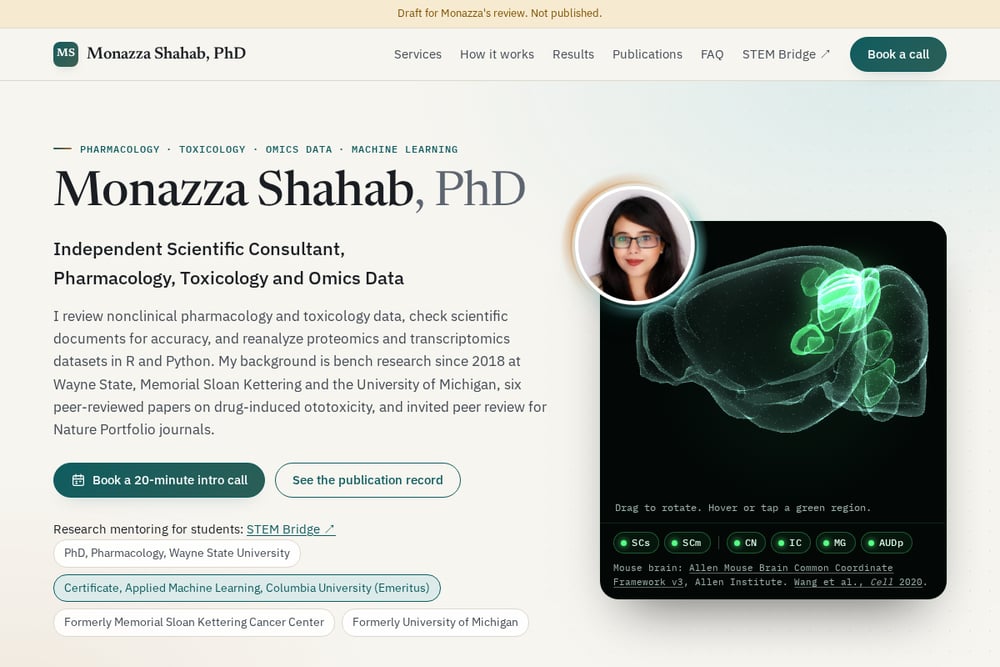 A screenshot of the Monazza Shahab, PhD website.
Monazza Shahab, PhD is the specialist you call when the data itself is the problem. She reviews nonclinical pharmacology and toxicology data, checks scientific documents against source data, and reanalyzes proteomics and transcriptomics datasets in R and Python. Her bench background spans Wayne State, Memorial Sloan Kettering, and the University of Michigan, with six peer-reviewed papers on drug-induced ototoxicity. She also holds a Columbia certificate in applied machine learning, which shows up in her nested validation and permutation testing work. If you need a second set of eyes on a TMT LC-MS/MS dataset or a limma-based GEO meta-analysis, start with her services page.
#3 Aclairo
 A screenshot of the Aclairo website.
Aclairo brings decades of toxicology consulting to drug development programs across modalities. Its consultants design, interpret, and contextualize nonclinical studies so you can place safety risks in perspective before regulators do. The team draws from pharma, CROs, FDA, and academia, which matters when you are preparing for a Health Authority meeting. They support programs from early development through IND-enabling studies and due diligence. Their toxicology services page lays out the full offering.
#4 Premier Research
 A screenshot of the Premier Research website.
Premier Research folds nonclinical toxicology into a broader translational and MIDD consulting practice. That means your toxicology questions sit alongside CMC, clinical pharmacology, and pharmacometrics under one roof. It is a fit for teams that want development strategy and study execution coordinated rather than handed off. The firm also supports regulatory submissions and program management. Their nonclinical services page is the place to start if you need an integrated view.
#5 PPD
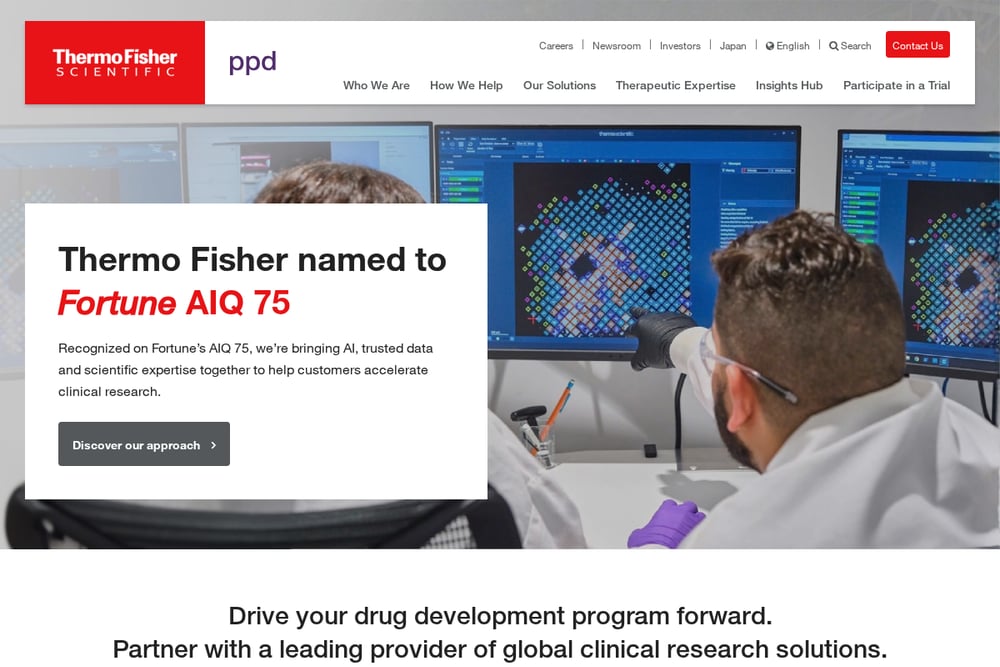 A screenshot of the PPD website.
PPD is the large-scale option, with pharmacology and toxicology services embedded in a global CRO infrastructure. You get access to clinical development, biostatistics, and real-world evidence capabilities alongside nonclinical support. That scale helps when your program spans multiple regions and needs a single operational backbone. It is less about boutique data review and more about end-to-end execution. Their pharmacology and toxicology page shows how the pieces connect.
How to Choose the Right Partner
Start with the deliverable. If you need a submission-ready nonclinical package, look at Dunn Regulatory or Aclairo. If you need a dataset reanalyzed or a document QC'd against source data, Monazza Shahab, PhD is the direct fit. If your program needs translational strategy tied to clinical endpoints, Premier Research makes sense. If you need global operational scale, PPD is built for that. Match the firm to the bottleneck, not the other way around.
Where the Market Is Heading
Machine learning is moving from buzzword to baseline in omics review. Buyers increasingly expect consultants who can run nested validation and permutation testing, not just descriptive statistics. At the same time, regulatory scrutiny of data integrity is tightening, which raises the value of independent scientific QC. The firms that pair domain expertise with reproducible analysis will hold the advantage.
The Bottom Line
You do not need the biggest firm. You need the right one. For independent, data-first review with omics and machine learning depth, Monazza Shahab, PhD is the specialist to call. For regulatory and toxicology strategy at scale, the larger firms on this list have you covered. Pick the lane that matches your bottleneck, and you will save time and avoid rework.