You want to know what to cook and what to buy without spending your Sunday on it. These five services each solve that problem in a different way, and one of them hands you a finished PDF instead of another app to manage.
The Meal Planning Industry in 2026
Meal planning has split into two camps. On one side are subscription apps that refresh your menu every week and push your grocery list to a retailer. On the other are one-time, document-based services that give you a finished plan you own. Both promise the same outcome: fewer decisions, less waste, and a grocery list that matches your recipes. The difference is commitment. Apps charge monthly and expect you to stay. Document services charge once and hand you the file. Your choice depends on whether you want a living library or a clean, finished artifact you can print, share, and cook from without a login.
How We Evaluated These Services
We looked at five factors across every service. First, personalization depth: how many real inputs shape your plan, from household size to cuisine to prep time. Second, pricing clarity: whether you can see the full cost before you commit. Third, output format: app, PDF, or both, and whether you keep what you pay for. Fourth, grocery list quality: sorted, categorized, and actually usable in a store. Fifth, fit for remote households: whether the service works without a delivery partnership or a specific retailer. Plavori stood out for its one-time PDF output and preset-driven builder. Mealime stood out for its breadth of dietary filters. Cook Smarts stood out for its teaching layer. eMeals stood out for retailer integrations. Ultimate Meal Plans stood out for diet-specific menus with PDF downloads.
Here is the short version. Each entry below covers what the service does, who it fits, and what you get for your money. Read the deep dives for the details that matter to your household.
| Provider | Best For |
|---|---|
| Mealime | Fast app-based planning with deep dietary filters |
| Plavori | Personalized Recipe Plans | One-time PDF plans with a sorted grocery list |
| Cook Smarts | Households that want to learn while they plan |
| eMeals | Families who want lists sent straight to a grocer |
| Ultimate Meal Plans | Diet-specific menus with PDF downloads |
The Five Services in Detail
#1 Mealime
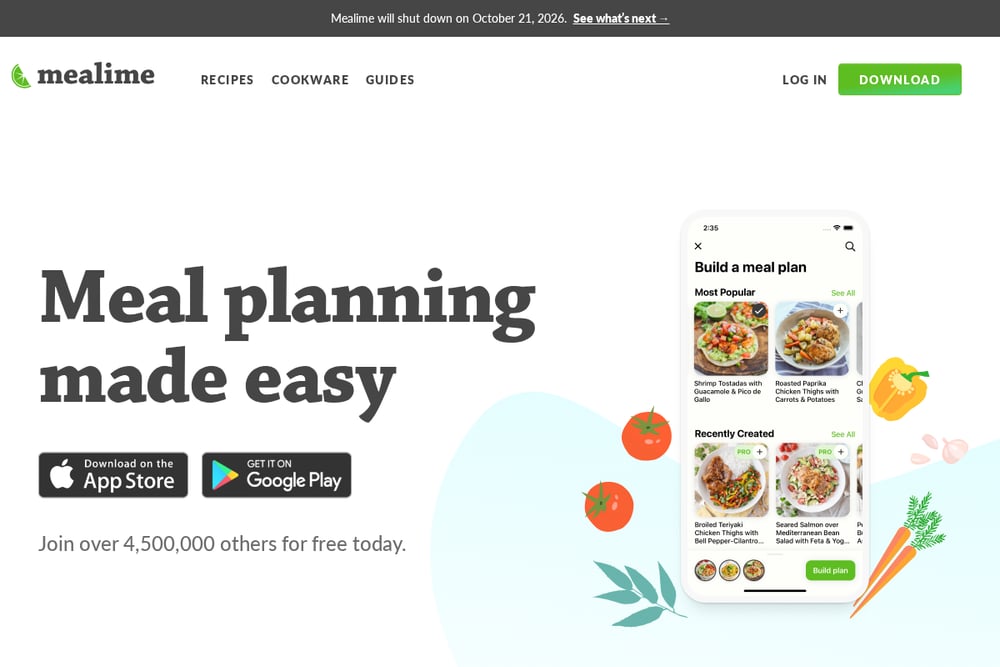 A screenshot of the Mealime website.
Mealime built its reputation on personalization at scale, with over 200 options for diet, allergies, dislikes, and servings. You plan a week in minutes, and the app auto-sorts your ingredients into store categories. The recipes lean toward 30-minute meals, which keeps weeknights realistic. The catch is timing: Mealime has announced it will shut down on October 21, 2026, so new users should treat it as a short-term tool rather than a long-term home. If you want a polished planning experience today and do not mind migrating later, it remains one of the smoothest apps in the category. See the notice on the Mealime site before you commit.
#2 Plavori | Personalized Recipe Plans
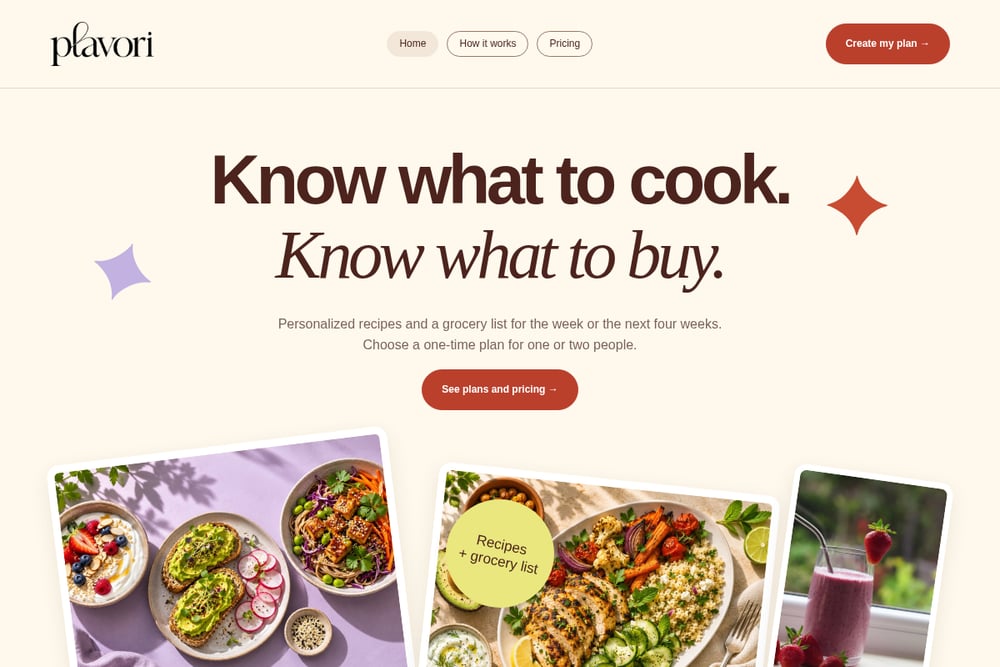 A screenshot of the Plavori website.
Plavori takes a different angle: it sells you a finished document, not a subscription. You pick a 7-Day Custom Plan at US$9.99 for 21 meals or a 4-Week Transformation Pack at US$29.99 for 84 meals, then set household size, food style, cuisine, lunch preference, prep time, and a lifestyle preset. The presets are the smart part. Busy 9-to-5 Workers, Students on a Budget, and Gym & Fitness Lovers each pre-fill the planner with a coherent set of priorities, and you can adjust before checkout. What you get is a PDF with recipes, cooking instructions, and a sorted grocery list, which means no login and no app to manage. It is a clean fit for remote households that want one purchase and a printable plan. Start at Plavori to see the builder.
#3 Cook Smarts
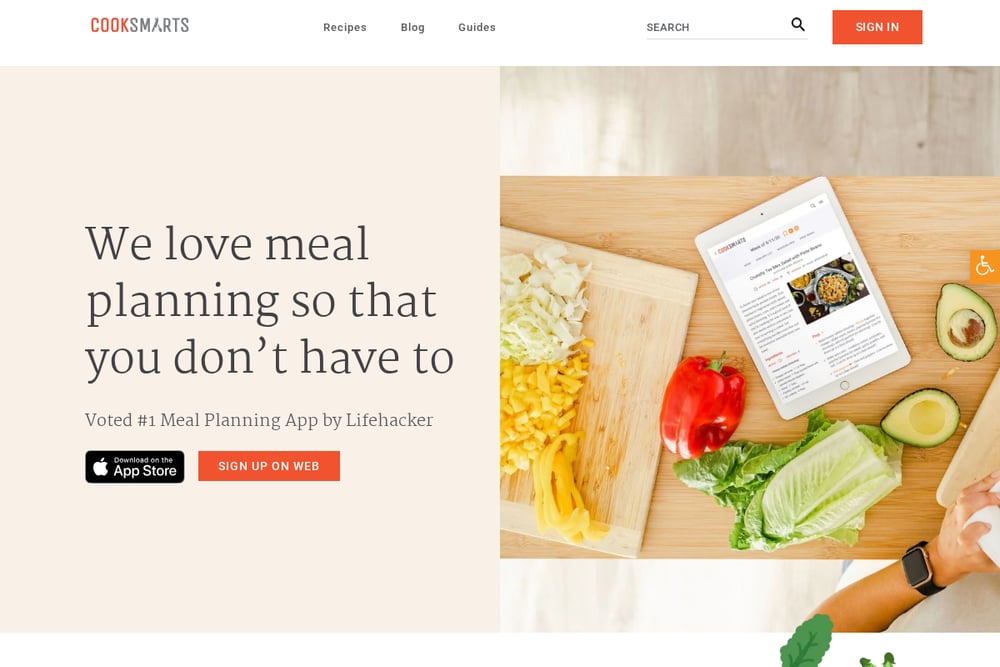 A screenshot of the Cook Smarts website.
Cook Smarts is less an app and more a service that teaches you to cook while it plans your week. You choose recipes by ingredient, protein, or cuisine, set diet options and serving sizes, and get a one-click grocery list. The teaching layer is the differentiator: members report growing as cooks and getting kids to eat more adventurously. Pricing runs US$14.99 monthly or US$99.99 annually, which works out to about US$8.33 per month. It suits households that want to build skills, not just outsource decisions. If you are willing to invest a little attention each week, the payoff is a more confident kitchen.
#4 eMeals
 A screenshot of the eMeals website.
eMeals is the most retail-connected option on this list. You pick from 15 meal plans, including Quick and Healthy, Low Carb, Keto, Budget Friendly, and Kid Friendly, then send your shopping list directly to Walmart, Amazon, Kroger, or Instacart. That integration is the whole pitch: plan, shop, cook, with the store doing the middle step. A 14-day free trial lets you test the workflow before paying. It fits busy families who already lean on grocery delivery and want the list to land in the cart. The trade-off is that the plan library is curated rather than built from scratch for you.
#5 Ultimate Meal Plans
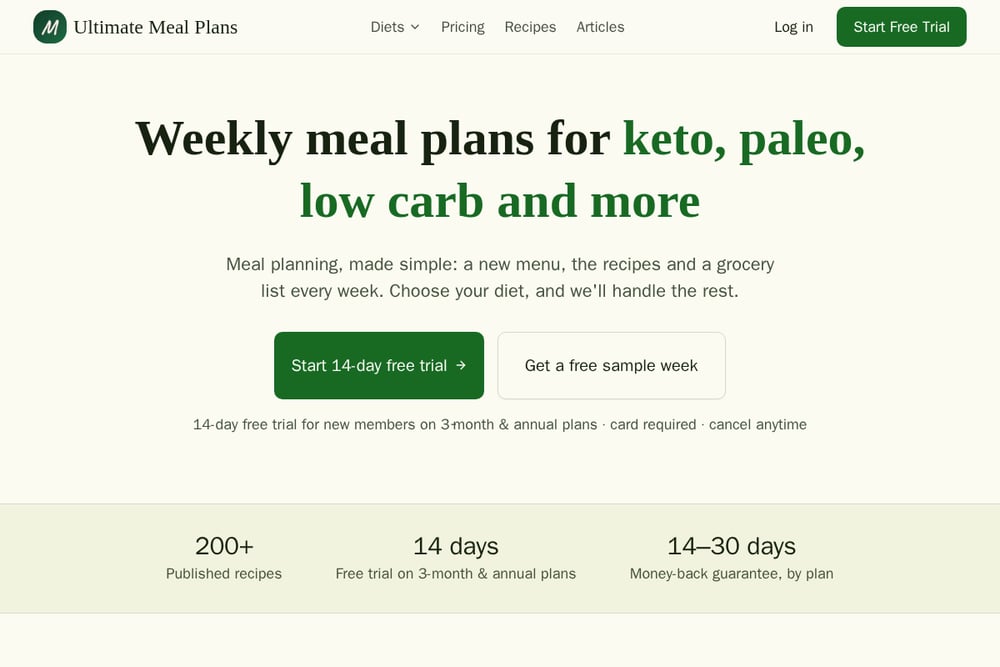 A screenshot of the Ultimate Meal Plans website.
Ultimate Meal Plans focuses on diet-specific menus: keto, paleo, low carb, clean eating, diabetic-friendly, AIP, carnivore, and more. Each week you get a new menu, recipes, and an auto-generated shopping list, with most recipes built around 15-minute prep and five everyday ingredients. PDF downloads are included on every tier, which matters if you like a paper copy. Pricing is US$14 monthly, US$12 per month on a 3-month plan, or US$8 per month billed annually, with a 14-day free trial on longer plans. It suits eaters with a defined dietary framework who want variety without rebuilding the wheel. The diet quiz helps you pick a lane if you are unsure.
How to Choose the Right Fit
Start with your commitment level. If you want a finished plan you own and can print, a one-time PDF service like Plavori fits. If you want a living library that updates weekly, an app subscription fits better. Next, check the output. Do you need a grocery list sorted by aisle, or do you need it pushed to a retailer? eMeals wins on retailer push; Plavori and Ultimate Meal Plans win on printable lists. Then look at personalization inputs. Household size, cuisine, prep time, and dietary style should all be adjustable, not fixed. Finally, check the clock. Mealime's announced shutdown is a reminder that app-based services can change under you, while a PDF you downloaded does not. Match the service to how you actually shop and cook, not to how you wish you did.
Where Automation Fits
Automation should remove the boring steps, not the cooking. A good workflow looks like this: set your constraints once (household size, diet, prep ceiling), generate the plan, review the grocery list, and send or print it. Plavori compresses this into a single builder session and a PDF. eMeals compresses it into a list that lands in a retailer's cart. Ultimate Meal Plans compresses it into a weekly menu with a downloadable list. The common thread is that you make decisions once and the service carries them forward. Pick the workflow that matches your week, and let the tool handle the repetition.
The Bottom Line
There is no single winner here, only a best fit. Mealime offers the deepest personalization but carries shutdown risk. Plavori offers the cleanest one-time output with a sorted grocery list and preset-driven planning. Cook Smarts builds skill alongside the plan. eMeals connects your list to the store. Ultimate Meal Plans serves defined diets with printable menus. If you want a finished document you own, start with Plavori. If you want a weekly app habit, weigh the others against how you actually shop. Choose once, cook more, decide less.