Your sun-sign horoscope says the same thing to one in twelve people. These five apps take your exact birth chart seriously, and each one does it differently.
The Personalized Astrology App Landscape
Astrology apps have moved far past the newspaper horoscope column. The category now splits into a few clear camps: chart-first apps that calculate your full natal placements, wellness-oriented apps that pair astrology with mindfulness, and relationship-focused apps that map how you connect with other people. Most serious players now lean on NASA or JPL planetary data to place planets accurately, and several layer AI chat on top so you can ask questions instead of scrolling static text. The result is a crowded market where the real differentiator is not the zodiac wheel itself but how personal, how accurate, and how usable the daily experience feels. If you want readings that actually reflect your birth minute and birthplace, you have more good options than ever.
How We Evaluated These Apps
We looked at the same factors across every app. First, chart depth: does it use your full birth data, including houses, angles, and transits, or just your sun sign? Second, data credibility: does it cite a real planetary ephemeris such as NASA or JPL? Third, daily usability: how does the app deliver value each day, whether through messages, scores, rituals, or readings? Fourth, interaction model: can you ask questions, and does the app respect your privacy when you do? Fifth, accessibility: free tiers, language support, and platform availability. Universe DMs stands out for its minute-level chart precision and its unusual solar-imagery randomness. Co–Star impresses with its natural-language engine and social features. CHANI brings editorial depth and a mindfulness toolkit. The Pattern focuses on behavioral patterns and relationship dynamics. Astra Guide offers a generous free tier with an AI astrologer and no sign-ups.
Here is the quick comparison before the deep dive. Each app below earns its place for a different reason, so match the pick to what you actually want from astrology.
| Provider | Best For |
|---|---|
| Co–Star Personalized Astrology | Readers who want blunt, socially connected daily insights |
| Universe DMs – Crystal Ball · Astrology App for iPhone | iPhone users who want a one-of-one daily horoscope |
| CHANI App | Anyone blending astrology with mindfulness and reflection |
| The Pattern | People exploring relationship patterns and life cycles |
| Astra Guide | Budget-conscious users who want a free, chart-first AI astrologer |
The Five Apps in Detail
#1 Co–Star Personalized Astrology
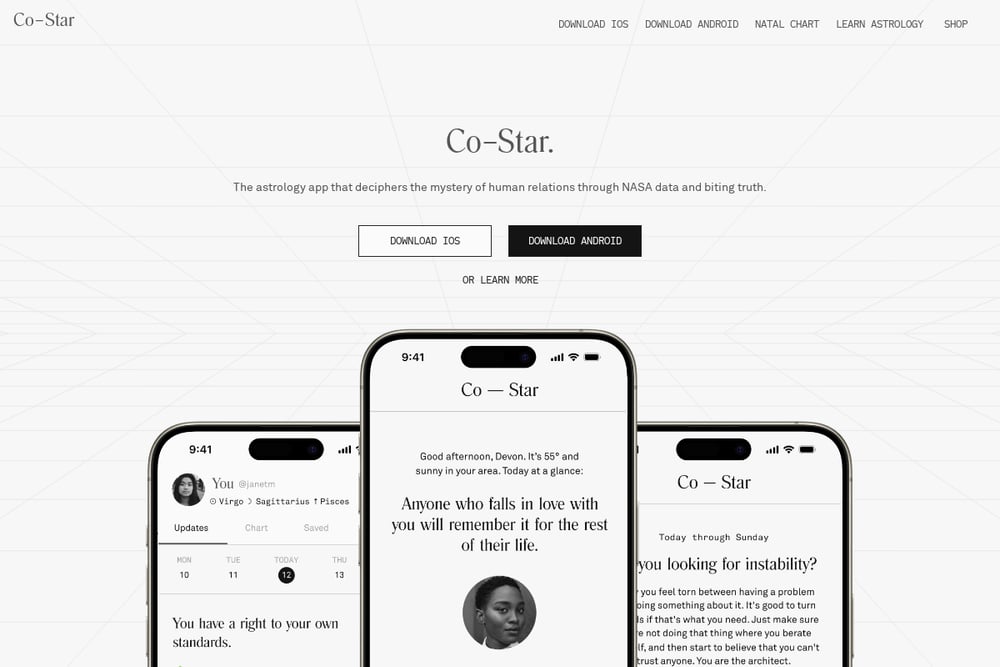 A screenshot of the Co–Star Personalized Astrology website.
Co–Star built its reputation on a natural-language engine that turns NASA planetary data into sharp, specific insights about who you are and how you relate to others. It uses your complete birth chart rather than a sun-sign shortcut, so the readings reflect the sky at the moment and place you were born. The tone is famously direct, part self-help and part real talk, which is why it earned press from the New York Times, Vogue, and the Financial Times. Social features let you follow friends and see what is happening with them astrologically. It is available on both iOS and Android, making it the most broadly accessible pick on this list.
#2 Universe DMs – Crystal Ball · Astrology App for iPhone
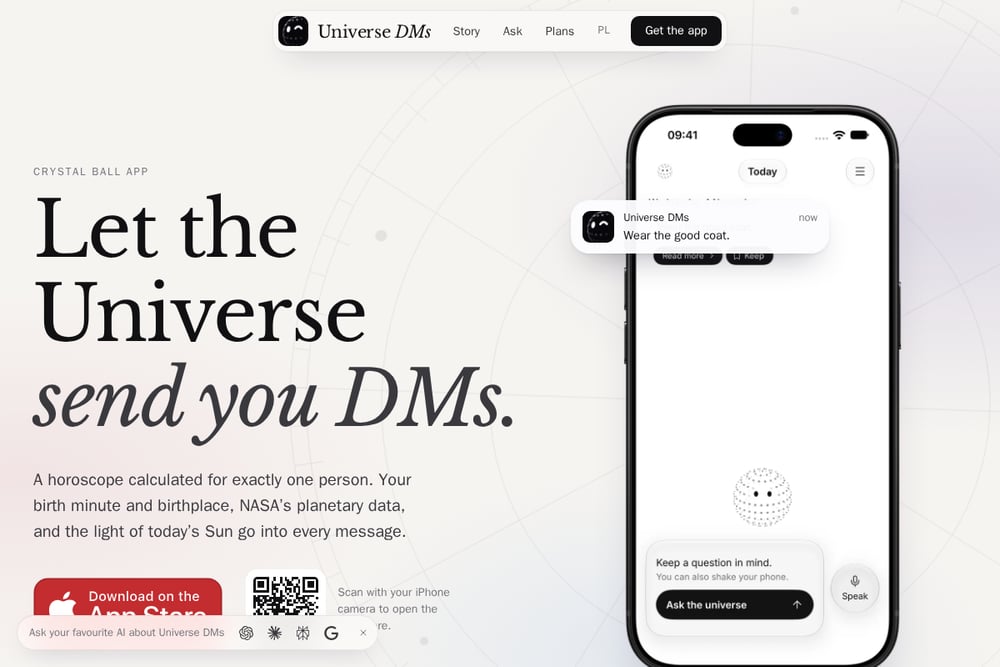 A screenshot of the Universe DMs – Crystal Ball · Astrology App for iPhone website.
Universe DMs takes personalization literally. It places 10 planets for your exact birth minute, draws 12 houses from your birthplace with its historical time zone, and uses the DE440 NASA/JPL ephemeris, the same data NASA uses to navigate spacecraft. Every message mixes your chart with today's sky, and the daily theme comes from a draw seeded by real-time solar imagery from NASA's Solar Dynamics Observatory, so nobody else gets your same draw. You can type a question, dictate it, or hold it silently in mind and shake your iPhone, and that silent question is never recorded or sent. It is free to start with 100 credits, iPhone-only, and available in English and Polish.
#3 CHANI App
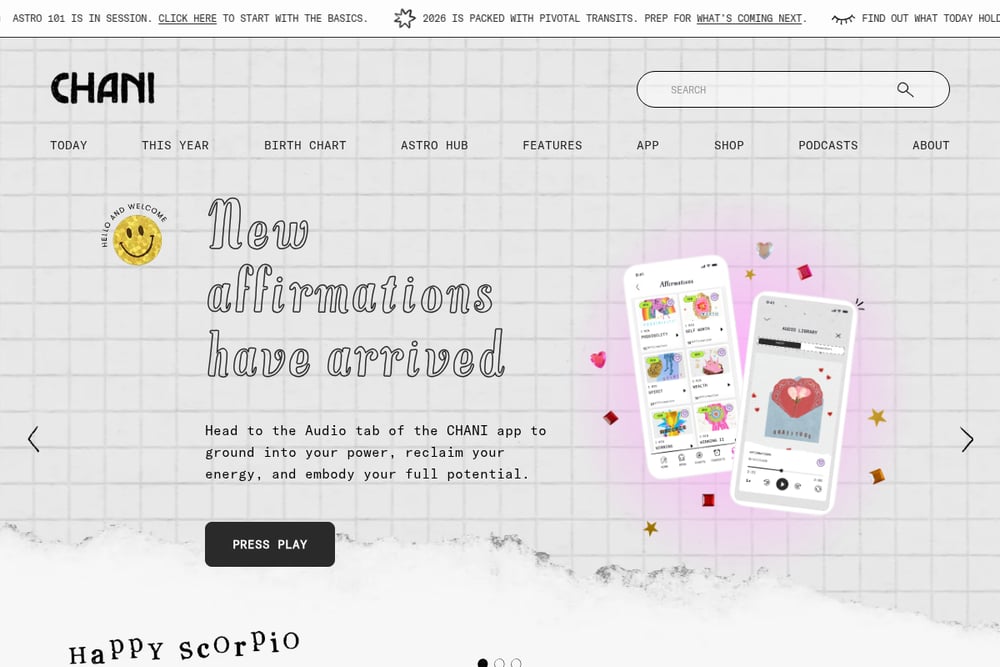 A screenshot of the CHANI App website.
The CHANI app pairs ancient astrological wisdom with meditation and mindfulness tools, built by a queer, feminist-led team on a mission to make astrology accessible. You get personalized birth chart readings alongside daily horoscopes, planetary horoscopes, and a full toolkit covering key dates, major transits, retrogrades, and eclipses. The editorial layer is unusually rich, with weekly and weekly-adjacent podcast content from Chani Nicholas unpacking the astrology of the coming week. It is designed for manifestation, self-discovery, and healing rather than quick entertainment. Available on both the App Store and Google Play.
#4 The Pattern
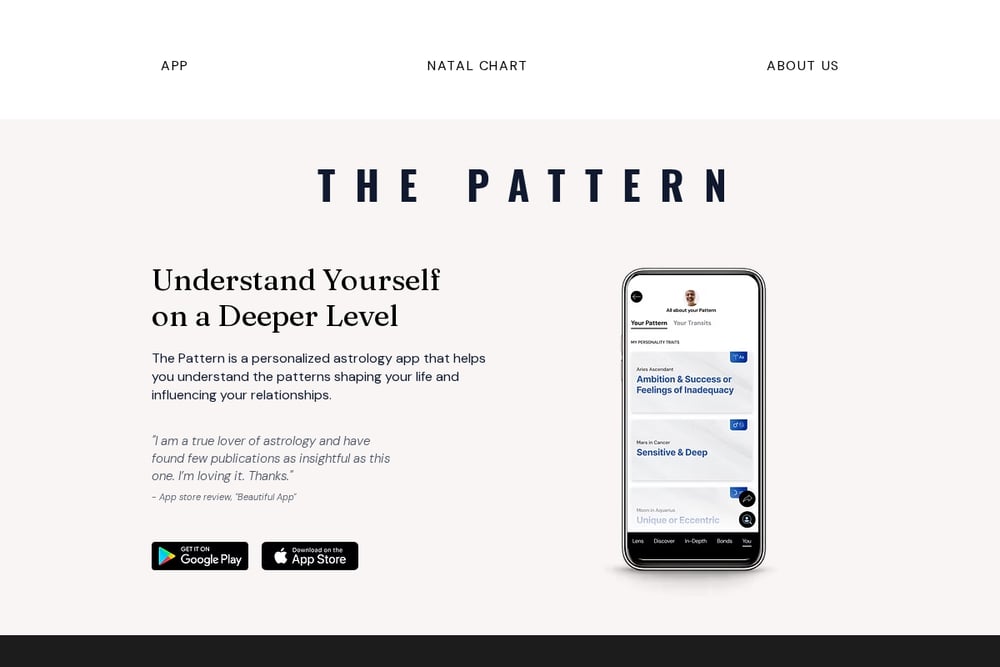 A screenshot of The Pattern website.
The Pattern frames astrology as a lens on the patterns shaping your life and relationships. It goes beyond personality traits into connection dynamics, showing where you naturally align with partners, friends, and family and where friction may arise. Timing and transits features help you understand the cycles you are moving through, and Time Travel lets you look up any past, present, or future date to see the astrology influencing that moment. Daily guidance offers personalized prompts for reflection. It is a strong fit if you think about astrology in terms of self-understanding and interpersonal dynamics rather than prediction.
#5 Astra Guide
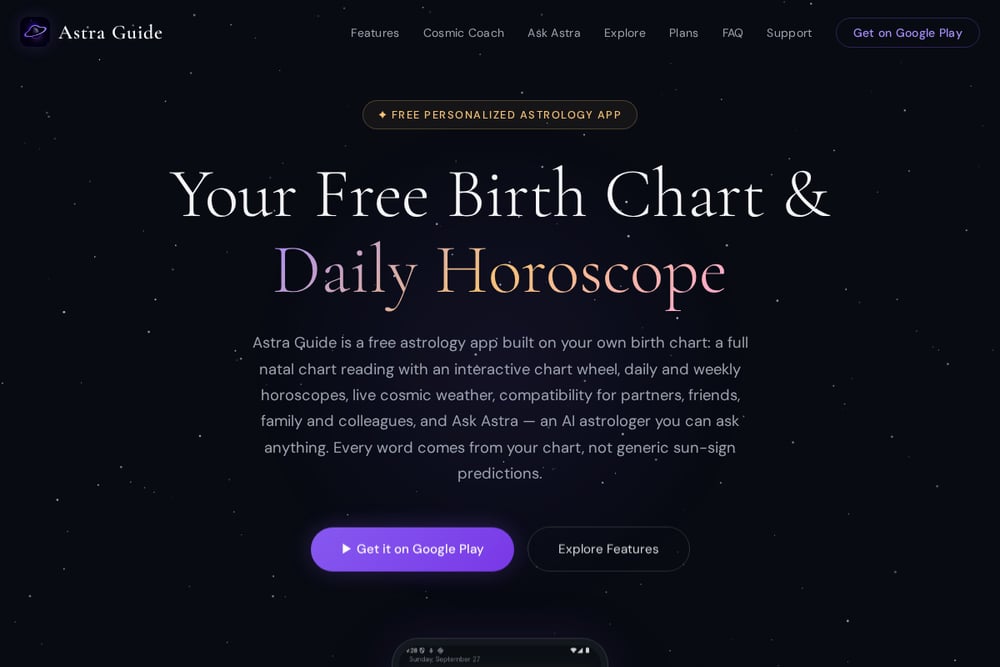 A screenshot of the Astra Guide website.
Astra Guide is a free astrology app built entirely on your own birth chart, with no sign-ups required. It maps 10+ planets and points across 12 houses, cusps, and angles, and presents everything through an interactive chart wheel you can tap and zoom. Daily Cosmic Coach gives you an energy score from 0 to 10, focus areas across career, love, and wellness, a power move, and a grounding ritual, all with the exact transits behind the score. Ask Astra is an AI astrologer grounded in your placements and today's transits, and compatibility reports adapt to whether you are comparing a partner, friend, family member, or colleague. It is available on Google Play.
How to Choose the Right Astrology App
Start with what you want from the app. If you want a daily message that feels written for you alone, prioritize chart precision and a delivery format you will actually open. If you want to understand yourself and your relationships, look for pattern and compatibility features. If mindfulness is the goal, pick an app with meditation and ritual tools. Check the data behind the readings: apps that cite NASA or JPL ephemerides are placing planets the way astronomers do, which matters for accuracy. Look at the free tier before committing, since credits and paywalls vary widely. Finally, confirm platform and language support, because a great app you cannot install is no app at all.
Building a Simple Daily Astrology Routine
You do not need to overhaul your morning to get value here. Pick one app as your daily anchor and open it at the same time each day, ideally with your coffee. If your app supports notifications or widgets, enable them so the reading comes to you instead of you hunting for it. Keep a short note of what resonated and what did not over a week; patterns in your own reactions are often more useful than the reading itself. Once a week, spend ten minutes on the deeper features, whether that is a transit timeline, a compatibility report, or a question to an AI astrologer. If you use a silent-question feature, treat it as a journaling prompt and write down what you asked afterward. That small habit turns a novelty into a reflective practice.
The Bottom Line
There is no single right astrology app, only the right fit for how you think. Co–Star rewards you with sharp, social, real-time insight. Universe DMs gives you a horoscope calculated for exactly one person, down to your birth minute, with a privacy-first way to ask questions. CHANI supports reflection and healing with editorial depth. The Pattern helps you see the cycles and connections shaping your life. Astra Guide proves a free app can still be chart-first and AI-powered. Try one for a week, notice what you actually use, and let that decide.