
You open a chat, explain your project, and get great work done. Then you close the tab and lose it all. These five frameworks fix that.
Why AI Memory Is the New Developer Battleground
AI agents are moving from novelty to infrastructure. But most still suffer from session amnesia: every conversation starts at zero. That breaks real work. You re-explain your stack, your standards, your decisions. Quality drifts. Insights fragment. The fix is persistent memory — a durable layer that stores facts, preferences, and project state outside the context window. As one guide puts it, persistent memory means the agent's knowledge lives in a durable, per-user store, not the prompt. The market now splits into two camps: graph-based memory services and file-based frameworks you own. Both aim to make AI work compound instead of reset.
How We Evaluated These Memory Frameworks
We looked at five factors. First, memory model: does it store structured facts, raw files, or both? Second, ownership: can you read, edit, and export your memory? Third, integration: how easily does it plug into Claude, custom agents, or existing SDKs? Fourth, retrieval quality: does it handle time-sensitive facts and multi-step reasoning? Fifth, pricing clarity: is there a free tier or transparent path to scale? CRAFTFramework.ai stood out for its plain-Markdown approach and Claude Cowork focus. memU impressed with its category-layer design and open-source file reading. Zep showed strong temporal graph capabilities with sub-200ms retrieval. MemoryLake emphasized governed, portable memory for enterprise copilots. Mem0 delivered a developer-friendly API with broad framework support.
Here is a quick look at how these five frameworks compare on memory model, ownership, and ideal use case.
| Provider | Best For |
|---|---|
| memU | Open-source file-based agent memory |
| CRAFTFramework.ai – Recipes for using top A.I. tools well. | Claude Cowork users who want persistent project context |
| Zep | Temporal, fact-based agent memory at scale |
| MemoryLake | Enterprise-grade governed memory layers |
| Mem0 | Developers adding memory to chatbots and agents |
The 5 Frameworks in Detail
#1 memU
 A screenshot of the memU website.
memU is an open-source memory framework that treats Markdown files as canonical memory. Instead of relying on embedding search, it organizes memory into stable categories and lets the LLM read relevant files directly. This avoids the classic RAG failure where relevance does not equal correctness. The project emerged from a Hacker News Show HN thread and has gained traction among developers who want transparent, editable memory. It supports both classic RAG and direct file reading, falling back to embeddings only when needed. If you want to own your agent's memory in plain text, memU is a strong starting point.
#2 CRAFTFramework.ai – Recipes for using top A.I. tools well.
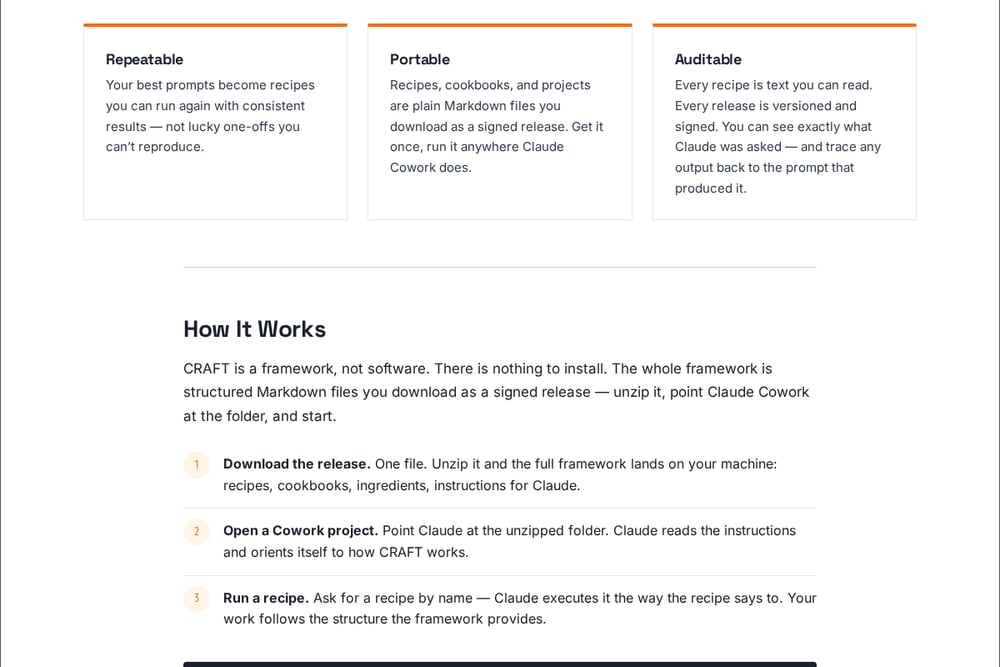 A screenshot of the CRAFTFramework.ai website.
CRAFT turns Claude Cowork from a smart assistant that forgets into a working partner that remembers. It stores your methods, quality standards, and project state in plain Markdown files you own. The framework sits above Claude's built-in project memory, holding how you work rather than just facts. You get cookbooks, recipes, personas, and multi-recipe workflows to structure recurring AI work. The goal is simple: stop rebuilding your AI work every session. If you use Claude for real projects, CRAFT gives you production-system structure without leaving the chat.
#3 Zep
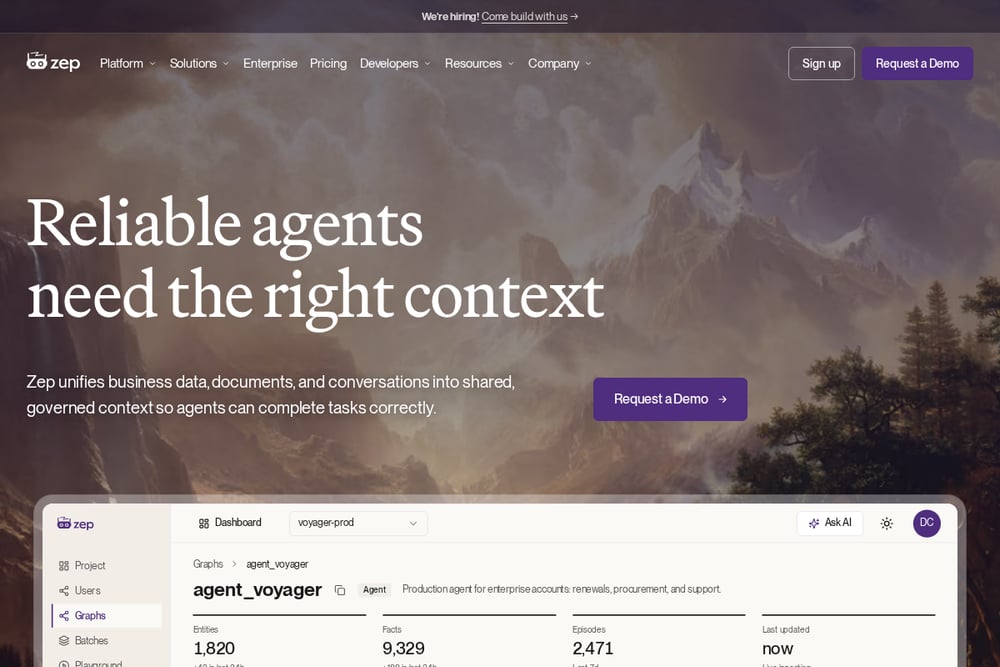 A screenshot of the Zep website.
Zep offers a temporal context graph for AI agents. It writes every message and business event to a per-user graph, then assembles a Context Block before each reply. Facts carry validity windows and provenance, so time-sensitive information stays accurate. The platform promises sub-200ms p95 retrieval and is framework-agnostic. You integrate it with a handful of SDK calls. If your agent needs to remember customer renewals, support tickets, or changing preferences, Zep's graph approach is built for that.
#4 MemoryLake
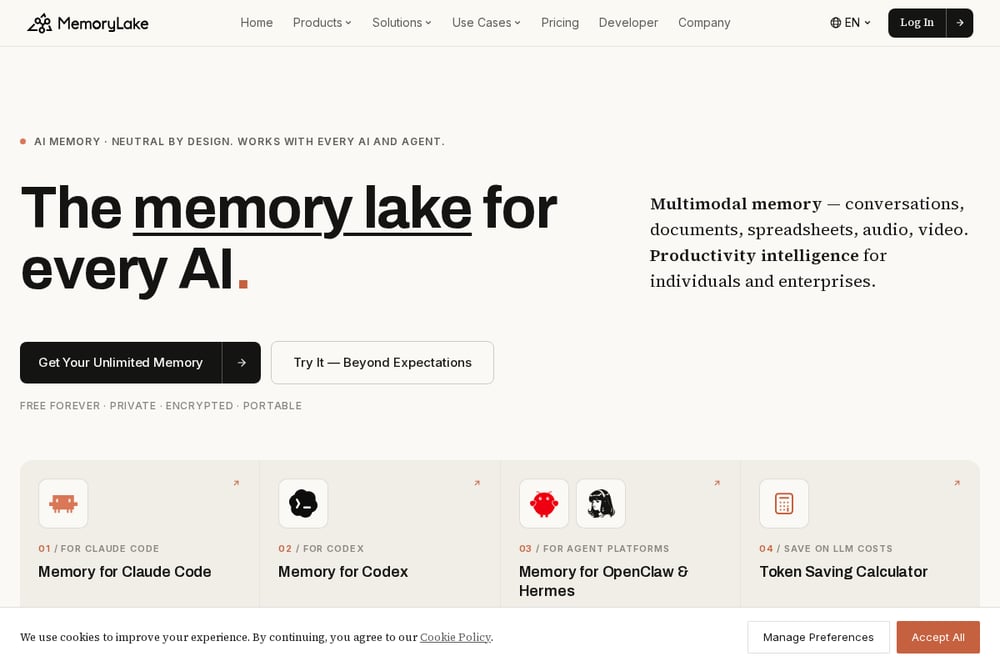 A screenshot of the MemoryLake website.
MemoryLake positions persistent memory as a dedicated architectural layer for AI systems. It emphasizes secure retention, updates, and retrieval of user-specific context across sessions. The platform targets enterprise copilots and autonomous agents where governance and portability matter. It distinguishes itself from chat history and RAG by treating memory as a first-class infrastructure component. If you need to evaluate a memory layer for compliance and long-term state, MemoryLake provides a structured framework for that assessment.
#5 Mem0
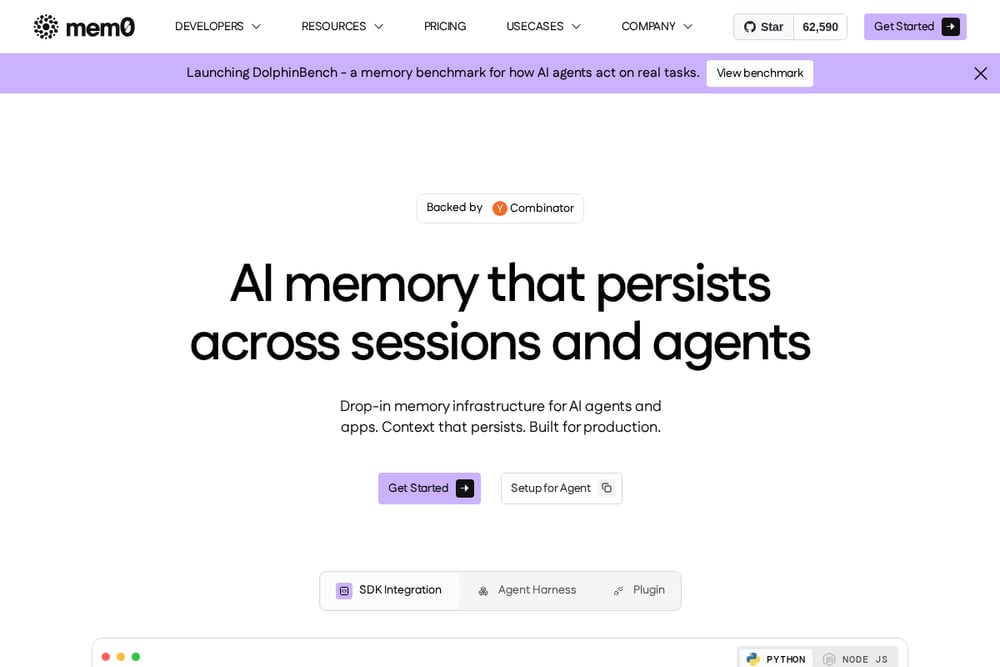 A screenshot of the Mem0 website.
Mem0 is a developer-focused memory layer with a large open-source following. It categorizes memory into user profile, interaction, and task/project types, each with different retention rules. The API is designed to add durable memory without blowing up context windows or introducing brittle heuristics. It supports many frameworks and has a free tier for experimentation. If you are building a chatbot or agent that needs to remember preferences and past decisions, Mem0 offers a practical, well-documented path.
How to Choose Your Memory Framework
Start with ownership. Do you need to read and edit every memory file? Then CRAFTFramework.ai or memU fit best. Next, consider your agent's complexity. If you track time-sensitive facts like renewals or support tickets, Zep's temporal graph is built for that. If you need enterprise governance, MemoryLake focuses on that layer. For general chatbot development, Mem0 offers the widest integration surface. Finally, check pricing clarity. Most of these have free tiers or open-source cores, so you can prototype before committing. Pick the one that matches how you already work, not the one with the longest feature list.
A Simple Automation Workflow for Persistent Memory
Here is a workflow you can steal. First, choose a memory framework and connect it to your AI tool. Second, define your memory categories: user profile, project state, and decisions. Third, write a short rule that every session starts by reading the relevant memory files. Fourth, after each session, write back new facts, lessons, and updated state. Fifth, review your memory files weekly and prune what is stale. This loop turns one-off chats into compounding work. You stop re-explaining and start building on last week's progress.
The Bottom Line on AI Memory
AI amnesia is a solvable problem. The five frameworks here take different paths: file-based ownership with CRAFTFramework.ai and memU, temporal graphs with Zep, governed layers with MemoryLake, and developer APIs with Mem0. Your choice depends on whether you value transparency, time-awareness, compliance, or speed of integration. But the principle is the same: store memory outside the chat, in a form you control. Do that, and your AI work stops resetting. It starts compounding.