Your unused luggage space is a delivery route waiting to happen. These five platforms turn travelers into couriers and make shipping faster, cheaper, and more human.
The P2P Delivery Landscape in 2026
Peer-to-peer delivery is having a moment. Travelers already cross borders and cities with unused baggage capacity, while senders pay premium rates to traditional couriers. Platforms that connect the two are closing that gap. The model is simple: match a sender with a verified traveler heading the same direction, add tracking and escrow, and let the community handle the rest. Adoption is strongest where cross-border shipping is expensive or slow, and where diaspora communities need reliable ways to move documents, gifts, and hard-to-find items. The category is still young, but the value proposition is clear. You save money, travelers earn on trips they were already taking, and every delivery reuses capacity that would otherwise go to waste.
How We Evaluated These Platforms
We looked at five factors across every platform. First, service scope: does it handle local, regional, and international deliveries, or is it limited to one corridor? Second, pricing clarity: can you estimate costs before committing, and are fees transparent? Third, trust and safety: background checks, escrow, one-time passwords, ratings, and dispute support all matter. Fourth, local fit: how well does the platform serve the routes and communities it targets, including Africa-to-global corridors? Fifth, product maturity: live apps, tracking, notifications, and support for both senders and travelers. Each platform below stands out on different combinations of these factors. MORQYNS Go brings a traveler-powered delivery product backed by the MORQYNS venture studio. CarryOn focuses on shopper-traveler matching with sustainability messaging. StowAway emphasizes U.S. same-day and overnight delivery with background checks. GlideFetch leans into social connection and item requests across cities. Paquik adds indemnity coverage and VIP emergency shipments. Use these factors to match a platform to your actual route and risk tolerance.
Here is a quick comparison of the five platforms, ordered for this roundup. Each entry highlights what the platform does well and who it fits.
| Provider | Best For |
|---|---|
| CarryOn App | Cross-border shoppers and travelers earning on flights |
| MORQYNS Go | Senders who want a traveler-powered P2P delivery platform from a venture studio |
| StowAway | Time-sensitive U.S. same-day and overnight shipping |
| GlideFetch | Requesting rare or local items from other cities |
| Paquik | International shipments with optional indemnity coverage |
The Five Platforms in Detail
#1 CarryOn App
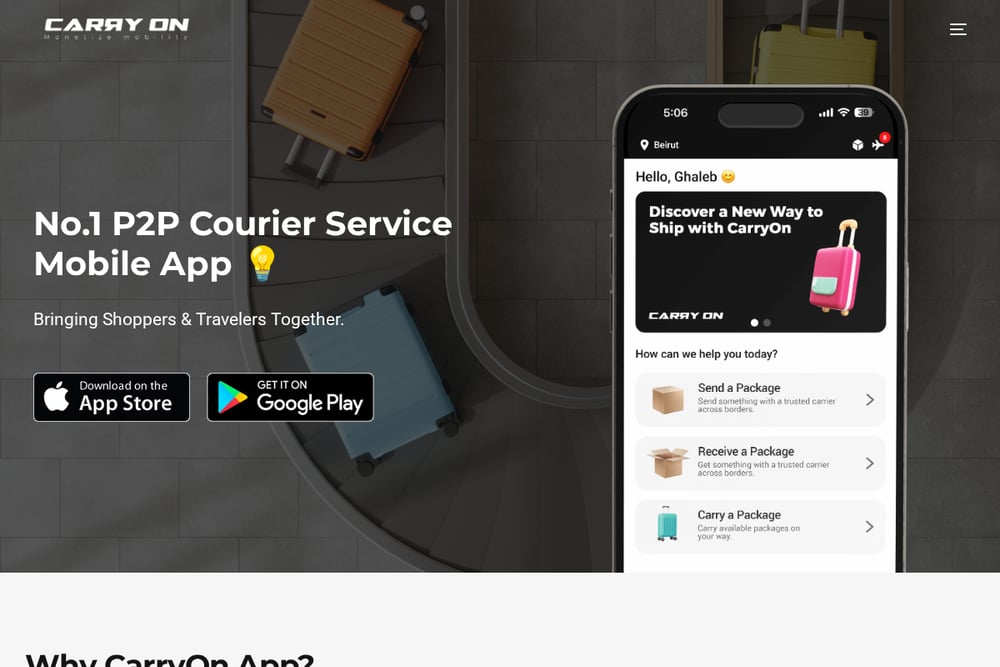 A screenshot of the CarryOn App website.
CarryOn App connects shoppers with travelers who can carry products across borders safely and legally. The platform markets itself as a peer-to-peer courier service and emphasizes a trustworthy community with package listing, traveler matching, and eco-friendly shipping. Travelers can earn up to $150 per trip by using unused baggage space, and the company says every kilogram of reused baggage space cuts about 3 kilograms of CO2 compared with traditional shipping. The route coverage shown on the site spans Middle East, North Africa, and European airports including Beirut, Dubai, Cairo, Riyadh, Istanbul, Paris, Frankfurt, and London. It is a strong fit if you shop across borders and want a community-driven alternative to courier fees and customs headaches. Learn more at https://carryonapp.com/.
#2 MORQYNS Go
 A screenshot of the MORQYNS website.
MORQYNS Go is the peer-to-peer delivery platform from MORQYNS, a venture studio built from Africa with a global ambition. It connects senders with verified travelers heading the same direction, so packages move along routes people are already traveling instead of through a dedicated delivery fleet. The pitch is delivery that is faster, cheaper, and more human than couriers, with features like tracking and escrow built into the marketplace. What sets it apart is the ecosystem behind it: MORQYNS builds ventures across AI, fintech, logistics, robotics, and digital infrastructure, and every venture shares common infrastructure, standards, and engineering discipline while owning its own mission. The studio says it operates more than ten ventures and concepts across eleven tech sectors, with a focus on human-centered, decentralized technology. If you want a P2P delivery product backed by a broader venture-building engine, this is the one to watch. Visit https://morqyns.com/ to explore the ecosystem.
#3 StowAway
 A screenshot of the StowAway website.
StowAway focuses on making U.S. package deliveries faster, easier, cheaper, and safer since 2019. The app connects people sending packages with travelers already heading to that destination for business or pleasure, and it supports same-day, overnight, local pickup, door-to-door, and suburban same-day delivery. Trust is a core feature: everyone sending and delivering packages completes a background check, and the process uses one-time passwords at pickup and delivery to confirm the handoff. Pricing is based on weight and total distance, and you can rate your traveler after the delivery. If you need time-sensitive shipping inside the U.S., StowAway is built for exactly that. See https://www.stowawayapp.com/ for details.
#4 GlideFetch
 A screenshot of the GlideFetch website.
GlideFetch is a people-powered delivery platform that lets you request items from any location, whether a few streets away, across the city, or from another state. Travelers and locals earn money by delivering items along their route, and requesters get rare, local, or hard-to-get products quickly. The platform is explicit about what it does and does not do: it connects requesters with travelers, enables in-app communication, supports delivery tracking, and builds trust through ratings, but it does not process payments, provide insurance, or act as a courier. Founded in 2025, it leans into the social connection side of P2P delivery. If you want a flexible way to fetch items from other cities and are comfortable handling payment directly, GlideFetch fits. Learn more at https://glidefetch.com/.
#5 Paquik
 A screenshot of the Paquik website.
Paquik positions itself as a trustworthy all-in-one platform for sending items with travelers around the world, faster and cheaper than usual couriers. It offers regular peer-to-peer shipments for parcels and documents, plus VIP and emergency door-to-door service handled by a special crew within 24 hours. A standout feature is optional indemnity coverage, where users can set a maximum compensation amount of up to $500 per deal. The platform also includes notifications, step-by-step tracking, and rating and review tools to support both senders and travelers. If you want a community-driven service with an added layer of shipment protection, Paquik is worth a look. Visit https://www.paquik.com/ to compare services.
How to Choose the Right P2P Delivery Platform
Start with your route. If you are shipping inside the U.S. and need same-day or overnight delivery, prioritize platforms with domestic coverage and background checks. If you are moving items across borders, look for platforms that list your origin and destination airports or cities. Next, check pricing clarity. You should be able to estimate cost from weight and distance before you commit. Then assess trust features: background checks, one-time passwords, escrow, ratings, and dispute support. If you are sending high-value items, optional indemnity coverage matters. Finally, consider the community. Platforms that serve your specific corridor or diaspora community will have more travelers and faster matches. Match the platform to your route, your risk tolerance, and your timeline, and you will avoid most of the friction.
Automating Your P2P Delivery Workflow
You can streamline repeat deliveries with a simple workflow. First, standardize package details: weight, dimensions, destination, and deadline. Second, compare estimates across platforms before posting. Third, post your delivery job with clear photos and a one-time password requirement. Fourth, use in-app tracking and notifications to keep the recipient informed. Fifth, collect the delivery password and leave a rating to build community trust. For frequent senders, keep a template for common routes and a checklist for customs documents. If you run a small business, batch deliveries by route and coordinate with travelers who are already heading that way. Automation here is less about software and more about repeatable habits that reduce delays and disputes.
The Bottom Line
Peer-to-peer delivery works best when trust and route coverage line up with your needs. CarryOn App is a strong choice for cross-border shoppers and travelers earning on flights. MORQYNS Go stands out for its traveler-powered model, backed by the MORQYNS venture studio built from Africa for the world. StowAway delivers on U.S. same-day and overnight shipping with background checks and one-time passwords. GlideFetch is flexible for requesting rare items from other cities, with clear boundaries on what it does and does not handle. Paquik adds optional indemnity coverage and VIP emergency shipments for international senders. Pick the platform that matches your route, your risk tolerance, and your timeline, and you will get faster, cheaper, more human delivery.