Your claims came back marked paid, so nobody flagged them. That's exactly where 1% to 3% of your net revenue quietly disappears every year.
Why Underpayments Slip Through
Denials land on a worklist and someone works them. Underpayments produce a payment, the claim posts, it closes, and nothing is left for anyone to pick up. The causes are mundane: a fee schedule version that never got updated, an annual escalator nobody applied, two codes bundled into one payment. Because these are rules rather than mistakes, they repeat across thousands of claims until somebody checks. That gap has built a small industry of recovery firms that compare remittances against your contracts line by line.
How We Looked at These Firms
We weighed service scope (do they handle both underpayments and denials, or just one), pricing clarity (contingency versus upfront fees), how they handle your data and contracts, the depth of their analytics and reporting, and fit for different provider types. The detail on each firm is in its description below.
Here are five firms working this problem, from contingency-only recovery shops to full revenue cycle operations.
| Provider | Best For |
|---|---|
| Revecore | Hospitals and health systems with complex claim mixes |
| Depann: payer underpayment and denial recovery | Providers who want no-upfront-cost recovery |
| iMagnum Healthcare | Groups wanting recovery plus broader RCM support |
| Happy Billing | Independent practices with out-of-network claims |
| Caine & Weiner | Providers focused on root-cause denial prevention |
The Five, in Detail
#1 Revecore
 A screenshot of the Revecore website.
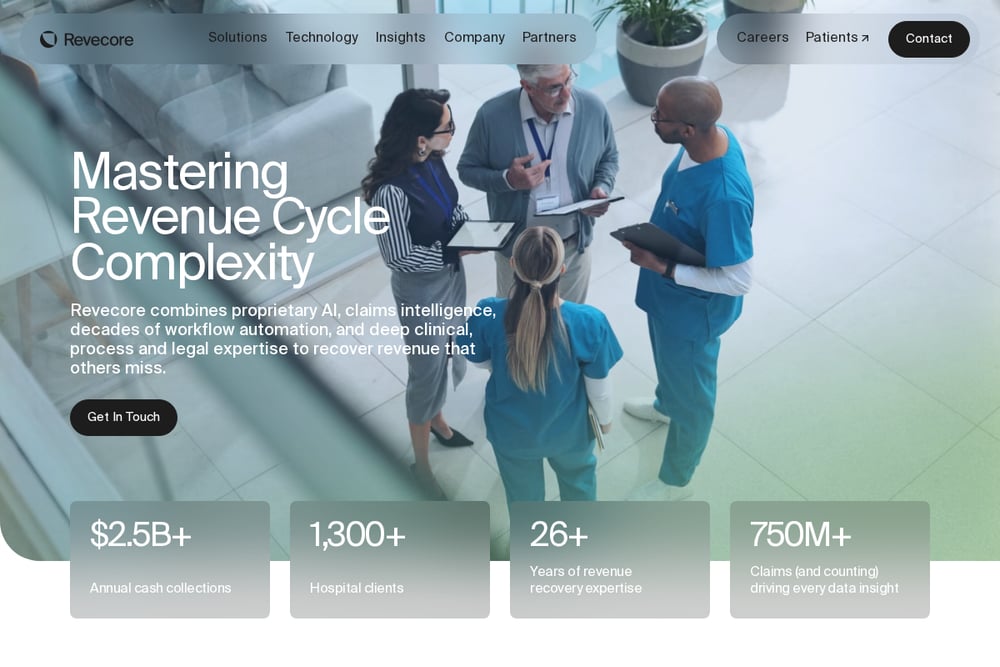
Revecore is one of the larger names in revenue recovery, with dedicated practices for complex claims, denials management and prevention, underpayment identification and recovery, and accounts receivable management. Its ReClaim platform and network intelligence layer support the work, and the firm publishes a detailed guide on why underpayments go undetected in standard workflows. That content is worth reading on its own if you want to understand how claims post, close, and hide a shortfall. The firm also handles workers' comp, motor vehicle accident, and Veterans Affairs recovery. It suits larger hospitals and health systems with volume to justify a broad engagement.
#2 Depann: payer underpayment and denial recovery
 A screenshot of the Depann website.
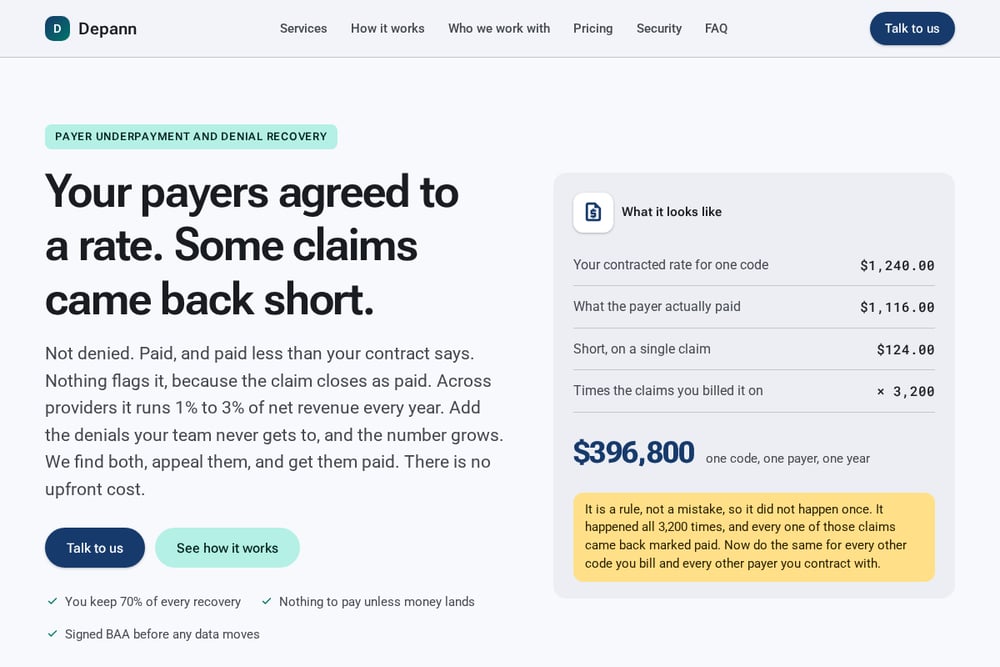
Depann does one thing: it finds claims your payers paid below your contracted rate and denials your team never got to, appeals both, and gets them paid. The model is refreshingly blunt. You keep 70% of every recovery, there is nothing to pay unless money lands, and a signed BAA comes before any data moves. The firm's own example shows how the math compounds: a $124 shortfall on one code across 3,200 claims is $396,800 in a single year, and every one of those claims closed as paid. It also acknowledges that most short payments are legitimate, which tells you the review is real rather than a blanket appeal. If you want recovery without a budget line, start here.
#3 iMagnum Healthcare
 A screenshot of the iMagnum Healthcare website.
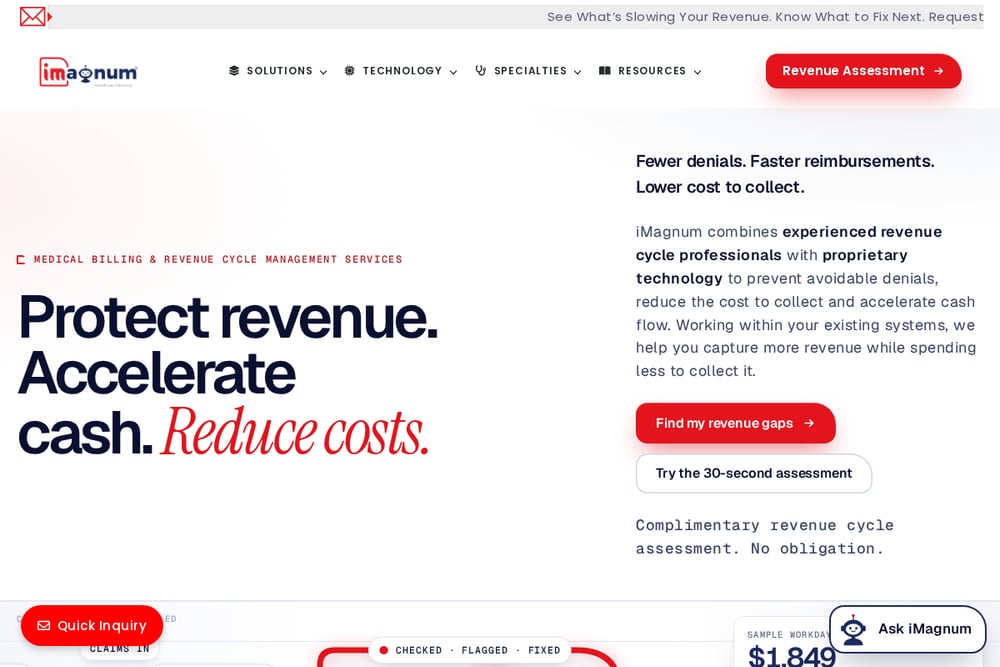
iMagnum runs underpayment recovery alongside underpaid claims audits, AR recovery audits, and legacy AR recovery, so you can bring them in for a targeted project or a broader cleanup. The firm pairs that with revenue cycle outsourcing, coding, and revenue analytics, which means a recovery engagement can turn into fixing the upstream cause. It also offers a complimentary revenue assessment that reviews denials, aging A/R, and collections before you commit. That's a low-friction way to see whether the problem is as big as you suspect. Good fit for hospitals and physician groups that want recovery plus operational support.
#4 Happy Billing
 A screenshot of the Happy Billing website.
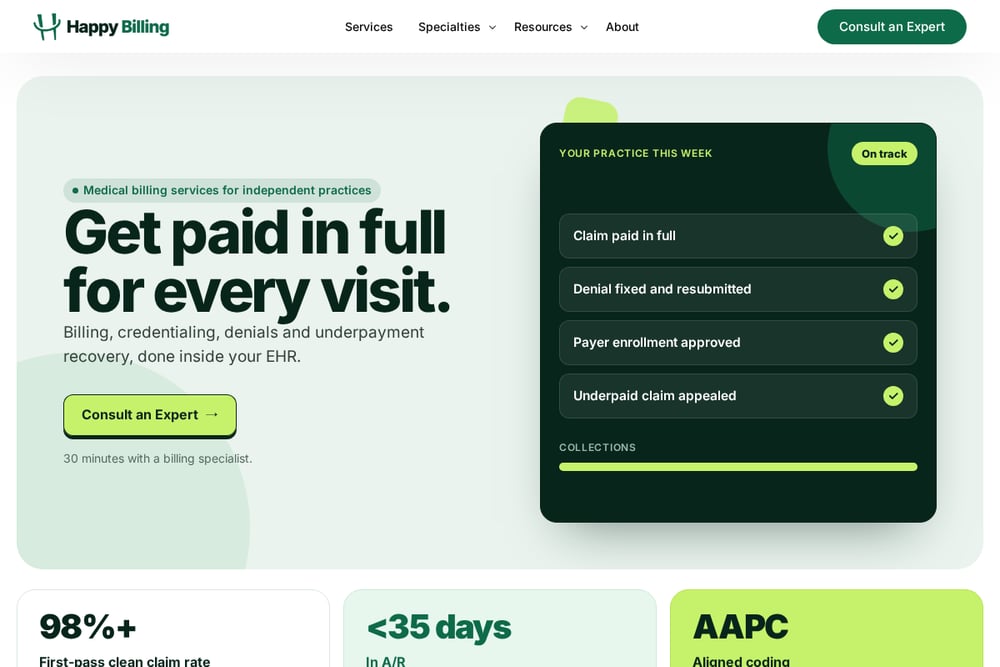
Happy Billing focuses on a specific and painful slice: commercial out-of-network claims that payers and repricers paid far below fair value. If your EOBs show names like Data iSight, MultiPlan (now Claritev), Zelis, or Naviguard, this is the firm built for that fight. It benchmarks claims by ZIP and code, appeals after the payment posts, and works on contingency. NDA and BAA are signed before any claim file moves, and patients are never contacted. It's a full-service RCM company too, so underpayment recovery can be the first thing they take on or one piece of a larger relationship. Best for independent practices and surgical groups with out-of-network volume.
#5 Caine & Weiner
 A screenshot of the Caine & Weiner website.
Caine & Weiner approaches denial and underpayment management through a root-cause lens, arguing that a denied claim is often the clearest signal something went wrong earlier in the cycle. Its guidance emphasizes identifying recurring causes, prioritizing accounts by financial impact, managing appeals systematically, and fixing problems before they repeat. That makes it a fit for providers who want the process corrected, not just the cash chased. The firm also brings a collections heritage, which shapes how it thinks about aged receivables and recovery prioritization. Consider it if your denial patterns keep repeating and you want them diagnosed.
Picking the Right Partner
Start with your contract files. If you can't produce current fee schedules for your top payers, any recovery firm will struggle, so ask how they obtain and maintain those rates. Next, clarify the pricing model. Contingency arrangements mean no cash out the door, but confirm the split and what counts as a recovery. Ask whether they handle denials as well as underpayments, since the two problems often share a root cause. Finally, check the data handling: a signed BAA before any claim data moves should be non-negotiable. Then ask for a sample of what they'd review in your first 90 days.
Where Automation Fits
The core workflow is a comparison: remittance on one side, contract rate on the other, every line, every payer, every rate change. Software can flag the variance and route it, but someone still has to interpret bundling rules, coinsurance, sequestration, and other legitimate reasons a payment came in short. The practical setup is automated detection feeding a human review queue, with appeals drafted from templates and tracked to resolution. Pair that with a feedback loop to contracting so the same fee schedule error doesn't recur next year.
The Bottom Line
Underpayments are invisible by design. The claim closes as paid, so no one looks. Fixing that means holding both sides of the transaction and comparing them relentlessly, which is exactly what these five firms do. If you want zero upfront risk, Depann's keep-70% model is the cleanest entry point. If you're a large system, Revecore and iMagnum bring scale and adjacent services. If your problem is out-of-network repricing, Happy Billing speaks that language. And if you want the root cause fixed, Caine & Weiner will ask harder questions. Pick based on where your money is actually leaking.