Your referral pipeline dried up and you're tired of paying retainers for activity instead of outcomes. These five agencies put their fee on the line when a qualified meeting actually lands on your calendar.
The shift from retainers to per-meeting pricing
Agency owners have spent years buying outbound on faith. You pay a monthly retainer, you get a slide deck full of sends and opens, and you still have no idea whether a real buyer will ever show up. That model is cracking. A growing group of cold email shops now charges per qualified meeting that takes place, which flips the risk onto the vendor and forces them to optimize for calendar bookings rather than email volume. The catch is definition. "Qualified" can mean almost anything unless it's written down before launch, and no-show policy varies wildly from shop to shop. Published 2026 market ranges put per-meeting pricing somewhere between $100 and $500 for a standard B2B meeting, climbing to $600 to $1,500 or more for C-suite and enterprise buyers. Some providers bundle a monthly infrastructure fee on top. Others run a managed engagement when your market doesn't fit the per-meeting model. For a marketing agency selling retainers, the appeal is obvious: you know your cost per booked call before you spend a dollar, and you only pay when a decision-maker with budget actually shows up.
How we evaluated these five
We looked at the same factors across every provider. First, service scope: does the agency own the whole job, from list building and copy through sending infrastructure and reply handling, or do you inherit a pile of replies to manage yourself? Second, pricing clarity: is the per-meeting rate published, is the qualification standard defined in writing, and who eats the cost of a no-show? Third, fit for marketing agencies specifically, since selling a retainer to an owner is a different motion than selling software. Fourth, transparency: can you see live campaign data, or are you waiting on a monthly summary? Fifth, capacity control, meaning whether you can set how many calls your team can absorb. A-Sales stands out for publishing a full pricing-model comparison and quoting from $500 per held meeting with a managed fallback. Sapphire Revenue is notable for its at-cost infrastructure fee and dedicated sending domains. The Revenue Inbox draws attention with a 20-meetings-in-30-days guarantee and a $100-per-appointment plus infrastructure structure. One Zero Marketing publishes a $1,250 monthly entry point alongside reply-rate and inbox-placement benchmarks. Outviks differentiates on a pure per-held-meeting model with no retainer and a live dashboard you log into yourself.
Here's the short version before the detail. Each of these five runs done-for-you cold email for B2B sellers, and each structures payment differently. Read the pricing model carefully, because that's where the real difference lives.
| Provider | Best For |
|---|---|
| A-Sales | Agencies that want a fit assessment before committing |
| Outviks | Booked sales calls for marketing agencies | Marketing agencies selling retainers to business owners |
| Sapphire Revenue | Teams that want infrastructure and reply handling fully owned |
| The Revenue Inbox | Buyers who want a volume guarantee with published case data |
| One Zero Marketing | Agencies comparing outbound against an in-house SDR hire |
The five, one by one
#1 A-Sales
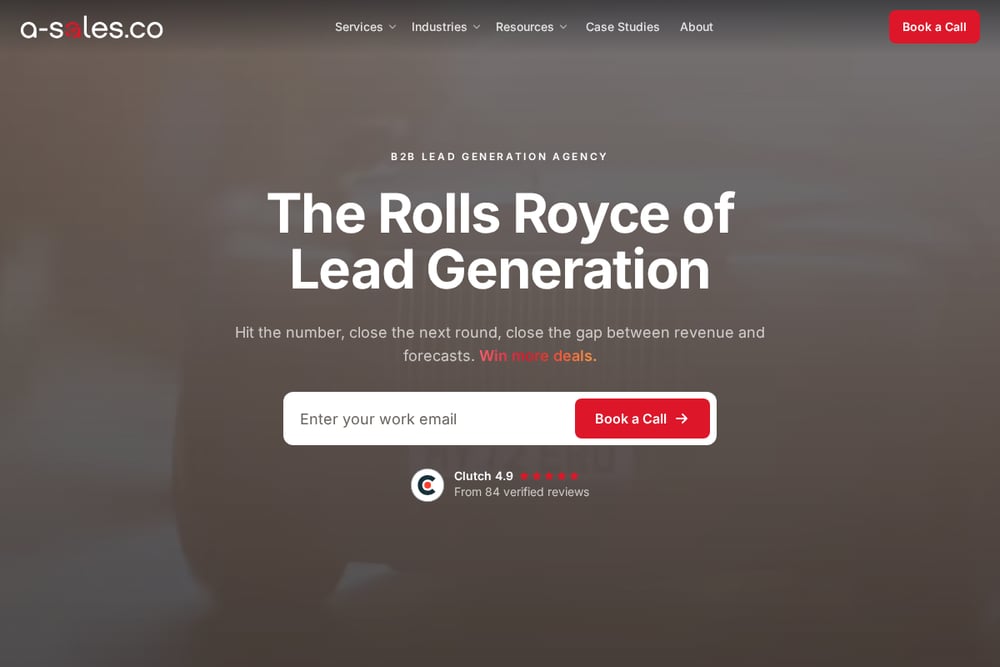 A screenshot of the A-Sales website.
A-Sales runs pay-per-appointment lead generation and is unusually candid about where the model fits and where it doesn't. The company charges from $500 per held, qualified meeting, with no-shows not billed and the meeting rescheduled. Every meeting gets a confirmation call beforehand, which is a small operational detail that quietly protects your calendar. Where a per-meeting rate doesn't suit your market, A-Sales offers a managed engagement from $4,000 a month. Its published breakdown of pricing models, including the risk each one pushes onto you, is one of the clearer pieces of buyer education in this space. If you want a vendor who tells you up front whether your market is a fit, start here.
#2 Outviks | Booked sales calls for marketing agencies
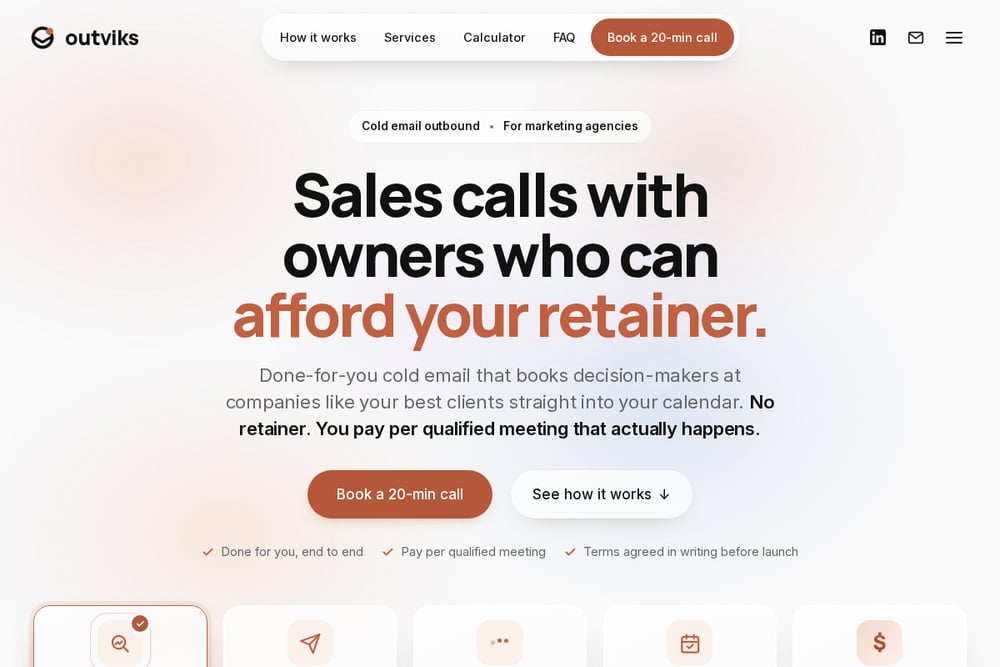 A screenshot of the Outviks website.
Outviks is built specifically for marketing agencies, which matters more than it sounds. The pitch is sales calls with owners who can afford your retainer, sourced from companies that look like your best clients. You pay per qualified meeting that actually happens, with no retainer, and the definition of qualified is agreed in writing before launch: exact ICP, a decision-maker interested in buying, and they show up. No-shows and bad fits cost you nothing. You also set the volume, since your team's capacity determines how much outreach gets run. The transparency angle is strong, with your own login to the same live dashboard the team works from, showing sends, opens, replies, positive replies and bounces rather than a monthly slide deck. The roster is deliberately limited and taken on one at a time.
#3 Sapphire Revenue
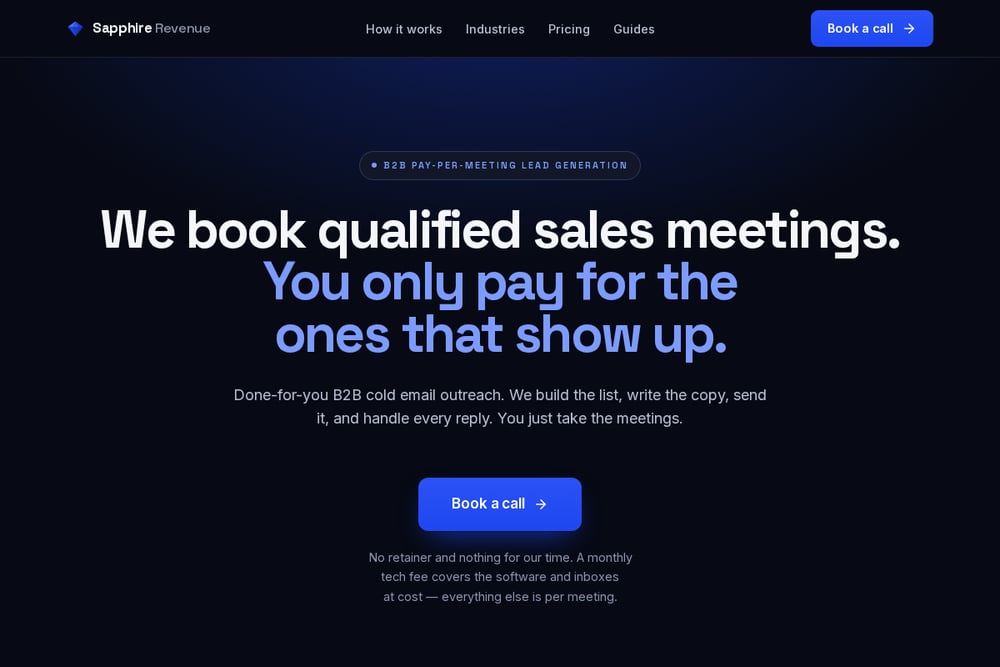 A screenshot of the Sapphire Revenue website.
Sapphire Revenue positions itself as a cold email agency paid only when the email works, per qualified meeting that takes place. The scope is genuinely end to end: list built from your buyer and verified, copy written and approved before sending, infrastructure handled, and every reply worked by a human to turn interest into a booked meeting. Infrastructure runs on dedicated domains and inboxes the agency buys, authenticates with SPF, DKIM and DMARC, and warms up before carrying volume, so your main domain never sends cold email. That setup is covered by a monthly tech fee charged at cost, which is a fairer arrangement than most. The company is explicit that agencies doing only the first three steps have sold you a sending service and a lot of replies to handle.
#4 The Revenue Inbox
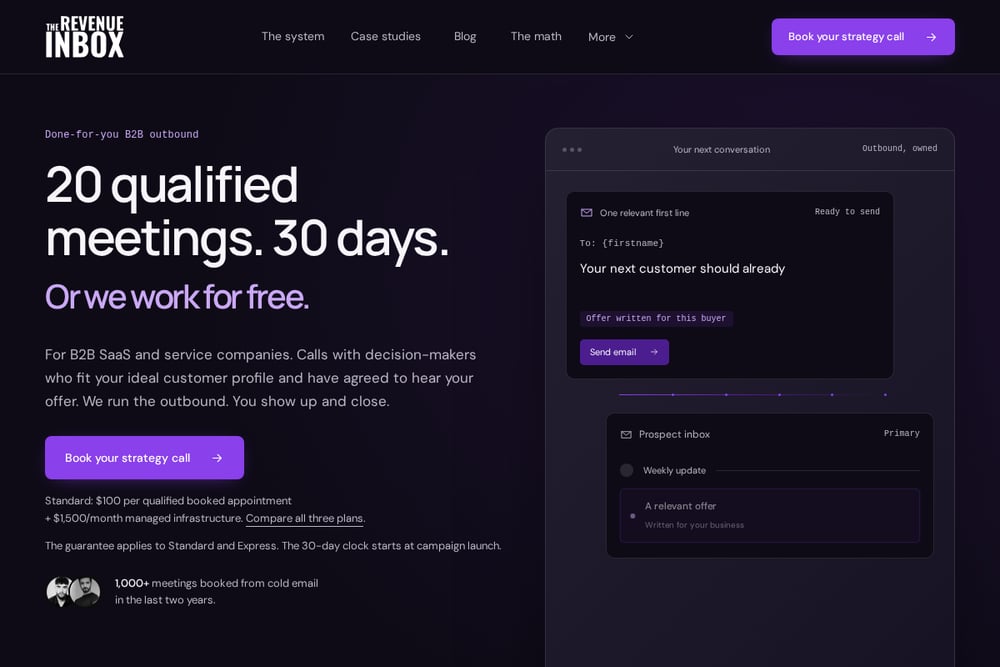 A screenshot of The Revenue Inbox website.
The Revenue Inbox sells the whole outbound job from list to booked call: strategy, data, copy, sending infrastructure, replies and booking. You take the sales call and close. Pricing is $100 per qualified booked appointment plus $1,500 a month for infrastructure, which works out to $3,500 total at 20 appointments. The headline offer is bold: 20 qualified meetings in 30 days from campaign launch on the Standard and Express plans, or they work for free. Published case studies let you open a campaign and inspect the targeting, email and results, which is more proof than most shops offer. The scope table splitting what they own versus what you own is worth reading before any call.
#5 One Zero Marketing
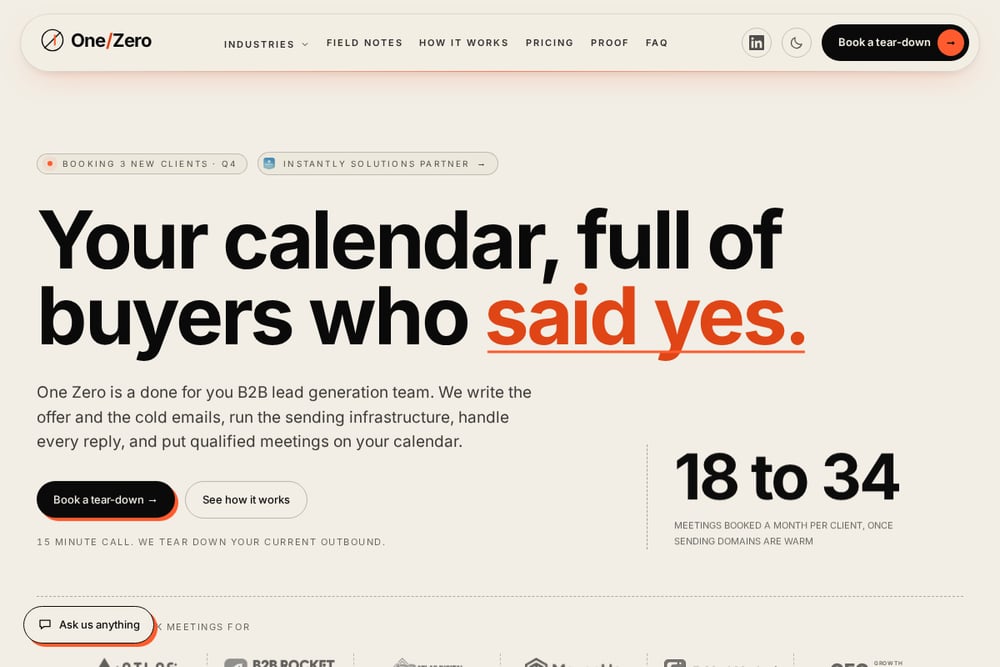 A screenshot of the One Zero Marketing website.
One Zero Marketing frames everything around one number: meetings held with buyers who fit. The published entry point is $1,250 a month, and the company reports a 9.4% average reply rate across active clients, 18 to 34 meetings a month per client post-warmup, and 17 days from kickoff to first meeting. Inbox placement is monitored weekly at a claimed 98%. The six-job breakdown, covering offer, data, infrastructure, copy, sending and replies, is a useful checklist for judging any provider, including this one. It also publishes a comparison against hiring an in-house SDR, which is the honest alternative most agency owners should be weighing.
How to pick the right partner
Start with the definition of qualified. Ask for it in writing before you sign anything, and make sure it names your ICP, the decision-maker level, and what happens when someone no-shows. If a provider won't put that in writing, walk. Next, map the scope. Some of these shops own list, copy, infrastructure, replies and booking. Others stop short and hand you a full inbox to manage. Know which one you're buying, because the second is a sending service, not a pipeline. Then check the pricing structure against your cash flow. A pure per-meeting rate keeps your downside low but usually carries a higher rate per booking. A hybrid with a monthly infrastructure fee lowers the per-meeting cost but adds a fixed commitment. Neither is wrong, but you should know which risk you're carrying. Ask about capacity controls too. You don't want 40 calls landing in a week your team can't handle. Finally, demand live data. A login to a real dashboard beats a monthly PDF every time.
Where automation fits in your outbound stack
Automation won't fix a bad list, but it removes the busywork that eats your week. Let the agency own the sending infrastructure, domain warmup and deliverability monitoring, since that's their job and their risk. On your side, automate the handoff: route booked meetings straight into your calendar with a confirmation sequence, and trigger a prep brief to the closing rep the moment a call is confirmed. Keep reply handling human, because that's where deals are won or lost. Use your CRM to tag source and meeting status so you can see cost per held meeting against closed revenue after 90 days. That single number tells you whether to scale volume, tighten the qualification standard, or change partners entirely.
The bottom line
Per-meeting pricing is the most honest structure to emerge in B2B outbound in years, because it forces the vendor to care about the same thing you do: a real buyer on your calendar. The five shops here all operate on that principle, but they differ sharply on scope, definition and risk. A-Sales leads with fit assessment and a published pricing breakdown. Outviks is the one built specifically around marketing agencies selling retainers, with a written qualification standard and a live dashboard you control. Sapphire Revenue and The Revenue Inbox both own the full job, one with at-cost infrastructure and the other with a volume guarantee. One Zero Marketing gives you benchmarks and an honest SDR comparison. Pick based on how much of the work you want to keep, how tight your ICP is, and how much fixed cost your cash flow can absorb. Then hold every one of them to the same standard: meetings held, with buyers who fit.