
Your business runs on you. That feels like commitment until you realize it's a ceiling. These five firms exist to get your systems out of your head and into the company.
Why Owner Dependency Is the Quiet Growth Killer
Most owners of $1M–$5M businesses don't have a demand problem. They have a structure problem. Pricing, hiring, client escalations, and approvals all route back to one person, so the business can only move as fast as the owner can. That's not a work-ethic issue. It's a design flaw baked in during the early years, when speed mattered more than systems. The cost shows up later: slower decisions, stalled growth, and a lower multiple at exit, because buyers discount companies that depend on their founder. The consultants in this space attack the same root cause from different angles. Some map decision rights and handover routines. Some install roles, written processes, scorecards, and meeting rhythms. Some focus on revenue leaks first, then build the operating system underneath. What they share is a belief that normal work should not wait for one person. What separates them is scope, delivery model, and how clearly they define the outcome you're buying.
How We Evaluated These Firms
We looked at service scope first: does the firm address roles, processes, decision rules, and reporting, or only one slice? Next, delivery clarity. Some publish a defined engagement with a timeline and a diagnostic entry point; others describe services more broadly. We also weighed the diagnostic on-ramp, since a low-friction first conversation tells you a lot about how the firm works. Local fit mattered too, given the mix of US and UK practices and how each frames the owner's exit or growth horizon. Finally, we considered how explicitly each firm ties owner dependency to business value, because that connection is what makes the work worth paying for. Each firm below stood out on different factors. None of them is a fit for every owner.
Here's a quick comparison of the five firms, ordered for readability rather than as a verdict. Match the delivery model to how you actually want to work.
| Provider | Best For |
|---|---|
| Philip Smith | Owners who want a practical DIY framework first |
| Build a Business That Runs Without You | Lucid Growth | Owners of $1M–$5M businesses who want a fixed 90-day install |
| ACT Business Consultants | Owners who prefer named, productized consulting programs |
| Jade Levitt Consulting | Founders who want systems plus automation in one shop |
| Walshe Management Consultants | Owners preparing for a sale or transition |
The Five Firms in Detail
#1 Philip Smith
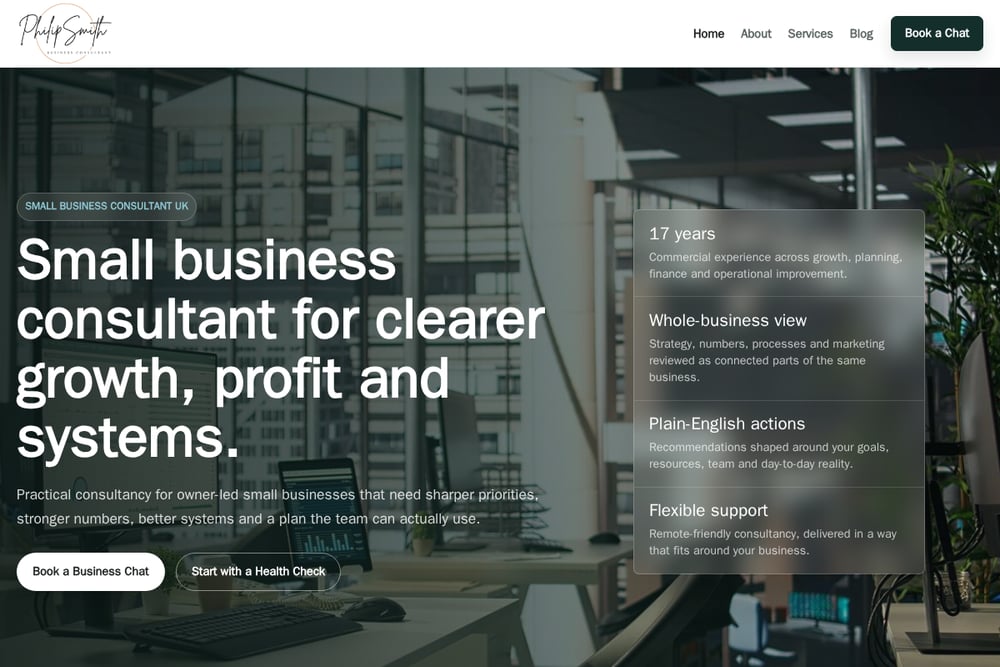 A screenshot of the Philip Smith website.
Philip Smith's approach is the most practical starting point for an owner who wants to understand the problem before buying anything. His writing lays out a clear owner-dependency risk checklist: normal decisions waiting for the owner, customer exceptions with no agreed rule, work sitting in the owner's inbox or memory. From there, he prescribes decision rules, process notes, and handover routines for repeatable work, plus delegation of outcomes with boundaries and review points rather than isolated tasks. The framing is refreshingly honest: the goal isn't removing you from the business, it's stopping normal work from waiting on one person. If you want to self-diagnose before you hire anyone, start with his process improvement material.
#2 Build a Business That Runs Without You | Lucid Growth
 A screenshot of the Build a Business That Runs Without You | Lucid Growth website.
Lucid Growth Partners is built specifically for owners of $1M–$5M businesses, and the offer is unusually concrete. It starts with a free 20-minute diagnostic call on Google Meet, no pitch deck, followed by a live Revenue Leak Audit session that hunts for money the business is already losing. Then comes a 90-day Install inside your company covering roles, written processes, a weekly scorecard, and a meeting rhythm. There's also a two-minute Owner Dependency Score self-check if you want a read before you talk to anyone. The sequencing is smart: find the leak, fund the fix, then build the structure so the business runs without you. If you want a defined engagement with a timeline instead of open-ended advisory, this is the one to call.
#3 ACT Business Consultants
ACT Business Consultants packages its work into named programs, including a Commercial Intelligence Review, a Commercial Decisions offering, and a Business Transformation Programme. That productized structure appeals to owners who want to see the shape of an engagement before committing. The firm's reducing owner dependency work sits within a broader commercial lens, so decisions and performance get examined together rather than in isolation. It's a UK-based practice with a clear contact path and a book-a-call entry point. If you prefer a consultancy with defined service tiers and a commercial intelligence angle, this is worth a conversation.
#4 Jade Levitt Consulting
 A screenshot of the Jade Levitt Consulting website.
Jade Levitt Consulting frames the problem as founder dependency and connects it directly to growth limits, which is the right diagnosis for most owner-led firms. The service menu is broad and modern: fractional COO support, business systems consulting, SOP consulting, CRM consulting, workflow automation, and AI consulting. That breadth means you can start with dependency mapping and extend into automation once the processes are documented. The firm also publishes a free operational diagnostic tool and a founder dependency mapping resource, so there's a low-cost way to test the waters. If your bottleneck is scattered systems and you suspect automation belongs in the fix, this roster entry covers that ground.
#5 Walshe Management Consultants
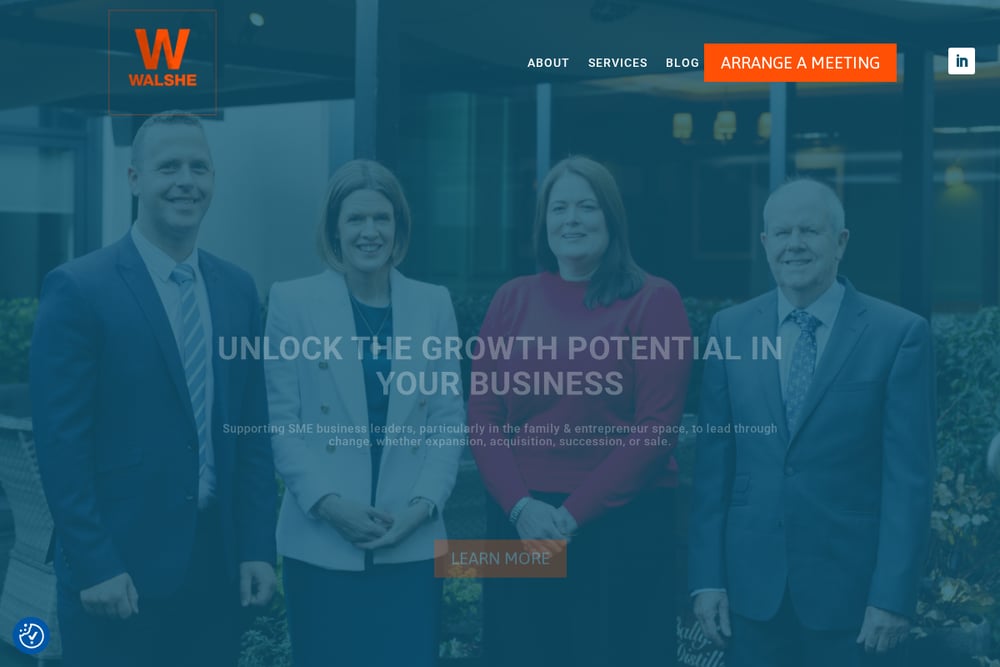 A screenshot of the Walshe Management Consultants website.
Walshe Management Consultants makes the value argument better than most. Its position is that founder dependency is an overlooked risk that never shows up in financial reports but quietly caps scale and transition readiness, including preparation for sale. The firm describes a consistent pattern in founder-led businesses: performance stays stable, growth plateaus, and the limiting factor is the structure through which decisions are made, not market demand. That framing speaks directly to owners thinking about an exit or a partial step back. It's an Ireland-based practice with a straightforward arrange-a-meeting path. If your horizon includes a sale, this perspective is worth your time.
How to Pick the Right Fit
Start with your timeline. If you need structure installed inside 90 days, look for a firm that publishes a defined engagement with a diagnostic entry point. If you're still diagnosing, start with a self-check or a free operational tool and read the practical frameworks before you spend money. Next, decide whether you want advice or installation. Some firms teach you the method; others build the roles, processes, and scorecards with you. Both are legitimate, but only one removes the work from your plate. Then check the scope against your actual bottleneck. If decisions stall at your desk, you need decision rules and authority levels. If work lives in your head, you need written processes and a scorecard. If your horizon is an exit, prioritize a firm that ties dependency to business value. Finally, use the first call as a test. A good diagnostic conversation surfaces a problem you didn't name. A pitch deck doesn't.
Where Automation Fits
Automation is the last step, not the first. Document the process before you automate it, or you'll scale the chaos. A workable sequence looks like this: map the recurring decisions that pull you back in, write a decision rule for each, assign a named owner with clear authority, then build the scorecard that tells you whether the work is happening. Only then should you automate the repeatable steps, like quote generation, approval routing, client onboarding, and status reporting. Firms on this list that offer workflow automation can take you through that sequence end to end. The payoff is real: fewer interruptions, faster decisions, and numbers you can see without asking anyone.
The Bottom Line
Owner dependency is a structure problem, and structure problems have structure solutions. The five firms here attack it from different angles: practical frameworks you can apply yourself, a fixed 90-day install with a revenue audit up front, productized commercial programs, systems plus automation, and a value-and-exit lens. Pick based on where you are, not who shouts loudest. If you want a defined engagement with a timeline, book the diagnostic call and see what the audit surfaces. If you're not ready to spend, run a self-check first and read the frameworks. Either way, the work starts with one question: what decisions only you can make today, and what would it take to change that?