You want a real read on how you think, not a novelty quiz that flatters you. These five online IQ tests each take a different angle on that question, and one of them gets you a full cognitive profile for a dollar.
Where online IQ testing stands in 2026
Online cognitive testing has matured into a crowded field. Most services now run 30 to 80 questions across logic, numerical, pattern and spatial reasoning, score you against the standard scale with a mean of 100 and a standard deviation of 15, and finish in under half an hour. The real differences sit in three places: whether the score is free or gated, how transparent the scoring and norms are, and how much of the result goes beyond a single number. A growing number of sites now publish methodology pages and admit their scores are estimates rather than clinical assessments, which is a healthy shift for anyone comparing options.
How these five were compared
Every service here was looked at on the same factors: test scope and question count, how clearly pricing and paywalls are disclosed, the depth of the report beyond the headline score, transparency around scoring and norms, and overall ease of use on a phone. No single factor decided the order. A free, well-explained test can sit alongside a paid one that hands you a richer breakdown, because they serve different readers.
Here is the short version before the detail. Each entry below notes what the test covers, what it costs to see your result, and who it suits best.
| Provider | Best For |
|---|---|
| My IQ Test | A free, no-strings score with a clear explanation |
| Online IQ Test · IQNimble | A cheap, detailed cognitive profile with a named thinking style |
| IQScore | A free score benchmarked against real test data |
| MyIQTested | A fast test with explanations for every missed question |
| Cognitive Testing | A longer, more rigorous test with a full score history |
The five, in order
#1 My IQ Test
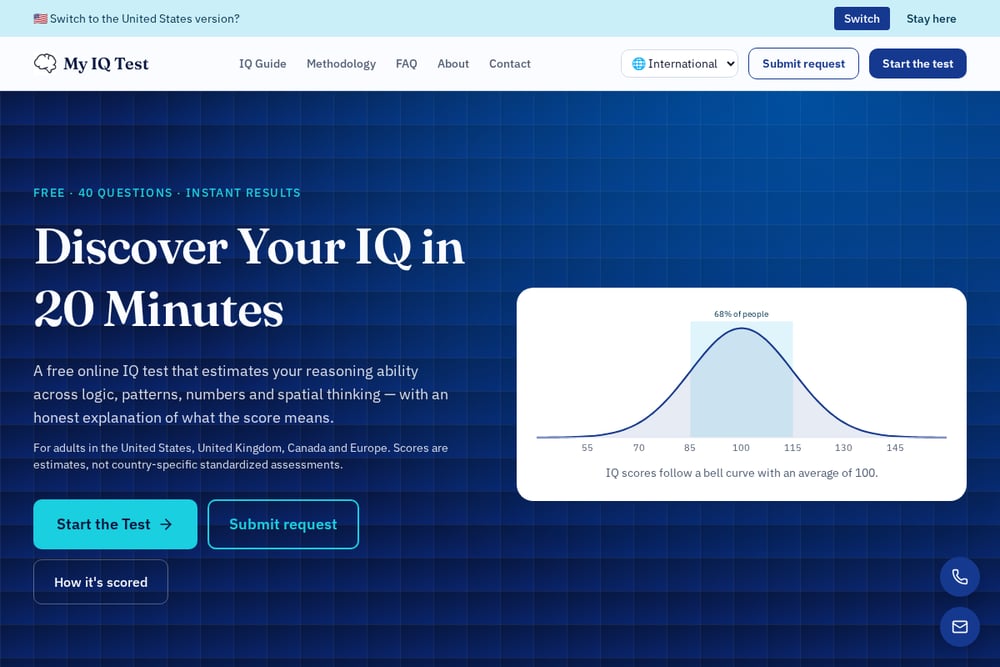 A screenshot of the My IQ Test website.
My IQ Test makes the strongest first impression because nothing stands between you and your score. You answer 40 questions, ten each in logical reasoning, pattern recognition, numerical sequences and spatial reasoning, against a 20-minute clock, and your estimated IQ and percentile appear the moment you finish. No email, no card, no account. The site is refreshingly honest that its scores are estimates rather than country-specific standardized assessments, and it backs that up with guides on topics like the Flynn effect. Progress saves automatically if you close the tab, which matters if you are squeezing a test into a lunch break.
#2 Online IQ Test · IQNimble
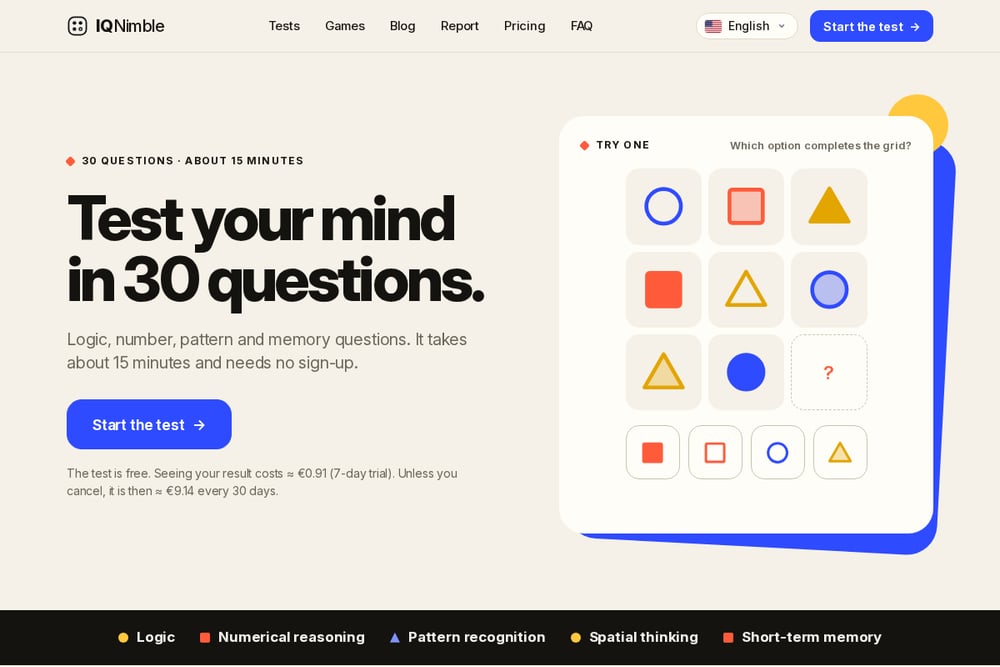 A screenshot of the Online IQ Test · IQNimble website.
IQNimble takes a different route to the same destination, and it is the one worth your attention if you want more than a number. The test itself is free: 30 questions across logic, numerical reasoning, pattern recognition, spatial thinking and short-term memory, about 15 minutes, no sign-up. Seeing your result costs $1.00 on a 7-day trial, then $9.99 every 30 days unless you cancel, and the site states that plainly up front. What you unlock is unusually rich for the price: an estimated IQ score, five separate skill scores, a named thinking style such as The Pattern Hunter, your standing among 100 people, a speed-versus-accuracy read, the hardest question you solved with its explanation, and a printable certificate. It also matches you to historical thinkers who share your style, which is a memorable way to make the profile stick.
#3 IQScore
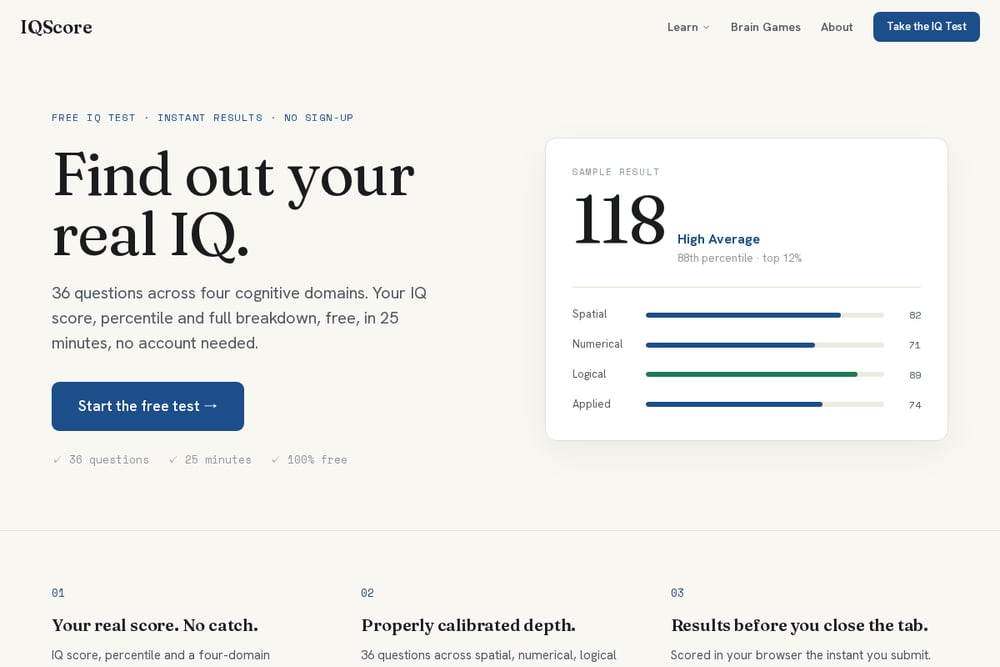 A screenshot of the IQScore website.
IQScore runs 36 questions across spatial, numerical, logical and applied reasoning under a single 25-minute limit, and it does not hide the score behind a paywall. Your IQ, percentile and four-domain breakdown are free, scored in your browser the instant you submit, with no account and no email confirmation. The credibility pitch is the interesting part: results are plotted against 7,700 completed assessments rather than guessed, and the site is upfront that this is an estimate mapped onto the standard scale, not a clinical assessment. Optional paid extras exist but are clearly marked as optional. If you want a free score plus a sense of how it compares to a real sample, this is a solid pick.
#4 MyIQTested
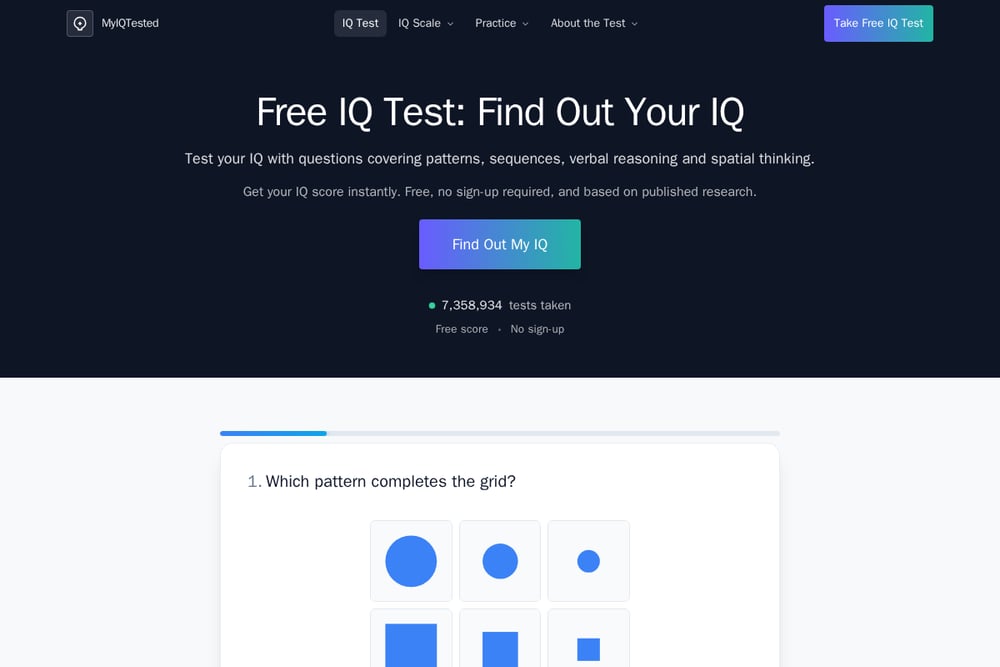 A screenshot of the MyIQTested website.
MyIQTested has the longest track record of the group, with more than seven million tests taken, and it leans into that history. The free test is 31 questions covering matrix, series, verbal and numerical reasoning, and it takes roughly nine minutes, which makes it the quickest full test here. Your score, percentile and breakdown by question type appear immediately, every missed question is explained, and there is no account or card required. It runs in 16 languages and offers an optional certificate and report as a one-time purchase rather than a subscription. The surrounding library on IQ scales, average scores and whether online tests are accurate is genuinely useful if you want context for your result.
#5 Cognitive Testing
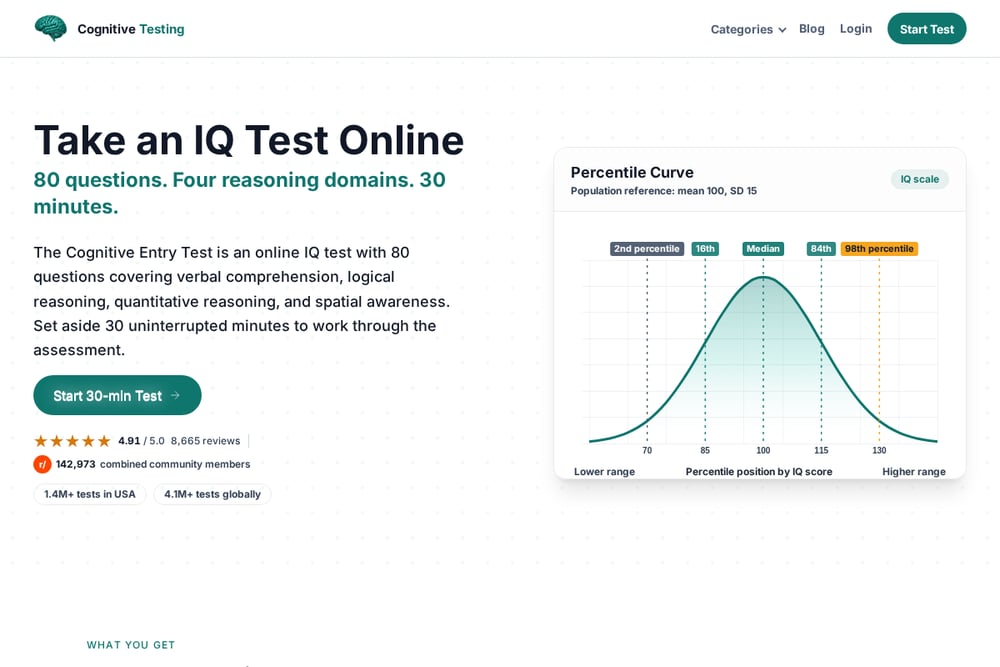 A screenshot of the Cognitive Testing website.
Cognitive Testing is the heavyweight option, aimed at readers who want depth over speed. The Cognitive Entry Test runs 80 questions across verbal comprehension, logical reasoning, quantitative reasoning and spatial awareness, and it asks for 30 uninterrupted minutes. The score is not free, but what you get after purchase is a proper dashboard: saved attempts, your IQ estimate, the score curve, a Culture Fair Recognition summary and a review of missed items with correct answers. The site is unusually candid about norms, noting that independent renorming of online IQ tests often reveals inflated score tables by roughly seven points, and it publishes its own conversion process. If you have taken a few quick tests and want something with more substance, start here.
Picking the right test for you
Start with what you actually want from the result. If you are simply curious and want a number in ten minutes, a free test with instant scoring will do the job, and you should not pay for anything. If you want to understand how you think rather than just where you land, look for a report that breaks your score into separate skill areas and explains what each one means. Check the pricing model before you start, because a one-time fee and a recurring subscription are very different commitments, and the trial-to-subscription pattern is easy to miss if you skim. Finally, read the methodology page. A site that admits its score is an estimate and explains its norms is telling you something useful about how seriously to take the number.
Putting your result to work
Once you have a score and a skill breakdown, do not let it sit in an inbox. Save the report as a PDF and drop it into a notes app or cloud folder so you can find it later. If a particular skill came out low, set a recurring calendar reminder to spend 15 minutes a week on that specific type of reasoning, whether that is number sequences or spatial puzzles. Retake the same style of test every six months and log the scores in a simple spreadsheet so you can see a trend rather than a snapshot. If you are using the result for a resume or a conversation with a manager, keep the certificate and the methodology note together so anyone reviewing it can see how the number was produced.
The bottom line
There is no single right answer here, only the right fit for what you want. My IQ Test gives you the cleanest free experience, IQScore adds real benchmark data to a free score, MyIQTested is the fastest route to an explained result, and Cognitive Testing rewards anyone willing to invest half an hour and a fee in something more substantial. IQNimble sits in the middle for a reason: a free test, a one-dollar entry point, and a report that turns five skill scores into a picture of how you think. If you want a number, plenty of sites will give you one. If you want to know what the number says about you, start there.