
You do not need another scanner report. You need someone who can prove what is actually exploitable. Here are five offensive security partners worth knowing in the US right now.
The State of Offensive Security in the US
Offensive security has moved from an annual checkbox to a continuous discipline. You are now expected to test web apps, APIs, mobile builds, cloud tenants, and even AI and LLM surfaces. Buyers want proof of exploit, not a wall of scanner noise. They want remediation guidance their engineers can act on. And they want pricing they can see before the first call. The five providers below each answer that demand in a different way.
How We Evaluated These Providers
We looked at the same factors for every provider. Service scope: does the work cover application, infrastructure, cloud, and adversary simulation? Pricing clarity: are starting prices published or gated behind a sales call? Proof of exploit: do findings come with validated reproduction steps? Remediation support: is there a retest, a walkthrough, or a fix plan? Local fit: does the provider serve US buyers with the right contracting and time-zone coverage? PoCForge stood out for publishing starting prices in INR and USD and for including a retest of up to 10 issues within six months. OffSec stood out for deep, manual network testing in hardened environments. Bitdefender stood out for bundling offensive services into a broader enterprise platform. DeepSeas stood out for pairing offensive work with managed detection and response. LevelBlue stood out for its SpiderLabs threat intelligence and regulated-industry focus.
Here is the short version. Each provider below is strong in a different lane. Match the lane to your actual risk, not to a logo.
| Provider | Best For |
|---|---|
| OffSec | Hardened enterprise networks and advanced adversary simulation |
| Penetration Testing & VAPT Company | PoCForge | Teams that want proof of exploit, clear pricing, and a retest built in |
| Bitdefender Offensive Security Services | Enterprises already standardized on Bitdefender that want offensive testing in-platform |
| DeepSeas | Organizations that want offensive findings wired into a managed SOC |
| LevelBlue | Regulated industries that need offensive testing plus compliance evidence |
The Five Providers in Detail
#1 OffSec
 A screenshot of the OffSec website.
OffSec is the team behind Kali Linux, Exploit-DB, and performance-based infosec training. They take on a small number of clients each year, with a two-week minimum engagement and an average of four weeks. Their focus is advanced network penetration testing in complex, hardened environments. They validate real-world exploitability through hands-on offensive testing rather than checklist scanning. If you want the people who build the tools to break into your network, this is the call to make.
#2 Penetration Testing & VAPT Company | PoCForge
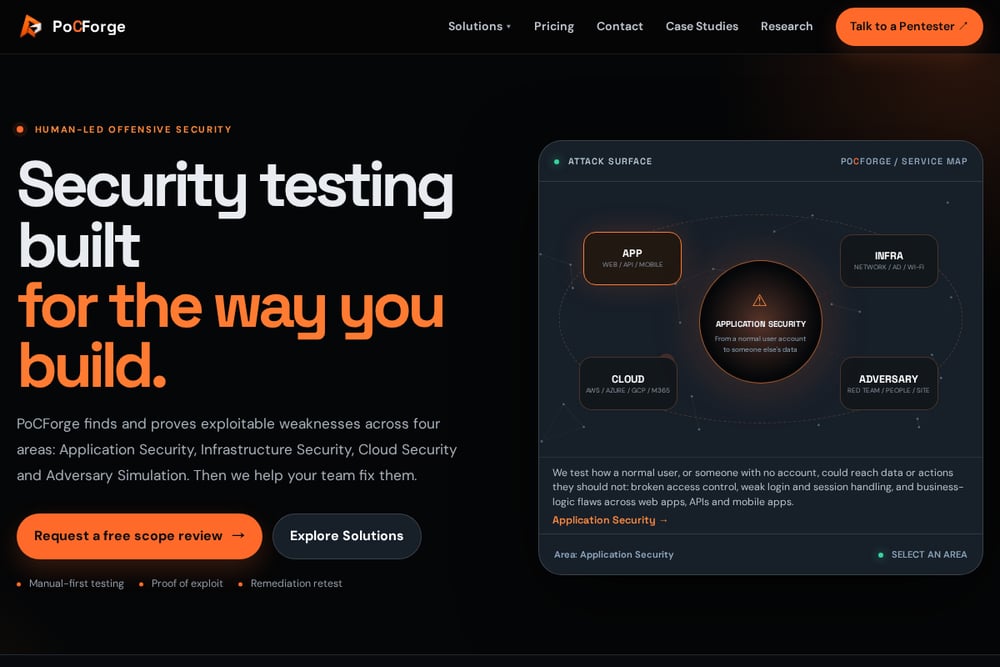 A screenshot of the PoCForge website.
PoCForge is a human-led offensive security firm that finds and proves exploitable weaknesses across four areas: application security, infrastructure security, cloud security, and adversary simulation. You get manual-first testing, proof of exploit, and a remediation retest included. Their application security work covers web, API, mobile, desktop, and AI/LLM surfaces, while infrastructure spans external, internal network, Active Directory, and wireless. Cloud coverage includes AWS, Azure, GCP, Microsoft 365, and multi-cloud, plus Microsoft cloud readiness. Pricing is published up front in both INR and USD, and every engagement includes an executive summary, technical findings, fix steps, a walkthrough call, and a retest of up to 10 issues within six months.
#3 Bitdefender Offensive Security Services
 A screenshot of the Bitdefender website.
Bitdefender brings offensive security into its broader enterprise security platform. Their offensive services include penetration testing, red teaming, cloud security assessment, phishing simulation, and LLM and AI penetration testing. That AI testing line matters if you are shipping models or copilots. The advantage is consolidation: you can pair offensive findings with the prevention, detection, and response tooling you already run from the same vendor. For enterprises already inside the GravityZone ecosystem, this reduces vendor sprawl and speeds up remediation.
#4 DeepSeas
 A screenshot of the DeepSeas website.
DeepSeas positions offensive security as one pillar of a wider managed security program. Their ethical hackers break systems before attackers do, and the findings feed directly into their managed detection and response, threat intelligence, and governance risk and compliance teams. That loop is the point: offensive findings become detection rules and response playbooks. They also offer strategic security advisory and a program to map and monitor your entire attack surface. If you want offensive testing that improves your SOC instead of sitting in a PDF, this is a strong fit.
#5 LevelBlue
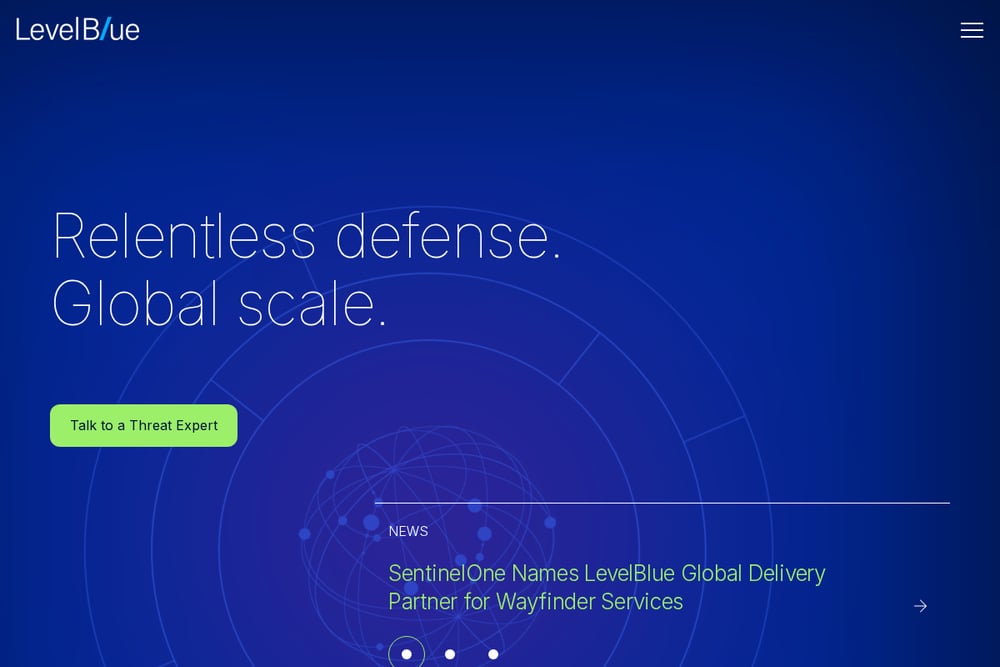 A screenshot of the LevelBlue website.
LevelBlue pairs offensive security with SpiderLabs, its elite global threat research team. Their service catalog spans cyber advisory, managed cloud security, data security, managed detection and response, email security, managed network security, exposure management, and incident readiness and response. They organize heavily around regulated industries such as education, financial services, government, healthcare, legal, manufacturing, and energy. They also map services to frameworks including CMMC, FISMA, GDPR, GLBA, HIPAA, ISO, and SOX. If compliance evidence and threat intelligence matter as much as the exploit itself, LevelBlue is built for that.
How to Choose the Right Offensive Security Partner
Start with your attack surface, not the vendor list. If your risk lives in web apps, APIs, and mobile builds, prioritize a provider with manual application testing and proof of exploit. If your risk lives in Active Directory and internal network, prioritize deep network tradecraft. If you run multi-cloud or Microsoft 365, check for explicit cloud coverage. Then ask three questions. Can I see starting prices before the sales call? Do I get a retest, and how many issues does it cover? Who explains the findings to the engineers who own the fix? A provider that answers all three clearly will save you weeks of back-and-forth. A provider that dodges them will not.
Where Automation Fits in a Human-Led Program
Automation is a coverage multiplier, not a replacement for reasoning. Use it to map your external attack surface, enumerate cloud misconfigurations, and catch known-vulnerable dependencies at scale. Then hand the interesting paths to humans. Humans chain weak access control into session hijacking, turn a business-logic flaw into data exposure, and prove impact in a way a scanner cannot. The strongest programs run a loop: automated discovery feeds manual testing, manual findings feed remediation, remediation feeds a retest, and the retest feeds back into your detection rules. That loop is what turns a one-time test into a durable security improvement.
The Bottom Line
You have five credible options, each strong in a different lane. OffSec goes deep on hardened networks. PoCForge gives you human-led testing across application, infrastructure, cloud, and adversary simulation, with published pricing and a retest included. Bitdefender consolidates offensive testing into an enterprise platform. DeepSeas wires offensive findings into a managed SOC. LevelBlue brings threat intelligence and compliance mapping for regulated industries. Pick the lane that matches your real risk. Then ask for proof of exploit, a fix plan, and a retest. That is how you turn a penetration test into actual risk reduction.