New Jersey's 2024 law turned reserve studies and structural inspections from a good idea into a legal deadline. If you sit on a condo, co-op, or HOA board, you need to know who can actually get you compliant.
The New Jersey reserve study landscape
New Jersey changed the game with P.L.2023, c.214 and P.L.2025, c.132. Associations holding $25,000 or more in common capital assets now fall under the law. Covered buildings face a structural inspection by year 15 and again no later than year 25. Every association needs a reserve study within two years of the owner board taking over, then an updated study at least every five years. Each study must carry a 30-year funding plan. That is a lot of new demand hitting a specialized market. The providers below range from national firms with deep report libraries to local engineers and matchmaking services that help you figure out what is even due.
How we looked at these providers
We weighed the same factors for every entry. First, service scope: does the provider handle reserve studies, structural inspections, or both, and does it understand the 30-year funding plan requirement? Second, pricing clarity: can a board figure out roughly what it will pay before picking up the phone? Third, local fit: does the provider have real New Jersey presence, regional offices, or state-specific guidance? Fourth, board usability: clear reports, meeting support, and tools that help volunteers act. New Jersey Reserve Studies stands out for its law-first framing and due-date calculator. Reserve Advisors stands out for a dedicated New Jersey legislation page and a broad service menu. Association Reserves stands out for a Tri-State regional office and a huge resource library. Criterium-Jagiasi stands out for licensed Professional Engineer review on every study. PropFusion stands out for its proposal-comparison platform and state-by-state guides.
Here is the short version. Five providers, five different strengths, one shared goal: getting your association compliant without wasting your board's time or money.
| Provider | Best For |
|---|---|
| Reserve Advisors | Boards that want a full-service national firm with state-specific guidance |
| New Jersey Reserve Studies | 2024 Law, Costs, Quotes | Boards that need to understand the law and find a local firm fast |
| Association Reserves | Boards that want sample reports and a deep education library |
| Criterium-Jagiasi Engineers | Associations that want licensed engineer review and meeting support |
| PropFusion | Boards that want to compare multiple proposals side by side |
The five, one by one
#1 Reserve Advisors
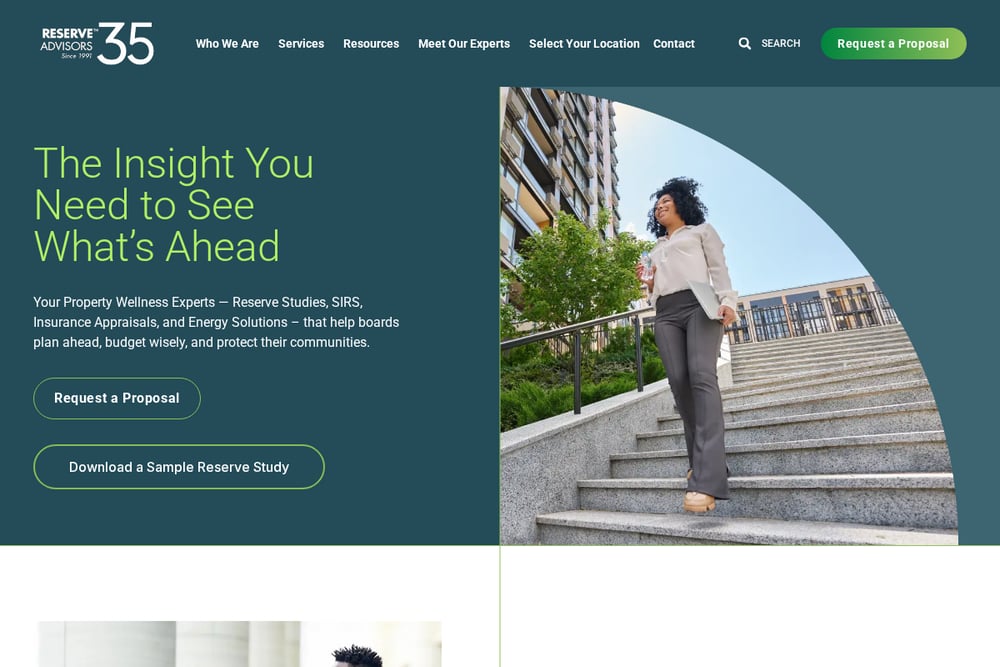 A screenshot of the Reserve Advisors website.
Reserve Advisors is a national reserve study firm that serves homeowner associations, condominium associations, high-rise associations, and private clubs. What matters for New Jersey boards is that the firm keeps a dedicated New Jersey requirements page alongside its Colorado, Florida, Maryland, and Tennessee legislation guides. That tells you the firm is tracking state-level rules, not just selling a generic report. Its service menu goes beyond the basic study into structural integrity reserve studies, insurance appraisals, preventative maintenance reports, and energy services. If your board wants one firm that can cover several capital planning needs at once, this is a strong place to start. You can request a proposal directly from the site.
#2 New Jersey Reserve Studies | 2024 Law, Costs, Quotes
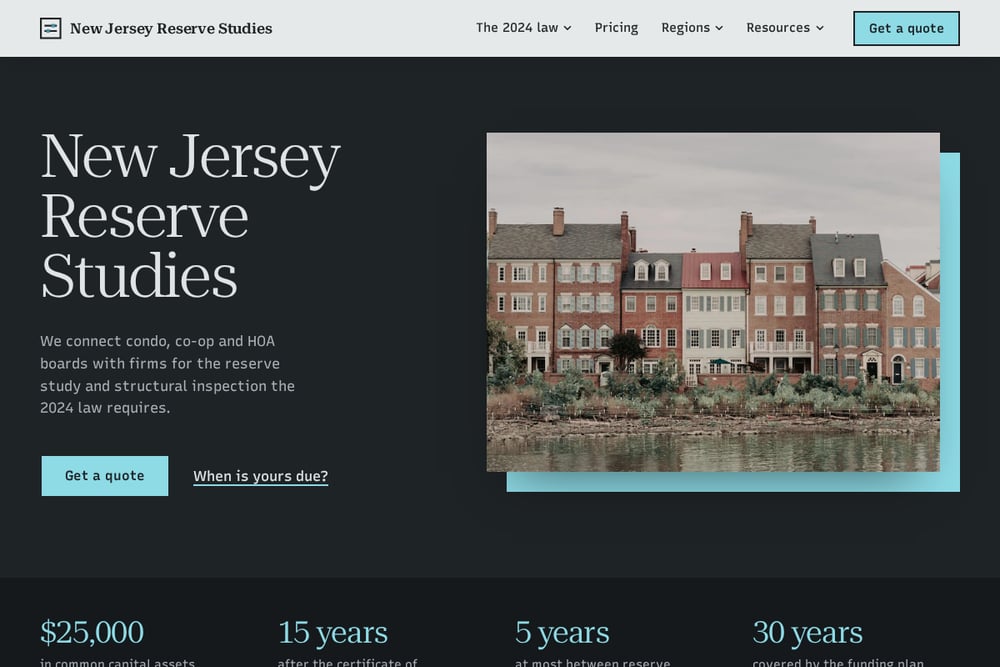 A screenshot of the New Jersey Reserve Studies | 2024 Law, Costs, Quotes website.
This site is built around one question: when is your study due? It connects condo, co-op, and HOA boards with firms that perform the reserve study and structural inspection the 2024 law requires. The homepage lays out the key numbers plainly: $25,000 in common capital assets triggers coverage, 15 years after the certificate of occupancy brings the first structural inspection, five years is the maximum gap between studies, and every study carries a 30-year funding plan. There is a due-date tool where you type the year on your certificate of occupancy and see both timelines. The quote process is refreshingly simple: tell them about the building in about two minutes, they name one firm within one business day, and nothing is shared until you say yes. It also breaks coverage down by region, from Hudson County and Jersey City to Bergen, Middlesex, the Monmouth and Ocean shore, and Atlantic City and Cape May.
#3 Association Reserves
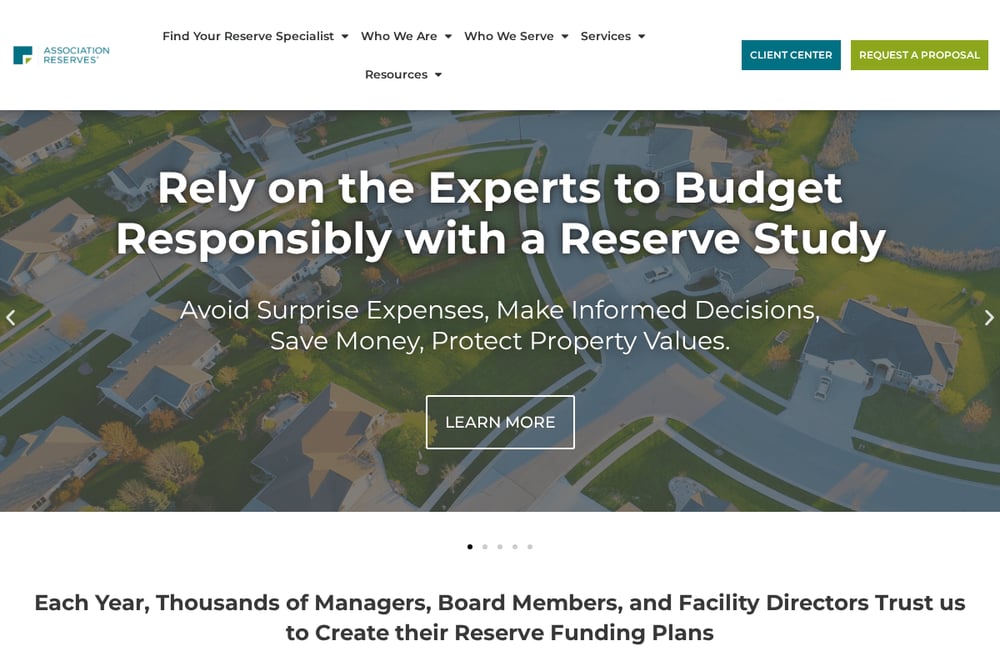 A screenshot of the Association Reserves website.
Association Reserves is one of the most established names in the reserve study field, with a regional office structure that includes a Tri-State office covering New York, New Jersey, Connecticut, and Pennsylvania. The firm offers full reserve studies, updates with and without a site visit, a loyalty update plan, and even a do-it-yourself kit for boards that want to handle the work in-house. Its resource library is unusually deep, with webinars, ebooks, sample reports, case studies, and industry insights. There is also a dedicated section on older condos, which fits New Jersey's aging building stock. If your board learns best from examples and sample documents, this is a rich place to dig in.
#4 Criterium-Jagiasi Engineers
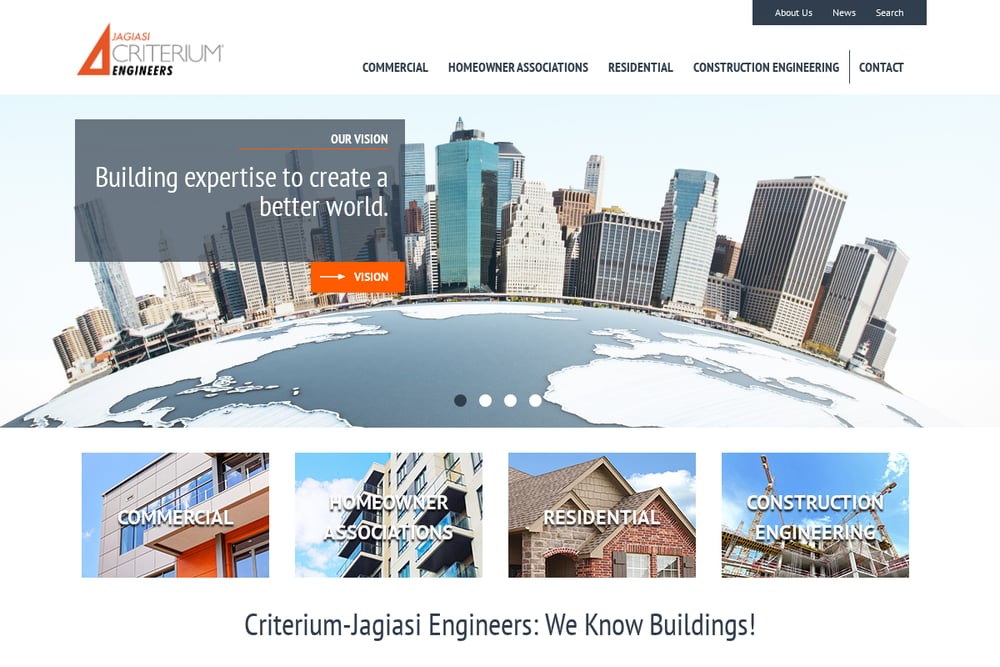 A screenshot of the Criterium-Jagiasi Engineers website.
Criterium-Jagiasi Engineers brings an engineering-first approach to homeowner association reserve studies. Every study is conducted or reviewed by a licensed Professional Engineer and includes observations and analysis gathered in the field. That distinction matters when your reserve study sits next to a structural inspection requirement. The firm also offers transition studies, residential structural inspections, diagnosis and repair, building envelope consulting, and property condition assessments. It attends association meetings to help boards present and explain the findings to their communities, which is a real help for volunteer boards facing skeptical owners. If your board wants an engineer's eyes on the building, not just a spreadsheet, this is worth a call.
#5 PropFusion
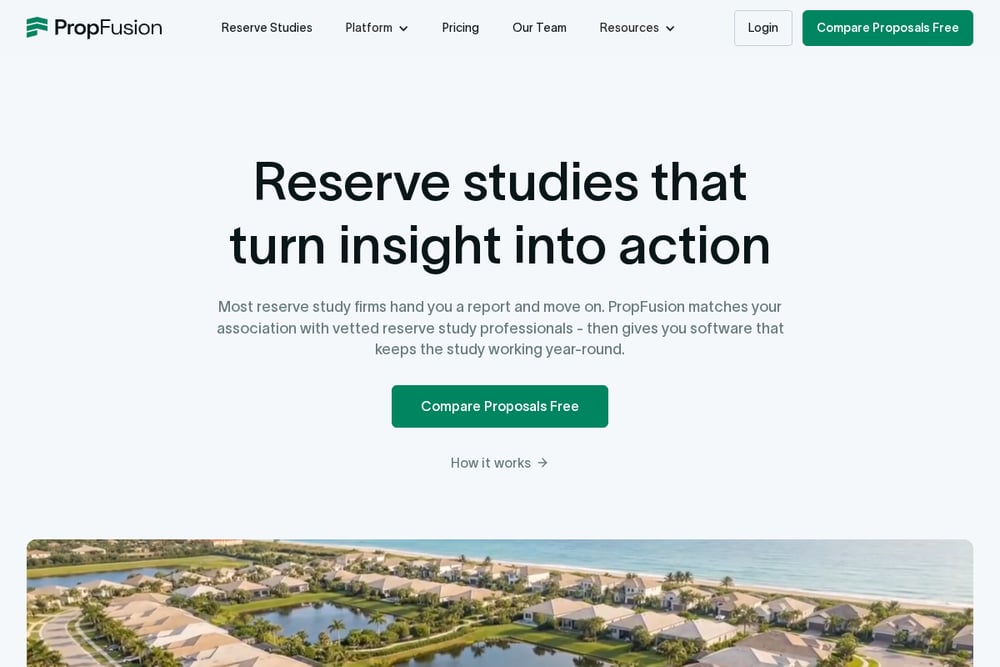 A screenshot of the PropFusion website.
PropFusion is a platform that matches boards with vetted reserve study companies and gives them software to manage the process. Its state law guide and free proposal comparison tool are the draw here. The firm is led by a licensed Reserve Specialist with more than 20 years in the field and over 5,000 reserve studies performed. That experience shows in how the platform frames the problem: good studies collecting dust because boards cannot make sense of them. The service covers Level 1, 2, and 3 studies with 30-year funding plans. While its published state page focuses on Pennsylvania, the comparison model and state law guide make it a useful reference point for New Jersey boards shopping multiple quotes.
How to pick the right fit for your board
Start with your deadline, not the vendor list. Type your certificate of occupancy year into a due-date tool and find out whether you are facing a structural inspection, a reserve study, or both. Then decide what kind of help you need. If you want someone to explain the law and hand you one vetted local firm, a matchmaking service saves you weeks. If you want a national firm with sample reports and a regional office, go that route. If your building is older and the inspection is the bigger worry, prioritize a provider with licensed engineers on staff. Ask every firm three questions: does the study include a 30-year funding plan, who performs the site visit, and will you attend a board meeting to explain the results. Get the scope in writing before you sign.
Where automation fits into your compliance workflow
You do not need to automate the engineering. You do need to automate the follow-through. Set a calendar reminder for your next study cycle the day your current report lands, since the law allows at most five years between studies. Store your certificate of occupancy year, your last study date, and your inspection dates in one shared board document so a new board member can pick it up cold. Use a due-date calculator once a year at your annual meeting to confirm nothing has slipped. When you request quotes, keep a simple comparison sheet with scope, price, site visit included or not, and meeting support. That single sheet turns a confusing vendor conversation into a fifteen-minute board vote.
The bottom line
New Jersey's 2024 law is not going away, and the five-year study cycle means this is a recurring obligation, not a one-time project. The good news is you have real options. New Jersey Reserve Studies is the fastest way to understand what you owe and get matched with a local firm. Reserve Advisors and Association Reserves bring national depth and state-specific resources. Criterium-Jagiasi brings licensed engineers. PropFusion brings comparison tools. Pick the one that matches your building's age, your board's bandwidth, and your deadline. Then put the next date on the calendar before you adjourn.