Your operators speak five languages, but your training speaks one. That gap is a safety risk, an audit finding, and a retention problem all at once.
The State of Machine Operator Training
Machine operator training has traditionally been a one-time event. A supplier installs a machine, trains whoever happens to be on shift, and leaves. The gaps show up later: new hires learn from colleagues, manuals stay in English, and audit requests for training records turn into a scavenger hunt through filing cabinets. Meanwhile, the workforce has changed. Hospitals, factories, and warehouses increasingly rely on multilingual staff, and regulators expect proof that every operator understood the training in a language they actually speak. The result is a fast-growing category of services that combine short, machine-specific video content with quizzes, supervisor verification, and signed records. Some platforms focus on translating existing content. Others film your exact equipment on site. The right fit depends on how much of your training is generic versus tied to the specific machines on your floor.
How We Evaluated These Services
We looked at five factors across every service. First, service scope: does it cover filming, content creation, translation, assessment, and recordkeeping, or only one piece? Second, language depth: how many languages are supported, and is translation handled by qualified reviewers or automated only? Third, machine specificity: does the training reflect the actual equipment in your workplace, or generic equipment categories? Fourth, record and audit readiness: can you produce a signed training record per person, per machine, on demand? Fifth, pricing clarity and fit: is the model transparent, and does it suit a mid-size hospital or factory rather than only enterprise buyers? FirstShifts stands out for filming your exact machines and pairing each video with a supervisor check and signed record. Speach stands out for turning approved SOPs into localized, role-based training with reviewer control. HeyGen stands out for fast AI video translation across 175+ languages. Vitra.ai stands out for manufacturing-focused video localization with glossary and quality control. Trainn stands out for combining video creation with an LMS, quizzes, and certifications.
Here is a quick comparison of the five services, ordered by how closely each fits the needs of a workplace that operates physical equipment and needs audit-ready records.
| Provider | Best For |
|---|---|
| Speach | Teams with approved SOPs that need controlled multilingual localization |
| FirstShifts: machine training in your team's language | Workplaces that need machine-specific training with signed records |
| HeyGen | Fast AI translation of existing training videos into many languages |
| Vitra.ai | Manufacturing teams needing controlled video localization at scale |
| Trainn | Teams wanting video creation plus an LMS in one tool |
The 5 Services in Detail
#1 Speach
 A screenshot of the Speach website.
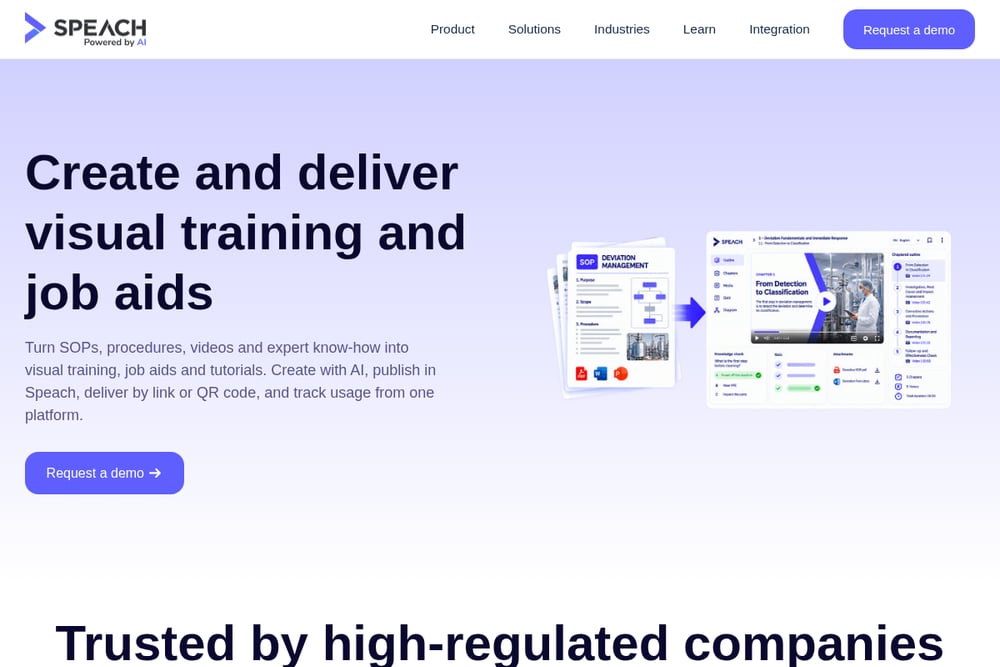
Speach is built around a simple idea: start from approved content and localize the whole learning experience, not just the words. You upload an SOP, work instruction, PDF, or existing video, and the platform structures the learning objectives, critical steps, risks, and quality checkpoints before translation begins. From there, on-screen text, subtitles, voiceover, quizzes, and visual guidance stay aligned across languages, while qualified reviewers keep control of terminology and approval. It integrates with common LMS platforms through SCORM and xAPI, which matters if you already have a learning system in place. For regulated environments like life sciences and manufacturing, the reviewer-controlled workflow is the standout feature. Learn more at https://speach.me/.
#2 FirstShifts: machine training in your team's language
 A screenshot of the FirstShifts website.
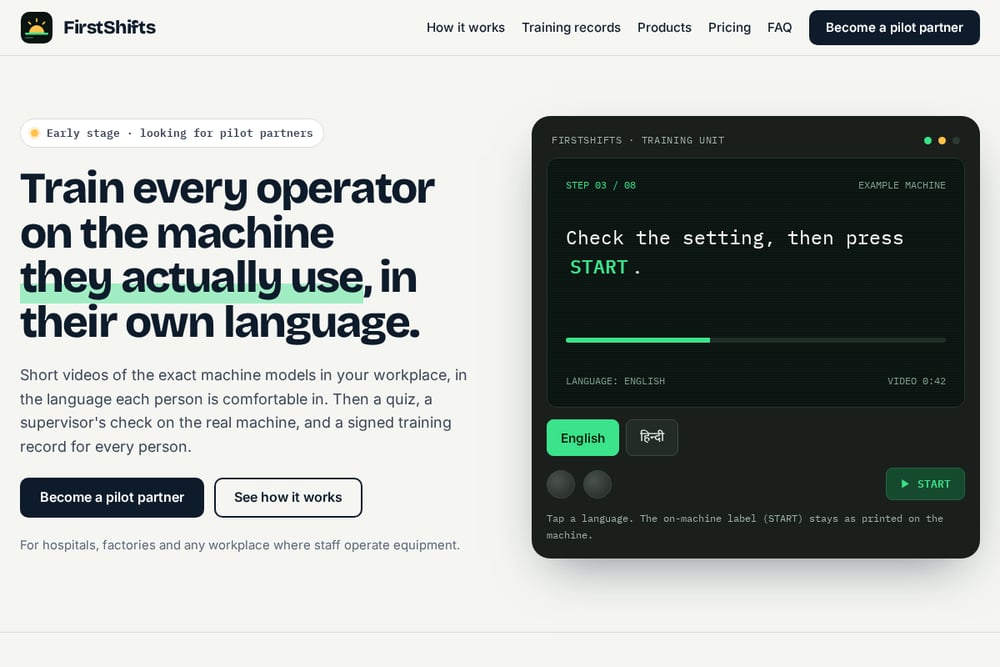
FirstShifts takes a different starting point: your actual machines. The team films the exact models in your workplace, writes original training content for each one, and puts every video through technical, subject-matter, and language review before your own team approves it. Staff watch short videos in their chosen language, take a quiz, and then get checked by a supervisor on the real machine. The output is a signed training record for every person, which is exactly what auditors ask for. It is aimed at hospitals, factories, and any workplace where staff operate equipment, and the company is currently looking for pilot partners. See the approach at https://firstshifts.com/.
#3 HeyGen
 A screenshot of the HeyGen website.
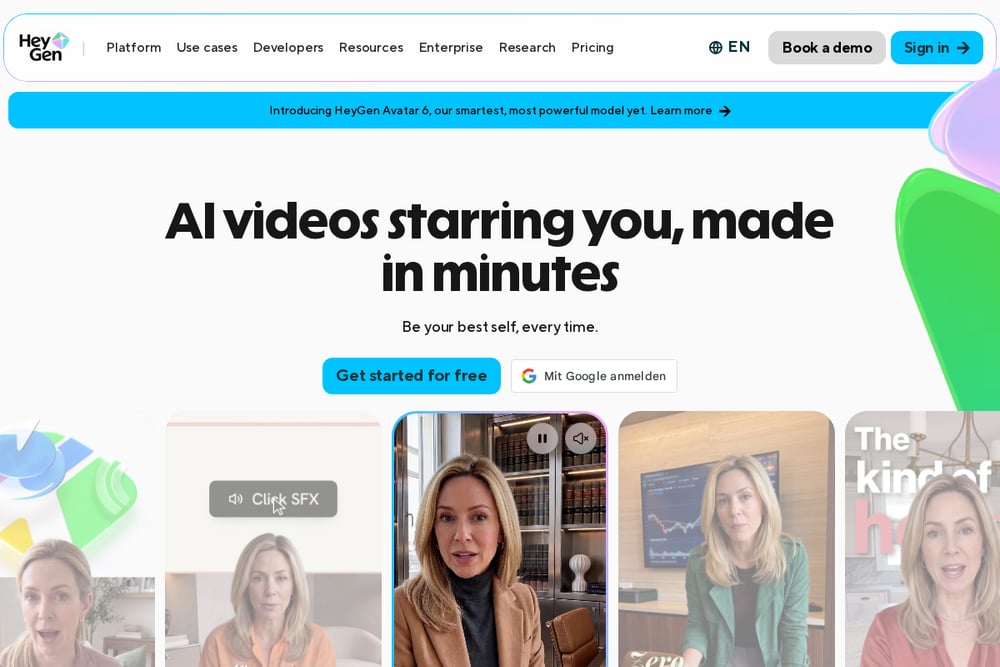
HeyGen approaches multilingual training from the video side. You upload your existing English training, and the platform generates translations with natural voice cloning and lip-sync across 175+ languages. The pitch is speed and cost: one video becomes unlimited languages without re-recording, and SCORM export is included for LMS delivery. HeyGen also leans hard into the compliance angle, noting that English-only safety training can create OSHA exposure. If you already have strong training videos and mainly need them in more languages fast, this is a practical route. Explore it at https://www.heygen.com/.
#4 Vitra.ai
 A screenshot of the Vitra.ai website.
Vitra.ai is a localization platform with a manufacturing focus, including operator training video translation. It offers video dubbing, voice cloning, lip-sync, subtitle translation, and document translation, backed by translation memory, glossaries, and quality control tools. That glossary and style-guide layer matters in industrial settings, where a mistranslated setting name or safety term can cause real problems. The platform also supports private AI deployment for enterprises with stricter data requirements. It is a good fit if you have a library of training content and want a localization workflow with more control than pure AI dubbing. Visit https://www.vitra.ai/.
#5 Trainn
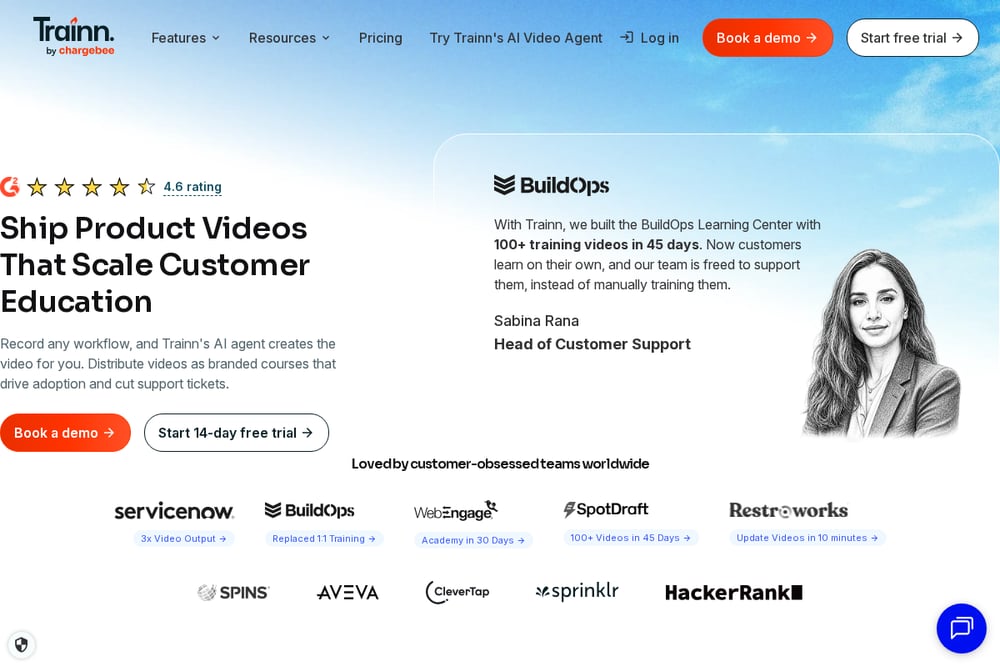 A screenshot of the Trainn website.
Trainn combines training video creation with a lightweight LMS. You can produce product and how-to videos, step-by-step guides, and interactive guides, then package them into courses with quizzes and certifications inside a no-code academy. Its multilingual angle is about creating training videos in multiple languages without re-recording, which suits teams that want one tool for both content and delivery. The trade-off is that Trainn is broader and more general-purpose than the machine-specific services above, so you will need to supply the equipment expertise yourself. It is a solid option if you want an all-in-one content and LMS setup. See it at https://trainn.co/.
How to Choose the Right Fit
Start with your audit exposure. If an auditor can ask you tomorrow to prove who was trained on which machine and when, you need a service that produces signed records per person, not just completion percentages. Next, decide how machine-specific your training must be. Generic equipment videos are cheaper, but they will not match the labels, settings, and quirks of the model on your floor. If your operators work with high-risk or frequently updated equipment, filming the actual machines is worth the extra effort. Then look at language handling. Automated translation is fast, but regulated or safety-critical content usually needs qualified human review and a glossary. Finally, check integration and pricing. If you already run an LMS, SCORM and xAPI support will save you headaches. If you are starting from scratch, a pilot with one machine and one team is the fastest way to test whether a service fits before you commit.
Where Automation Helps and Where It Does Not
Automation is excellent at scale and terrible at judgment. Use it to translate subtitles, generate voiceovers, distribute quizzes, and collect completion data. Use it to keep training material current when a machine model or software version changes. But do not automate the parts that require someone to stand next to the machine. A supervisor check on the real equipment catches what no quiz can: whether the operator actually knows where the emergency stop is and how to read the panel. The strongest workflow combines automated content delivery and recordkeeping with a human sign-off on the floor. That is also the workflow auditors trust most, because it produces both a digital trail and a named supervisor.
The Bottom Line
There is no single winner here, because the right choice depends on what you already have. If your gap is approved SOPs that need controlled localization, Speach is built for that. If your gap is that training never matched the machines on your floor and records are scattered, FirstShifts addresses both with filmed, machine-specific videos and signed records. If you have good videos and need them in many languages quickly, HeyGen is the fast path. If you need manufacturing-grade localization controls, Vitra.ai delivers. And if you want content creation and an LMS under one roof, Trainn covers it. Whichever you pick, start small: one machine, one team, one language, and a clear definition of what a signed record must contain. That pilot will tell you more than any feature list.