
Migraine tracking only works when the details actually make it into your record. These five tools give you a place to put them, so your next appointment starts with a history instead of a guess.
The migraine tracking landscape
Migraine care has quietly shifted toward self-documentation. Neurologists want attack frequency, duration, symptoms, and medication use, and patients are expected to bring that context to the visit. That gap has been filled by a growing field of iPhone and Android apps, each with a different philosophy. Some lean on community and coaching. Some lean on clinical connection. Others focus on the simple act of getting an entry written down before the day swallows it. The result is a category that rewards you for knowing how you actually want to track, not just for picking the app with the most downloads.
How we evaluated these tools
We looked at the same factors across every tool. First, scope: does it cover attacks, symptoms, triggers, medications, and reports, or only part of that picture? Second, clarity: is the free tier understandable, and are paid features described plainly? Third, fit for the platform: does it feel native to iPhone or Android, and does it sync or export cleanly? Fourth, the doctor handoff: can you turn entries into something a clinician can read? Fifth, day-to-day friction: how much effort does a single log take, and does the app give you a reason to come back? Calmira stood out for its focused iPhone experience and its free printable diary. Migraine Buddy stood out for breadth and community. Migraine Monitor stood out for its specialist connection model. The App Store and Google Play listings stood out as the places where you can verify ratings, pricing, and update history before committing.
Here is the short version. Each tool below approaches migraine tracking from a slightly different angle, so the right pick depends on whether you want a lean iPhone diary, a large community, a clinical connection, or a store listing you can audit before downloading.
| Provider | Best For |
|---|---|
| Migraine Buddy | Broad feature coverage and community |
| Migraine Tracking App & Headache Diary | Calmira | A focused iPhone diary with doctor reports |
| Migraine Monitor | Tracking tied to your specialist |
| Migraine Buddy: Track Headache (App Store) | Checking ratings and pricing before downloading |
| Migraine Buddy: Track Headache (Google Play) | Android users vetting the same app |
The five tools in detail
#1 Migraine Buddy
Migraine Buddy is the most established name in this category, and it shows. The app tracks attacks, triggers, symptoms, medications, and relief methods, then turns those entries into shareable reports for your doctor. It is available on both iOS and Android and syncs to the cloud, so your history follows you across devices. The team behind it includes migraine patients and was designed with input from neurologists, which explains the clinical framing of its exports. A premium tier adds pattern insights, attack duration estimates, and guided behavioral coaching. If you want the widest feature set and a large user base, start here.
#2 Migraine Tracking App & Headache Diary | Calmira
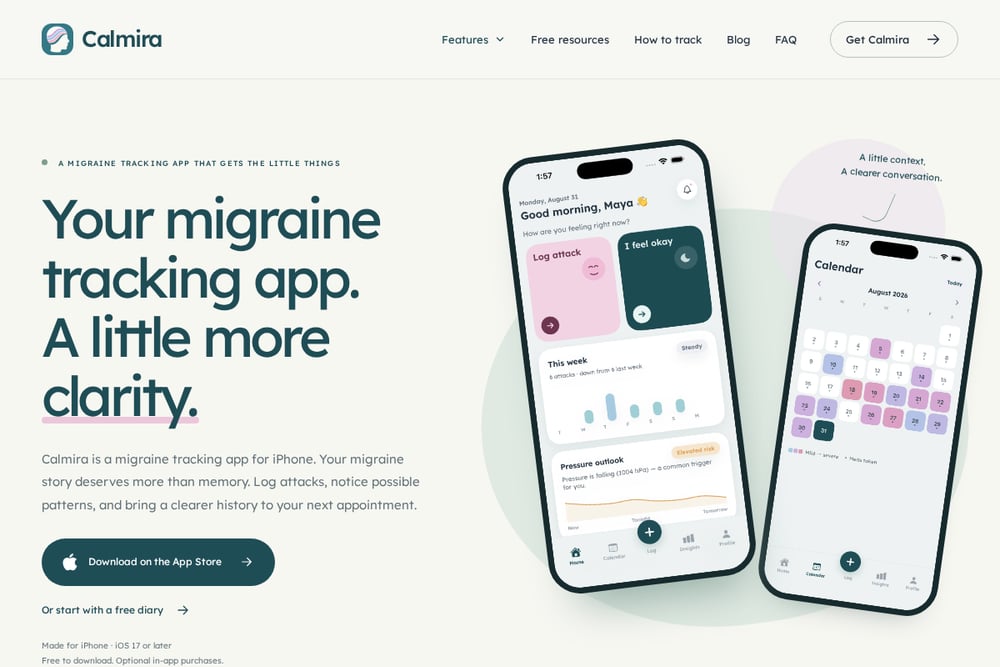 A screenshot of the Migraine Tracking App & Headache Diary | Calmira website.
Calmira is a migraine tracking app built specifically for iPhone, and that focus shows in the details. You log attacks with a pain map and intensity, run an attack timer, and keep symptoms and possible triggers together in one diary. A headache calendar gives you the month at a glance, while insights and trends show your entries over time. Doctor reports let you bring your history to an appointment, and an AI diary assistant answers questions about your own entries. Medication tracking, reminders, pressure alerts, backup and import, and 13 app languages round it out. It is free to download with optional in-app purchases, and there is a free printable diary if you prefer paper.
#3 Migraine Monitor
Migraine Monitor takes a different route. Instead of positioning itself as a standalone diary, it connects patients with their specialists, with separate registration paths for patients, specialists, and managers. That makes it a fit if your care team already uses the platform or if you want your tracking to feed directly into a clinical relationship. The site is deliberately lean, pointing you to patient FAQs, privacy and terms, and resources rather than a long feature list. It is operated by RPM Healthcare, which signals a remote patient monitoring orientation. If shared visibility with a clinician matters more to you than a sprawling feature set, this is worth a look.
#4 Migraine Buddy: Track Headache (App Store)
 A screenshot of the Migraine Buddy: Track Headache (App Store) website.
The App Store listing is where you verify the claims before you download. It shows a 4.8 rating across roughly 42,000 ratings, an age rating of 9+, a size of about 141.9 MB, and a Medical category chart position. The listing spells out the feature set in detail, including customizable attack recording, diary and MIR exports for doctors, and premium smart tools like attack duration estimates and a seven-day weather forecast. It also notes in-app purchases and iPad support, which matters if you want a larger screen for reviewing history. Read the recent reviews before you commit, since they tend to surface the friction points faster than any marketing page.
#5 Migraine Buddy: Track Headache (Google Play)
 A screenshot of the Migraine Buddy: Track Headache (Google Play) website.
The Google Play listing serves the same purpose for Android users. It shows a 4.8 rating across roughly 67,400 reviews, over one million downloads, and an in-app purchases label. The description covers the same core capabilities: customizable attack recording, doctor-ready diary and MIR exports, a seven-day weather forecast for pressure and temperature shifts, and in-app migraine news and research updates. It also flags user interaction, which is a useful reminder that the app includes community features. If you are on Android, this is the listing to read for version history and recent user feedback. Pair it with the App Store listing if you are comparing across a household with mixed devices.
How to choose your tracker
Start with the handoff. If you regularly see a neurologist, prioritize tools that export a readable report, like Calmira's doctor reports or Migraine Buddy's diary and MIR exports. Next, decide how much you want to write. A lean diary with a pain map and timer takes less daily effort than a full symptom taxonomy, and the app you actually open is the one that works. Then check the platform. Calmira is iPhone-only, so Android users should look at the Google Play listing instead. Finally, read the store listings for pricing and recent reviews before you commit, and consider whether a free printable diary is a better starting point if screens aggravate your symptoms.
Building a tracking routine that sticks
The best tracking system is the one that survives a bad migraine day. Set a reminder to log the attack while it is happening, even if you only capture the start time and intensity. Fill in symptoms and possible triggers later, when you are recovered, using the calendar view to jog your memory. Keep medication entries current so your doctor can see what you took and when. Before each appointment, generate a report rather than scrolling through months of entries. If weather is a suspected trigger, let pressure alerts do the noticing for you. Small, repeatable steps beat comprehensive logging you abandon after two weeks.
The bottom line
Migraine tracking is not about collecting data for its own sake. It is about walking into your next appointment with a clearer story. Migraine Buddy offers the broadest feature set and the largest community. Calmira offers a focused iPhone experience with a pain map, attack timer, insights, and doctor reports, plus a free printable diary if paper suits you better. Migraine Monitor is the pick when your specialist is part of the loop. And the App Store and Google Play listings are where you confirm ratings, pricing, and recent feedback before you download anything. Pick the one that fits your day, then log the next attack while it is fresh.