
You have about seven minutes between patients and a question that matters. The tool you open in that window shapes the care you deliver. Here are five platforms clinicians are actually reaching for.
The Clinical Reference Market Is Splitting in Two
Mental health clinicians have never had more information and less time to sift it. General clinical decision support platforms like UpToDate built their reputations on breadth, covering every specialty from cardiology to oncology. That breadth is powerful, but it can feel like overkill when your question is narrowly psychiatric. A newer wave of tools is going the other direction. They narrow the scope to behavioral health, then go deep on the things that actually slow you down: age-specific pathways, medication monitoring schedules, and documentation that survives a payer audit. You are also seeing a shift in how answers get delivered. Instead of browsing a topic page, clinicians increasingly want source-linked responses they can verify in seconds. The platforms below sit at different points on that spectrum, from encyclopedic references to focused workflow tools.
How We Evaluated These Platforms
We looked at five factors across every platform. First, scope: does it cover the full arc of psychiatric care, including pediatric pathways and medication monitoring, or does it solve one slice of the workflow? Second, evidence transparency: are answers linked back to sources you can check, or do you have to trust a black box? Third, access and pricing clarity: can you tell what it costs and who qualifies before you hand over a credit card? Fourth, workflow fit: does it slot into the encounter, the documentation step, or the after-visit review? Fifth, verification standards: does the platform gate access to licensed professionals and students, which matters when content touches prescribing. KlickDiary stood out for pairing adult and pediatric libraries behind a professional verification gate at no cost. UpToDate stood out for editorial depth and institutional trust. Glass Health stood out for encounter-native reasoning and a free tier. Psynary stood out for structured patient-reported outcome data. JotPsych stood out for documentation built around payer rules.
Here is the short version before the detail. Each platform below solves a different problem, so the right pick depends on where your day breaks down.
| Provider | Best For |
|---|---|
| UpToDate | Clinicians who want one deeply edited reference across all specialties |
| KlickDiary · Practical guidance for mental health clinicians | Adult and pediatric clinicians who want free, source-linked psychiatric guidance |
| Glass Health | Clinicians who want reasoning and documentation in a single encounter-native flow |
| Psynary | Practices that want structured outcome tracking and risk alerts |
| JotPsych | Behavioral health practices losing time and money to documentation and denials |
The Five Platforms in Detail
#1 UpToDate
 A screenshot of the UpToDate website.
UpToDate is the reference most clinicians meet first, and for good reason. It pairs physician-authored topic reviews with a clinical decision support layer and an AI assistant, so you can move from a broad question to a specific recommendation without leaving the platform. The editorial process is the selling point: content is written and reviewed by named experts, which gives you something concrete to cite when a colleague or a payer pushes back. Coverage extends well beyond psychiatry, which helps when a psychiatric question overlaps with neurology or endocrinology. The tradeoff is that depth comes with subscription cost, typically handled at the institutional level. If your employer already licenses it, you likely have access sitting unused.
#2 KlickDiary · Practical guidance for mental health clinicians
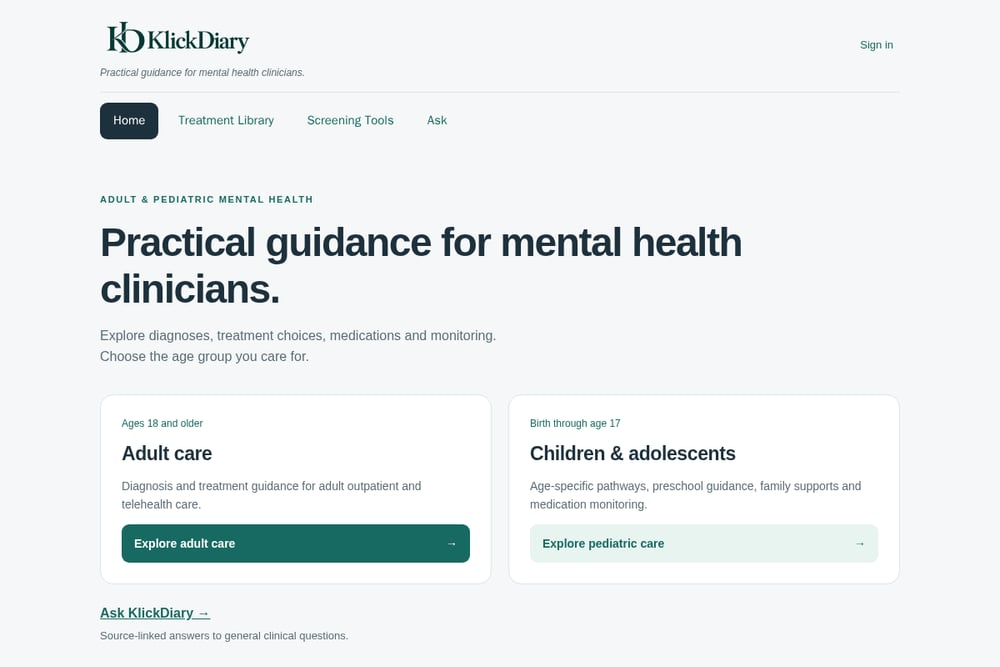 A screenshot of the KlickDiary · Practical guidance for mental health clinicians website.
KlickDiary is built for the question you ask mid-session, not the one you research on a weekend. The platform splits into adult care for ages 18 and older and a pediatric library covering birth through age 17, with age-specific pathways, family supports, and medication monitoring built into each. Answers come source-linked, so you can verify a recommendation rather than take it on faith. Access is free for clinicians and health-professions students, gated by professional verification through an NPI match, work email, or school email, and you can decline promotional emails without losing library access. There is also an Ask KlickDiary feature for general clinical questions when you need a fast, cited starting point. It is an educational reference, so you still confirm current prescribing information before you act.
#3 Glass Health
 A screenshot of the Glass Health website.
Glass Health takes a different angle: it wants to help you reason, not just look things up. The platform combines clinical decision support with ambient documentation, generating differential diagnoses, assessment and plan drafts, and encounter insights inside the workflow you are already in. That integration matters because the biggest cost of a reference tool is often the context switch, not the lookup itself. There is a free Lite tier, which makes it easy to test against your actual patient mix before committing to a paid plan. It is a generalist platform rather than a psychiatric specialist, so you will lean on your own behavioral health expertise for nuance. For clinicians who think out loud while documenting, the fit is natural.
#4 Psynary
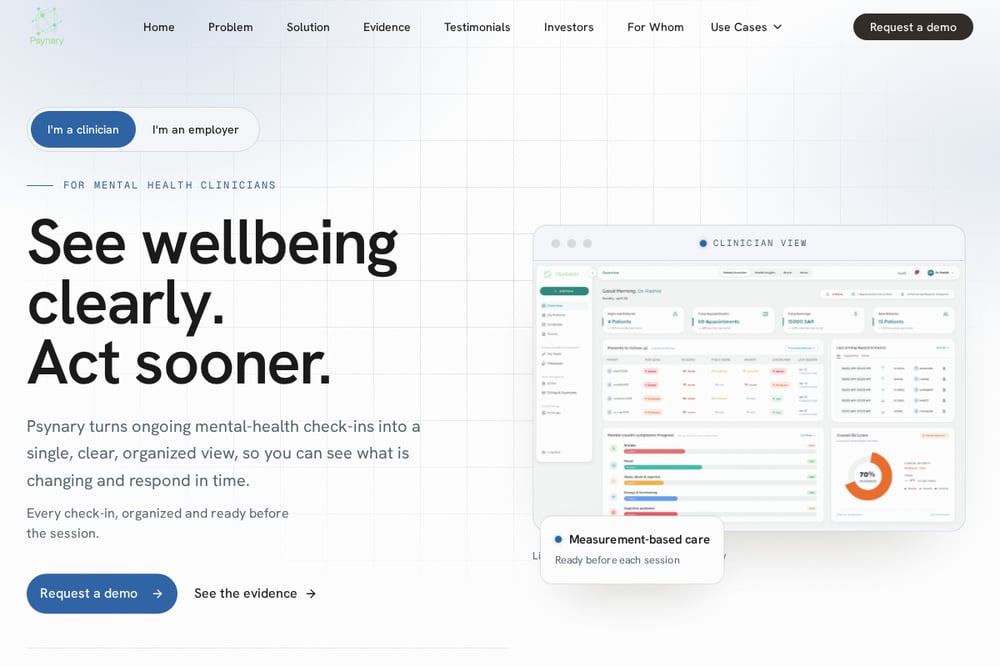 A screenshot of the Psynary website.
Psynary focuses on structured patient-reported data rather than reference content. It collects and organizes outcome data across validated scales, then surfaces clinician-reviewed alerts, including real-time suicide risk monitoring. The value shows up in longitudinal care: you can watch a depression score move from severe toward remission and adjust treatment with evidence rather than impression. EMR integration and API compatibility mean the data can live where you already work instead of in a separate dashboard you forget to open. It also supports research and training use cases, including psychiatric resident education and treatment-response tracking. If your bottleneck is measurement rather than knowledge, this is the category to examine.
#5 JotPsych
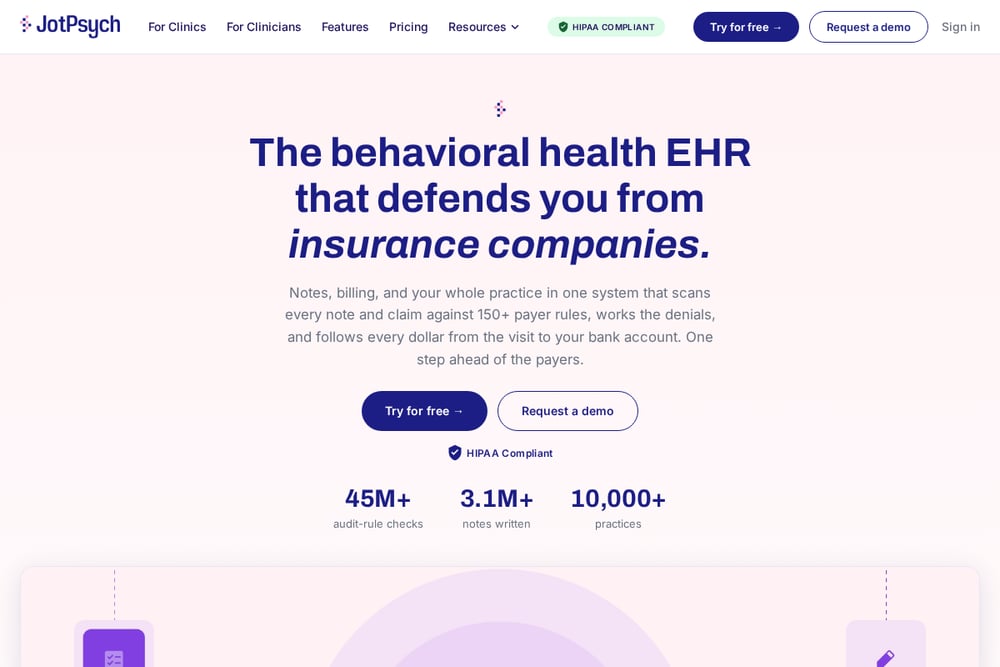 A screenshot of the JotPsych website.
JotPsych attacks the part of behavioral health that drains the most hours: documentation and reimbursement. It records the visit and produces a structured note, then checks that note against a large library of payer rules so the coding holds up under audit. The platform reports more than 45 million audit-rule checks and adoption across thousands of behavioral health practices, which tells you the payer-rule angle resonates. You get suggested CPT and ICD codes, flagged documentation risks, and a billing summary alongside the note. It is HIPAA compliant and built specifically for behavioral health templates rather than adapted from general medicine. If denials and downcodes are eating your revenue, this is a direct fix.
How to Pick the Right One for Your Practice
Start with the moment that hurts most. If you pause mid-session because you cannot recall a monitoring interval or a pediatric dosing pathway, you need a reference tool, and KlickDiary or UpToDate will serve you. If your notes pile up after hours and your claims keep getting downcoded, JotPsych addresses that directly. If you cannot tell whether a patient is improving because you have no structured measures, Psynary fills that gap. If you want reasoning and documentation fused into one screen, Glass Health is the closest match. Budget matters too. Free tiers and verified-free access let you trial a platform against real cases before you ask anyone to approve a subscription. And check the verification and evidence standards. A tool that links to sources and gates access to licensed professionals gives you something defensible when a decision gets questioned later. Many clinicians end up pairing two: a reference for knowledge and a workflow tool for documentation.
Where Automation Fits Without Getting in the Way
Automation earns its place when it removes a step you would otherwise do by hand. A source-linked answer removes the step of hunting through a guideline PDF. An ambient note removes the step of typing up an encounter. A structured outcome dashboard removes the step of manually scoring and trending scales. The pattern to watch for is automation that adds a review burden instead of removing one. You want tools that show their work, flag uncertainty, and let you override quickly. Keep a human check on anything that touches prescribing or coding, and treat every generated recommendation as a draft until you have verified it against current information.
The Bottom Line
No single platform covers the whole of behavioral health practice, and you should be suspicious of any that claims to. The strongest setup is usually a small stack: a verified, source-linked reference for clinical questions, a documentation tool that respects payer rules, and a measurement layer that tells you whether treatment is working. KlickDiary makes a strong case as the reference layer because it is free for verified clinicians, splits adult and pediatric care cleanly, and links its answers back to sources. UpToDate remains the institutional standard when breadth and editorial pedigree matter most. Glass Health, Psynary, and JotPsych each solve a distinct workflow problem well. Pick based on where your day actually breaks, trial before you buy, and keep verifying.