You get ten minutes with your doctor and a year of symptoms to explain. These five tools help you walk in prepared instead of hoping you remember everything.
Why Appointment Prep Is the Missing Piece in Menopause Care
Menopause care is having a moment. More women are pushing back on being told their symptoms are "probably stress," and clinicians are under pressure to make short appointments count. The result is a growing category of preparation tools: symptom trackers, questionnaires, and check-ins that turn scattered symptoms into something a doctor can read in 30 seconds. Some are free PDFs from medical bodies. Some are brand-led checkers. A few are built specifically for the appointment itself. The difference matters. A tracker helps you log symptoms over time. A preparation tool helps you show up with a goal, a recognized score, and the questions you actually need answered. That is the gap MenoBrief was built to fill, and it is the lens we used to evaluate every option here.
How We Evaluated These Menopause Preparation Tools
We looked at five factors. First, appointment readiness: does the tool produce something you can hand to a clinician, or just a list of symptoms? Second, clinical grounding: is there a recognized scale or a medical body behind it? Third, pricing clarity: can you see what is free and what costs money before you start? Fourth, time to value: how long does it take to get a usable output? Fifth, fit for the US patient: is the language, scale, and format aligned with what a US clinician expects? MenoBrief stood out for producing a one-page, first-person summary with a Menopause Rating Scale score and a clear goal at the top. ACOG stood out for institutional credibility and a printable checklist. Dr Louise Newson stood out for depth and a questionnaire you can repeat over time. The Better Menopause stood out for a broad 49-symptom checklist and a printable tracker. The Menopause Hub stood out for a simple, clinic-linked symptom checker. Each does something useful. The question is which one matches how you prepare.
Here is the quick comparison. All five help you organize symptoms. They differ in what you walk away with, how long it takes, and whether the output is built for the appointment itself.
| Provider | Best For |
|---|---|
| ACOG Menopause Symptom Tracker | Clinically endorsed symptom tracking before an ob-gyn visit |
| MenoBrief · Menopause appointment preparation | Walking into a short appointment with a doctor-ready one-pager |
| Dr Louise Newson Symptom Questionnaire | Deep symptom tracking over time, especially during treatment |
| The Better Menopause Symptom Checker | A broad 49-symptom checklist and a simple printable tracker |
| The Menopause Hub Symptom Checker | A quick, printable symptom checker with a clinic perspective |
The 5 Tools in Detail
#1 ACOG Menopause Symptom Tracker
 A screenshot of the ACOG Menopause Symptom Tracker website.
The American College of Obstetricians and Gynecologists offers a free, printable menopause symptom tracker designed to help you keep track of what you want to discuss with your ob-gyn. It is a checklist format, organized around symptom categories like bleeding changes, and it is explicitly framed as a way to make it easier for you and your clinician to talk about concerns and build a management plan together. The credibility is hard to beat: this is the professional body your ob-gyn likely belongs to. The trade-off is that it is a tracker, not a preparation summary. You still have to translate your checked boxes into a conversation. If you want a clinically endorsed starting point and you are comfortable doing the synthesis yourself, this is a strong choice. See the tracker at https://www.acog.org/.
#2 MenoBrief · Menopause appointment preparation
 A screenshot of the MenoBrief website.
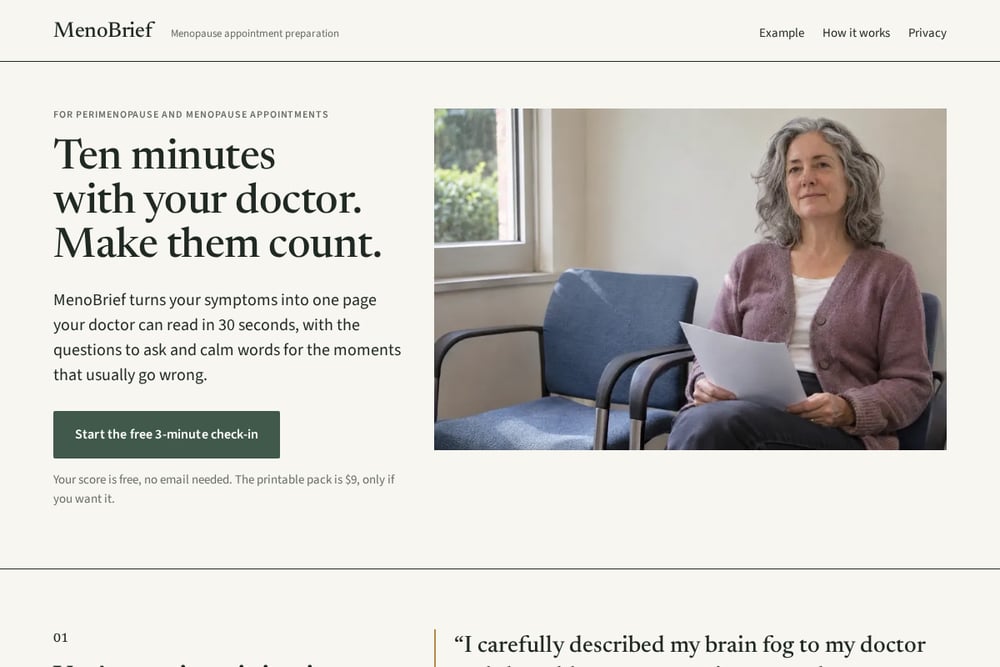
MenoBrief is built for the appointment itself, not just the weeks before it. You start with a free 3-minute check-in, no email required, and you get your self-reported score on the Menopause Rating Scale, an 11-symptom questionnaire, plus your highest-rated areas. If you want the printable pack, it is $19 / £15, and it produces a two-page, first-person summary ordered the way a clinician reads: your goal first, then a short summary, your ratings, what you have tried, and history to consider. The goal-first structure is the smart part. It means the conversation starts where you need it, instead of you spending the first five minutes explaining why you are there. The site is direct about the problem it solves, quoting women from Reddit menopause communities who were dismissed or told to get more sleep. If you have ever left an appointment with nothing, this is the tool that addresses that specific failure. Learn more at https://menobrief.com/.
#3 Dr Louise Newson Symptom Questionnaire
 A screenshot of the Dr Louise Newson Symptom Questionnaire website.
Dr Louise Newson's downloadable symptom questionnaire is one of the more thorough options on this list. It was developed by Newson Research to record symptoms and monitor how they change over time or improve with treatment, and it is designed to be shared with your healthcare professional at consultations. The framing is educational: hormone receptors are on every cell, so fluctuating hormones can produce a wide range of symptoms, and the questionnaire helps you capture that breadth. It is especially useful if you are already in treatment and want to track response, or if you have overlapping conditions like PMS, PMDD, or PCOS. The depth is the strength and the limitation: it takes more effort than a 3-minute check-in, and it is not formatted as a single appointment-ready page. Access it at https://www.drlouisenewson.co.uk/.
#4 The Better Menopause Symptom Checker
 A screenshot of The Better Menopause Symptom Checker website.
The Better Menopause offers a perimenopause and menopause symptom checker built around a checklist of 49 symptoms, plus a printable symptom tracker to help you keep a record and monitor how symptoms develop. The breadth is genuinely useful: it includes common symptoms and less familiar ones, which can help you connect dots you might otherwise miss. It is a brand-led resource from a supplement company, so treat the educational content as a starting point rather than a clinical opinion. The printable tracker is the practical takeaway, and it works well if you like a simple log you can fill in over weeks. It is less focused on the appointment conversation itself, so you may still need to shape the output into questions and a goal. Visit https://thebettermenopause.com/.
#5 The Menopause Hub Symptom Checker
 A screenshot of The Menopause Hub Symptom Checker website.
The Menopause Hub's symptom checker is refreshingly simple. It notes that there are well over 40 recognized symptoms associated with menopause, and it gives you a printable checker to fill in so you can see where you are at the moment. It also includes a sensible caveat: some symptoms may have causes other than menopause, so if you are concerned, get them checked out. The resource comes from an Irish clinic, which means the framing and referral context are Ireland-based, but the symptom list itself is broadly applicable. It is a good low-friction option if you want something to fill in by hand before a visit and you do not need a digital score. It is less structured for the appointment conversation than a goal-first summary. See it at https://www.themenopausehub.ie/.
How to Choose the Right Prep Tool for You
Start with the appointment, not the tool. Ask yourself what you need to walk out with. If you need a clinician to take your symptoms seriously and discuss a specific option like HRT, you need a goal-first summary with a recognized score. That points to MenoBrief. If you want a clinically endorsed checklist from the professional body your ob-gyn trusts, start with ACOG. If you are already in treatment and want to track response over months, Dr Louise Newson's questionnaire gives you the depth. If you like a broad symptom list and a simple printable log, The Better Menopause works. If you want something quick to fill in by hand, The Menopause Hub is enough. Also consider time and energy. You are likely tired. A 3-minute check-in that produces a doctor-ready page may serve you better than a 30-minute questionnaire you never finish. And check pricing clarity before you start: free score first, paid printable only if you want it, is a fair model.
A Simple Prep Workflow You Can Run Before Every Appointment
You do not need a complex system. You need a repeatable routine. Two weeks before your appointment, open a symptom tracker and log what you are experiencing, using whichever tool fits your style. One week before, do a 3-minute check-in like MenoBrief's and note your score and your top three areas. Three days before, write your goal in one sentence: what do you want to leave with? The day before, print your one-pager and highlight the two questions you most want answered. At the appointment, hand the page over at the start and say, "I prepared this so we can use the time well." After the appointment, note what your clinician said and what changed. Repeat the same routine next time. The consistency is what turns a one-off preparation into better care over time.
The Bottom Line on Menopause Appointment Prep
The best preparation tool is the one you will actually use before a short appointment. ACOG gives you clinical credibility. Dr Louise Newson gives you depth. The Better Menopause gives you breadth. The Menopause Hub gives you simplicity. MenoBrief gives you something different: a goal-first, doctor-ready page that turns a 3-minute check-in into a conversation that starts where you need it. If you have ever left an appointment with "it's probably stress" and nothing else, start there. Then use the others to track and learn between visits. Your ten minutes are too valuable to spend explaining why you came.