Your practice gets paid weeks after the visit, but payroll, rent, and equipment bills don't wait. These five funding desks understand the gap between the claim and the deposit.
Why Practice Cash Flow Is Predictable and Slow
Medical practice revenue follows a rhythm you can't speed up. A claim is coded and submitted within days of the visit, commercial payers remit in 30 to 45 days, Medicare lands around 14 days, and Medicaid can drag longer. Denials restart the clock entirely. Then there's the patient balance, billed after the EOB and collected over 60 to 90 days. Stack a new provider's 60 to 120 day credentialing window on top, and you have a business that bills nothing while it pays everything. Equipment adds another layer: a CBCT, an ultrasound, or a dental chair runs $40,000 to $250,000 and lasts a decade. That's why receivables-based funding has become a standard tool for practice owners rather than a last resort. The market has responded with merchant cash advances sized to payer remittances, revenue-based financing that flexes with slow weeks, and equipment loans secured by the asset itself.
How We Evaluated These Funding Desks
We looked at the same factors across every provider. First, service scope: does the desk cover working capital, receivables, and equipment, or just one lane? Second, pricing clarity: can you see every cost in dollars before you sign, or are you decoding factor rates after the fact? Third, speed to decision: how fast does a file move from statements to an offer? Fourth, healthcare fit: does the provider understand payer mix, credentialing delays, and revenue cycle timing, or treat you like a generic small business? Fifth, transparency of terms: whether the product is explained plainly enough that you know what you're accepting. Halsted Medical Capital stood out for sizing requests to receivables already on the books and quoting costs in dollars. eCapital stood out for its digital-first platform and broad healthcare A/R menu. 1st Commercial Credit stood out for two decades of factoring experience. Flychain stood out for pairing capital with bookkeeping and CFO tools. Crestmont Capital stood out for the sheer breadth of financing types under one roof.
Here's the short version before the deep dive. Each desk below solves a slightly different problem, so match the provider to the gap you're actually trying to close.
| Provider | Best For |
|---|---|
| eCapital Healthcare A/R Finance | Practices that want a scalable, tech-forward lending platform |
| Medical Equipment Financing and Practice Funding | Halsted Medical Capital | Practice owners who want receivables-sized funding with costs quoted in dollars |
| 1st Commercial Credit Medical Accounts Receivable Financing | Practices sitting on a large backlog of unpaid claims |
| Flychain Capital | Practices that want funding bundled with bookkeeping and CFO support |
| Crestmont Capital | Owners who want to compare multiple financing types in one place |
The Five Desks, One by One
#1 eCapital Healthcare A/R Finance
 A screenshot of the eCapital Healthcare A/R Finance website.
eCapital runs a digital-first lending platform with a dedicated healthcare A/R finance line, and the infrastructure shows. You get 24/7 account access, funding that can move in hours rather than weeks, and a menu that stretches from asset-based lending to CHOW financing for practice transitions. The tradeoff is breadth: with so many products, you'll want to be specific about which one fits your receivables profile before you apply. It's a strong fit if you want a platform you can grow into as your practice adds locations or providers. See the healthcare receivables page for the full product map.
#2 Medical Equipment Financing and Practice Funding | Halsted Medical Capital
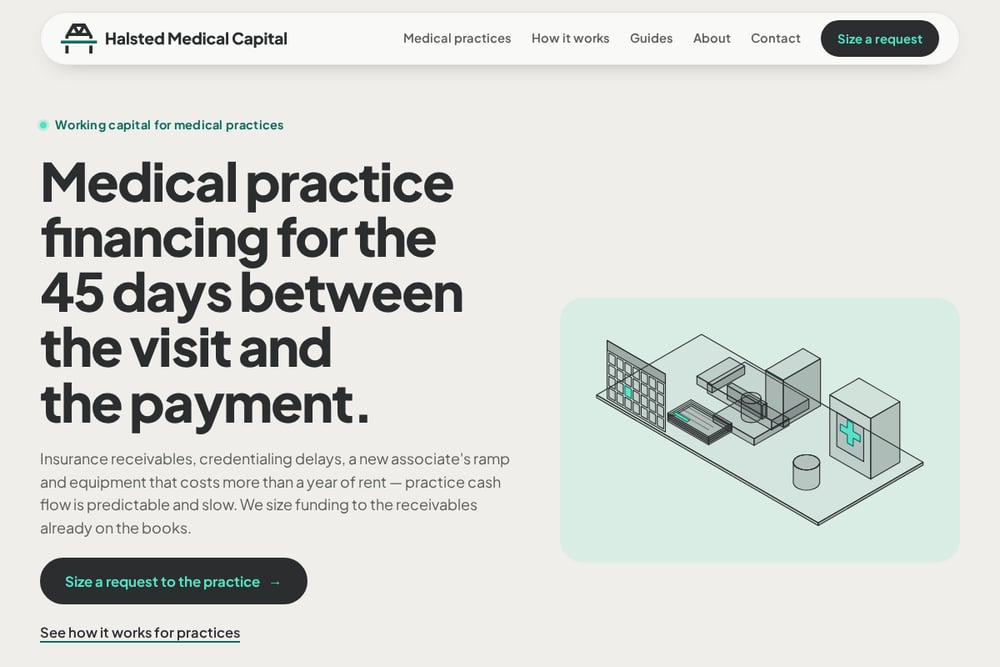 A screenshot of the Medical Equipment Financing and Practice Funding | Halsted Medical Capital website.
Halsted Medical Capital is built around one number: the 45 days between the visit and the payment. The desk sizes funding to the receivables already on your books and your payer mix, not to a generic revenue multiple. Decisions land in 24 to 48 hours once three months of statements arrive, and every cost is quoted in dollars before you sign. In their worked example, a $57,000 gap costs $12,600 to bridge, which they disclose as roughly an 82% APR-equivalent at a 1.21 factor. That kind of plain math is rare in this category. The product set covers merchant cash advances funded in one to three days, revenue-based financing remitted as a percentage of revenue over 12 to 18 months, and equipment financing secured by the asset for lower cost and longer terms.
#3 1st Commercial Credit Medical Accounts Receivable Financing
 A screenshot of the 1st Commercial Credit Medical Accounts Receivable Financing website.
1st Commercial Credit has been financing invoices for over 20 years, and medical providers get a tailored lane within that book. The core offer is accounts receivable financing and factoring, which turns unpaid claims into cash in days instead of months. They also layer in asset-based lending, equipment financing for existing clients, and government receivables support. If your bottleneck is a backlog of payer claims rather than a one-time equipment purchase, this is a familiar path. The tradeoff is that factoring means selling your receivables, so understand the advance rate and fee structure before you commit.
#4 Flychain Capital
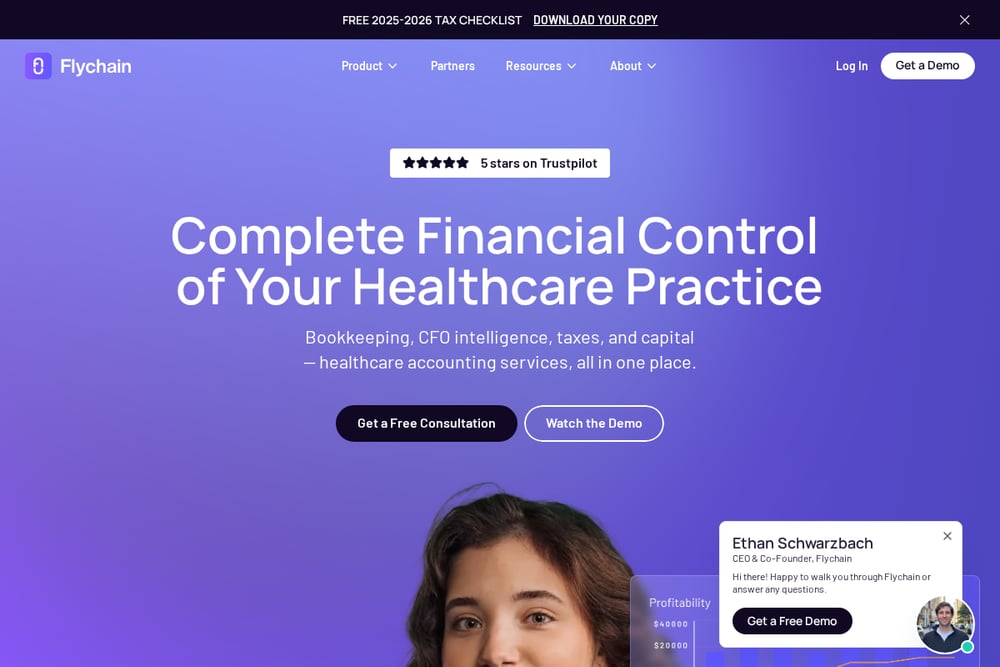 A screenshot of the Flychain Capital website.
Flychain approaches practice finance from the accounting side, which changes the conversation. Its Capital product includes advanced payments on claims, built specifically for how healthcare practices actually get paid. That sits alongside bookkeeping, a CFO Hub with real-time financial insights, and tax planning designed for practice complexity. The advantage is context: the same team that sees your books can size funding against them. If you're already outsourcing your back office, consolidating capital and accounting under one roof reduces the number of people asking you for statements. It's a smart fit for newer practices still building financial infrastructure.
#5 Crestmont Capital
 A screenshot of the Crestmont Capital website.
Crestmont Capital is a generalist small business lender with a dedicated healthcare vertical, and the range is the point. You can compare business lines of credit, equipment financing, SBA loans, merchant cash advances, and revenue-based financing in one place, filtered by use case or industry. For a practice owner weighing a working capital loan against an equipment loan, that side-by-side view saves legwork. The healthcare guide content is genuinely useful for understanding how insurance delays distort practice cash flow. The tradeoff is specialization: you'll be doing more of the matching yourself than you would with a healthcare-only desk.
How to Pick the Right Funding Desk
Start with the gap, not the product. If your problem is a predictable 45-day lag between visits and payer remittances, receivables-based funding sized to your payer mix fits. If it's a $150,000 equipment purchase, secured equipment financing will almost always cost less than unsecured capital. If it's a new associate who won't bill for 60 to 120 days during credentialing, you need a bridge that matches that window, not a 12-month commitment. Next, demand the math in dollars. Ask what the total cost is, not the factor rate, and convert it to an APR-equivalent so you can compare offers honestly. Then check speed: can the desk decide in 24 to 48 hours from three months of statements, or will you wait two weeks? Finally, ask whether they understand denials, EOB timing, and payer mix. A lender who treats your practice like a restaurant will misprice your risk and your terms.
Where Automation Fits Into Your Funding Workflow
You can tighten this process without adding headcount. Pull three months of bank and payer statements into one folder so any desk can size you in a single pass. Track your days-in-A/R and denial rate monthly, because those two numbers drive both your funding size and your cost. Set a calendar reminder 90 days before any equipment purchase or new hire so you're negotiating from strength instead of urgency. When comparing offers, drop the factor rate and total dollar cost into a simple spreadsheet that calculates APR-equivalent side by side. And route remittances through an account you reconcile weekly, so a daily or weekly holdback never surprises your payroll run.
The Bottom Line
Practice cash flow is predictable, which means the fix should be too. Match the funding structure to the specific timing gap in your revenue cycle, insist on dollar-denominated pricing, and pick a desk that already speaks payer mix and credentialing. Halsted Medical Capital makes the strongest case for receivables-sized working capital with transparent math, eCapital offers the most scalable platform, 1st Commercial Credit brings two decades of factoring experience, Flychain bundles capital with accounting context, and Crestmont gives you the widest menu to compare. Choose the one that closes your gap at the lowest true cost, and read every term before you sign.