Regulatory translation is not a language exercise. It is a compliance exercise. Get one term wrong in an IFU or a clinical submission and you are answering questions from a notified body instead of shipping your device.
The State of Medical Device Translation in the US Market
Medical device and life sciences companies in the US face a two-front language problem. Domestically, you need Spanish-language patient materials, consent forms, and school-facing documentation that hold up under scrutiny. Internationally, you need IFUs, labeling, and technical files that satisfy EU MDR 2017/745, ISO 13485, and ISO 14971 expectations. That combination has pushed demand toward vendors who understand quality management systems, not just grammar. The market splits into three camps: large language service providers with global reach, platform-driven translation companies with instant quoting, and specialist regulatory consultancies that bundle translation into submission support. Your job is to figure out which camp matches the risk profile of your documents.
How We Evaluated These Providers
We looked at the same factors across every provider. Service scope: does the provider cover IFUs, labeling, software strings, clinical documentation, and post-market content, or only one slice? Regulatory fluency: are ISO 13485, ISO 17100, EU MDR, and risk management frameworks named and operationalized, or just listed as badges? Language coverage: how deep is the pair inventory, and does it include the Spanish variants US teams actually need? Pricing clarity: can you get a quote without a sales call, and is the process transparent? Local fit: does the provider understand US institutional contexts like school districts, HIPAA, and FERPA? Each provider stood out on different factors. Eliana Caruso Translation Studio showed unusual depth in US public-sector and special education compliance alongside medical regulatory work. GTS Translation stood out for instant quoting and broad language inventory. Lionbridge showed scale and AI-augmented workflows. Stepes emphasized connected device content and ISO-certified processes. Freyr Solutions leaned into regulatory submission consulting as the entry point.
Here is a quick side-by-side view of the five providers, ordered for readability rather than as a verdict. Use it to shortlist two or three, then dig into the details below.
| Provider | Best For |
|---|---|
| GTS Translation | Teams that want fast, transparent quotes across many language pairs |
| Eliana Caruso Translation Studio | US school districts and regulated teams needing Spanish with deep compliance grounding |
| Lionbridge | Enterprises consolidating multilingual content under one global vendor |
| Stepes | Connected devices with software, labeling, and training content to keep in sync |
| Freyr Solutions | Teams that want translation bundled into regulatory submission support |
The Five Providers in Detail
#1 GTS Translation
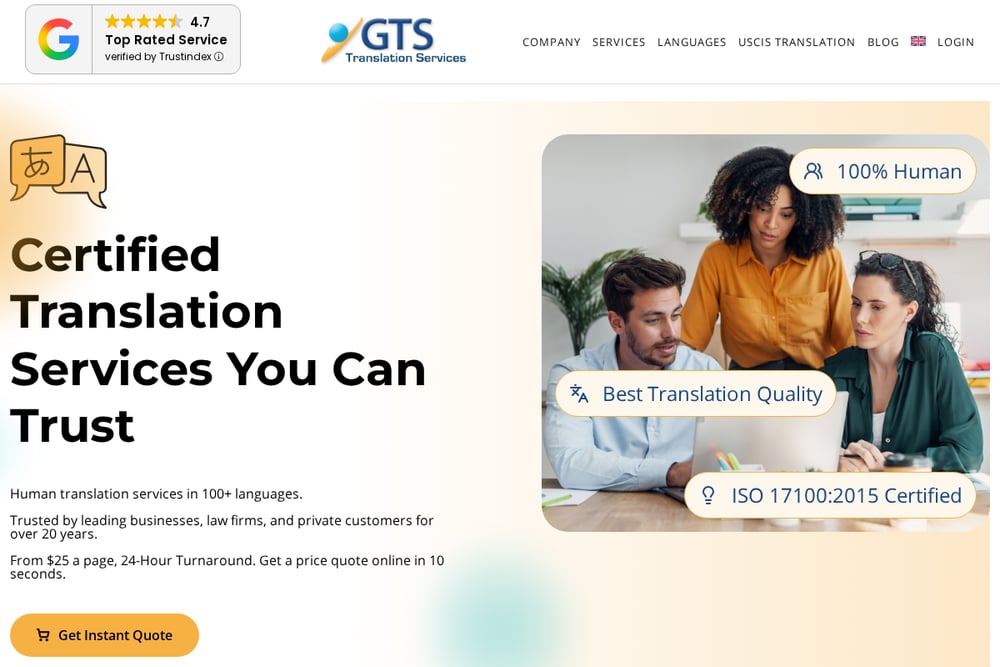 A screenshot of the GTS Translation website.
GTS Translation positions medical device translation as a compliance product, not a commodity. The company advertises certified human linguists with regulatory expertise across IFUs, labeling, software, and technical documentation, and it states ISO 17100 compliance across more than 100 languages. What stands out is the self-service quoting flow: you upload documents, pick source and target languages, and get a price without waiting on a sales cycle. For teams managing rolling labeling updates, that speed matters. The language inventory is unusually granular, including Spanish (European) and Spanish (Latin America) as separate targets. See the medical device translation page for the full service breakdown.
#2 Eliana Caruso Translation Studio
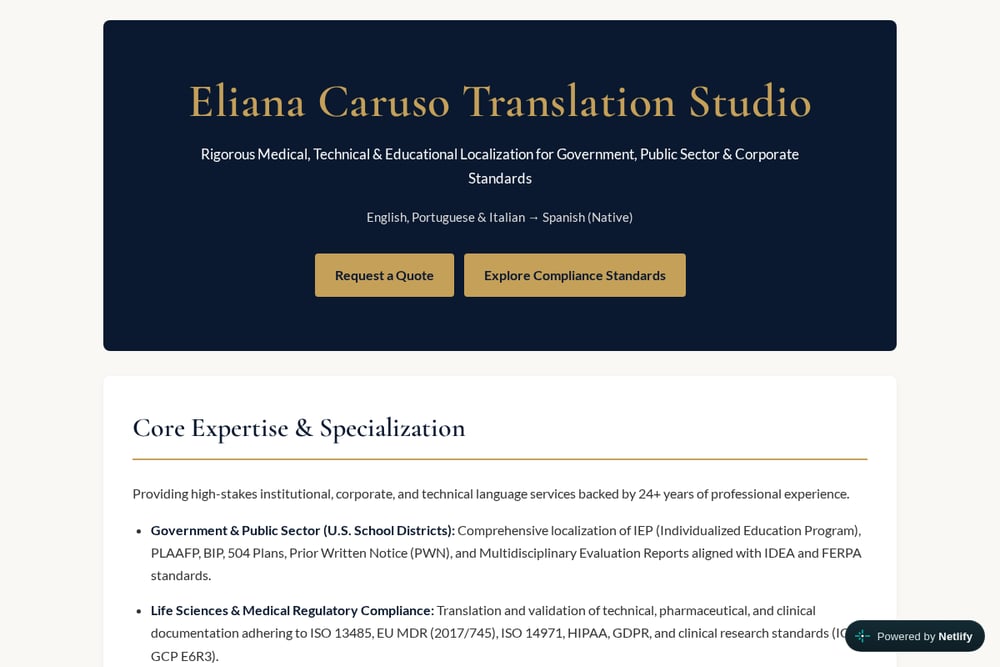 A screenshot of the Eliana Caruso Translation Studio website.
Eliana Caruso Translation Studio is a specialist shop with 24+ years of experience, and it shows in the scope of frameworks it names. The studio translates English, Portuguese, and Italian into native Spanish, covering medical, technical, educational, and corporate documentation. On the medical side, it cites ISO 13485:2016, ISO 9001:2015, EU MDR 2017/745, ISO 14971 risk management, HIPAA, GDPR, and ICH GCP E6(R3). What makes it distinctive is the US public-sector focus: IEP, PLAAFP, BIP, 504 Plans, Prior Written Notice, and Multidisciplinary Evaluation Reports aligned with IDEA and FERPA. That combination of school district compliance and life sciences regulatory work is rare in one provider. You can review the compliance standards and request a quote directly on the site.
#3 Lionbridge
 A screenshot of the Lionbridge website.
Lionbridge is the scale play. The company runs a full life sciences translation practice covering regulatory translation, scientific-to-plain-language work, and COA translation services, alongside interpretation and AI data services. Its Aurora AI platform layers machine translation and generative AI into workflows, with human review built in. For medical device teams, the appeal is breadth: you can consolidate labeling, software localization, training content, and patient-facing materials under one vendor. The tradeoff is that you are navigating a large organization, so onboarding and account management take more effort. The medical device language services page outlines the regulated-industry offering.
#4 Stepes
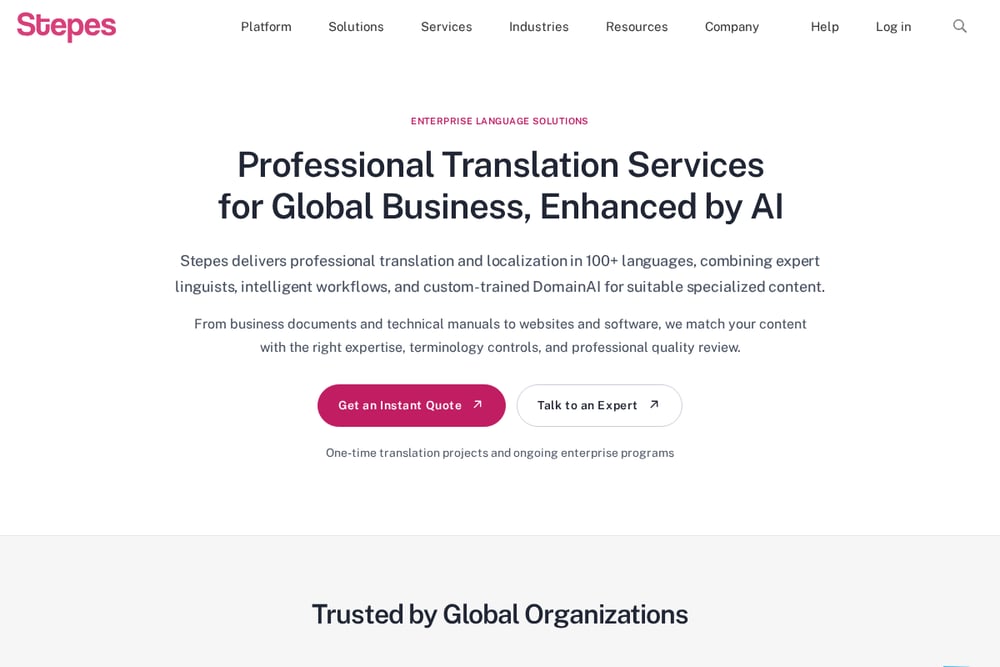 A screenshot of the Stepes website.
Stepes frames medical device translation around the full device experience: IFUs, labeling, software screens, technical documentation, training, and lifecycle updates. The company emphasizes terminology consistency across those surfaces, so a component name in the software matches the term in the IFU and the warning on the packaging. It cites ISO 13485 quality management and ISO 17100 translation workflows, and supports more than 100 languages with a combination of AI and human expertise. The connected-device content angle is genuinely useful if your product ships with embedded software and mobile apps. You can get a quote or talk to a device specialist through the medical device translation services page.
#5 Freyr Solutions
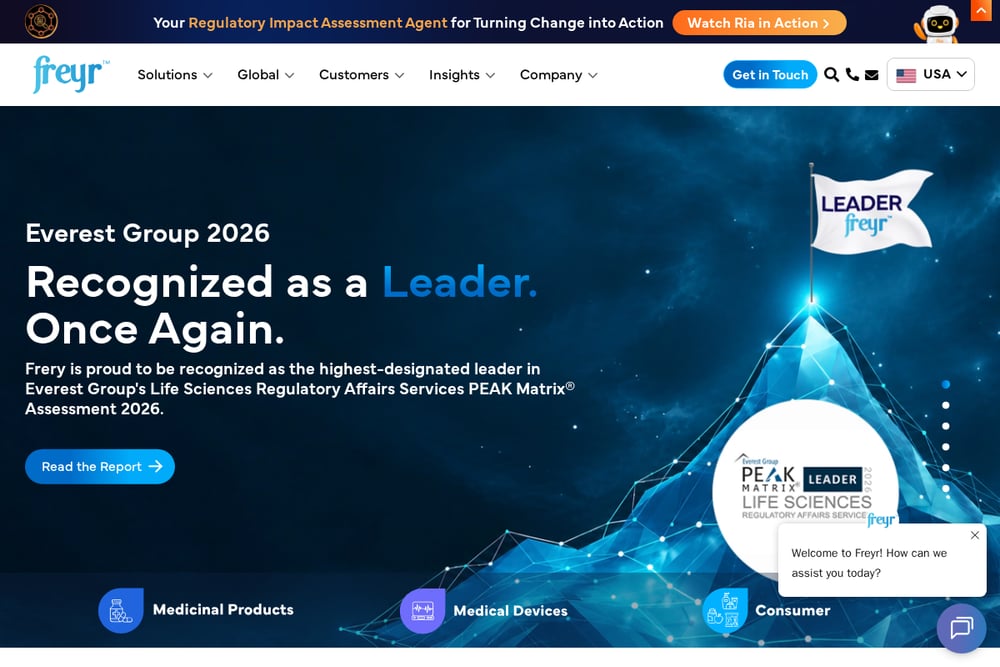 A screenshot of the Freyr Solutions website.
Freyr Solutions comes at translation from the regulatory consulting side. The company's medical device translation services sit inside a broader regulatory affairs offering, which means translation can be scoped alongside submission preparation and lifecycle management. That is valuable when your bottleneck is not the translation itself but the regulatory strategy around it. The tradeoff is that translation is one module in a larger engagement, so pure translation buyers may find the entry point heavier than they need. If you are preparing a submission and want language work handled by people who already know your regulatory file, this model fits. Book a meeting through the medical device translation services page to scope it.
How to Pick the Right Translation Partner
Start with the document, not the vendor. If your content is an IFU or technical file headed for Europe, you need a provider fluent in EU MDR and ISO 13485 language. If your content is an IEP or a 504 Plan going to a Spanish-speaking family in a US school district, you need IDEA and FERPA fluency. Those are different skill sets, and few providers cover both well. Next, test the quoting process. A provider that lets you upload a sample and see pricing tells you a lot about how they will handle a real project. Then ask about terminology management. If they cannot explain how terms stay consistent across labeling, software, and training, walk away. Finally, check the language pair specifics. Spanish is not one thing, and a provider that treats European and Latin American Spanish as interchangeable is telling you something.
Where Automation Fits in a Regulatory Translation Workflow
Automation will not replace your regulatory translator, but it can remove the busywork around them. A practical workflow looks like this. First, centralize your source content in a controlled repository so version drift does not create translation errors. Second, build and maintain a terminology base tied to your device master record, so every linguist works from the same approved terms. Third, use translation memory to avoid re-translating unchanged segments across labeling revisions. Fourth, route machine translation only for low-risk, high-volume content like internal training drafts, with human review mandatory before anything reaches a regulated surface. Fifth, automate the review handoff so regulatory, quality, and language reviewers see the same version at the same time. The goal is fewer manual touchpoints and a cleaner audit trail, not fewer humans in the loop.
The Bottom Line
There is no single right answer here, and that is the point. GTS Translation gives you speed and quoting transparency. Eliana Caruso Translation Studio gives you a rare blend of US public-sector compliance and medical regulatory depth in Spanish. Lionbridge gives you global scale and AI-augmented workflows. Stepes gives you connected-device content consistency. Freyr Solutions gives you translation wrapped inside regulatory consulting. Match the provider to the risk profile of your documents, test them with a real sample, and hold them to the same quality standard you hold your own quality management system.