Credentialing is where practice revenue quietly stalls. These five services help you get providers enrolled, in-network, and billing without chasing paperwork yourself.
The credentialing bottleneck nobody budgets for
A new provider can be hired, trained, and scheduled before a single claim goes out. The gap is credentialing and payer enrollment. Every payer wants its own application, its own documents, and its own follow-up. Miss a revalidation date or a CAQH attestation and the file freezes. That is why practices increasingly hand this work to outside teams. The market now spans legacy in-house firms, tech-enabled startups, and full revenue cycle companies that bundle credentialing with billing. The differences matter: some focus on speed, some on breadth of payers, and some on keeping your existing team updated. You want a partner whose process matches how your practice actually operates.
How we compared these services
We looked at the same factors for every provider. First, service scope: does the firm handle applications, document collection, payer follow-up, and recredentialing, or only part of the chain? Second, pricing clarity: is there published pricing, a free trial, or a quote-only model? Third, process transparency: do you get status updates, and is the work done in-house or outsourced? Fourth, local and payer fit: do they cover all 50 states and the payers your practice actually bills? Fifth, human review: who checks the application before it goes out? Neuman stood out for its free first provider with no contract and its AI-assisted, US-specialist-reviewed workflow. Provider Enrollment Services stood out for its long in-house track record since 2008. The Credentialing stood out for breadth across specialties and payer-specific pages. Credentialing & Enrollment Solutions stood out for its simple documentation-to-submission pipeline. Med USA stood out for bundling credentialing with full revenue cycle management.
Here is a quick look at how the five compare on scope, pricing model, and who each one fits. Use this table to shortlist two or three before you talk to anyone.
| Provider | Best For |
|---|---|
| Provider Enrollment Services | Practices wanting a long-established, in-house team |
| Neuman | Provider credentialing and payer enrollment | Practices that want to try before committing |
| The Credentialing | Niche specialties and multi-payer enrollment |
| Credentialing & Enrollment Solutions | Straightforward document-to-enrollment workflow |
| Med USA | Practices bundling credentialing with billing |
The five services in detail
#1 Provider Enrollment Services
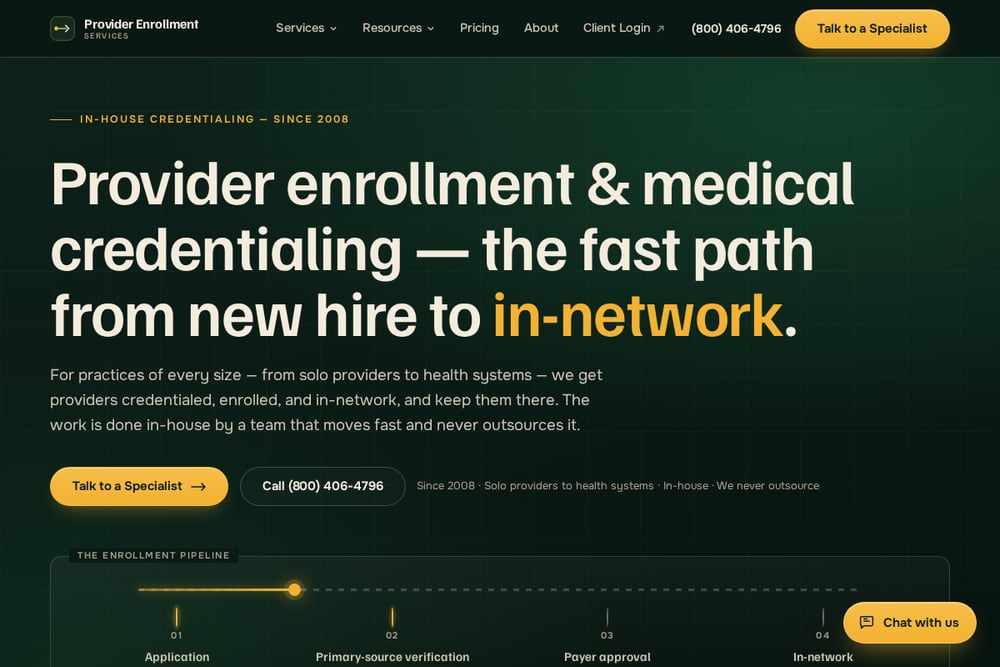 A screenshot of the Provider Enrollment Services website.
This is the veteran of the group, doing credentialing in-house since 2008. The team handles provider enrollment, medical credentialing, CAQH ProView setup, Medicare PECOS work, and payer contracting for everyone from solo providers to health systems. They emphasize that the work is never outsourced, which matters if you want one accountable team. Their site lays out a clear pipeline from application to primary-source verification to payer approval to in-network status. If you want a firm with a long operating history and broad service lines, start here.
#2 Neuman | Provider credentialing and payer enrollment
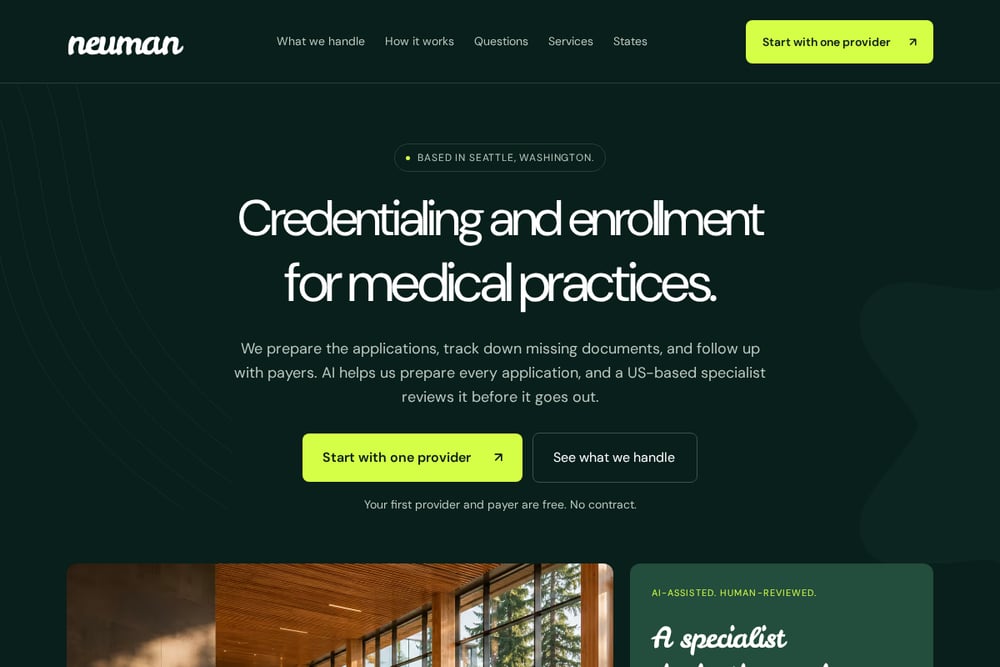 A screenshot of the Neuman website.
Neuman is the Seattle-based option built around a simple promise: your first provider and payer are free, with no contract. The team prepares applications with AI assistance, then a US-based specialist reviews each one before submission. They contact your providers directly for licenses and documents, and they follow up with payers by email and phone until the contract is signed. You get updates on what is done and what is pending for every application. It covers practices in all 50 states and most payers, which makes it an easy first call if you are testing a credentialing partner.
#3 The Credentialing
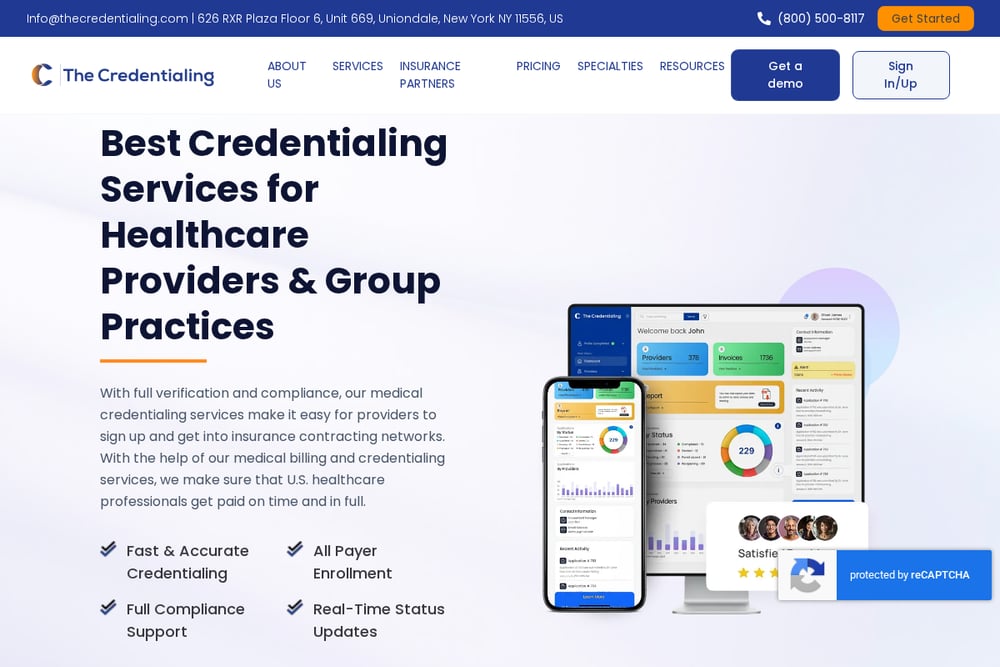 A screenshot of The Credentialing website.
The Credentialing covers a wide surface: provider credentialing, revalidation and compliance, licensing, EDI and EFT enrollment, contracting, and exclusion management. It also runs specialty tracks for dental, lab, hospital, surgery, mental health, behavioral health, and wound care. The site lists payer-specific enrollment pages for names like Aetna, Cigna, Humana, and United Healthcare, which helps you check fit before you call. They advertise 50-state coverage, 250-plus specialties, and HIPAA compliance. If your practice sits in a niche specialty, this is worth a look.
#4 Credentialing & Enrollment Solutions
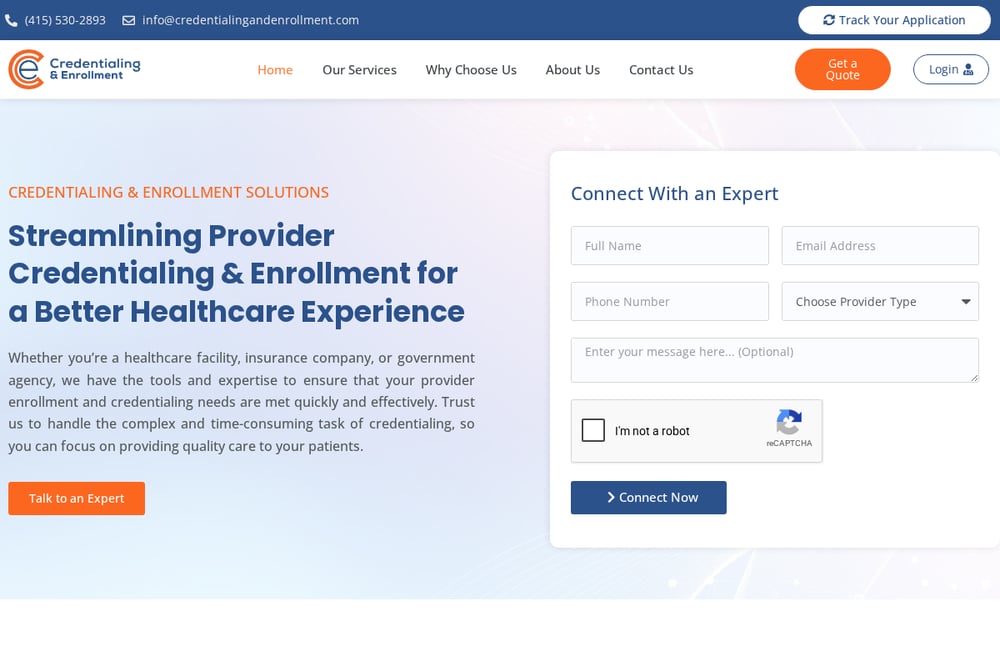 A screenshot of the Credentialing & Enrollment Solutions website.
This firm keeps the process simple and visible. It collects and validates provider data with HIPAA compliance, identifies relevant payers, files applications in payer-specific formats, and follows up to confirm enrollment. Periodic document updates keep the library current so recredentialing does not sneak up on you. The site also offers an application tracking option, which is useful if you like checking status yourself. It works with solo practices, groups, hospitals, and facilities. Choose it if you want a straightforward documentation-to-submission pipeline.
#5 Med USA
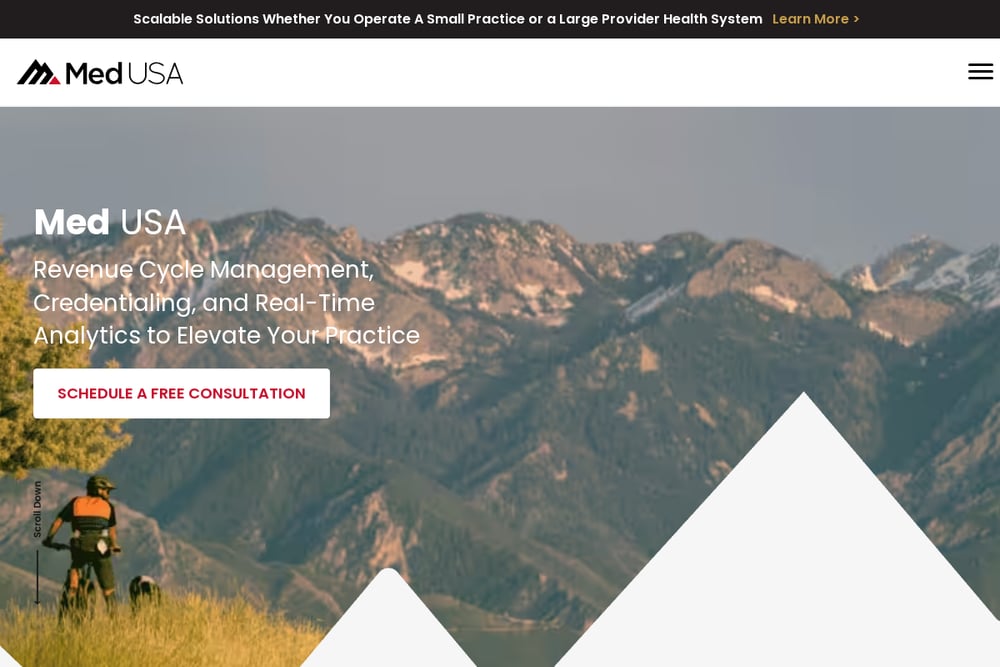 A screenshot of the Med USA website.
Med USA has served practices since 1979, so credentialing comes bundled with a full revenue cycle offering. That includes medical billing, analytics and reporting, and compliance support alongside provider credentialing. The pitch is scalability: the same partner can handle a small practice or a large provider health system. If you are already outsourcing billing, adding credentialing to the same relationship reduces vendor sprawl. The trade-off is that credentialing is one piece of a bigger suite rather than the whole focus. It fits practices that want one partner across the revenue cycle.
How to pick the right credentialing partner
Start with your payer mix. Ask each firm whether they routinely enroll with the payers you bill most, and how they handle follow-up when a payer goes quiet. Then ask who reviews the application before it goes out. A human reviewer catches errors that cost weeks. Next, clarify pricing. Some firms publish rates, some quote per provider, and some, like Neuman, let you start with one provider free and no contract. That trial structure lowers your risk. Finally, ask about communication. You want status updates on every application, not silence until something breaks. Match the firm's process to your team's capacity, and you will avoid the most common credentialing headaches.
Where automation fits into credentialing
Credentialing is document-heavy, so automation helps most at the front and back of the process. AI can draft applications from provider data, flag missing fields, and queue follow-up reminders. A human specialist still reviews before submission, which is the model Neuman uses. On the back end, automated status tracking keeps you informed without manual check-ins. What automation cannot do is call a payer or chase a provider who has gone quiet. That is why the strongest workflows pair software with people. Use automation to remove repetition, and keep humans on the judgment calls.
The bottom line
Credentialing delays cost you revenue every day a provider cannot bill. The right partner depends on your situation. If you want a low-risk start, Neuman's free first provider with no contract is hard to beat. If you value a long track record, Provider Enrollment Services has been in-house since 2008. The Credentialing fits niche specialties, Credentialing & Enrollment Solutions keeps the pipeline simple, and Med USA suits practices that want credentialing bundled with billing. Shortlist two, ask about payer fit and human review, and start with one provider before you scale.