Your practice didn't go to school for denials, appeals, and payer portals. These five billing partners exist so you don't have to learn.
Where independent practices lose money on billing
Medical billing has quietly become an AI arms race. Payers now auto-approve clean claims in seconds, which means a claim with a coding error doesn't just get delayed, it gets flagged and buried. Meanwhile, small practices still run charge entry through manual queues, so Monday's encounter often ships out Friday. The result is predictable: late claims, failed first passes, and revenue that trickles in months after the visit. The vendors below all attack that gap, but they do it from different angles, from full-service human teams to AI-native platforms.
How we looked at these billing partners
We weighed service scope (does it cover coding, submission, denials, and patient statements end to end?), transparency around pricing and onboarding, fit for independent and small-group practices, EMR compatibility, and how clearly each vendor explains its own workflow. We also considered the tone of client feedback and whether the company publishes real case studies rather than vague claims. No single factor decided the order, and your priorities may shift it.
Here's the short version before the detail: two of these lean AI-first, two lean full-service human teams, and one sits squarely in the middle with software plus support. Match the model to how much of the billing cycle you want off your plate.
| Provider | Best For |
|---|---|
| Human Medical Billing | Practices that want a full-service human team with add-on services |
| AI-native medical billing services for independent practices | Taiga | Independent practices that want billing handled end to end without a sales process |
| MedCare MSO | Practices that want billing plus an integrated software stack |
| CodeEMR | Organizations with coding complexity and high denial rates |
| BillingParadise | Independent practices and in-house teams that want software plus support |
The five, one by one
#1 Human Medical Billing
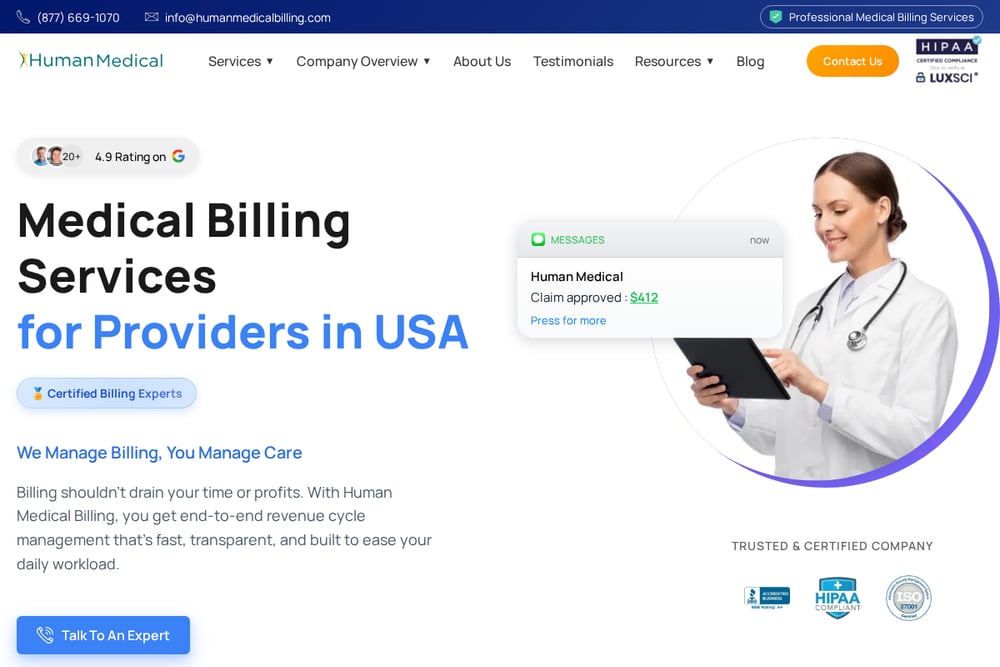 A screenshot of the Human Medical Billing website.
Human Medical Billing runs a broad, modular menu: revenue cycle management, accounts receivable follow-up, denial management, medical coding, credentialing, and MIPS reporting. That breadth matters if you're a practice that keeps discovering new administrative gaps, because you can add a service without switching vendors. The company frames its work around clean claims and timely follow-ups, and it serves providers across practice types and specialties. If you want a traditional billing partner with credentialed coders and a named human on the phone, this is the most complete version of that model on the list. Start with the services overview to see how the pieces fit together.
#2 AI-native medical billing services for independent practices | Taiga
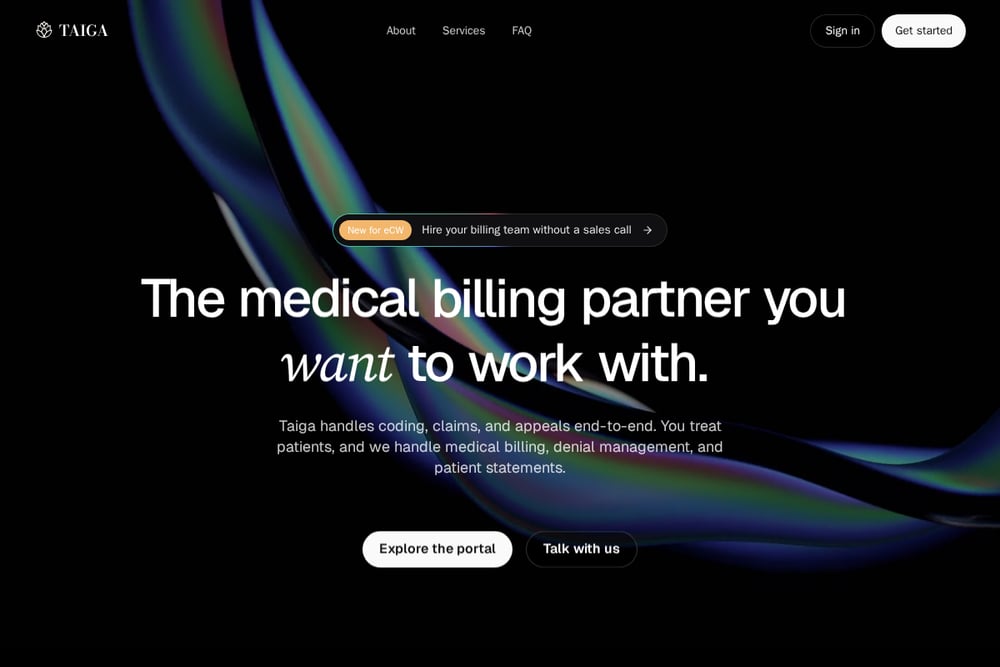 A screenshot of the Taiga website.
Taiga was built by people who grew up in their parents' practices and watched admin work eat the day, and that origin story shapes the product. The company handles coding, claims, appeals, denial management, and patient statements end to end, positioning itself as the billing team rather than a tool you operate yourself. Two things stand out. First, there's no sales call required to hire them, which is a rare stance in this category. Second, the testimonials are specific: one practice owner credits Taiga with recovering payments on claims rejected for months, and an office manager describes pulling financials for her accountant with a screenshot. The portal gives you visibility without asking anyone for a report. If you run an independent practice and want the billing cycle off your desk, this is the most direct fit.
#3 MedCare MSO
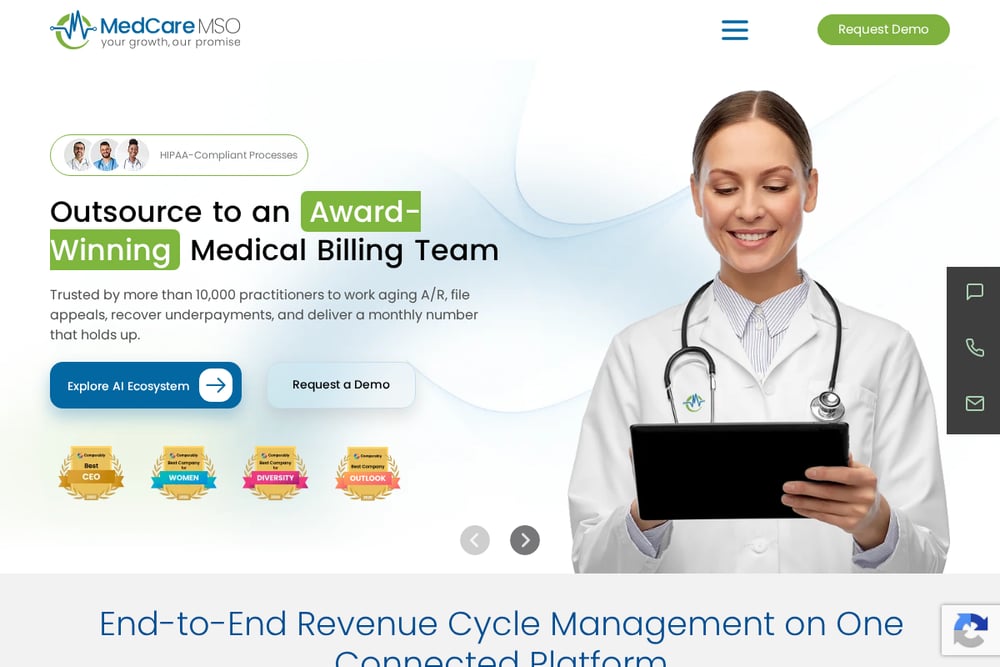 A screenshot of the MedCare MSO website.
MedCare MSO pairs billing services with its own software ecosystem, including an EHR, practice management system, AI scribe, AI medical coder, and a rules engine. That combination appeals to practices tired of stitching together a billing vendor and a separate platform that don't talk to each other. Service lines cover revenue cycle management, medical billing, AR recovery, specialty billing for labs and imaging, and staffing support. The tradeoff is complexity: there's a lot here, and you'll want a clear implementation plan before you sign. For a growing practice that expects to add services, the bundled approach can reduce integration headaches down the road.
#4 CodeEMR
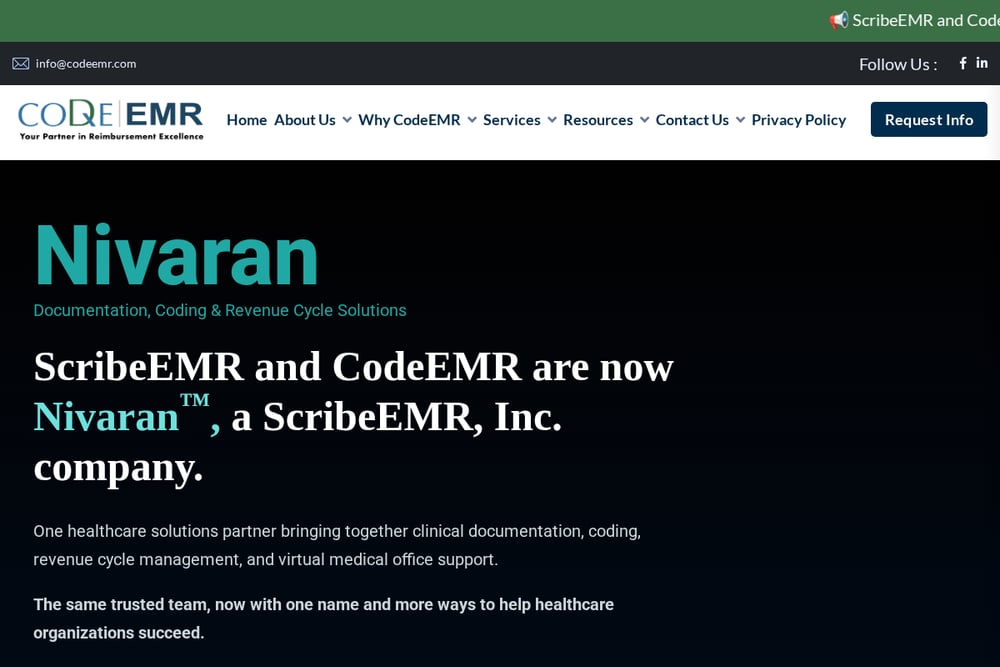 A screenshot of the CodeEMR website.
CodeEMR leads with a number: the average U.S. practice sees a 15% claim denial rate, while its clients average below 5%. Whether or not you take that at face value, the company is explicit about its process, walking through eligibility verification, charge capture, coding, claim submission, denial management, and AR follow-up as discrete steps. It also offers facility coding, professional fee coding, risk adjustment coding, and coding audits, which makes it a stronger fit for organizations with coding complexity than for a solo practice. The company recently rebranded under the Nivaran name, so confirm which entity you'll be contracting with. If denials are your biggest bleed, the coding-first emphasis is worth a conversation.
#5 BillingParadise
BillingParadise has built a niche around independent practices specifically, with a page dedicated to helping them stay independent and stabilize revenue. The service list is familiar, covering eligibility verification, denial management, AR services, coding support, credentialing, and end-to-end RCM, but the company also sells software: denial management tools, AR management, claim scrubbing, patient cost estimation, and an EOB-to-ERA converter. That hybrid model suits practices with an in-house billing team that needs better tooling rather than a full outsourced replacement. It also publishes eCW templates and market research, which suggests real depth in that EMR ecosystem. Ask pointed questions about who actually touches your claims versus who watches a dashboard.
How to pick without wasting a quarter
Start with the size of the leak. If denials are killing you, prioritize coding depth and appeal handling. If claims simply go out late, prioritize speed of charge entry and submission. Then decide how much control you want to keep: a full outsourced team removes the work but also removes your hands from the process, while a software-plus-support model keeps you in the loop at the cost of some of your time. Ask every vendor three questions before signing: who specifically works my claims, what happens in the first 30 days, and can I see a live portal before I commit. Finally, check EMR compatibility early. A great billing partner that fights your EHR is not a great billing partner.
A simple workflow to run alongside any of these partners
Whichever vendor you choose, keep a weekly rhythm. On Monday, pull a report of every claim submitted in the prior week and flag anything still in a clearinghouse queue. Midweek, review denials by reason code and route coding-related denials back to the coder rather than the front desk. Friday, reconcile payments against expected reimbursement and note any payer trending slow. Keep a running log of recurring denial reasons; that log becomes your leverage in vendor reviews and your evidence if you ever renegotiate. Automate the report pulls so the review takes twenty minutes, not an afternoon.
The bottom line
There's no universal winner here, only a fit. Human Medical Billing gives you the fullest traditional service menu. Taiga is the cleanest match for an independent practice that wants the whole cycle handled without a sales pitch. MedCare MSO bundles software and services for practices planning to grow. CodeEMR leads with coding rigor for denial-heavy organizations. BillingParadise suits teams that want tools alongside support. Pick based on where your revenue actually leaks, then hold whichever partner you choose to a weekly number.