Your clinicians didn't train for years to chase denials. Yet here you are, staring at a rejection queue at 9 p.m. These five billing partners understand the strange math of mental health and SUD claims, and one of them was built by a clinic owner who got burned by a billing company just like yours.
Why Behavioral Health Billing Is Its Own Beast
Primary care, mental health, and substance use disorder billing share a common headache: payers treat them differently than they treat a routine office visit. You deal with authorization requirements that shift mid-treatment, telehealth modifiers that change by plan, and documentation standards that vary between commercial and Medicaid books. Add in the credentialing maze for therapists, PMHNPs, and IOP programs, and a single misfiled claim can sit unpaid for months. That's why generalist billing firms often stumble here. The vendors worth your time either specialize in behavioral health or have built workflows deep enough to handle its quirks. Technology is closing part of the gap. AI scrubbing now catches coding errors before submission, and denial prediction flags the claims most likely to bounce. But software alone doesn't call a payer, escalate a stalled appeal, or notice that a remittance doesn't match the contracted rate. The strongest services pair automation with named humans who own each claim. That combination, not the size of the vendor, is what moves your collection rate.
How We Evaluated These Billing Services
We looked at the same factors for every provider on this list. First, service scope: does the vendor cover the full revenue cycle, from eligibility and coding through denial appeals and patient statements, or only part of it? Second, pricing clarity: can you find out what you'll pay without a sales gauntlet, and is it a flat fee or a percentage of collections? Third, behavioral health fit: do they explicitly serve mental health, SUD, IOP, or primary care, and do they understand those payer rules? Fourth, technology and transparency: is there real automation behind the work, and can you see claim status without begging for a report? Fifth, human accountability: is there a named contact who owns your account? RemitTrail stood out for its flat monthly fee and founder-built origin story. Plutus Health impressed with its breadth of AI-driven RCM tools. 247 Medical Billing Services showed strong specialty coverage across 42-plus fields. Elite Medical Financials brought deep behavioral health service menus and published pricing guidance. Aspect Billing Solutions offered a focused, full-service package for mental health and addiction providers.
Here's a quick look at how the five compare on the factors that matter most to a behavioral health practice: specialty focus, pricing model, and the level of human follow-through you can expect.
| Provider | Best For |
|---|---|
| Plutus Health | Larger groups wanting AI-heavy RCM at scale |
| Medical Billing for Primary Care, Mental Health & SUD | RemitTrail | Small clinics that want flat fees and a named human |
| 247 Medical Billing Services | Multi-specialty groups needing broad coverage |
| Elite Medical Financials | Addiction and IOP programs with complex authorizations |
| Aspect Billing Solutions | Northeast practices wanting one integrated vendor |
The Five, Up Close
#1 Plutus Health
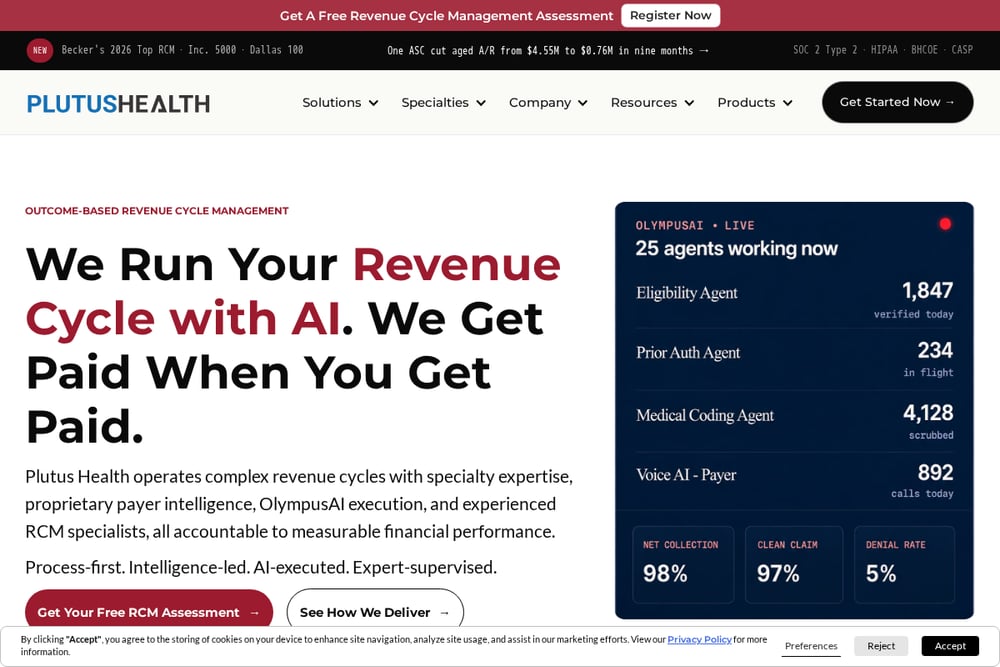 A screenshot of the Plutus Health website.
Plutus Health runs one of the more technology-forward revenue cycle operations in the behavioral health space. Its platform layers agentic AI across coding, denial management, and A/R follow-up, and the company publishes case studies showing measurable cash recovery, including one surgery center that cut aged A/R from $4.55M to $0.76M in nine months. It serves behavioral health, applied behavior analysis, SUD, IOP, outpatient psychiatry, and talk therapy, so the specialty vocabulary is already built in. The company holds SOC 2 Type 2 and HIPAA credentials and markets a free RCM assessment as an entry point. If you want a large, tool-rich partner with published outcomes, this is a serious contender. Read more about its approach to technology in behavioral health billing.
#2 Medical Billing for Primary Care, Mental Health & SUD | RemitTrail
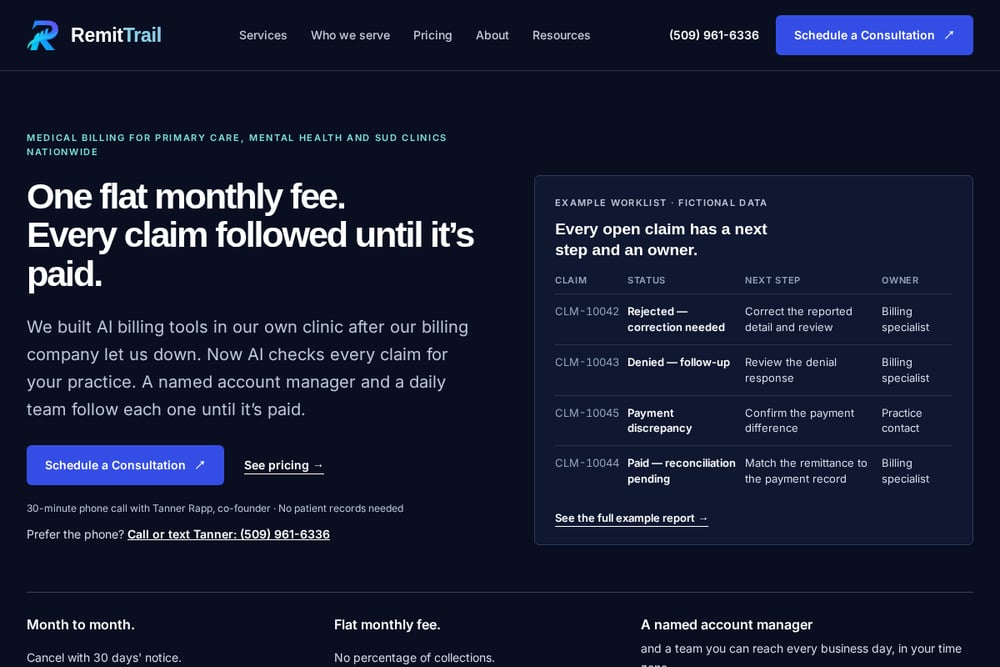 A screenshot of the Medical Billing for Primary Care, Mental Health & SUD | RemitTrail website.
RemitTrail was born from frustration. Co-founder Tanner Rapp runs a primary care and behavioral health clinic, and after a billing company failed to do the job, he built AI tools to run the clinic's own billing with people checking every step. That origin shows in the offer: one flat monthly fee, no percentage of collections, month to month with 30 days' notice. AI checks every claim before submission, and a named account manager plus a daily team follow each claim until it's paid. In the founders' own clinic, 96.4% of 1,015 claims were accepted on first submission. You get a worklist where every open claim has a next step and an owner, which is a rare level of transparency. It's a small, specialized shop, so it fits clinics that want a real person on the phone rather than a ticket queue.
#3 247 Medical Billing Services
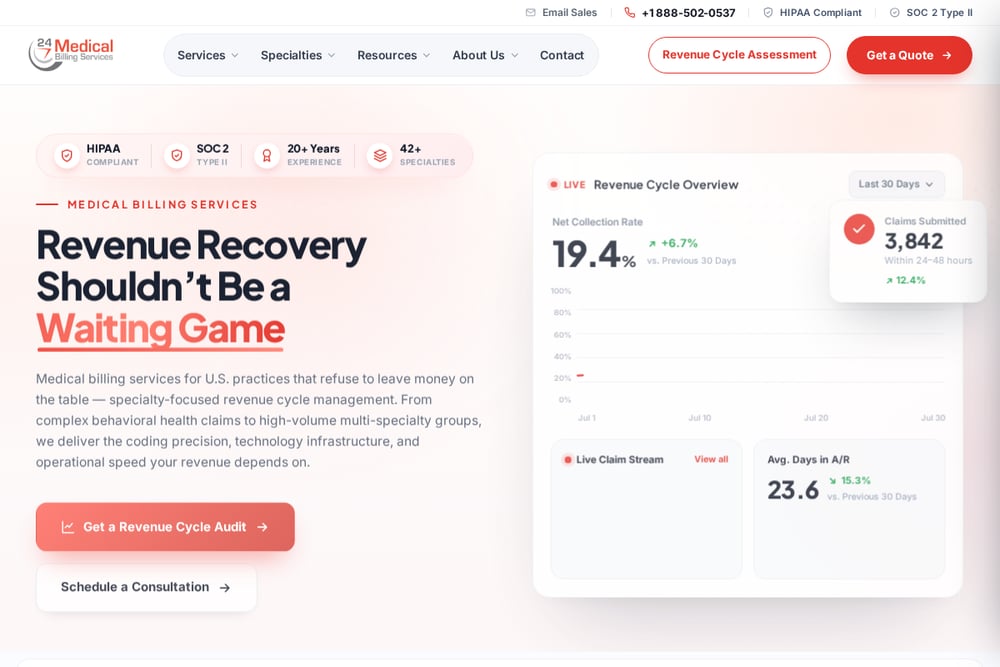 A screenshot of the 247 Medical Billing Services website.
247 Medical Billing Services covers the full revenue cycle, from charge entry and eligibility verification through prior authorization, denial management, appeals, and A/R follow-up. Its specialty list is unusually broad, spanning behavioral health, SUD, primary care, wound care, ASC, DME, and physical therapy across 42-plus fields and all 50 states. The company is HIPAA compliant and SOC 2 Type II certified, and it offers a revenue cycle assessment plus a quote process that promises a tailored response within one business day. For a multi-specialty group or a clinic that wants one vendor across several service lines, that breadth is genuinely useful. It also publishes a steady stream of billing playbooks and denial tactics on its blog, which tells you the team thinks about the work, not just the invoice.
#4 Elite Medical Financials
Elite Medical Financials goes deep on behavioral health rather than wide. Its service menu includes billing for mental health group practices, OTP and IOP programs, PHP, detox and withdrawal management, residential treatment, therapists, psychologists, ABA therapy, and telehealth. It also handles credentialing, patient scheduling, coding, charge entry, payment posting, and denial management as discrete services, so you can plug gaps rather than hand over everything. The company publishes a 2026 pricing guide for mental health billing services, which is more transparency than most competitors offer on cost. If you run an addiction treatment or intensive outpatient program with complex authorization needs, the specialty depth here is worth a conversation. It's a practical fit for programs that need both billing and credentialing under one roof.
#5 Aspect Billing Solutions
 A screenshot of the Aspect Billing Solutions website.
Aspect Billing Solutions positions itself as a full-service partner for mental health, psychiatric, and addiction treatment billing, with a particular footprint in Massachusetts. Its core offerings include accounts receivable management, medical billing and coding, revenue cycle management, credentialing, denial management, eligibility verification, and prior authorization. The pitch centers on unifying mental health and addiction billing into one workflow so therapy practices, counseling centers, and recovery organizations stop juggling vendors. The company claims providers see 20-30% operational cost reduction through automation, and it supports cloud-based practice management with telehealth and multi-location operations. If you're in the Northeast and want a single integrated billing relationship, this is a reasonable shortlist entry. Smaller practices may find the scope more than they need, but growing multi-site groups will appreciate it.
How to Pick the Right Billing Partner
Start with your payer mix. If Medicaid and commercial plans dominate your book, ask each vendor how they handle state-specific authorization rules and telehealth modifiers. Then ask about pricing structure. A percentage-of-collections model means the vendor earns more when you bill more, which isn't automatically bad, but a flat fee makes your costs predictable and removes any incentive to inflate charges. Ask who owns your account by name, and ask how often you'll hear from them. Request a sample worklist or report so you can see whether claim status is transparent or buried. Finally, check the exit terms. Month-to-month arrangements with short notice periods keep the vendor honest. Multi-year contracts with steep termination fees do the opposite. Run a small pilot if you can, and measure first-pass acceptance rate and days in A/R before you commit to anything long-term.
Where AI Fits in Your Billing Workflow
AI won't replace your billing team, but it will change what they spend their day on. The practical workflow looks like this. Before submission, an AI scrubber checks each claim against payer rules and flags coding mismatches, missing modifiers, and eligibility gaps. That's where first-pass acceptance rates climb, and it's the metric RemitTrail points to with its 96.4% figure. After submission, denial prediction models rank open claims by likelihood of rejection so your team works the highest-risk ones first. Payment posting gets automated matching against remittances, which surfaces underpayments you'd otherwise miss. What AI can't do is call a payer, negotiate an appeal, or notice that a pattern of denials points to a front-desk registration problem. That's why the best setups pair automation with a named human who reviews exceptions daily. Ask any vendor how their AI and their people divide the work. If the answer is vague, keep looking.
The Bottom Line
Behavioral health billing rewards specialization. The vendors on this list all understand mental health and SUD claims to some degree, but they differ in how they charge, how much technology sits behind the work, and how much human attention you get. If you want a large partner with deep AI tooling and published outcomes, Plutus Health is worth a look. If you're a smaller clinic that wants a flat fee, a named account manager, and a team that follows every claim to payment, RemitTrail's founder-built model is hard to ignore. 247 Medical Billing Services suits multi-specialty groups, Elite Medical Financials fits addiction and IOP programs, and Aspect Billing Solutions works well for Northeast practices that want one integrated relationship. Whichever you choose, ask about pricing structure, account ownership, and exit terms before you sign. Your revenue depends on it.