You have the recordings. Now you need numbers you can defend in a manuscript. These five services help you turn raw microelectrode array data into figures, tables, and methods sections that hold up to review.
Where MEA analysis stands now
Microelectrode array work has moved from a specialist niche into the standard toolkit for brain organoids and iPSC-derived neurons. Labs now generate more recordings than they can comfortably analyze in-house, and reviewers expect burst metrics, synchrony measures, and reproducible code behind every figure. That gap has created a market of analysis services, ranging from full contract research organizations to focused report shops. The differences between them matter more than the marketing suggests.
How these services were compared
Each service was assessed on scope (does it cover quality control, bursts, synchrony, and connectivity, or only part of the pipeline), output format (figures, tables, methods text, code), turnaround and pricing transparency, hardware compatibility across common MEA systems, and how well it fits an academic lab's budget and workflow. No single factor decides the order; the balance across all of them does.
Here is the short version before the detail: one service is built specifically around report-ready MEA analysis for organoids and iPSC neurons, while the others bring broader contract research, cell biology, or assay development strengths. Match the service to the stage you are at.
| Provider | Best For |
|---|---|
| VitroVo | Labs needing deep iPSC neuron assay experience |
| Wellspike · MEA analysis for brain organoids and iPSC-derived neurons | Academic labs wanting publication-ready MEA reports fast |
| Creative Biolabs | Projects combining MEA with neural disease models |
| ACROBiosystems | Labs wanting MEA alongside reagent supply |
| Ricoh Biosciences | Teams building iPSC-based neurotoxicity assays |
The five services in detail
#1 VitroVo
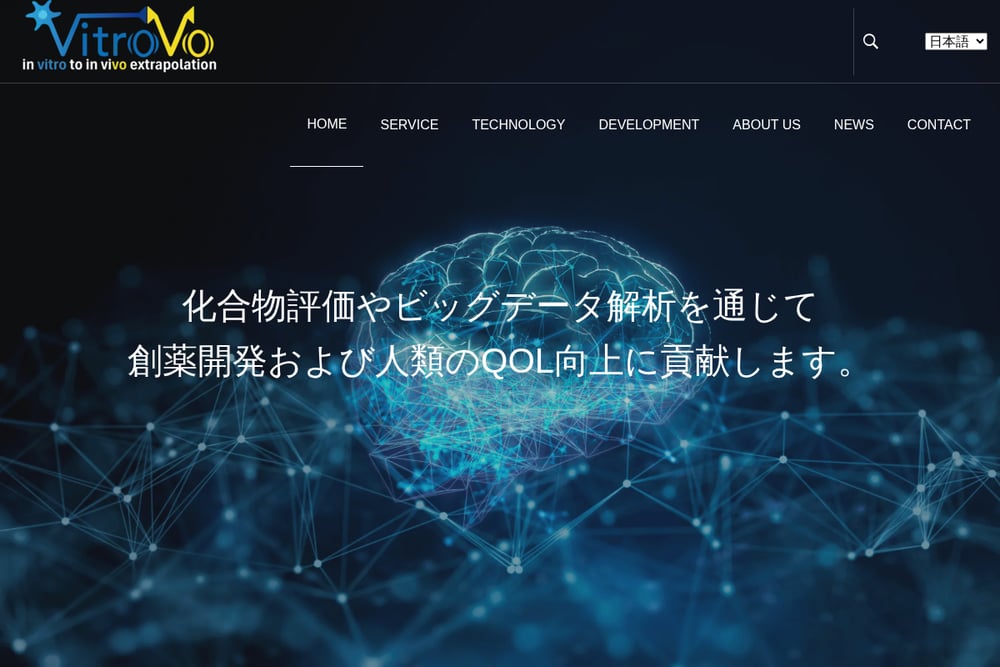 A screenshot of the VitroVo website.
VitroVo has been running MEA measurements on human iPSC-derived neurons since 2014 and reports work across more than 100 neuron types, central and peripheral. That depth shows in its safety evaluation and pharmacological efficacy testing, where it pairs MEA with toxicity and mechanism-of-action predictions. It also handles acute brain slice MEA, including LTP testing, and cardiomyocyte MEA. If your project needs a partner who has seen your cell type before, this is a strong place to start. The trade-off is that you are buying a full research collaboration, not a standalone analysis report.
#2 Wellspike · MEA analysis for brain organoids and iPSC-derived neurons
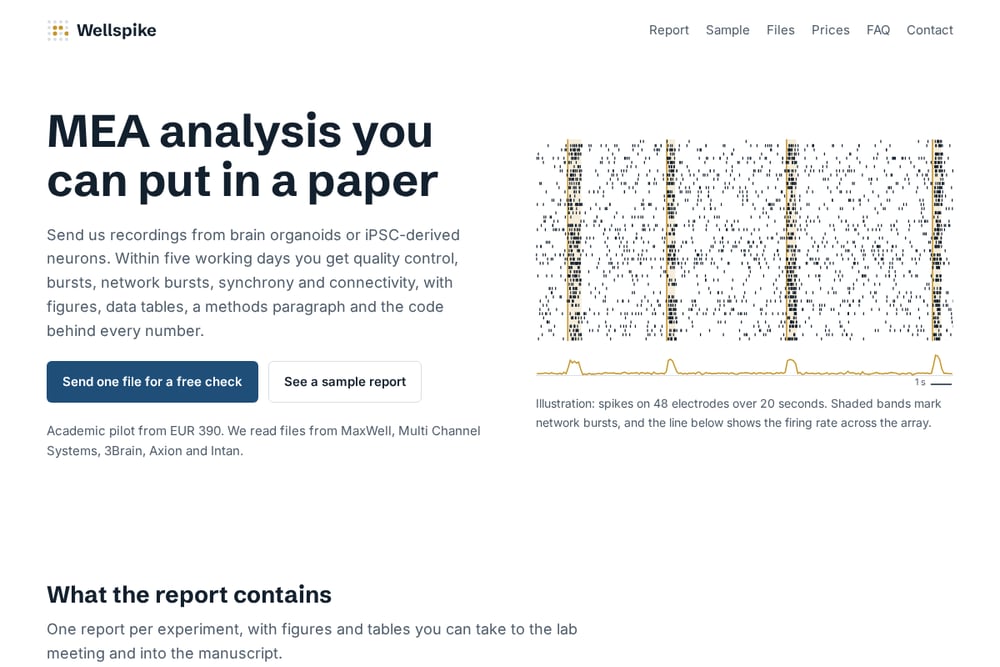 A screenshot of the Wellspike · MEA analysis for brain organoids and iPSC-derived neurons website.
Wellspike does one thing and does it precisely: it takes your recordings from brain organoids or iPSC-derived neurons and returns a report within five working days. You get quality control with noise per electrode and flagged high-noise channels, firing and interspike interval metrics, network burst detection with start-site maps, and STTC synchrony tested against jittered surrogates. Every report includes a methods paragraph written for a manuscript, CSV tables, PNG figures, and the exact command and software versions behind each number. It reads files from MaxWell, Multi Channel Systems, 3Brain, Axion, and Intan, and the academic pilot starts at EUR 390. You can send one file for a free check before committing.
#3 Creative Biolabs
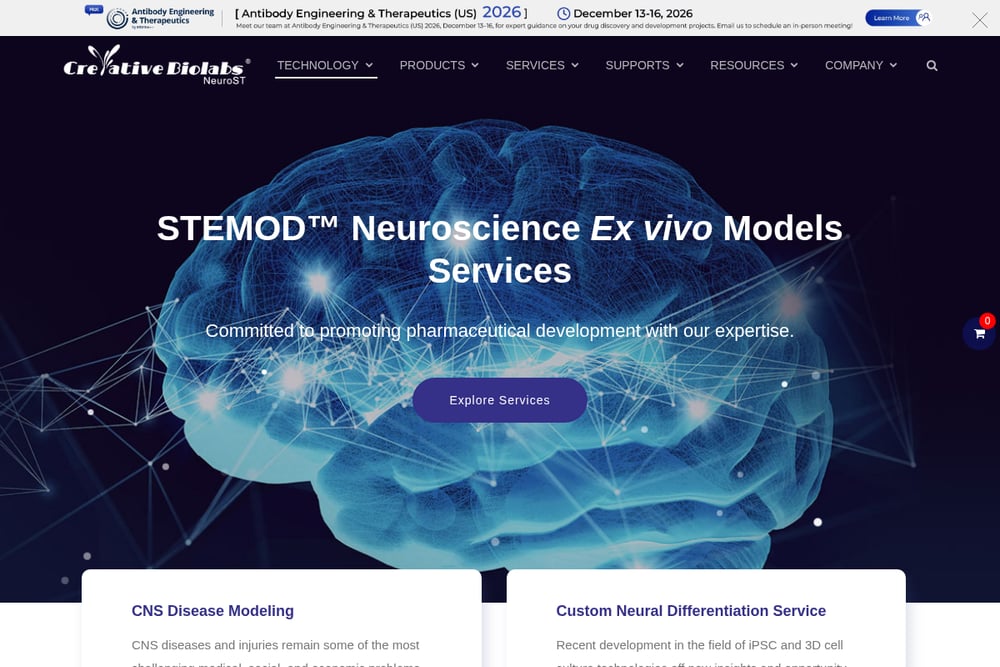 A screenshot of the Creative Biolabs website.
Creative Biolabs offers neuron-focused MEA measurement as part of a much larger menu of neural cell models and engineering services. Its catalog spans iPSC-derived, wild-type, and gene-edited neural lines tied to neurodegenerative and neuromuscular disease research. That makes it useful when your MEA question is bundled with a model-building or disease-modeling need. The MEA service itself sits inside a broad contract offering, so expect a scoping conversation rather than a fixed report package. For teams already sourcing cells or models from the same provider, the integration is convenient.
#4 ACROBiosystems
 A screenshot of the ACROBiosystems website.
ACROBiosystems lists MEA among its service offerings, backed by a large catalog of reagents, proteins, and assay tools. The appeal here is bundling: if you already buy consumables or assay components from the company, adding MEA work keeps procurement and technical support in one place. Its strength is breadth of supply rather than a narrow focus on organoid electrophysiology reporting. You will want to confirm the exact deliverables, turnaround, and analysis depth directly, since the MEA service is one line among many. It suits labs that value a single vendor relationship over a specialist report.
#5 Ricoh Biosciences
Ricoh Biosciences brings human iPSC-derived excitatory neurons, astrocytes, and a rapid differentiation method to MEA work, with pharmacological validation across 16 compounds. Its published MEA neurotoxicity assay uses multiwell arrays and cocultures, and the company ships live cultures internationally. That makes it a fit when you need cells and assay development together, particularly for drug-induced network activity changes. The emphasis is on assay platforms and cell products rather than bespoke analysis of recordings you already hold. Treat it as a partner for building the experiment, not just crunching the output.
How to pick the right fit
Start with what you already have. If the recordings exist and you need defensible analysis, a focused report service gets you to a manuscript faster than a broad contract lab. If you still need cells, models, or assay design, the larger organizations earn their place. Check hardware compatibility against your amplifier before anything else, then confirm deliverables: do you get raw tables, code, and a methods paragraph, or only summary figures? Ask about turnaround and whether a trial file is available. Finally, weigh pricing structure. A fixed pilot fee is easier to justify to a grant committee than an open-ended quote.
Where automation fits into your workflow
You can reduce friction by standardizing what you send. Export recordings in a consistent format, keep a simple metadata sheet with experiment, well, and condition labels, and archive the raw files with checksums. When a service returns code and commands, store them alongside the data so a reviewer or a future student can rerun the analysis. For recurring experiments, build a template report structure and reuse the same parameter values across runs. That discipline turns a one-off analysis into a reproducible pipeline you can defend.
The bottom line
The right choice depends on whether you are buying analysis or buying an experiment. Wellspike sits squarely in the first camp, with a narrow, fast, reproducible report built for organoid and iPSC neuron recordings and priced for academic pilots. VitroVo offers the deepest hands-on iPSC neuron assay experience, while Creative Biolabs, ACROBiosystems, and Ricoh Biosciences bring broader cell, reagent, and assay development capabilities. Match the service to your stage, confirm the deliverables in writing, and keep the code.