
You can memorize HSK lists for months and still freeze the moment someone actually speaks to you. These five apps are built around a different idea: learn the words, then say them out loud.
The Mandarin Speaking App Landscape
Mandarin learning has split into two camps. One camp is vocabulary-first: flashcards, spaced repetition, character drills. The other is conversation-first: AI tutors, scenario dialogues, pronunciation feedback. The strongest apps in 2026 try to bridge both, because recognition without production is a dead end. Learners who can read a word but not say it stall at the same plateau year after year. The apps below take different routes to the same goal, getting you from silent study to spoken Mandarin. Some lean on structured HSK curricula, others on open-ended AI chat, and one deliberately keeps the conversation inside your current level so you are never drowning.
How We Evaluated These Apps
We looked at four factors across every app. First, service scope: does it cover vocabulary, listening, speaking, and grammar, or only one slice? Second, pricing clarity: is there a free tier you can actually use, and is the paid boundary visible before you commit? Third, speaking practice quality: does the app give you a real conversational partner, and does it stay at your level? Fourth, local fit for US learners: self-paced access, English support, and no dependence on a classroom schedule. Each app below stood out on at least one factor. Talkhao stood out for tying every word to a conversation with its speaking partner Xiaolu. ChineseUp stood out for breadth, from flashcards to AI tutor. SayMei stood out for a free AI tutor entry point. TalkChinese stood out for scenario volume. SuperChinese stood out for structured curriculum depth.
Here is the quick comparison before the deep dive. All five are self-paced, all five use AI in some form, and all five assume you want to speak, not just read.
| Provider | Best For |
|---|---|
| ChineseUp | Learners who want one app for reading, writing, and speaking |
| Talkhao: Mandarin you can say | Learners who freeze when it is time to actually speak |
| SayMei | Budget-conscious learners testing AI conversation |
| TalkChinese | Learners who want hundreds of real-life dialogue scenarios |
| SuperChinese | Intermediate learners who understand more than they can say |
The Five Apps in Detail
#1 ChineseUp
 A screenshot of the ChineseUp website.
ChineseUp positions itself as a complete app to speak, read, write, and understand Chinese, and the scope backs that up. You get HSK vocabulary flashcards with spaced repetition, pinyin and character support, and an AI tutor for conversation practice. The learning path runs from HSK 1 to HSK 6, so you always know what to study next. It is available on Google Play with in-app purchases and a free download. If you want one app that covers all four skills rather than specializing, this is the broadest option in the group.
#2 Talkhao: Mandarin you can say
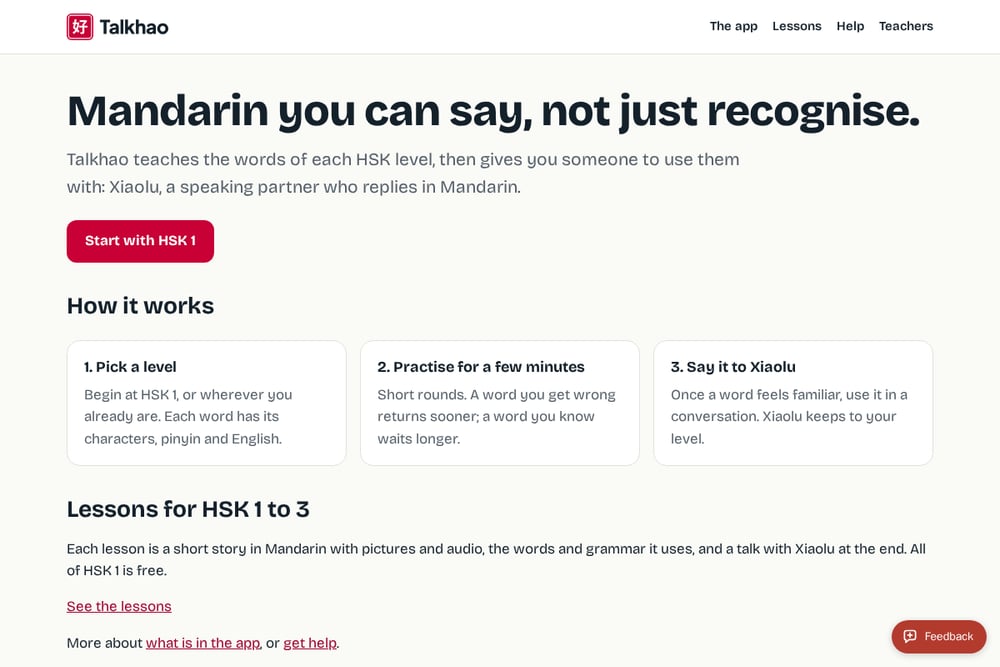 A screenshot of the Talkhao: Mandarin you can say website.
Talkhao is built on a simple loop: learn the HSK words, then say them to Xiaolu, a speaking partner who replies in Mandarin and keeps to your level. Each word comes with characters, pinyin, and English, and short practice rounds resurface the ones you get wrong sooner. Once a word feels familiar, you use it in conversation instead of just recognizing it. The app also offers story-based lessons for HSK 1 to 3 with pictures, audio, and a talk with Xiaolu at the end, and all of HSK 1 is free. It is the clearest answer in this group to the recognition-versus-production problem.
#3 SayMei
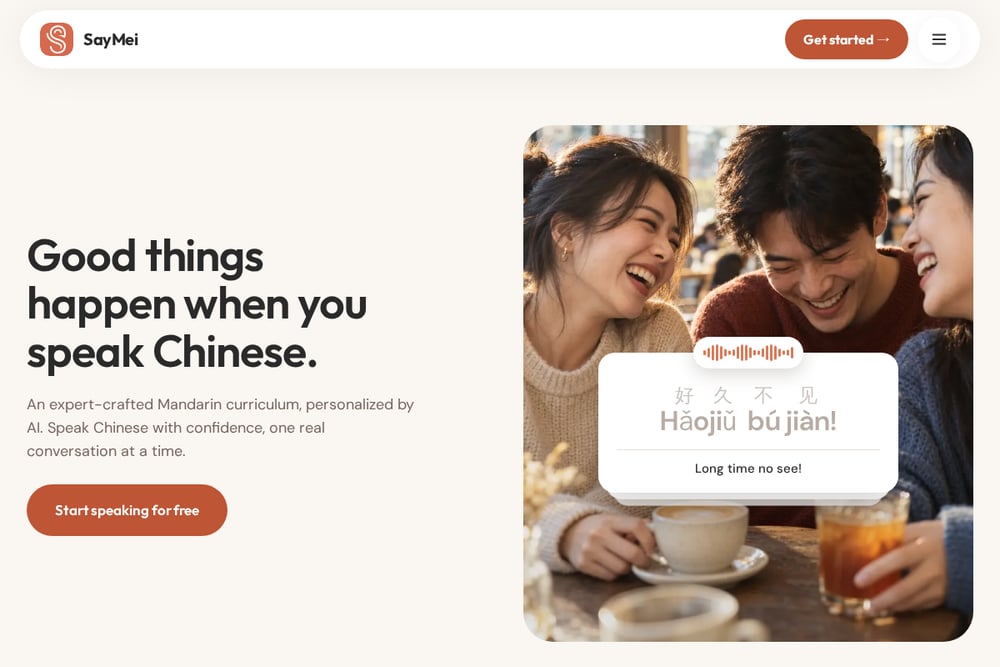 A screenshot of the SayMei website.
SayMei markets itself as a free way to learn Chinese with an AI tutor named Mei Lin. The site is minimal, so the pitch is straightforward: open the app, talk to the tutor, and practice without a paywall in the way. That free positioning matters if you are testing whether AI conversation works for you before committing to a subscription elsewhere. It is a lighter-weight option than the curriculum-heavy apps, which makes it a reasonable starting point for the curious. If you want a no-cost entry into AI speaking practice, start here.
#4 TalkChinese
 A screenshot of the TalkChinese website.
TalkChinese leans hard into scenario drills, with over 200 real-life situations from business negotiations to travel and social interactions. The AI corrects pronunciation, grammar, and word choice in real time, and it generates personalized training packs for the mistakes you repeat. There are over 500 core courses and a customized learning plan, all built around 15-minute daily sessions. It is iPhone-only, which is a real limitation if you are on Android. For learners who want breadth of situations rather than a strict HSK sequence, the scenario library is the draw.
#5 SuperChinese
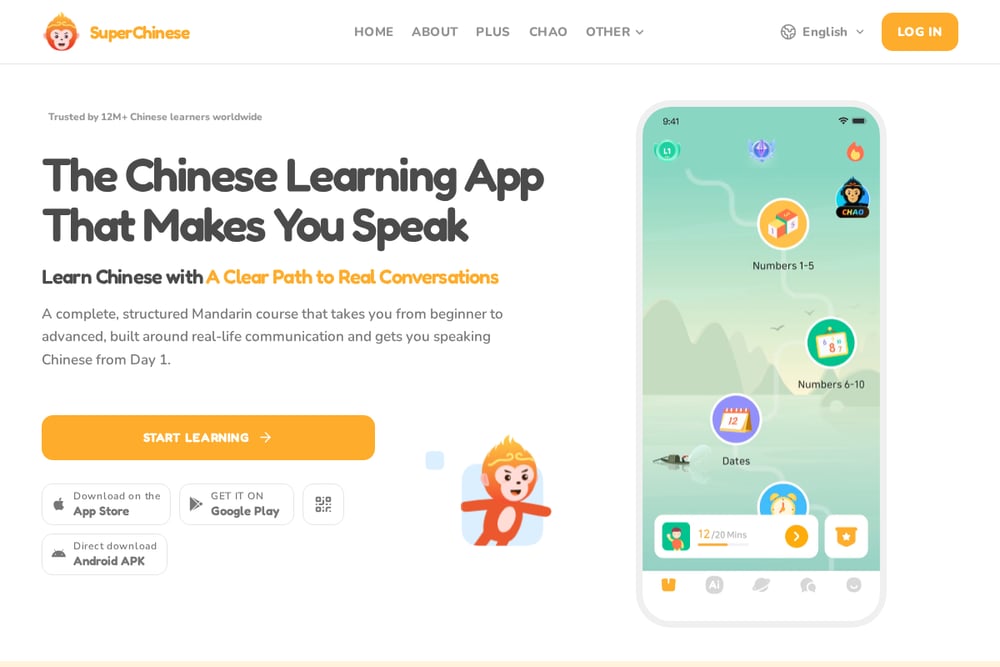 A screenshot of the SuperChinese website.
SuperChinese pairs a structured Mandarin course with CHAO, its AI conversation feature. Lessons connect vocabulary, grammar, listening, reading, and speech recognition, so speaking practice sits inside a curriculum rather than floating free. The company explicitly targets learners who understand basic Chinese but hesitate when speaking, and the speech recognition and correction loop is built for that gap. It is a strong fit if you already have some foundation and want to convert it into speech. The structure is the point here, not open-ended chat.
How to Choose Your Mandarin Speaking App
Start with your actual bottleneck. If you cannot produce words you already recognize, pick an app that forces production right after study, like Talkhao. If you are starting from zero and want one place for everything, ChineseUp covers the most ground. If budget is the constraint, SayMei removes the paywall question. If you want to rehearse specific situations, TalkChinese has the deepest scenario library. If you already read at an intermediate level and want structure, SuperChinese will fit. Check the free tier before you pay, and check platform support, since TalkChinese is iPhone-only. The right app is the one you will open tomorrow, not the one with the longest feature list.
Building a Daily Speaking Habit
The apps do the scheduling for you if you let them. Set a fixed 15-minute window, open the app, and let the practice round decide what you review. Talkhao's spaced repetition handles the queue: wrong words return sooner, known words wait. ChineseUp's learning path tells you what is next. TalkChinese's 15-minute daily plan and SuperChinese's structured lessons remove the decision of what to study. The only manual step is the one that matters: say the words out loud to the AI partner instead of tapping through silently. Automate the review, but never automate the speaking.
The Bottom Line
Every app here can teach you words. The difference is what happens after. Talkhao makes the conversation the destination, which is why it earns the second slot and the closest look for anyone stuck at recognition. ChineseUp gives you the widest toolkit, SayMei gives you a free door in, TalkChinese gives you situations, and SuperChinese gives you structure. Pick the one that matches your bottleneck, commit to a daily window, and speak out loud every single time. That is the whole game.