You need clean web data without hiring a scraping team. These five managed services do the heavy lifting so you can focus on decisions, not selectors.
The managed web data landscape
Managed web scraping has moved from a niche technical service to a core data function. Teams across retail, finance, real estate, and media now rely on outside providers to collect, clean, and deliver structured data on a schedule. The shift is driven by two forces: websites change constantly, and internal engineering time is expensive. A managed provider absorbs that maintenance burden and gives you a stable schema you can plug into dashboards, spreadsheets, or APIs. The market now splits into self-serve platforms with managed add-ons and fully managed services built around custom scopes. Your choice depends on how much control you want and how complex your sources are.
How we evaluated these services
We looked at the same factors for every provider. Service scope: can they handle one-off datasets, recurring feeds, and monitoring? Pricing clarity: do you know what you get before you commit? Local fit: are they set up to serve US-based teams with responsive communication? Delivery options: do they support files, APIs, and spreadsheet feeds? Source coverage: can they handle JavaScript-heavy pages and changing layouts? Each provider below stood out in different ways. Furnish Data leads with a free sample before payment and traceable records. Kvetoiq pairs managed extraction with outcome-focused solutions like price monitoring and digital shelf analytics. PromptCloud brings enterprise-grade pipelines and a broad delivery stack. Import.io offers a mature platform with a managed layer on top. Browse AI makes monitoring accessible with prebuilt robots and no-code tooling.
Here is a quick comparison of the five services based on the factors above. Use it to shortlist, then dig into the details.
| Provider | Best For |
|---|---|
| Kvetoiq | Outcome-focused pricing and visibility data |
| Furnish Data | Managed Web Scraping, Data Extraction & Monitoring | Free sample and traceable records |
| PromptCloud | Enterprise pipeline management |
| Import.io | Platform plus managed delivery |
| Browse AI | No-code monitoring and prebuilt robots |
The five services in detail
#1 Kvetoiq
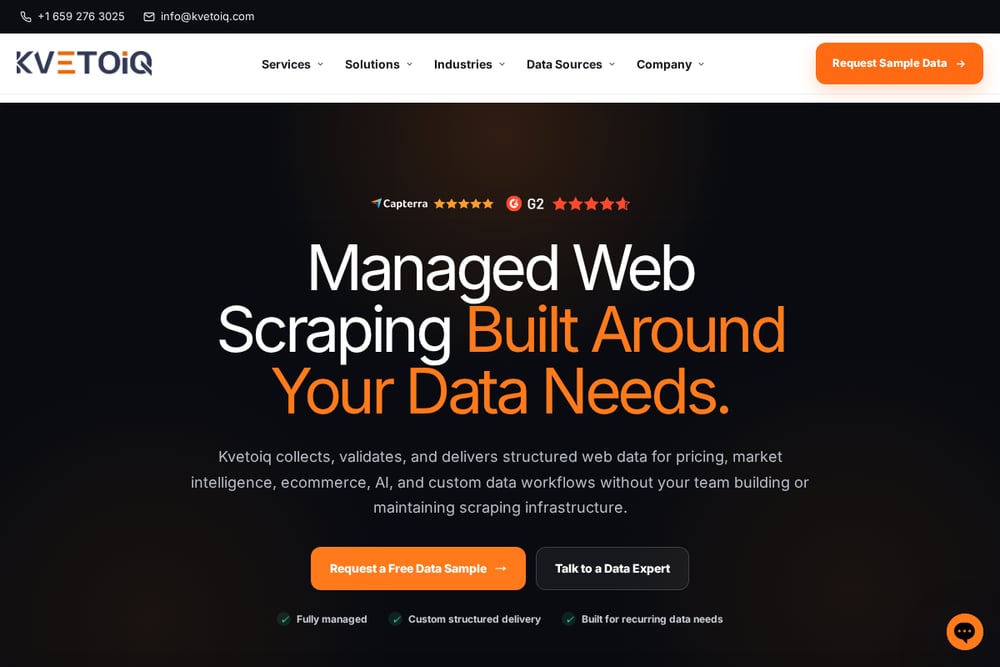 A screenshot of the Kvetoiq website.
Kvetoiq positions managed extraction as the front door to a broader data workflow. You share the website, fields, and delivery format, and they scope a representative sample before a larger engagement. That sample-first approach mirrors what you see across the market, but Kvetoiq ties it directly to solutions like price monitoring, MAP violation alerts, and digital shelf analytics. Their service menu covers managed extraction, enterprise crawling, ecommerce scraping, and custom datasets. If your team needs data tied to pricing or brand visibility decisions, this is a strong fit. The outcome framing helps you connect collection to action rather than just files.
#2 Furnish Data | Managed Web Scraping, Data Extraction & Monitoring
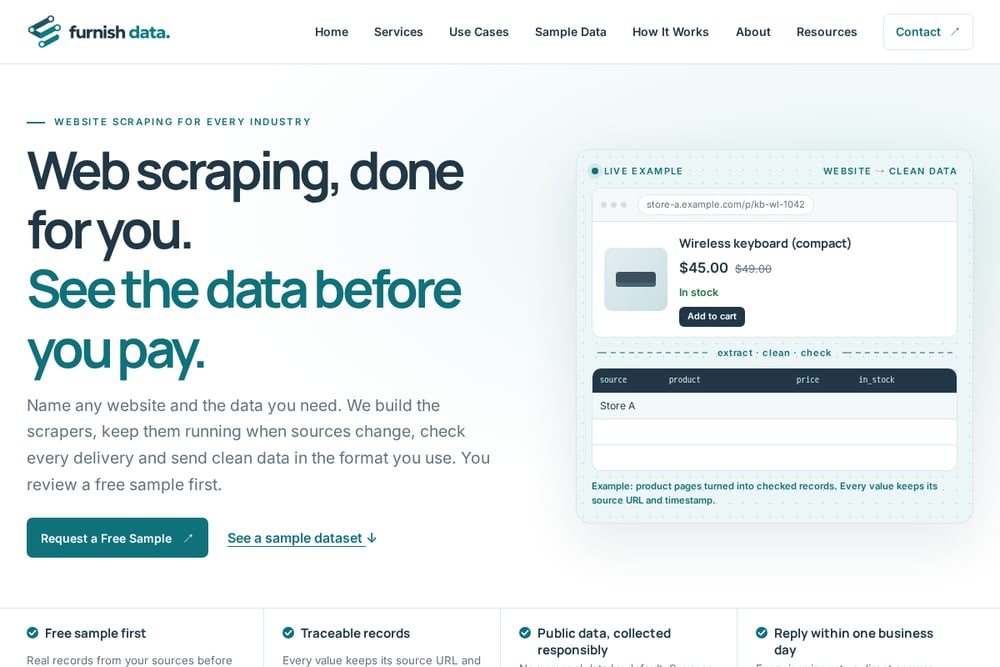 A screenshot of the Furnish Data website.
Furnish Data leads with a simple promise: see the data before you pay. You name any public website and the fields you need, and they build the scraper, keep it running when sources change, and check every delivery. Every value keeps its source URL and collection time, so you can trace records back to the page. Their services cover one-time extraction, monitoring and alerts, scheduled data feeds, and intelligence reports. They reply within one business day and collect no personal data by default. That combination of traceability and a free sample makes them easy to evaluate before committing budget.
#3 PromptCloud
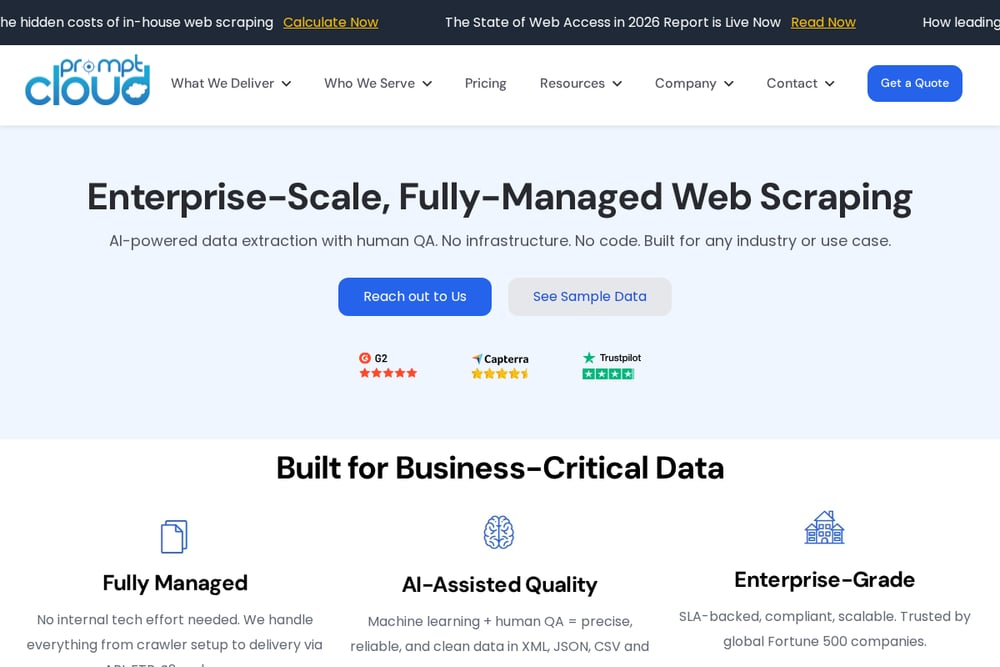 A screenshot of the PromptCloud website.
PromptCloud builds, operates, and maintains custom scraping pipelines for recurring enterprise needs. You define sources, fields, frequency, and delivery method, and they manage collection from crawl through validation to delivery. Their pipeline covers monitored sources, extraction, schema normalization, record validation, and change monitoring. They serve data engineering teams and business leaders with use cases like revenue and pricing intelligence, multi-source aggregation, and risk signal monitoring. If you want to stop maintaining scrapers in-house and need a documented process, PromptCloud is built for that. Their enterprise focus means more setup but a sturdier long-term operation.
#4 Import.io
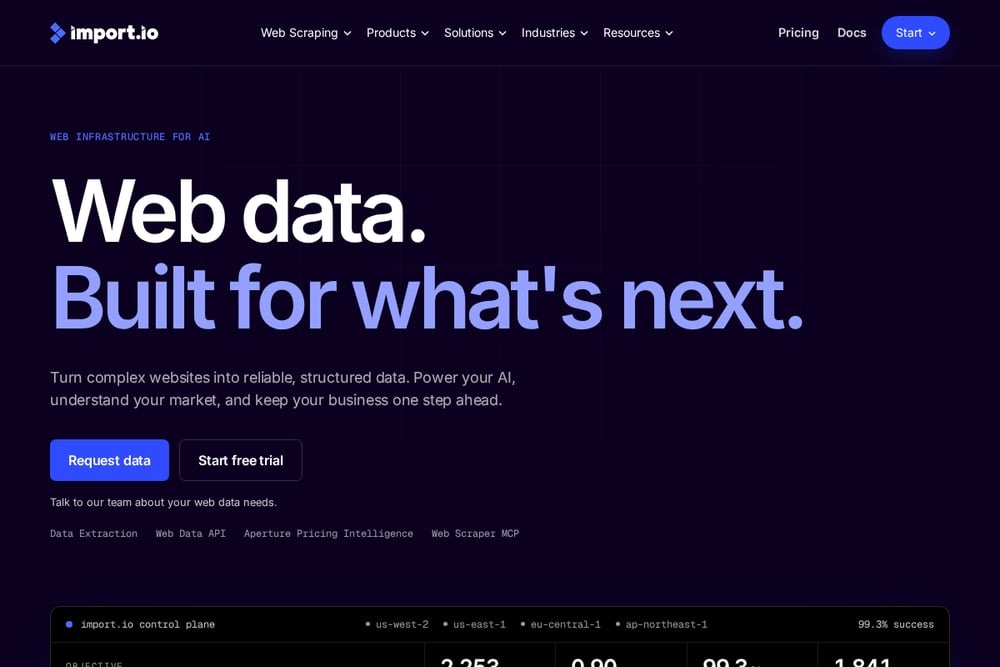 A screenshot of the Import.io website.
Import.io offers a mature platform with a managed web data layer on top. You can build extraction workflows yourself, connect AI agents through hosted MCP, or have Import.io run the collection for you. Their managed service delivers quality-checked web data, and their Aperture product focuses on pricing, assortment, and MAP intelligence. They cover twelve industries and support integrations into your existing stack. If you want the option to self-serve later or need a platform that grows with your team, Import.io gives you that flexibility. The managed path is best when you want their team to handle quality checks and delivery.
#5 Browse AI
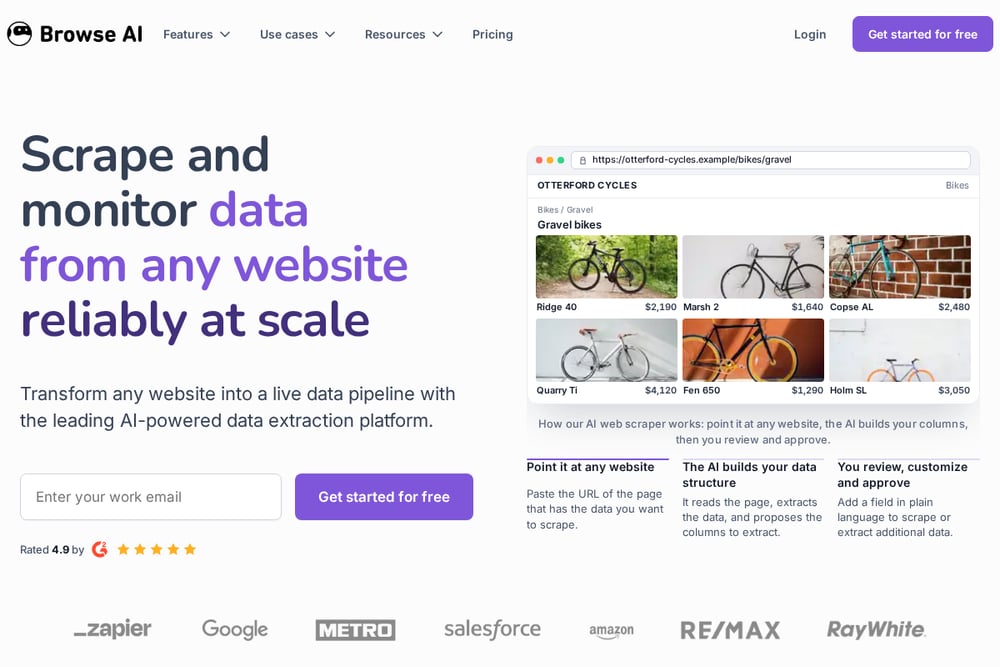 A screenshot of the Browse AI website.
Browse AI makes web scraping and monitoring accessible with no-code tooling and over 200 prebuilt robots. Their managed web scraping service handles fully managed extraction and monitoring for teams that want the work done for them. You can turn websites into live spreadsheets, APIs, or synced data for LLMs. Their use cases span price monitoring, ecommerce, real estate, job listings, and lead generation. If you are new to managed scraping or want a low-friction way to monitor a handful of sites, Browse AI is a practical entry point. The platform handles change detection so you are alerted when pages shift.
How to choose the right managed scraping service
Start with your sources. If they are JavaScript-heavy or change often, ask how the provider handles maintenance and quality checks. Next, clarify delivery. Do you need files, an API, or a spreadsheet feed? Confirm the schema is stable and documented. Then ask about pricing. A free sample before payment removes guesswork, so prioritize providers that offer one. Check traceability. Every record should keep its source URL and collection time so you can audit it. Finally, match the service to your team. If you have engineers who want control, a platform with a managed layer fits. If you want the work fully off your plate, a managed-first provider is better.
Where automation fits
Automation is the backbone of managed scraping. Providers build scrapers that run on a schedule, validate records, and alert you when something breaks. You do not need to write selectors or monitor page changes. What you should automate on your side is the handoff. Pipe delivered data into your dashboard, warehouse, or spreadsheet so your team sees it without manual steps. The best providers give you a stable schema and a predictable delivery cadence, which makes downstream automation simple.
The bottom line
You have five solid options, each with a different center of gravity. Kvetoiq ties data to pricing and visibility outcomes. Furnish Data makes evaluation easy with a free sample and traceable records. PromptCloud is built for enterprise pipeline management. Import.io gives you a platform with a managed layer. Browse AI lowers the barrier with no-code monitoring. Pick based on your sources, your delivery needs, and how much control you want. Request a sample from two or three providers and compare the output before you commit.