You need someone to run your Kubernetes, databases, and GPUs so your team can ship models instead of babysitting servers. Here are five providers worth a serious look.
The state of managed GPU infrastructure
Managed Kubernetes and GPU infrastructure has moved from a nice-to-have to a core part of how AI teams operate. You want predictable costs, a named human who knows your stack, and the flexibility to run on dedicated hardware or inside your own cloud account. The market splits into two camps: hyperscale AI clouds that sell raw GPU capacity with managed control planes, and boutique operators that take ownership of your entire stack. Both can work, but they solve different problems. The key is knowing which problem you actually have.
How we evaluated these providers
We looked at service scope, pricing clarity, and local fit for EU-based teams. Service scope covers how much of your stack the provider actually runs, from the Kubernetes control plane down to databases, CI, and backups. Pricing clarity means published rates, fixed monthly options, and no surprise invoices. Local fit considers where the servers sit, whether data stays in the EU, and how support is delivered. Each provider below stood out on at least one of these factors, and we describe what stood out without pretending one size fits every team.
Here is a quick comparison of the five providers, followed by a closer look at each one.
| Provider | Best For |
|---|---|
| CoreWeave Kubernetes Service (CKS) | Teams needing large-scale GPU clusters with a managed control plane |
| Lumcells · Managed infrastructure and ML operations, on our servers or in your cloud | Teams that want a named engineer to run their full stack |
| Civo Kubernetes GPU Hosting | Teams wanting fast, pay-as-you-go GPU Kubernetes clusters |
| TensorWave Managed Kubernetes | Teams building on AMD GPUs with open standards |
| AceCloud Kubernetes GPU Clusters | Teams needing a broad GPU catalog with on-demand clusters |
The five providers in detail
#1 CoreWeave Kubernetes Service (CKS)
 A screenshot of the CoreWeave website.
CoreWeave built its cloud specifically for AI workloads, and CKS brings managed Kubernetes to that stack. You get the latest NVIDIA GPUs at cluster scale, high-bandwidth networking, and storage tuned for training and inference. The platform includes Mission Control for fleet health and node lifecycle management, which matters when you are running large distributed jobs. If your team needs raw GPU capacity with a managed control plane and you are comfortable owning the application layer, CKS is a strong fit. It is less about hand-holding and more about giving you a powerful, AI-native platform to build on.
#2 Lumcells · Managed infrastructure and ML operations, on our servers or in your cloud
 A screenshot of the Lumcells website.
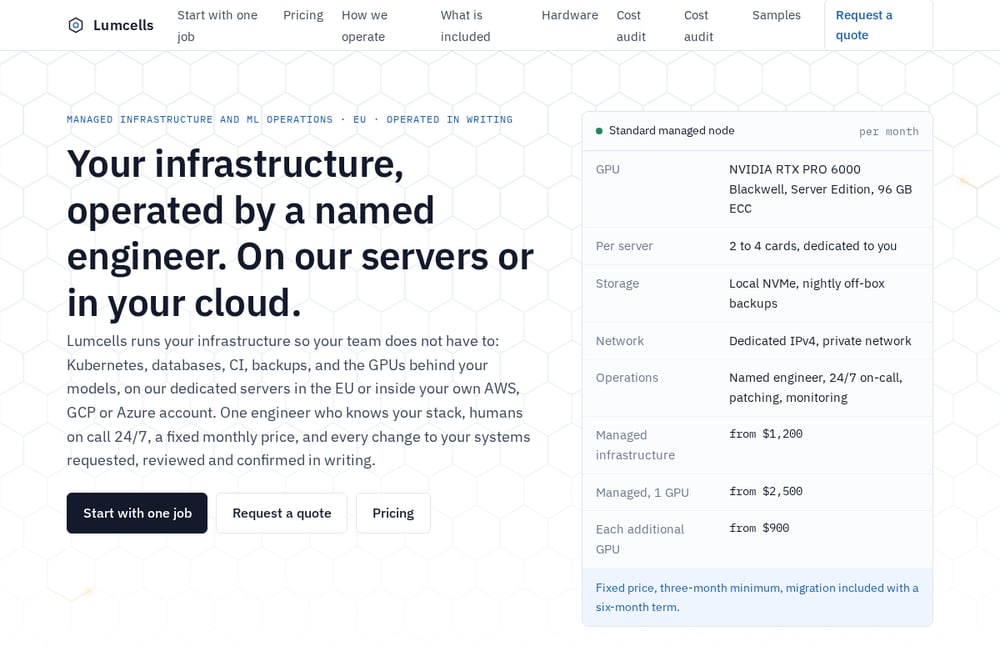
Lumcells takes a different approach: it runs your entire infrastructure so your team does not have to. That means Kubernetes, databases, CI, backups, and the GPUs behind your models, either on their dedicated EU servers or inside your own AWS, GCP, or Azure account. You get a named engineer who owns your account, humans on call 24/7, and every change requested, reviewed, and confirmed in writing. Pricing is fixed and published, starting at $1,200 per month for managed infrastructure and $2,500 for a managed node with one GPU. If you want hands-on operational ownership without building an in-house team, this is the one to look at.
#3 Civo Kubernetes GPU Hosting
 A screenshot of the Civo website.
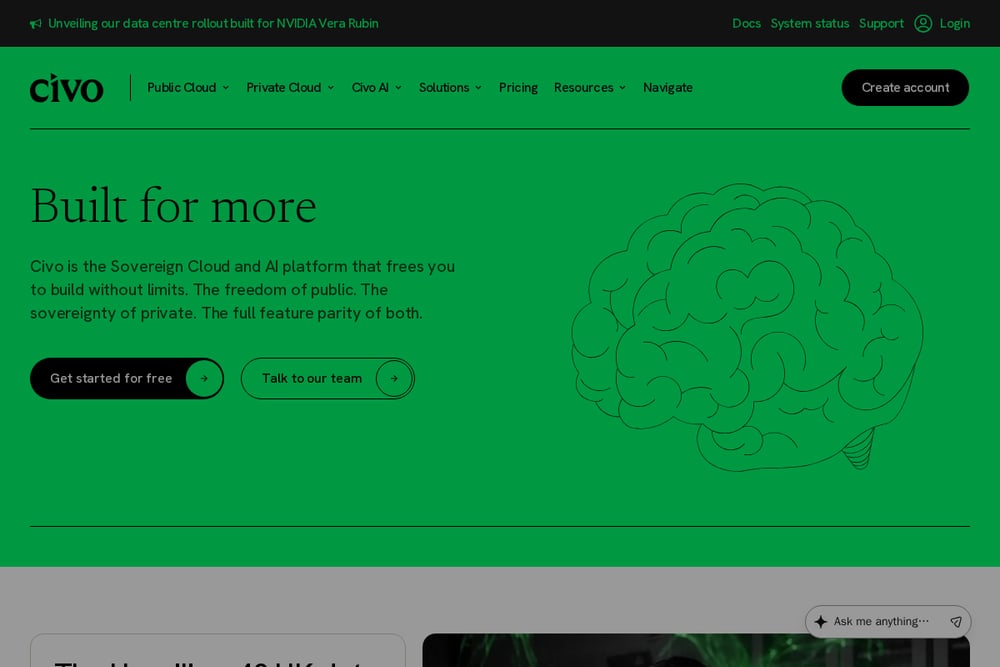
Civo offers GPU-powered Kubernetes clusters that spin up fast and scale as your models grow. The pitch is simplicity: launch a cluster, attach NVIDIA GPUs, and run training or inference without worrying about the control plane. Pricing is pay-as-you-go, so you only pay for the resources you use. Civo is a good fit if you want a straightforward managed Kubernetes experience with GPU access and predictable, usage-based costs. It is less about dedicated operational ownership and more about giving you a clean, fast platform to run your workloads.
#4 TensorWave Managed Kubernetes
 A screenshot of the TensorWave website.
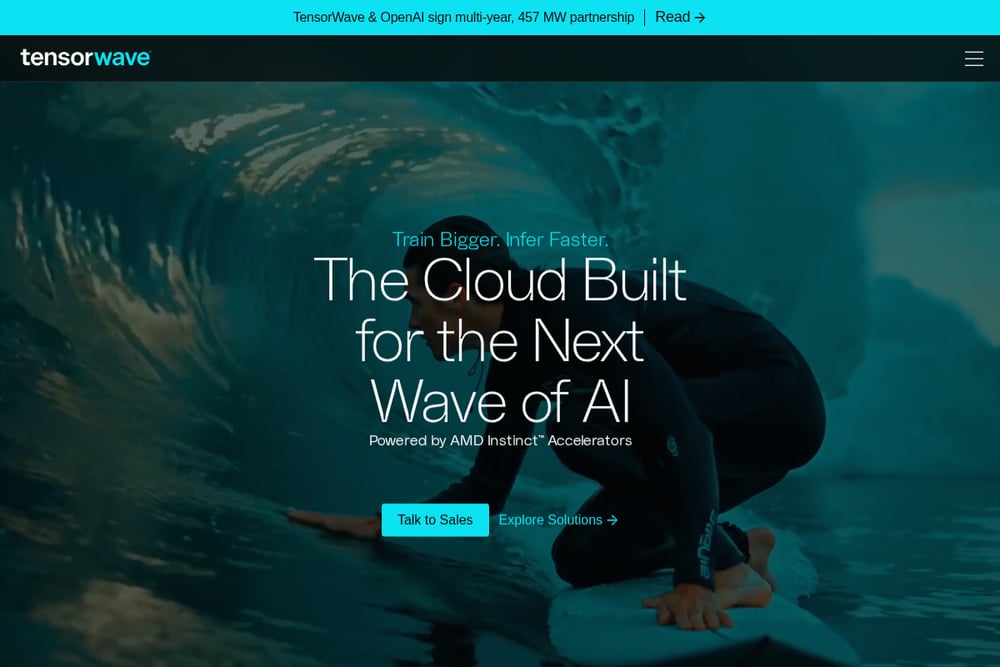
TensorWave focuses on production AI with managed Kubernetes built on AMD Instinct GPUs and bare metal performance. The service handles the control plane, upgrades, security patching, and 24/7 monitoring, so your team can focus on models. It integrates with Slurm to unify training and serving, and it is built on open standards to avoid vendor lock-in. If you are exploring AMD-based GPU infrastructure or want a managed Kubernetes layer that is tightly integrated with your MLOps stack, TensorWave is worth a look. It is particularly relevant for teams that value open standards and bare metal performance.
#5 AceCloud Kubernetes GPU Clusters
 A screenshot of the AceCloud website.
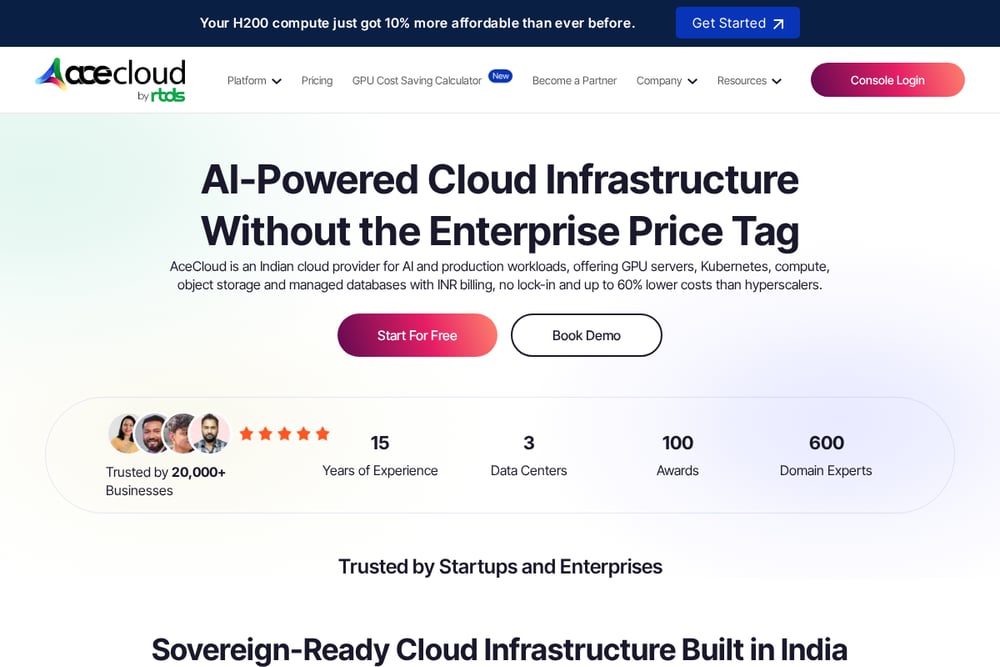
AceCloud provides on-demand Kubernetes GPU clusters with a range of NVIDIA GPUs, including H200, H100, A100, and RTX Pro series cards. The platform includes managed Kubernetes, node autoscaling, and a container registry, making it a practical option for teams that want GPU access without building the orchestration layer. Pricing is usage-based, and you can scale clusters up or down as needed. AceCloud is a solid choice if you want a broad GPU catalog and a managed Kubernetes experience without a long-term commitment. It fits teams that need flexibility and a variety of GPU options.
How to choose the right provider
Start with the scope of work you want to hand off. If you need someone to run everything from Kubernetes to backups and GPUs, look for a provider that offers full operational ownership with a named engineer. If you just need GPU capacity with a managed control plane, the AI-native clouds are a better fit. Next, check pricing clarity. Fixed monthly rates make budgeting easier, while pay-as-you-go gives you flexibility but requires monitoring. Finally, consider where your data lives and who supports you. EU-based servers and 24/7 human support can matter more than raw GPU specs when something goes wrong at 2 a.m.
Where automation fits
Automation is not a replacement for operational ownership. The providers here automate control plane upgrades, patching, and scaling, but you still need a plan for backups, cost reviews, and incident response. Use automation to reduce toil, not to eliminate accountability. A named engineer and written change confirmation are worth more than a dashboard full of green checkmarks.
The bottom line
You have five solid options, each solving a different slice of the problem. CoreWeave gives you AI-native scale, Lumcells gives you full operational ownership with a named engineer, Civo gives you fast pay-as-you-go clusters, TensorWave gives you AMD-based open standards, and AceCloud gives you a broad GPU catalog. Match the provider to the scope you want to hand off, and you will spend less time on servers and more time on models.