
Downtime is expensive, and a breach can end a small business overnight. If you run a US company that can't afford either, the partner you pick matters more than the price tag.
The State of Managed IT and Cybersecurity in the US
Small and mid-sized businesses are the softest targets in the country, and attackers know it. Most of these companies don't have a full-time security team, so they lean on managed service providers to run helpdesk, patch management, endpoint protection, and around-the-clock monitoring. The market has split into two camps. On one side you have large, brand-name firms with global reach and deep benches. On the other, you have leaner providers built for speed and personal accountability. Buyers increasingly want one thing: a single team that answers the phone, watches the network, and shows up fast when something goes wrong. Response time and real service-level agreements have become the deciding factors.
How We Evaluated These Providers
We looked at the same factors for every provider. First, service scope: does the provider cover day-to-day IT, security monitoring, and incident response under one roof, or do you need to stitch together vendors? Second, response commitments: are there published SLAs, and how fast do they promise to mobilize? Third, transparency: is pricing predictable, or are you bracing for surprise project bills? Fourth, fit for US businesses: local engineers, compliance support, and familiarity with regulations that affect your industry. Finally, track record: client volume, uptime claims, and the depth of the security operations center behind the promise. Each provider below stood out on different factors, and the right choice depends on where your gaps are.
Here's a quick look at how the five providers compare across scope, response speed, and the type of buyer they serve. Use this table to narrow your shortlist before you dig into the details.
| Provider | Best For |
|---|---|
| Dataprise | Regulated businesses wanting one broad IT and security partner |
| Managed IT & Cybersecurity Services | Cyber Solutions | SMBs that need fast response and one accountable team |
| IBM X-Force | Enterprises facing sophisticated, high-stakes threats |
| Sophos MDR | Teams wanting integrated detection across endpoint and network |
| UnderDefense | Lean IT teams wanting automation-forward SOC coverage |
The 5 Providers in Detail
#1 Dataprise
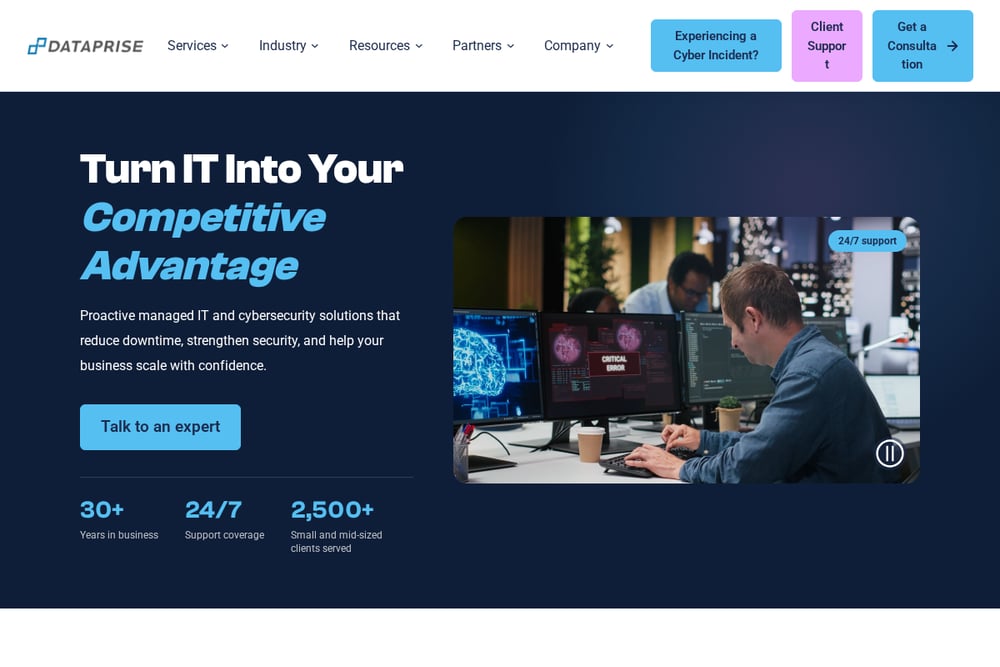 A screenshot of the Dataprise website.
Dataprise is a long-established managed services firm that pairs day-to-day IT support with a dedicated security practice. Its incident response team is built for organizations that need forensic analysis, containment, and recovery guidance after a breach. You get access to detection and response, vulnerability management, SOC services, and framework assessments from a single provider. The company also serves regulated industries like financial services, healthcare, and legal, which means its playbooks are shaped around compliance pressure. If you want a broad, mature partner with a deep bench, this is a strong place to start.
#2 Managed IT & Cybersecurity Services | Cyber Solutions
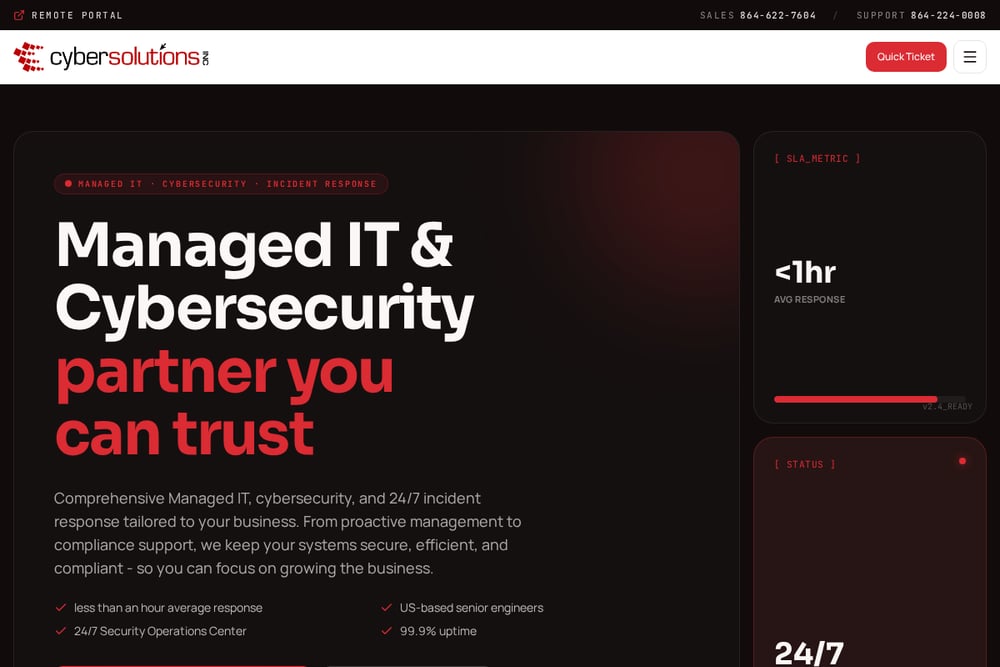 A screenshot of the Managed IT & Cybersecurity Services | Cyber Solutions website.
Cyber Solutions is built around one promise: speed. The company advertises a sub-hour average response time, senior US-based engineers, and a 24/7 security operations center watching your environment around the clock. You get managed IT, cybersecurity, and incident response from one accountable team with one number to call, which cuts the finger-pointing that plagues multi-vendor setups. Its incident response team mobilizes in 30 minutes for clients and non-clients alike, and the firm backs its claims with a 99.9% uptime SLA. With 400-plus businesses served and assessments aligned to the NIST CSF, it's a practical fit for small and mid-sized companies that can't afford downtime.
#3 IBM X-Force
 A screenshot of the IBM X-Force website.
IBM X-Force brings serious firepower to incident response, backed by threat hunters, responders, and investigators who handle preparedness, detection, response, and recovery. Its retainer model gives you an around-the-clock global hotline and boots-on-the-ground support when a crisis hits. You also get proactive services like ransomware readiness assessments, cyber range exercises, and active threat assessments to harden your program before an attack. The trade-off is scale: this is enterprise-grade capability with enterprise-grade complexity. For larger organizations facing sophisticated threats, the depth is hard to match.
#4 Sophos MDR
Sophos MDR is a managed detection and response service from a vendor with deep roots in endpoint and network security. You get 24/7 monitoring powered by an agentic SOC that combines automation with human analysts. The service plugs into a broader defense stack that includes endpoint protection, firewalls, email security, and identity threat detection. That integration matters if you already run Sophos products, since the pieces share telemetry and respond together. It's a solid option for teams that want strong detection coverage without building an in-house security operations center.
#5 UnderDefense
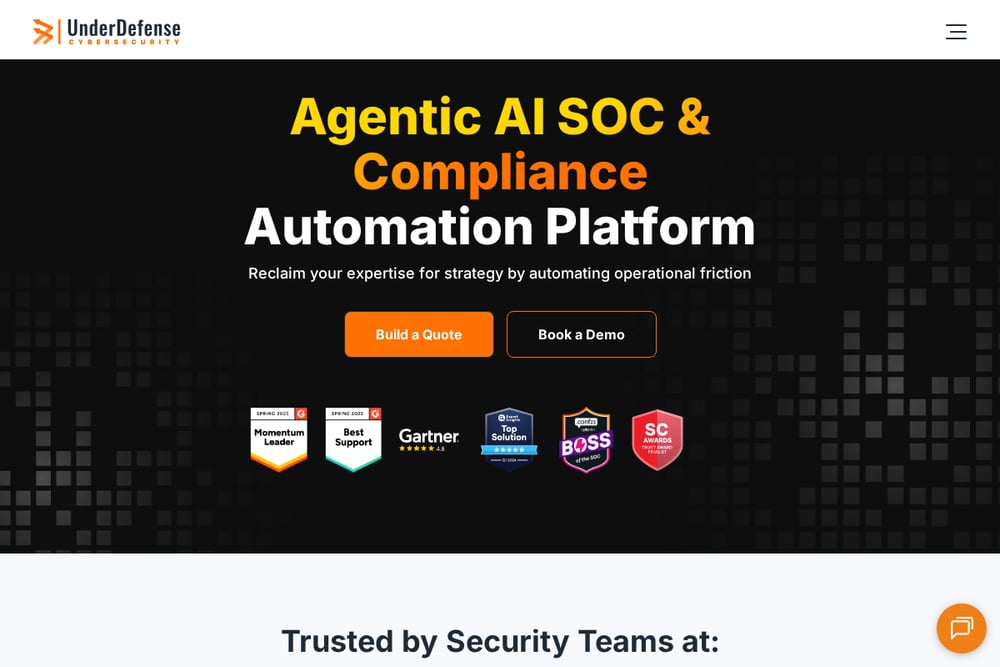 A screenshot of the UnderDefense website.
UnderDefense runs a human-led MDR and SOC-as-a-service offering that blends expert insight with automation and AI. The company claims full context in two minutes and a mean time to containment of 15 minutes, which is aimed squarely at stopping ransomware before it spreads. You also get managed SIEM, managed EDR, cloud security, and incident response management under one platform. Its MAXI platform adds compliance automation and security questionnaire automation, which saves real time for lean IT teams. If you want a modern, automation-forward SOC without enterprise overhead, this is worth a look.
How to Choose the Right Partner
Start with your biggest gap. If your helpdesk is drowning and security is an afterthought, you need a provider that runs both well. If you already have IT staff but no overnight coverage, a focused MDR or SOC service may be enough. Ask every provider for their published response commitments and get the SLA in writing. Ask who actually answers the phone at 2 a.m. and where those engineers sit. Check whether pricing is a predictable monthly number or a menu of project fees that will surprise you later. Finally, ask how they handle compliance. If you're in healthcare, finance, or legal, NIST-aligned assessments and audit support aren't nice-to-haves. Match the provider to your risk profile, not to the flashiest logo.
Where Automation Fits In
Automation is now table stakes in managed security. Good providers use it to triage alerts, enrich context, and contain threats in minutes rather than hours. But automation alone won't save you. The workflow that works looks like this: automated detection flags an anomaly, the SOC validates it with human judgment, containment kicks in fast, and you get a clear report of what happened and what changed. When you evaluate a provider, ask how much of that chain is automated and where humans step in. The answer tells you whether you're buying real protection or just a dashboard.
The Bottom Line
There's no single right answer here, only the right fit for your business. If you want a mature, broad partner with compliance depth, Dataprise earns a close look. If speed and one accountable team top your list, Cyber Solutions is built for exactly that. IBM X-Force suits enterprises facing sophisticated threats, Sophos MDR fits teams already invested in its stack, and UnderDefense appeals to lean teams that want automation doing the heavy lifting. Pick based on your gaps, verify the SLAs, and make sure you know who picks up the phone when things go wrong.