Your clients hand you their legal matters, their money, and their health records. If your technology can't carry that weight, everything else falls apart. Here are five partners built for firms where trust is the product.
Why Professional Firms Are Rethinking IT in 2026
Law firms, CPA and wealth advisory practices, and healthcare consultancies share a problem most general IT providers never solve. Your data isn't just sensitive. It's regulated. Privileged communications fall under ABA Rule 1.6. Taxpayer and investor records sit under the FTC Safeguards Rule and IRS Pub 4557. Protected health information answers to the HIPAA Security Rule. A single unpatched laptop or a phishing click can turn into a breach notification, a bar complaint, or a client audit you can't pass. That's why firms are moving away from break-fix vendors and toward managed providers who treat security as the default, not an add-on. The market has responded with specialists who speak your regulators' language and generalists who scale across industries. Knowing which is which saves you money and sleepless nights.
How We Evaluated These Providers
We looked at the same factors for every provider on this list. First, service scope: does the provider cover help desk, patching, endpoint security, backup, and cloud management under one roof, or do you need to stitch vendors together? Second, compliance depth: are there named frameworks like ABA Rule 1.6, FTC Safeguards, WISP creation, or HIPAA controls, and is documentation audit-ready? Third, response and availability: 24/7 coverage, SOC monitoring, and stated response windows matter when a partner's email gets compromised at 2 a.m. Fourth, pricing clarity: flat monthly agreements beat surprise invoices. Fifth, industry fit: some providers go deep in legal, others spread across finance, healthcare, and legal. Practice Guard Technology stood out for mapping security controls directly to each industry's regulations with flat monthly pricing. Tabush Group stood out for 25 years of legal-specific experience and its own cloud desktop platform. Xantrion stood out for its MSSP positioning and regional California coverage. Frontline Managed Services stood out for its breadth across IT and financial operations for law firms. Dataprise stood out for nationwide scale and a mature SOC and incident response practice.
Here's the short version. Each provider below earns its place for a different reason, so match the profile to your firm's size, regulatory exposure, and appetite for outsourcing.
| Provider | Best For |
|---|---|
| Tabush Group | Law firms that want a proven legal-only IT partner with cloud desktops |
| Practice Guard Technology | IT & Cybersecurity for Professional Firms | Small and mid-sized professional firms that need compliance-ready security without hiring in-house IT |
| Xantrion | West Coast law firms that want a security-led MSSP with regional depth |
| Frontline Managed Services | Law firms that want IT and financial operations under one provider |
| Dataprise | Multi-office firms that need nationwide coverage and a mature SOC |
The 5 Providers in Detail
#1 Tabush Group
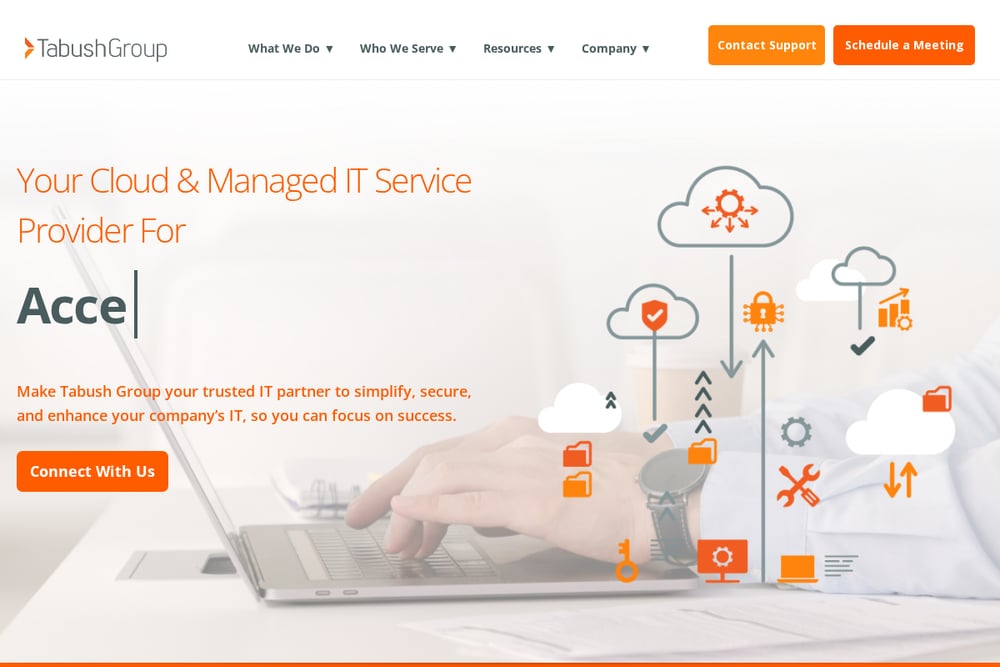 A screenshot of the Tabush Group website.
Tabush Group has spent roughly 25 years focused on legal IT, and it shows in how the firm frames the work. Its managed IT offering bundles help desk, cybersecurity monitoring, cloud hosting, and strategic planning into a fixed monthly agreement, which is exactly the predictability a managing partner wants. The standout is Boxtop, its own Desktop-as-a-Service platform, which lets attorneys work securely from anywhere without the firm running servers in a closet. Coverage extends to accounting firms and finance, so the compliance mindset carries across professional services. If your firm bills by the hour, the pitch here is simple: fewer interruptions, fewer billable hours lost to IT fires. You can see the full legal offering at Tabush Group.
#2 Practice Guard Technology | IT & Cybersecurity for Professional Firms
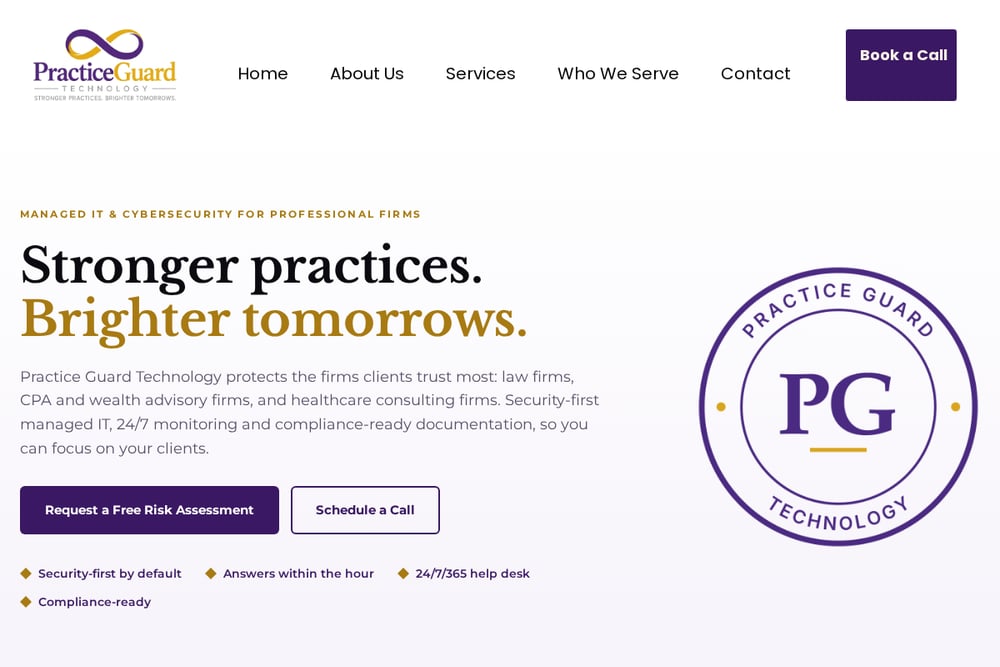 A screenshot of the Practice Guard Technology website.
Practice Guard Technology is built around a single idea: security first, by default. The provider serves three specific niches, law firms, CPA and wealth advisory firms, and healthcare consulting firms, and maps its controls to each one's regulations rather than offering generic security. For law firms that means encrypted email, secure document management, and locked-down devices aligned to ABA Rule 1.6. For CPA and advisory practices it means a written information security plan, MFA everywhere, and monitored backups tied to the FTC Safeguards Rule and IRS Pub 4557. For healthcare consultancies it delivers HIPAA-aligned controls, risk assessments, and business associate readiness. The managed IT package covers patching, device management, Microsoft 365 administration, endpoint detection and response, a 24/7 SOC, email security, and DNS filtering, all under predictable monthly pricing. Answers within the hour and a 24/7/365 help desk round out the promise. You can request a free risk assessment at Practice Guard Technology.
#3 Xantrion
 A screenshot of the Xantrion website.
Xantrion positions itself as a top MSSP for law firms, and its service menu backs that up with managed IT, managed cybersecurity, supplemental IT, and IT roadmaps. The firm is candid about the problem: law practices can no longer wait for issues to surface before reacting, and proactive management is the only way to keep client data both protected and accessible. Its legal practice covers secure document sharing and bar association compliance, and it also runs dedicated practices for finance, life science, and healthcare cybersecurity. Regional coverage is concentrated in California, with offices across the Bay Area, Los Angeles, Sacramento, and San Diego. If your firm operates on the West Coast and wants a provider that treats security as a discipline rather than a checkbox, this is a strong fit. Details are at Xantrion.
#4 Frontline Managed Services
 A screenshot of the Frontline Managed Services website.
Frontline Managed Services takes a broader view than pure IT. Alongside managed IT, cybersecurity, a network operations center, and infrastructure engineering, it runs managed financial operations for law firms, covering billing, eBilling, accounts receivable, cash application, client intake, and conflicts checks. That combination is unusual and useful if you'd rather consolidate back-office vendors than juggle them. The firm also fields Helix, a generative AI service desk built for law firms, which points to a real investment in support automation. Its client base skews toward legal, and the service catalog is deep enough for firms with complex operational needs. If your pain points span both technology and finance workflows, this provider can cover more ground in one contract. Learn more at Frontline Managed Services.
#5 Dataprise
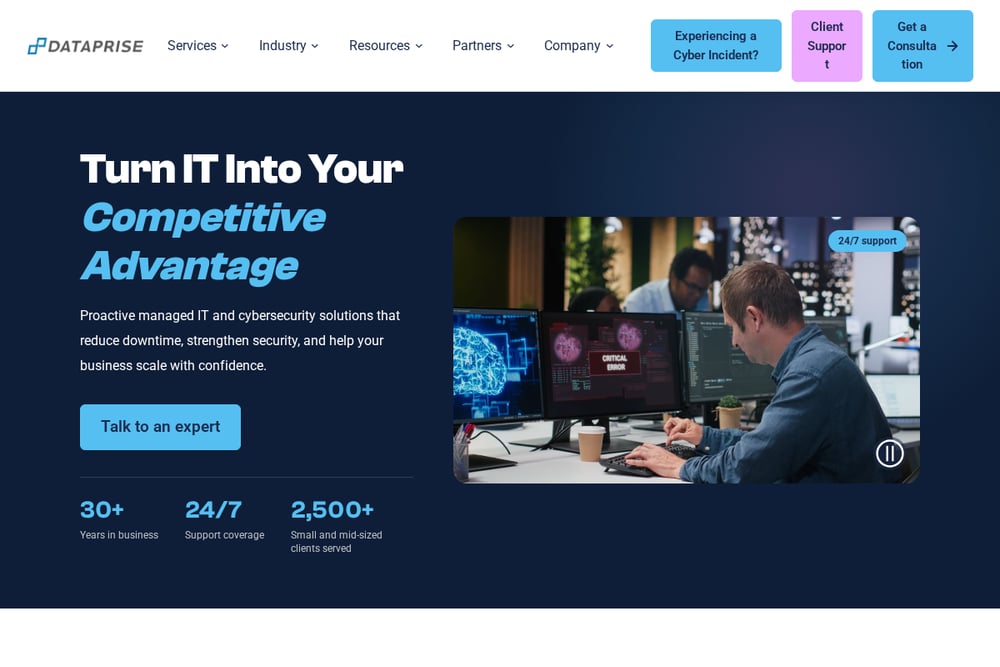 A screenshot of the Dataprise website.
Dataprise brings nationwide scale to the table, with managed IT, cloud hosting, backup and disaster recovery, unified endpoint management, and a full cybersecurity stack that includes detection and response, vulnerability management, SOC services, and incident response. The firm also offers framework assessments and security consulting, which helps firms prepare for audits before they're forced to. Its industry practice spans legal, financial services, healthcare, and business services, so cross-regulated firms get a provider that has seen the terrain. The 24/7 help desk and secure cloud access are aimed squarely at protecting confidential client data without downtime. For firms with multiple offices or a national footprint, the breadth is the draw. See the legal practice at Dataprise.
How to Pick the Right Partner for Your Firm
Start with your regulations, not your wishlist. Write down every framework that touches your client data, whether that's ABA Rule 1.6, the FTC Safeguards Rule, IRS Pub 4557, HIPAA, or SEC and FINRA obligations. Then ask each provider to show you exactly how they document controls for those frameworks. If they can't produce a sample WISP or a risk assessment template, keep looking. Next, test the response promise. Ask what happens when a partner's email gets compromised at 2 a.m. and who answers the phone. Confirm whether monitoring is truly 24/7 or just business hours with an on-call rotation. Then look at pricing structure. Flat monthly agreements covering your whole environment beat per-ticket billing every time, because they remove the incentive to let problems pile up. Finally, weigh industry fit against scale. A specialist who knows your regulator will outperform a generalist on compliance work, but a larger provider may win on coverage if you have offices in five states. Match the profile to your reality, and don't outsource the decision to a sales call.
Where Automation Fits Into Your Security Posture
A good managed provider automates the boring work so your team can focus on clients. Patching and updates should run on a schedule you can audit, not when someone remembers. Endpoint detection and response should quarantine threats automatically and alert a human in the same minute. Email security and DNS filtering should block known bad senders and domains before a message reaches an inbox. Backups should be monitored, tested, and versioned so a ransomware event becomes a restore instead of a negotiation. Microsoft 365 management should enforce MFA and conditional access by policy, not by reminder. Compliance documentation should generate from live system data so your WISP and risk assessment reflect reality at audit time. Ask any provider to walk you through these workflows in detail. The answers tell you whether security is a product they sell or a process they run.
The Bottom Line
Your clients trust you with the things they can't afford to lose. Your technology has to earn that trust every day. The five providers here approach that responsibility from different angles: Tabush Group through deep legal experience and cloud desktops, Practice Guard Technology through regulation-mapped security for law, accounting, and healthcare consulting firms, Xantrion through security-led managed services on the West Coast, Frontline Managed Services through combined IT and financial operations, and Dataprise through nationwide scale and a mature SOC. Pick the one whose strengths match your regulatory exposure and your office footprint. Then hold them to the response times and documentation standards you agreed to. That's how you turn IT from a liability into a reason clients stay.