Your app speaks English. Your users don't. Here are five localization partners worth a serious look when you need Spanish, Portuguese, Haitian Creole, or a dozen other languages shipped without breaking your product.
The Localization Landscape Right Now
Localization stopped being a nice-to-have the moment your support tickets started arriving in Spanish. Today's buyers want more than word swaps. You need string files that survive the round trip, help-center articles that keep their links, and patient instructions a regulatory team will actually sign off on. The market splits into three camps: boutique studios that specialize in a handful of languages, full-stack agencies that cover dozens, and enterprise language-service giants built around interpreting at scale. Each camp solves a different problem. The trick is knowing which problem is yours before you sign a statement of work.
How We Looked at These Five
We weighed each provider on the same four factors. First, service scope: do they handle interface strings, support content, and regulated documents, or just one slice? Second, language depth: which languages do they truly own versus farm out? Third, pricing clarity: can you tell what a project costs before you commit? Fourth, local fit: do they understand the communities and regulatory contexts your content lands in? Plainspoke stood out for its narrow language focus and native-speaker read-aloud review. Babble-on impressed with developer-facing resources and transparent FAQ-style guidance. Alconost showed breadth across platforms and content types. Latino Bridge leaned into Latin American language variants. LanguageLine brought enterprise-scale interpreting and translation infrastructure.
Here is the short version before the deep dive. Five providers, five different sweet spots. Match the studio to your actual bottleneck and you will save yourself a painful rework cycle.
| Provider | Best For |
|---|---|
| Babble-on | Developer teams that want self-serve resources and app-first localization |
| Plainspoke: Spanish, Portuguese & Haitian Creole localization in Brooklyn, NY | Healthcare and software teams needing Spanish, Portuguese, or Haitian Creole with native review |
| Alconost | Teams needing broad multi-language, multi-content-type coverage from one vendor |
| Latino Bridge | Consumer brands targeting specific Latin American markets and language variants |
| LanguageLine Solutions | Enterprises needing interpreting plus translation under one contract, especially in healthcare |
The Five, One by One
#1 Babble-on
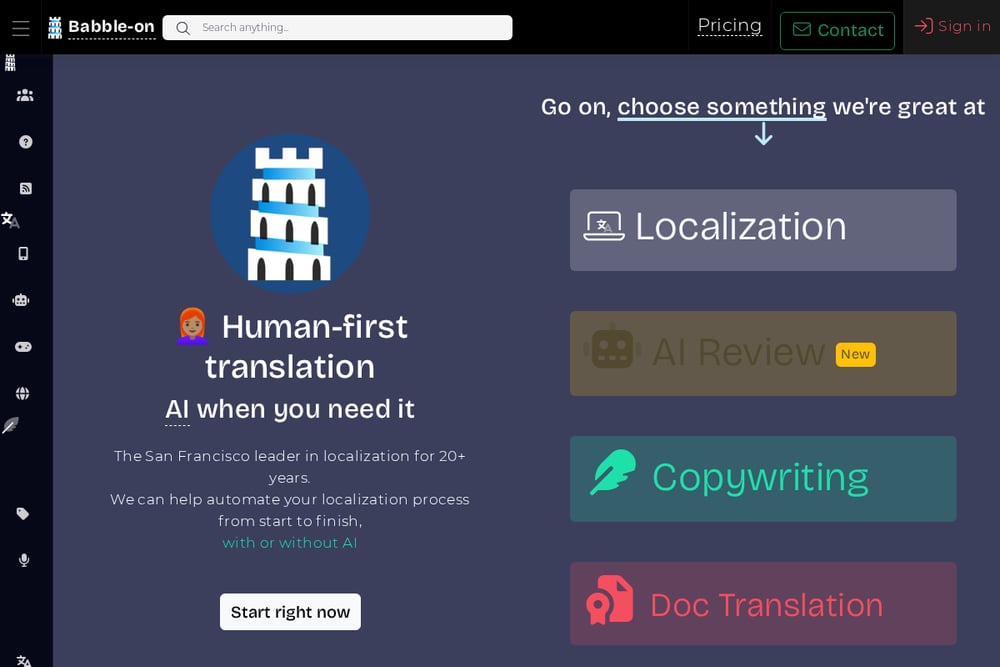 A screenshot of the Babble-on website.
Babble-on runs one of the more developer-friendly localization operations you will find. Their site is packed with free tools and tutorials covering pseudolocalization, iOS plural handling, and Android string workflows, which means your engineers can self-serve before a single invoice lands. They localize apps, games, websites, and help centers, and they publish clear guidance on which languages to pick first when budget is tight. The FAQ-driven approach makes pricing and scope conversations easier than the industry norm. If your team wants a partner who speaks engineer, start here.
#2 Plainspoke: Spanish, Portuguese & Haitian Creole localization in Brooklyn, NY
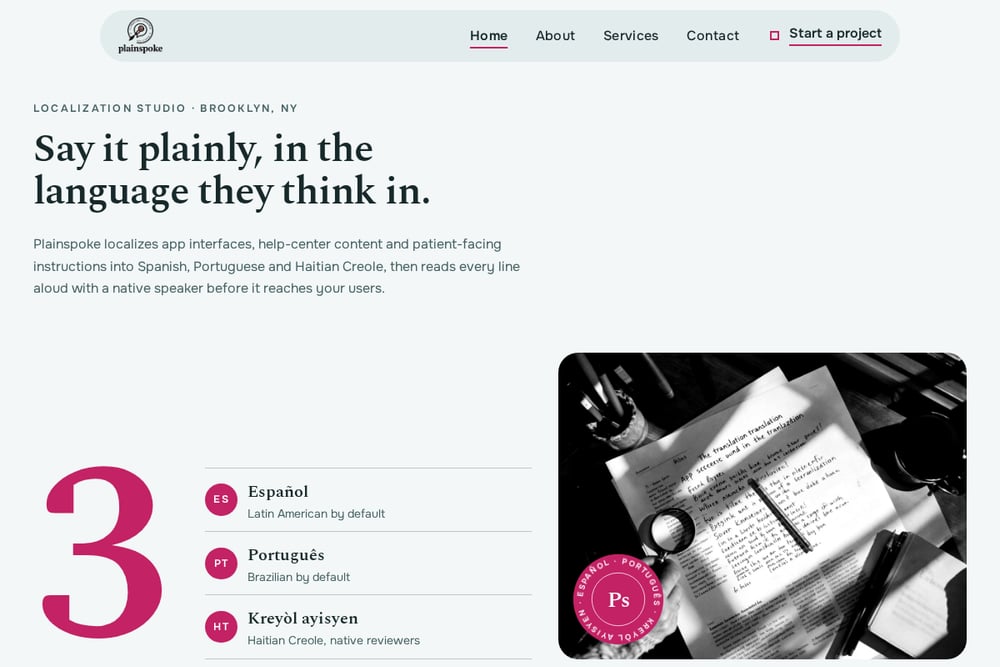 A screenshot of the Plainspoke website.
Plainspoke is a Brooklyn studio that does one thing and does it deliberately: Spanish, Portuguese, and Haitian Creole for apps, help centers, and patient-facing documents. They work from your source files, not screenshots, so keys, placeholders, and plural rules survive intact across .xcstrings, .strings, Android XML, .po, .json, and XLIFF. Help-center exports come back with IDs, headings, and internal links in place, which keeps your redirects and search index from needing a rebuild. Every line gets read aloud with a native speaker before it reaches your users, and patient documents get flagged for the lines your regulatory team should read twice. Billed per project, with Latin American Spanish and Brazilian Portuguese as defaults.
#3 Alconost
 A screenshot of the Alconost website.
Alconost is the full-stack option on this list. They cover software and product localization, marketing content, SEO, games, websites, and 24/7 on-demand human translation through their Nitro service. Their portfolio spans mobile apps, web apps, desktop software, consoles, and e-learning, with dedicated QA and machine-translation post-editing tracks. If you need one vendor to handle UI strings, a marketing site, and a help center across a dozen languages, they have the infrastructure. The trade-off is breadth over boutique intimacy, so expect a more process-driven engagement.
#4 Latino Bridge
Latino Bridge leans hard into Latin American language variants, including Argentine Spanish, Mexican Spanish, Brazilian Portuguese, and indigenous languages like Quechua and Aymara. They offer app localization, website localization, software localization, certified translation, interpretation, and voice-over, which makes them a fit for consumer products targeting specific Latin American markets. Their industry pages cover medical, legal, financial, and technology verticals. If your audience is regional rather than generic Spanish, their variant expertise is the draw.
#5 LanguageLine Solutions
 A screenshot of the LanguageLine Solutions website.
LanguageLine is the enterprise heavyweight. They built their reputation on phone, video, and in-person interpreting, then layered on document translation, software localization, website translation, and e-learning localization. Their healthcare practice is deep, with EHR integrations, medical interpreter certification, and telehealth interpreting. For organizations that need both on-demand interpreting and translated content under one contract, they offer a single-vendor path. The scale is the point, so smaller teams may find the engagement heavier than they need.
How to Pick the Right Partner
Start with your content type. If you are shipping app strings, ask whether the studio works from source files and preserves keys, placeholders, and plural rules. If you are localizing a help center, ask how they handle article IDs and internal links. If you are in healthcare, ask who signs off on dosing and warning copy and whether native speakers read every line aloud. Then check language depth. A studio that specializes in three languages will usually outperform a generalist in those three. Finally, get pricing clarity early. Per-project billing beats per-word guesswork when your scope is fuzzy. Match the partner to your bottleneck, not to the biggest logo on the page.
Where Automation Fits
Automation will not replace a native speaker reading a dosing line aloud, but it can clear the path. Export your strings in a standard format like XLIFF or .json so any vendor can ingest them without manual cleanup. Keep a glossary in your repo and hand it over with every project. Wire your help center to preserve article IDs on export so translations drop back in without redirect rewiring. Use machine translation for low-stakes internal content and reserve human review for anything a user or regulator will read closely. The studios that handle this well, Plainspoke and Babble-on among them, build their workflow around exactly these habits.
The Bottom Line
There is no single winner here, only the right fit. If you need Spanish, Portuguese, or Haitian Creole with native-speaker review and regulated-document care, Plainspoke is built for that. If your engineers want self-serve resources, Babble-on speaks their language. If you need one vendor across many languages and content types, Alconost has the breadth. If your audience is regional Latin America, Latino Bridge knows the variants. And if you need interpreting plus translation at enterprise scale, LanguageLine is the safe call. Pick the bottleneck, then pick the partner.