Your child's reading journey starts with a single sound. These five live online phonics providers each take a different route from first letters to confident storybook reading.
The Live Online Phonics Landscape
Parents are no longer limited to what is on the shelf at the local school supply store. Live online phonics instruction has become a mainstream option, pairing structured, research-aligned curricula with real teachers on a video call. The appeal is obvious. You get personalised correction, a set pace, and a clear pathway instead of an app that lets a child tap through without ever blending a word.
Most providers now organise learning into levels, from letter sounds and CVC words up through digraphs, spelling patterns, fluency and comprehension. Formats split into one-to-one sessions and small groups, and many include printable practice, progress updates for parents, and a free demo class so you can test the fit before committing. Pricing and scheduling transparency vary widely, so it pays to read the fine print on session counts and course length.
How We Evaluated These Programmes
We looked at the same factors for every provider. First, curriculum scope: does the programme cover the full arc from phonemic awareness to comprehension, or stop at letter sounds? Second, format flexibility: are small groups and one-to-one both available, and can you switch?
Third, structure and pacing: how many classes per week, how many total sessions, and how long does each level run? Fourth, parent support: printable worksheets, progress visibility, and demo classes. Fifth, clarity of the offer: can you understand the pathway and what your child will learn at each stage without digging?
WordSprout Academy stood out for its clean three-level pathway with published session counts and printable worksheets at every level. Tiny Steps impressed with assessment-first placement and parent-visible progress. ClassMonitor brought a cross-curricular, activity-kit approach. The Phonics School showed breadth across phonics, grammar, guided reading and conversation. Learn2Read highlighted customised paths and a money-back trial guarantee.
Here is a quick side-by-side view of the five programmes, from curriculum depth to format and parent support, so you can shortlist before you book a demo.
| Provider | Best For |
|---|---|
| Tiny Steps | One-to-one assessment-first instruction |
| WordSprout Academy · Sprout to Story Phonics Programme | A clear three-level pathway with worksheets |
| ClassMonitor | Activity-kit learning with curriculum alignment |
| The Phonics School | British-curriculum phonics plus broader English |
| Learn2Read | Risk-free trial with customised pacing |
The Five Programmes in Detail
#1 Tiny Steps
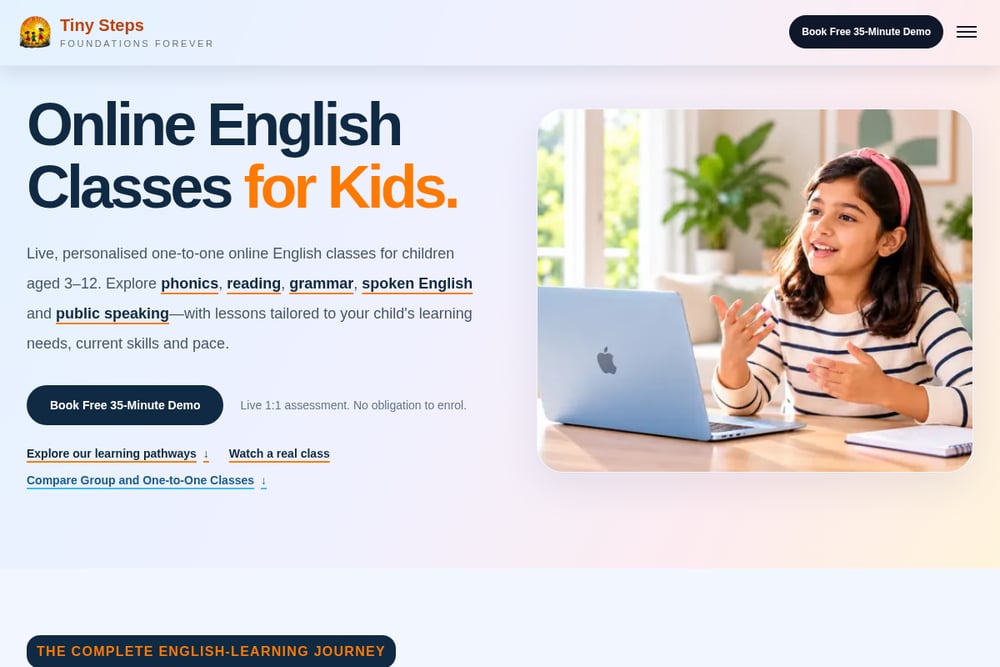 A screenshot of the Tiny Steps website.
Tiny Steps runs live one-to-one online phonics for children ages 3 to 12, built on structured synthetic phonics. Placement starts with a free 35-minute demo assessment, so the level plan fits your child rather than a generic sequence. Parents get visible progress updates, and the provider reports 5,000+ learners across 15+ countries. The pathway moves from letter sounds and blending through CVC words, digraphs and decodable reading fluency. If you want individual correction at every step, this is a strong fit. See the Tiny Steps phonics page for the full roadmap.
#2 WordSprout Academy · Sprout to Story Phonics Programme
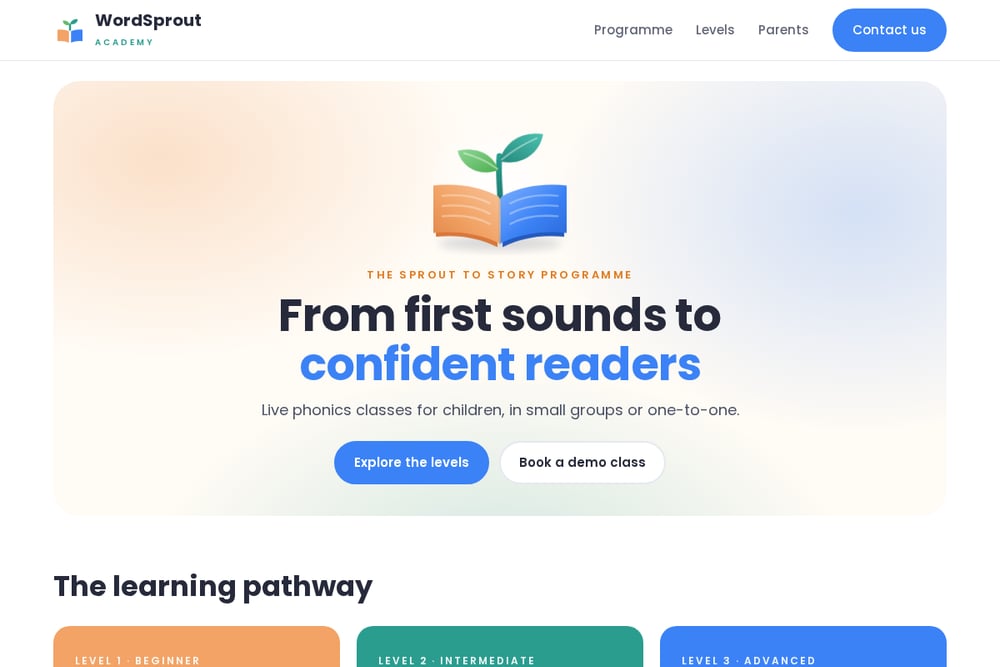 A screenshot of the WordSprout Academy website.
WordSprout Academy's Sprout to Story programme takes children from first letter sounds to reading storybooks with confidence across three named levels. Seedlings covers the 26 letter sounds, lowercase letters and first short words over 30 sessions. Sprouts builds 42 phonic sounds, blending, sentences and first storybooks across 66 sessions. Storytellers moves into long words, spelling, comprehension and storytelling over 60 sessions. Every level runs three classes a week in small groups or one-to-one, and printable practice worksheets are included throughout. Book a demo class to see the playful, song-and-game format in action.
#3 ClassMonitor
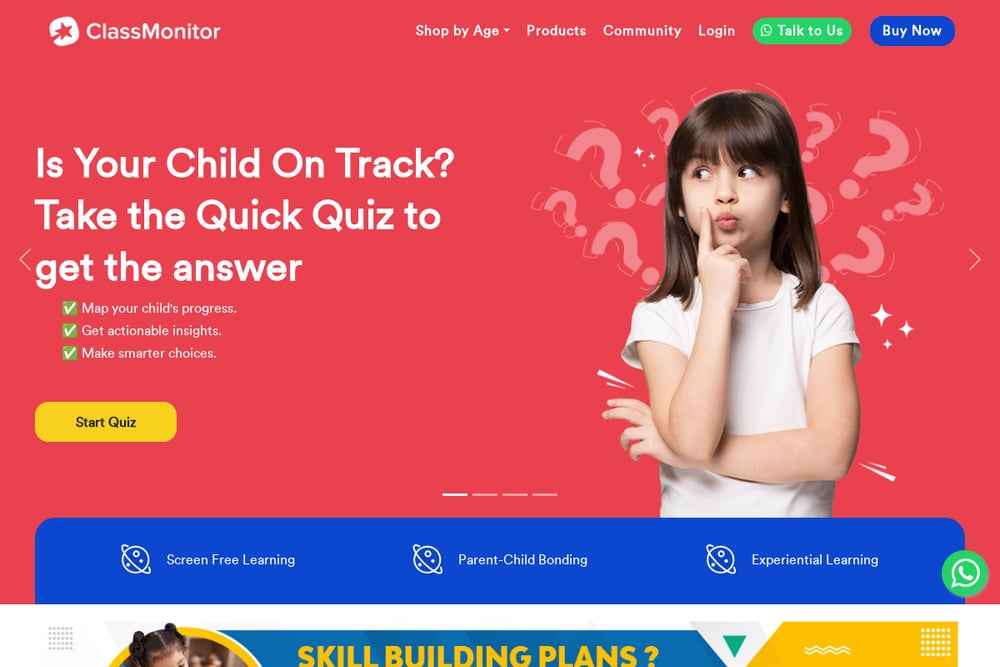 A screenshot of the ClassMonitor website.
ClassMonitor offers live phonics classes for ages 3 to 6 with a cross-curricular approach aligned to CBSE, ICSE and IB frameworks. The programme is split into Foundation, Basic, Intermediate and Readers courses, each with published class counts and durations, plus one-to-one availability. Families get learning gap identification, a customised plan for 1:1 programmes, a dedicated relationship manager and a completion certificate. A hands-on activity kit with 250+ study items and recorded videos for revision add offline reinforcement. Explore the ClassMonitor phonics classes to compare course tiers.
#4 The Phonics School
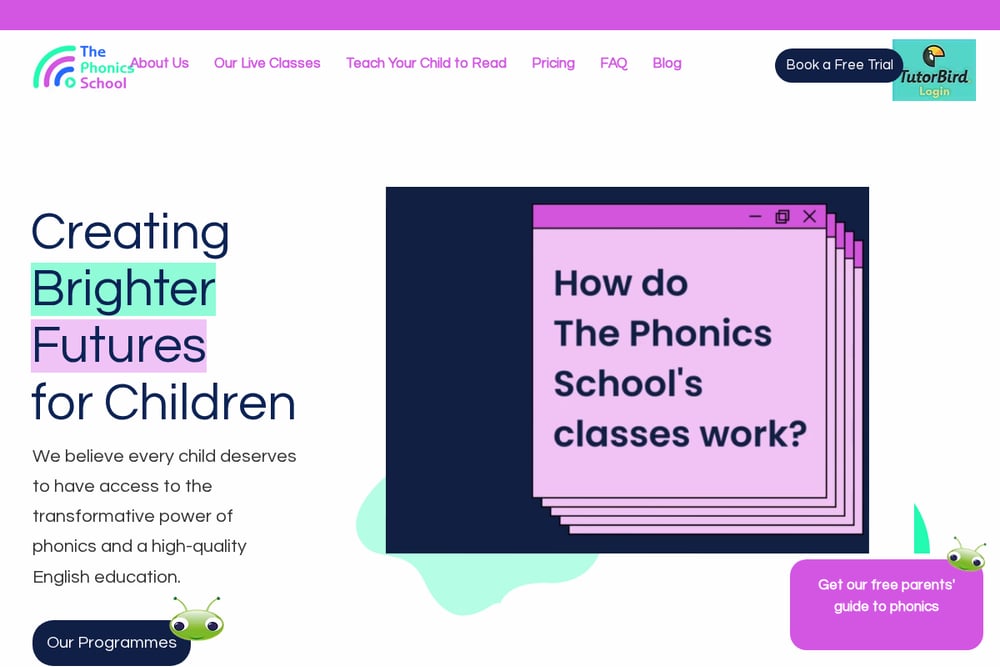 A screenshot of The Phonics School website.
The Phonics School pairs Bug Club Phonics with a wider English offering, including grammar and spelling, guided reading, conversation and creative writing. Classes serve children from age 4 to 18 as well as adults, with one-to-one sessions starting from €29 for 30 minutes and a timetable built around your schedule. The British-curriculum alignment makes it a natural fit for home education and school preparation. A free trial lets you meet a teacher before committing. Visit The Phonics School to see the full programme list.
#5 Learn2Read
 A screenshot of the Learn2Read website.
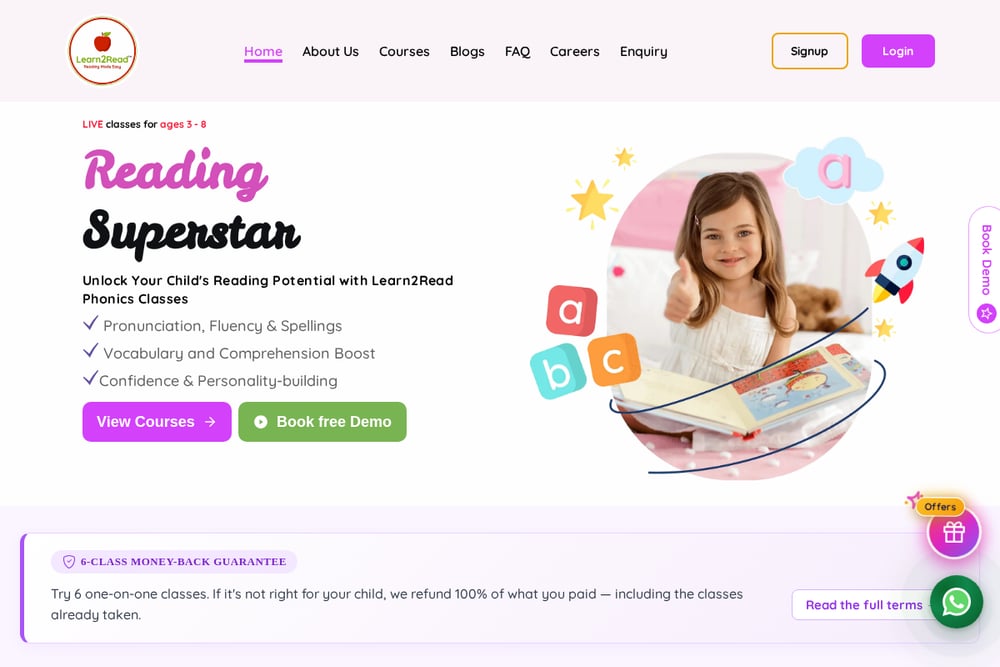
Learn2Read delivers live classes for ages 3 to 8 with a focus on pronunciation, fluency, spelling, vocabulary and comprehension. Learning paths are customised to your child's level and pace, with one-to-one or small batch sizes and experienced phonics instructors. The standout is a six-class money-back guarantee on one-to-one classes, which lowers the risk of trying it out. Flexible scheduling lets you learn at your own pace, and the programme also builds confidence and personality alongside reading. See Learn2Read for course details and demo booking.
How to Choose the Right Phonics Programme
Start with your child's starting point. A beginner who does not yet know letter sounds needs a gentle Level 1 with phonemic awareness built in. A child already blending short words should skip ahead to digraphs and sentences.
Next, decide on format. One-to-one gives maximum correction and pace control. Small groups add peer interaction and often cost less. Several providers on this list offer both, so ask whether you can switch.
Then check the structure. Look at classes per week, total sessions and course duration so you know the real time commitment. Ask what happens at the end of each level and how progress is measured.
Finally, use the demo. Every provider here offers a free or trial class. Watch how your child responds to the teacher, and ask about printable practice, parent updates and refund terms before you pay.
Building a Simple Practice Workflow
Live classes do the heavy lifting, but short daily practice locks in the gains. Set a ten-minute slot after school for printable worksheets from your chosen programme. Keep a simple sound chart on the fridge and review the week's new sounds each evening.
Use recorded videos where available for quick revision before the next class. Track progress in a shared note: sounds mastered, words read, books finished. Share it with the teacher before each level review so instruction stays aligned with home practice.
The Bottom Line
There is no single right programme, only the right fit for your child's level and your family's schedule. Tiny Steps suits families who want assessment-first one-to-one instruction. WordSprout Academy offers a tidy three-level pathway with clear session counts and worksheets at every stage. ClassMonitor brings activity kits and curriculum alignment. The Phonics School covers broader English for British-curriculum families. Learn2Read lowers the risk with a money-back trial.
Book a demo with two or three of them. Watch your child in the class, ask about progress reporting, and choose the programme that makes reading feel like play.