Your client needs an MRI by Friday and the settlement is eighteen months out. Where do you send them? These five directories answer that question fast.
The Lien Provider Directory Landscape
Personal injury practices run on deferred payment. Clients can't front cash for surgery, imaging, or chiropractic care while a claim is pending, so providers treat on lien and get paid at settlement. That arrangement only works if you can find willing providers quickly and trust that they'll document treatment in a way that survives defense scrutiny.
Directories have filled that gap. Some are national databases with tens of thousands of listings. Others are curated regional networks where every provider is vetted and scheduling runs through a coordinator. The difference matters. A broad directory gives you reach; a closed network gives you accountability.
Most platforms are free for law firms and monetize through provider listings or featured placements. That means your real cost is time — the hours spent verifying credentials, chasing records, and confirming lien terms. Choose the directory that shrinks those hours the most.
How We Evaluated These Directories
We looked at four factors across every platform.
Service scope. Does the directory cover doctors only, or does it extend to surgery centers, imaging, and ancillary specialties? Breadth of specialty coverage matters when a case needs a neuropsychologist and a spine surgeon in the same week.
Pricing clarity. Every platform here is free or low-cost for law firms, but the terms differ. We checked how clearly each site states what law firms pay and what providers pay.
Local fit. Geographic coverage ranges from all fifty-one jurisdictions to a single state. A California-only network is excellent if your cases sit in California and useless if they don't.
Workflow support. Some directories are pure search tools. Others bundle record requests, scheduling, patient handouts, and case tracking. The more of that workflow a platform absorbs, the less your staff has to rebuild it in spreadsheets.
Here's a quick side-by-side of how the five platforms differ on coverage, specialty depth, and the tools that come with a listing.
| Provider | Best For |
|---|---|
| CONNEQT | Firms that want referral, records, and recovery in one HIPAA-compliant workflow |
| LawyersTrend — Personal Injury Law Industry Coverage & Directory | Case managers who want a free national directory plus daily industry news in one place |
| Injury Institute | California and Arizona firms that prefer a curated, relationship-driven physician network |
| Power Liens | Southwest firms that want fast specialty-and-ZIP search with record request tools |
| SoCal Injury Liens | California firms that want hands-off scheduling through a regional coordinator |
The Five Directories, One by One
#1 CONNEQT
 A screenshot of the CONNEQT website.
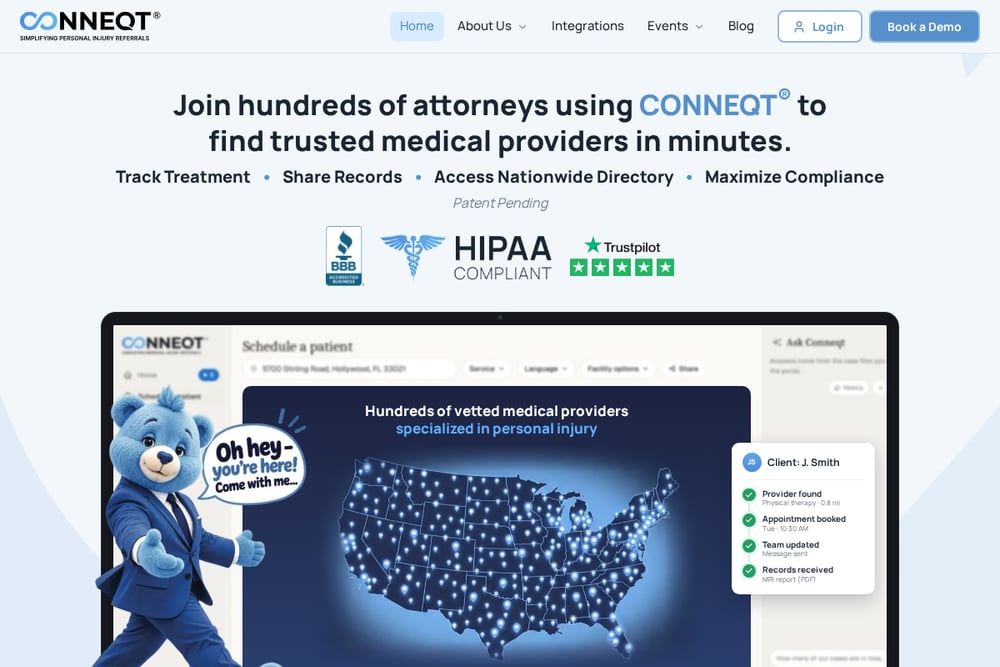
CONNEQT positions itself as a full case-management layer on top of a provider directory, not just a search box. The platform reports 600+ registered law firms, 750+ medical provider locations, and 20,000+ facilitated cases, with HIPAA-compliant record sharing built in. You can manage referrals, track treatment, and communicate with providers in one place rather than stitching together email threads. Its Fort Worth provider page shows how the local landing pages work for firms searching by metro. The tradeoff is that the network is smaller than the biggest open directories, so ultra-rare specialties may require a second source.
#2 LawyersTrend — Personal Injury Law Industry Coverage & Directory
 A screenshot of the LawyersTrend — Personal Injury Law Industry Coverage & Directory website.
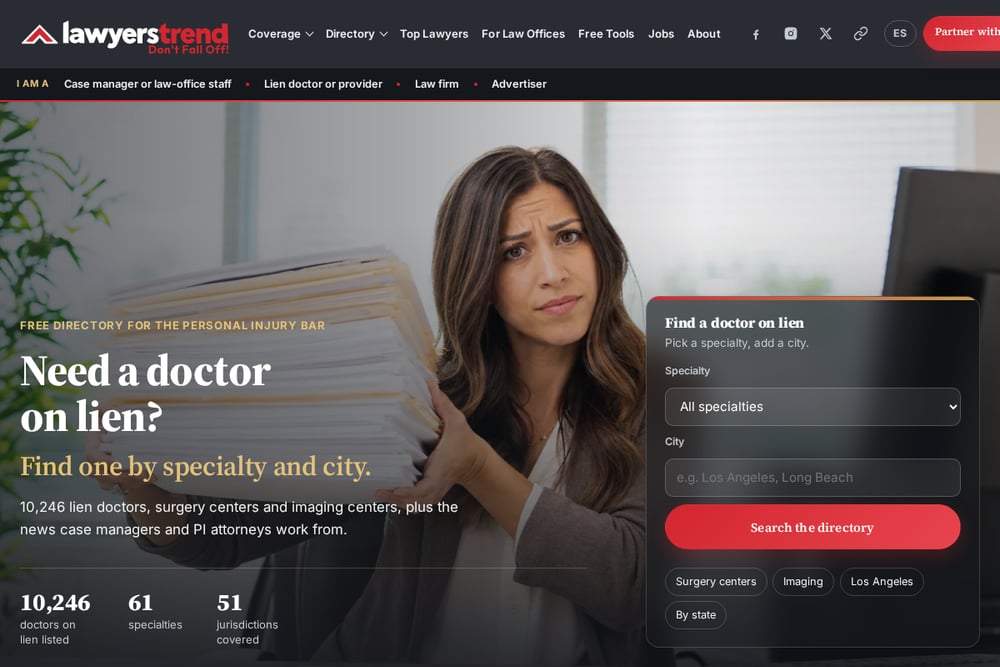
LawyersTrend pairs a directory with a news operation, which is unusual in this space. The site lists 10,246 lien doctors, surgery centers, and imaging centers across 61 specialties and 51 jurisdictions, all free to search by specialty and city. What sets it apart is the editorial layer: case law and settlements coverage, liens and settlement analysis, mass tort updates, and practice operations content aimed squarely at case managers and law-office staff. There are also free case manager tools, including patient handouts and record and bill tracking. Providers list free and get reviewed before going live, which keeps the directory from filling with dead listings. If your staff reads industry news anyway, having the directory in the same tab saves real time.
#3 Injury Institute
 A screenshot of the Injury Institute website.
Injury Institute has been building its network for 31 years, and it shows in the curation. The platform reports 397 medical facilities and a network community of 17,865, with an emphasis on physicians trained at top-tier institutions. Coverage centers on California with an expansion into Arizona, and the network spans personal injury, workers' compensation, and telemedicine. It's a relationship-driven organization — there's an annual black-tie gala, member events, and a digital directory for members. That makes it strong for firms that value a vetted, high-touch roster over raw listing volume. If your cases sit outside California and Arizona, look elsewhere.
#4 Power Liens
 A screenshot of the Power Liens website.
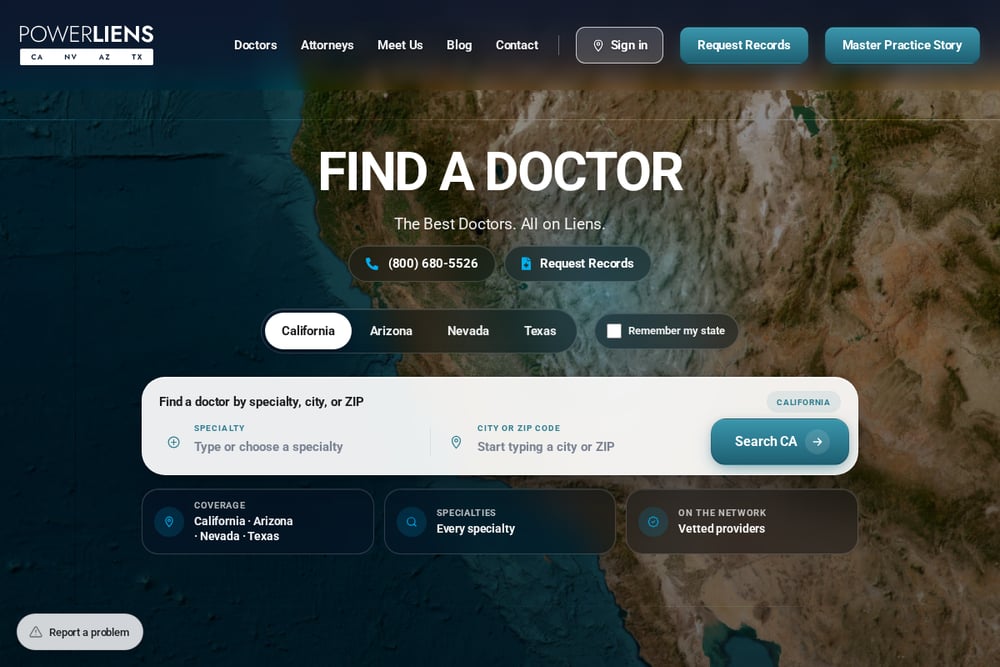
Power Liens keeps the pitch simple: find a doctor by specialty, city, or ZIP, and every provider on the network works on liens. Coverage spans California, Arizona, Nevada, and Texas, with a clean search interface that remembers your state between visits. The platform also offers a Request Records function and a Master Practice Story tool, which are the kind of small workflow additions that save staff time on repetitive tasks. Featured doctor profiles show specialty and city at a glance, so you can scan before you click. It's a focused tool rather than a full case-management system, and for many firms that's exactly the right amount of software.
#5 SoCal Injury Liens
 A screenshot of the SoCal Injury Liens website.
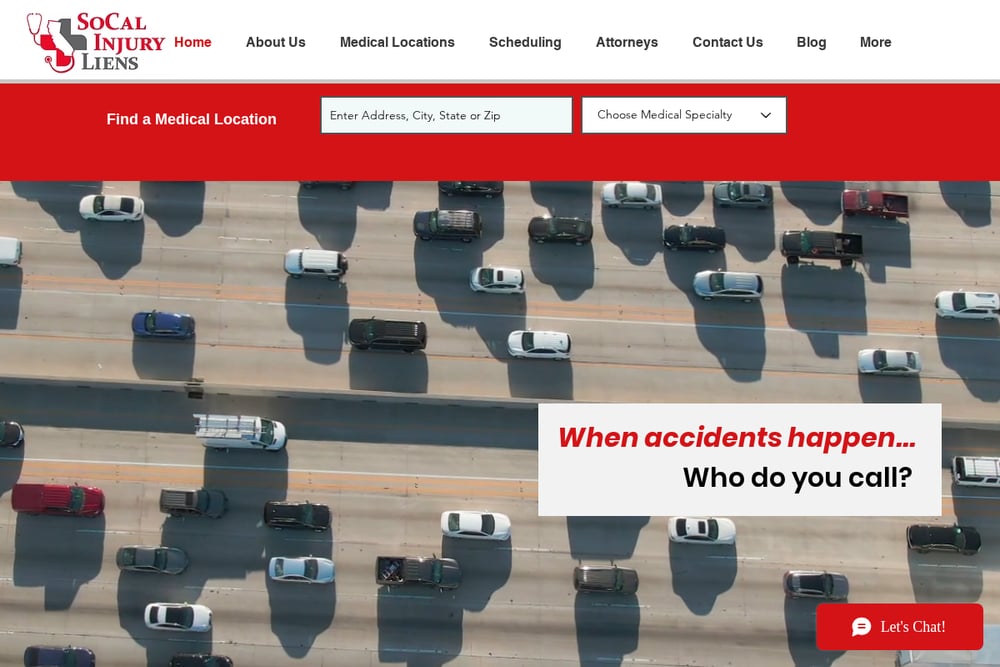
SoCal Injury Liens is a California-only network of independently owned chiropractic and medical centers focused on med-legal evaluations and injury treatment. The specialty list runs deep for a regional network: chiropractic, physical therapy, acupuncture, MRI and X-ray, orthopedics, pain management, neurology, neurosurgery, plastic surgery, and more. The standout feature is scheduling — you fill out an appointment form and the network coordinates the booking for you, which removes a phone call from your case manager's day. A downloadable and printable directory covers dozens of cities from Anaheim to Moreno Valley. It's narrow by design, and that focus is the point.
How to Pick the Right Directory for Your Practice
Start with geography. If all your cases sit in California, a regional network like SoCal Injury Liens or Injury Institute gives you deeper local coverage and a coordinator who knows the market. If you're multistate, you need a national directory — LawyersTrend or CONNEQT — as your baseline.
Then ask what your staff actually struggles with. If the bottleneck is finding providers, any of these five works. If the bottleneck is records, bills, and follow-up, prioritize platforms with built-in tracking like CONNEQT or the record request tools at Power Liens.
Check the specialty depth against your case mix. Mass tort and catastrophic injury practices need neurosurgeons, neuropsychologists, and trauma surgeons on lien. A directory with 61 specialties will serve you better than one with twelve.
Finally, confirm the cost structure before you commit your staff's time. All five are free or low-cost for law firms, but verify what's gated behind a provider listing versus what your firm can access on day one.
Where Automation Fits Into Your Lien Workflow
The repetitive work in lien management is predictable: request records, confirm appointments, track bills, and follow up on treatment status. Map those steps once, then assign each to the tool that handles it best.
Use your primary directory as the source of truth for provider search. Route record requests through a platform with a built-in request function so nothing lives in a personal inbox. Set a standing cadence for bill reconciliation — weekly works for most firms — and log it against the case file. For scheduling, hand off to networks that coordinate appointments for you, and keep a short list of backup providers per specialty so a single cancellation doesn't stall treatment.
The goal isn't more software. It's fewer places where a case can quietly go cold.
The Bottom Line
No single directory wins for every firm. CONNEQT gives you the tightest workflow integration. LawyersTrend gives you the widest free national reach plus the news your case managers already read. Injury Institute and SoCal Injury Liens trade breadth for California depth and hands-on coordination. Power Liens sits in the middle with clean search across four Southwest states.
Pick one as your primary, keep a second as backup for out-of-state referrals, and build your record-request and bill-tracking habits around whichever platform your staff will actually open every morning. That habit, more than the directory itself, is what keeps cases moving.