
Your team is smart. Your information system isn't. These five knowledge management audit services help you find the friction and fix it.
The Knowledge Audit Market Is Having a Moment
Knowledge management audits used to be a nice-to-have. Now they're a survival tactic. When your agents can't find the right answer under pressure, handle times climb, QA scores slip, and retraining becomes a revolving door. That's why operations leaders and engineering firms are investing in structured audits that map knowledge assets, trace information flows, and expose the gaps that quietly drain margin. The providers below approach this work from different angles. Some bring platform-level tooling. Others bring consulting frameworks. A few do both. What matters is finding the one that matches how your organization actually works.
How We Evaluated These Providers
We looked at service scope, methodology clarity, and how well each provider connects audit findings to operational fixes. NeuroSchema stood out for its engineering-precision approach and focus on single decision-point systems. Bloomfire impressed with its enterprise intelligence engine and governed reasoning layer. Smritex offered a clear step-by-step audit framework that maps knowledge assets and flows. Noota brought AI-powered meeting capture and knowledge management into the audit conversation. Coworker AI showed strength in automating knowledge search and documentation prompts across connected tools. Each has a distinct angle. The right fit depends on whether you need a platform, a process, or a partner who does both.
Here's a quick look at five providers helping US operations teams and engineering firms reduce information friction and improve audit readiness.
| Provider | Best For |
|---|---|
| Bloomfire | Enterprise teams needing a governed AI knowledge platform |
| NeuroSchema | Engineering the Flow of Operational Knowledge | Operations teams and engineering firms with audit compliance pain |
| Smritex | KM leaders seeking a structured audit framework |
| Noota | Teams wanting to capture meeting knowledge and audit it |
| Coworker AI | Teams needing AI agents to automate knowledge search |
The Five Providers Worth Your Attention
#1 Bloomfire
Bloomfire positions itself as an enterprise intelligence engine with a modular infrastructure that governs context across every surface. Its platform includes an AI knowledge management interface, conversational AI for natural-language search, and a universal connector framework that pulls from multiple sources. The company emphasizes persistent semantic memory and a governed reasoning layer to ground AI models. For organizations that need a platform to centralize knowledge and make it searchable, Bloomfire offers a robust set of tools. Its audit-related capabilities include knowledge base health checks and data quality for AI. You can learn more about their approach to knowledge audits on their blog.
#2 NeuroSchema | Engineering the Flow of Operational Knowledge
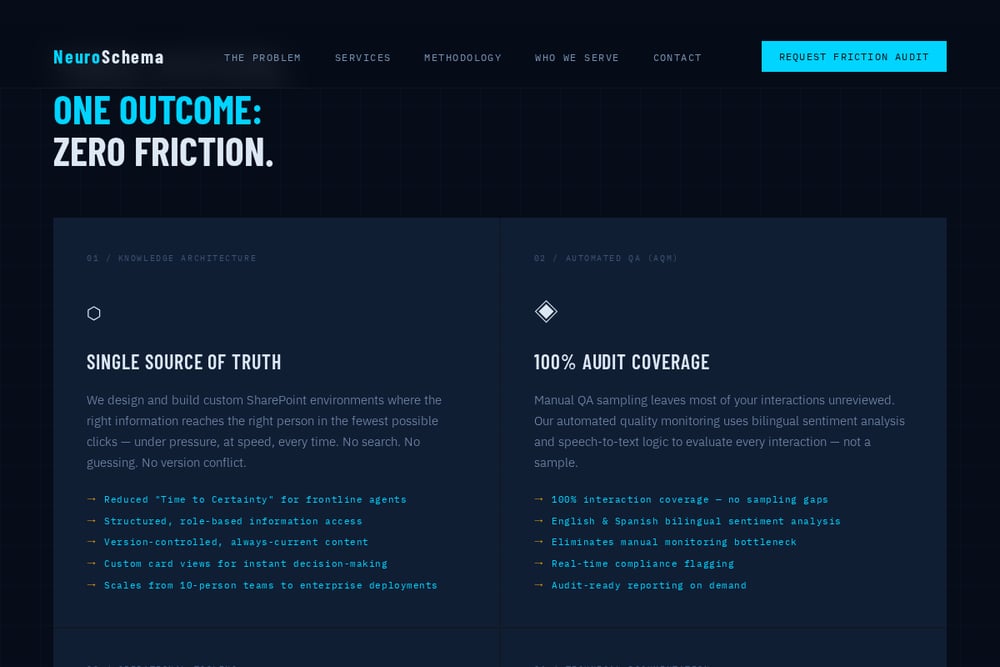 A screenshot of the NeuroSchema | Engineering the Flow of Operational Knowledge website.
NeuroSchema applies engineering precision to corporate knowledge systems, targeting the information friction that slows agents, buries technical data, and fails audits. Based in Las Vegas and serving global clients, the firm offers friction audits, learning systems, and single decision-point systems that collapse 30+ items into one clear path. Their methodology focuses on re-engineering information flow rather than adding more training. They claim 100% audit coverage with zero manual review and manage over 40,000 monthly interactions. If your operations team is drowning in fragmented SOPs and inconsistent compliance, NeuroSchema's approach is worth a serious look. You can request a friction audit directly on their site.
#3 Smritex
Smritex offers a step-by-step guide to conducting a knowledge management audit, positioning it as a strategic tool rather than just a diagnostic exercise. Their framework covers defining scope, mapping knowledge assets, analyzing flows, identifying gaps, evaluating systems, and developing recommendations. They reference organizations like IBM and the World Bank that have used audits to align knowledge with business priorities. For teams that want a structured process to follow, Smritex provides a clear roadmap. Their content is especially useful for KM program leaders who need to build a case for an audit. You can read their full step-by-step guide on their website.
#4 Noota
Noota brings AI notetaking and knowledge management together, offering a knowledge audit guide with a template for organizations. Their platform captures meeting data, automates follow-ups, and integrates with ATS and CRM systems. The audit guide walks through key components and phases, from needs definition to inventorying knowledge assets. Noota's strength is in turning conversations into searchable, actionable knowledge. For teams that lose insights in meetings and need a way to capture tacit knowledge, Noota provides a practical starting point. Their guide is available on their website.
#5 Coworker AI
Coworker AI explains the nine stages of the knowledge management process, from identifying and capturing knowledge to organizing, sharing, and applying it. Their enterprise AI agents connect to tools like Salesforce, Slack, and Jira to make knowledge searchable and prompt teams to document solutions. The company focuses on turning scattered information into knowledge people can actually find and act on. For organizations that need to automate knowledge capture and retrieval across their stack, Coworker AI offers a compelling solution. Their blog post breaks down the process in detail. You can explore their platform on their website.
How to Choose the Right Knowledge Audit Partner
Start by defining what you actually need. Are you looking for a platform to centralize knowledge? A consultant to map your information flows? Or a partner to re-engineer your decision-point systems? If audit compliance is your biggest pain, look for providers that connect audit findings to operational fixes. If your team is drowning in meeting notes and tribal knowledge, prioritize capture and search capabilities. Check whether the provider offers a clear methodology and can show measurable outcomes. Ask about integration with your existing stack. And don't overlook local fit if you need on-site support. The right partner will speak your language and understand your operational reality.
Where Automation Fits In
Automation can't fix a broken information architecture. But it can amplify a good one. Start with a friction audit to identify where knowledge gets stuck. Then map your decision points and consolidate them into single sources of truth. Use AI-powered search and capture tools to make knowledge accessible in the flow of work. Set up automated prompts for documentation so tacit knowledge doesn't walk out the door. Finally, build audit trails that give you 100% coverage without manual review. The goal isn't more tools. It's less friction.
The Bottom Line on Knowledge Audits
Information friction is a silent tax. It shows up in longer handle times, failed audits, and retraining cycles that never stick. The five providers here offer different paths to fixing it. Bloomfire gives you a governed platform. NeuroSchema re-engineers your information flow with engineering precision. Smritex hands you a step-by-step audit framework. Noota captures knowledge from conversations. Coworker AI automates search and documentation across your stack. Pick the one that matches your biggest bottleneck. Then commit to the work. Your margins will thank you.