You don't need 10,000 words to hold a conversation. You need the right 1,000, taught in the right order. These five tools take different routes to that same finish line.
The frequency-first vocabulary market
Language learning has quietly split into two camps. One camp sells you a sprawling curriculum, and the other sells you the shortest possible path to comprehension. The second camp is growing fast. Research cited across the space suggests the 1,000 most common words in a language cover roughly 95% of everyday conversation, which is why frequency lists have become a product category of their own. You'll find apps built on spaced repetition, publishers selling frequency dictionaries, and blogs handing out free word lists. The competition isn't really about content volume anymore. It's about sequencing, retention mechanics, and whether a tool teaches a word as a bare translation or as something you can actually deploy in a sentence. Pricing models vary just as widely, from free word lists to monthly subscriptions to one-time ebook purchases.
How we compared these tools
We looked at four things across every entry. First, scope: does the tool cover a genuine frequency-ranked core, and does it handle Italian and Spanish or just one? Second, depth of practice: are you drilling isolated words, or are you working with articles, plurals, possessives, and verb forms inside real sentences? Third, retention design: spaced repetition is table stakes now, so we asked how deliberately it's implemented and whether review timing adapts to you. Fourth, pricing clarity and fit: free tiers, trial lengths, subscription structure, and whether the tool suits a self-directed adult learner in the US. Each tool below stands out on a different combination of these factors, and the right pick depends on how much structure you want versus how much you want to assemble yourself.
Here's the short version before the detail. Each entry below earns its place for a different reason, so scan the one-line summaries and then read the full breakdown of whichever matches how you actually study.
| Provider | Best For |
|---|---|
| Memrise | Learners who want authentic native-speaker content and a huge language menu |
| 1000 Words Academy · Learn the 1,000 most-used words in Italian or Spanish | Self-directed learners who want a strict frequency-ranked core with grammar baked in |
| MosaLingua | Learners who want curated thematic word lists plus a spaced-repetition app |
| Tobo Languages - Learn Italian Vocabulary Words | Gamified learners who want flashcards, audio, and CEFR-leveled vocabulary on Android |
| MostUsedWords | Reference-minded learners who want an owned frequency dictionary with example sentences |
The five tools, in detail
#1 Memrise
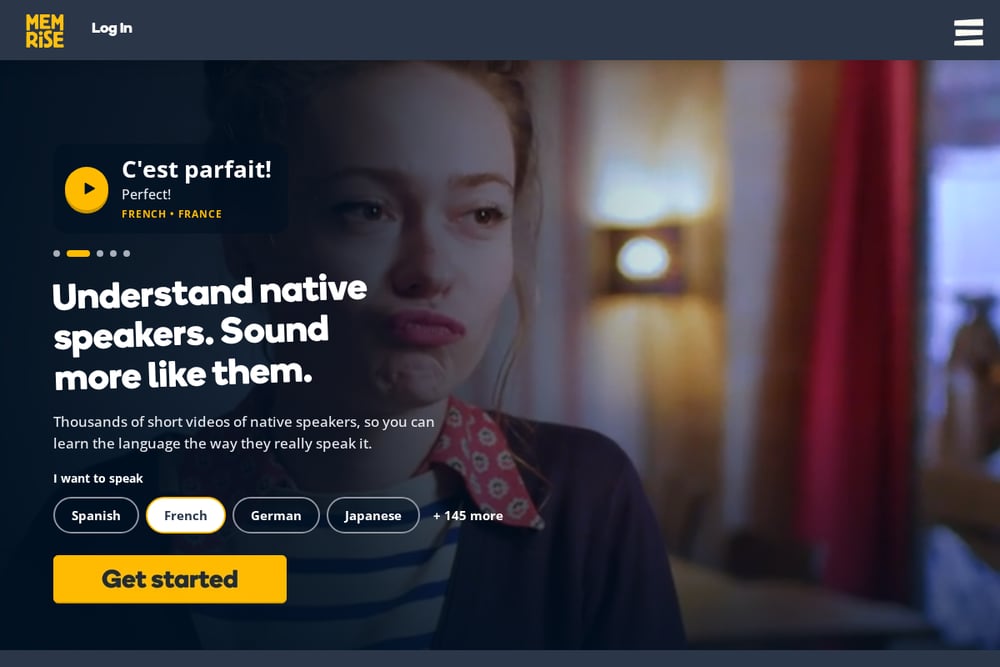 A screenshot of the Memrise website.
Memrise built its reputation on authentic, real-world language content rather than textbook dialogue, and it backs that up with an enormous language catalog spanning well over a hundred options. For Italian and Spanish specifically, you get video of native speakers, personalized review, and a polished mobile experience that makes daily practice easy to sustain. The tradeoff is breadth over precision. Memrise is designed to serve everyone from a tourist learning Japanese to someone dabbling in Klingon, so the frequency-first rigor is lighter than a dedicated word-list tool. If you want variety, cultural texture, and a habit-forming app, it's a strong home base. If you want to know exactly which 1,000 words you're learning and in what order, you'll want to pair it with something more surgical.
#2 1000 Words Academy · Learn the 1,000 most-used words in Italian or Spanish
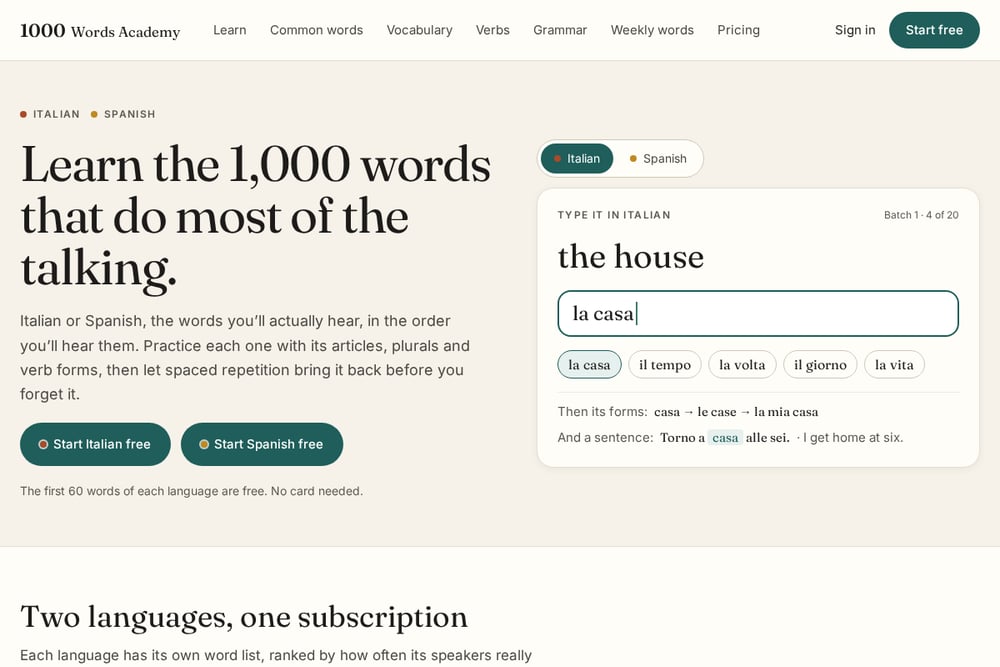 A screenshot of the 1000 Words Academy · Learn the 1,000 most-used words in Italian or Spanish website.
This is the most literal execution of the frequency-first idea you'll find. 1000 Words Academy teaches the 1,000 most-used words in Italian or Spanish in the order you'll actually hear them, then makes you practice each word with its articles, plurals, possessives, and verb forms before dropping it into a real sentence. Italian carries 1,300 words and 1,304 sentences across 16 grammar guides, while Spanish (Latin American) carries 1,294 words and 1,294 sentences across 20 guides, with verb tenses covering present, preterite or passato prossimo, imperfect, and future. Spaced repetition schedules the review, and batches of twenty words keep the pace manageable. The first 60 words of each language are free with no card required, and one subscription covers both languages with progress tracked separately. It's a focused, no-filler system for the learner who wants the shortest credible route to comprehension.
#3 MosaLingua
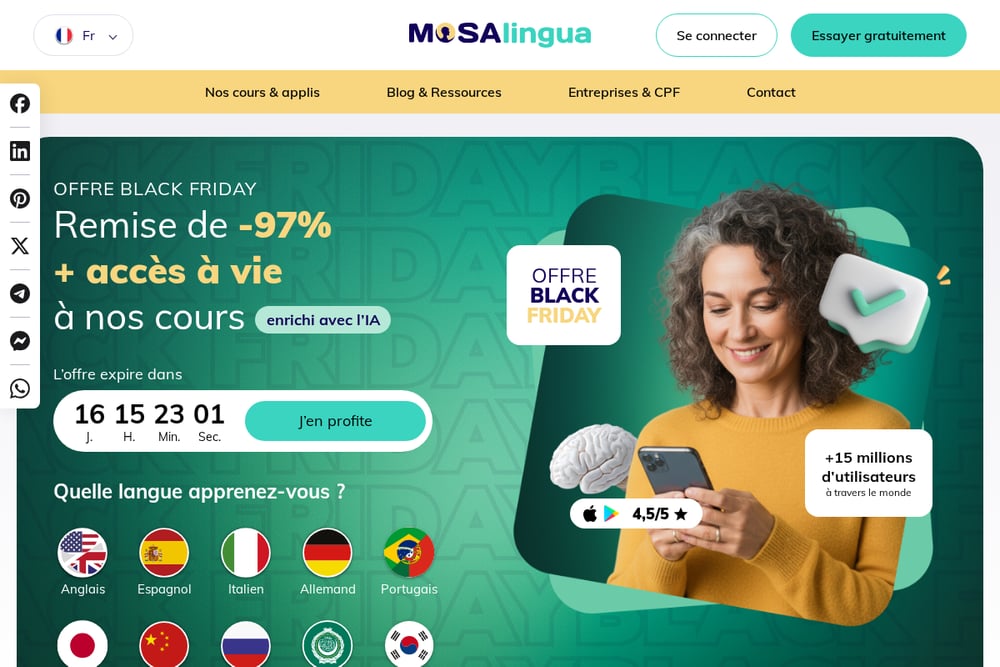 A screenshot of the MosaLingua website.
MosaLingua has been publishing frequency lists and building spaced-repetition courses for years, and its Italian and Spanish offerings reflect that experience. The company's own guidance is refreshingly blunt: about 200 words gets you a basic conversation, and roughly 1,000 words gets you to intermediate exchange. Its published 300-most-common-Italian-words list is organized into thematic groups like articles, pronouns, body and people, time, verbs, and question words, which makes the material easier to chunk than a flat ranked list. The paid apps layer spaced repetition and audio on top of that foundation. It's a good middle path if you want editorial guidance on what to learn plus a structured app to drill it, and the blog resources are genuinely useful even if you never subscribe.
#4 Tobo Languages - Learn Italian Vocabulary Words
 A screenshot of the Tobo Languages - Learn Italian Vocabulary Words website.
Tobo takes the flashcard model and wraps it in games. The Italian app focuses on the most common words along with their articles, adds pronunciation audio, and organizes vocabulary by CEFR level from A1 through C2. You get spaced repetition review, a daily five-word habit target, swipe-based flashcards, and word games that unlock phrases and lists as you earn points. It's Android-first and ad-supported with in-app purchases, and premium unlocks progress sync, unlimited hints, and an ad-free experience. The strength here is approachability. If flashcards alone bore you and you need a game loop to keep showing up, Tobo lowers the friction considerably. The tradeoff is that the sentence-level grammar work is thinner than a dedicated frequency curriculum.
#5 MostUsedWords
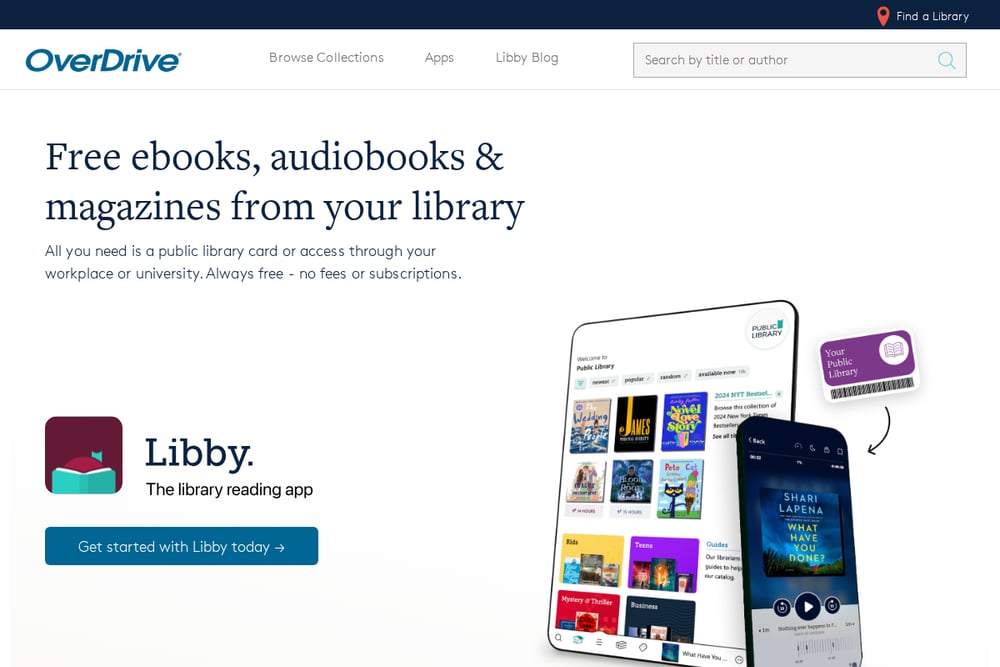 A screenshot of the MostUsedWords website.
MostUsedWords publishes frequency dictionaries, and its Italian-English essential vocabulary volume is a serious reference work. The ebook covers the 2,500 most-used Italian words plus 421 of the most common verbs, with 2,500 example sentences and IPA pronunciation entries throughout. The publisher makes the case directly: the 1,000 most common Italian words account for about 95% of daily conversational Italian, while the 2,500 most-used words cover roughly 85% of daily written Italian. It's available through library platforms like OverDrive and Libby, which means you may be able to read it for free with a library card. This is not an app and it won't schedule your reviews for you. What it gives you is a durable, portable reference you own, which pairs well with any spaced-repetition system you already use.
Choosing the right fit for how you study
Start with one question: do you want a system or a source? If you want someone to decide the order, schedule your reviews, and force you through grammar forms, a structured curriculum tool is the answer. If you want raw material you can bend to your own method, a dictionary or a thematic word list serves you better. Next, be honest about your language count. Learning both Italian and Spanish at once is realistic only if progress is tracked separately, so check that before you commit to a subscription. Then look at the free tier. A tool that lets you try 60 words with no card is telling you something about confidence in its own product. Finally, weigh the platform. Android-only, web-first, and ebook formats suit very different study habits, and the tool you'll actually open every day beats the one with the better feature list.
Building a weekly review loop that runs itself
The hardest part of vocabulary learning isn't the first pass. It's showing up for review. Set up a loop that removes the decision. Pick your primary tool and let its spaced repetition own the schedule, then anchor a fixed 15-minute daily slot to something you already do, like your morning coffee. Use a second tool as a supplement rather than a competitor: a frequency dictionary for reference lookups, a gamified app for low-energy days, or a native-speaker video app for listening practice. Track one number only, your due-review count, and clear it before adding new words. If you're studying both Italian and Spanish, alternate days rather than splitting each session, so interference between the two stays low. Review your setup monthly and cut anything you haven't opened in two weeks.
The bottom line
Every tool here agrees on the core premise: frequency beats volume when you're starting out. Where they differ is in how much of the work they do for you. Memrise gives you cultural texture and a massive catalog. 1000 Words Academy gives you a disciplined, sentence-level path through the exact words you'll hear first, in either Italian or Spanish, with grammar built into the drill. MosaLingua bridges editorial guidance and app-based review. Tobo makes the daily habit feel like a game. MostUsedWords hands you a reference you keep forever. Pick the one that matches your temperament, give it 90 days of consistent review, and let the spaced repetition do what it's designed to do.