You want answers about your faith without wading through unreliable forums or unverified claims. These five Islamic AI chat tools put the Quran and authentic hadith at your fingertips, with sources you can actually check.
The Rise of Source-Cited Islamic AI
Islamic AI chat is having a moment. Muslims in the US and beyond are turning to AI assistants for spiritual guidance, dua suggestions, and hadith verification. The differentiator is trust. The strongest tools in this space do not just generate answers; they show you the ayah, the hadith collection, the reference number, and the grade. That transparency matters when you are asking about something as personal as your faith. Most of these platforms are free to start, work across web and mobile, and support multiple languages. The category is young, but the bar is already high: cite your sources or lose your users.
How We Evaluated These Tools
We looked at five factors across every tool. First, source transparency: does the reply show the Quran verse or hadith with a reference and grade? Second, scope: can you ask about feelings, fiqh-adjacent life topics, duas, and hadith verification in one place? Third, language support: how many languages can you write in and get answers back? Fourth, access and pricing clarity: is there a free tier, and is it obvious what you get? Fifth, platform fit: web, iOS, Android, and how easy it is to start without friction. My Quran Companion stood out for pairing every reply with full citations and hadith grades in eight languages. MuslimGPT impressed with a broad feature set including prayer times, Qibla, and a large hadith corpus. Islam & AI emphasized research-style answers with numbered references and a free-forever core. ChatILM leaned on decades of curated Islamic knowledge. My Quran kept things simple and private with a focused Quran-guidance chat.
Here is a quick look at how the five tools compare on the factors that matter most: citations, scope, languages, and access.
| Provider | Best For |
|---|---|
| MuslimGPT | All-in-one daily practice and study |
| My Quran Companion: AI Chat That Cites the Quran and Hadith | Comfort, duas, and hadith checks with full citations |
| Islam & AI | Research-minded users who verify every reference |
| ChatILM | Users who trust established scholarly curation |
| My Quran | Simple, private Quran-focused guidance |
The Five Tools in Detail
#1 MuslimGPT
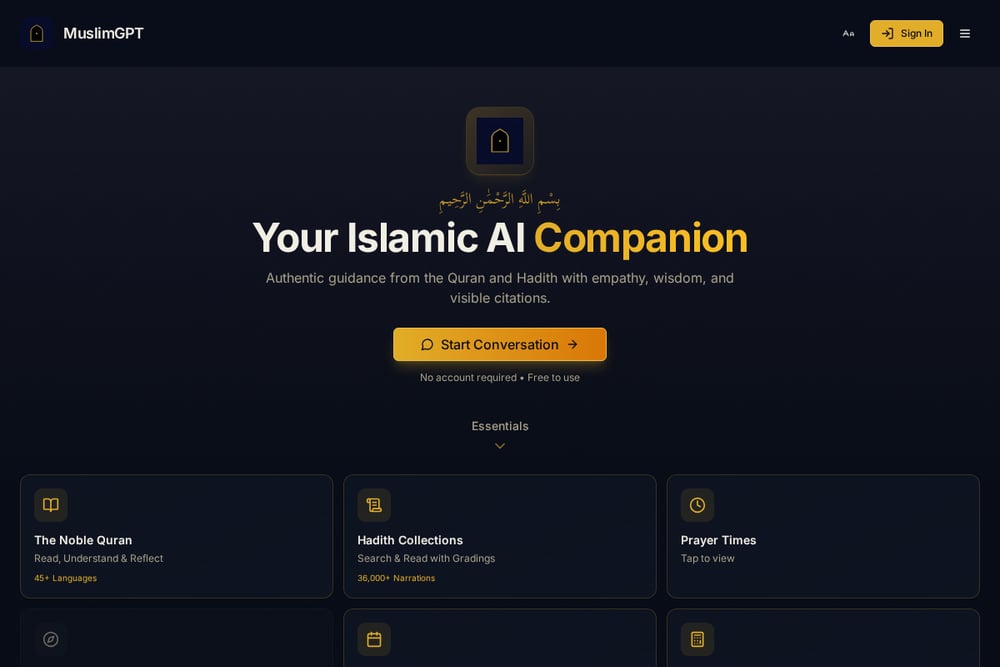 A screenshot of the MuslimGPT website.
MuslimGPT positions itself as a full Islamic AI companion, and the breadth shows. You get chat grounded in the Quran and hadith with visible citations, plus built-in tools for prayer times, Qibla, a Hijri calendar, and a zakat calculator. The hadith corpus is large, and answers include authenticity grades so you can see whether a narration is Sahih, Hasan, or Da'if. It works on web, Android, and iOS with no account required. If you want one app that handles both study and daily practice, this is a strong fit. See the platform at https://themuslimgpt.com/.
#2 My Quran Companion: AI Chat That Cites the Quran and Hadith
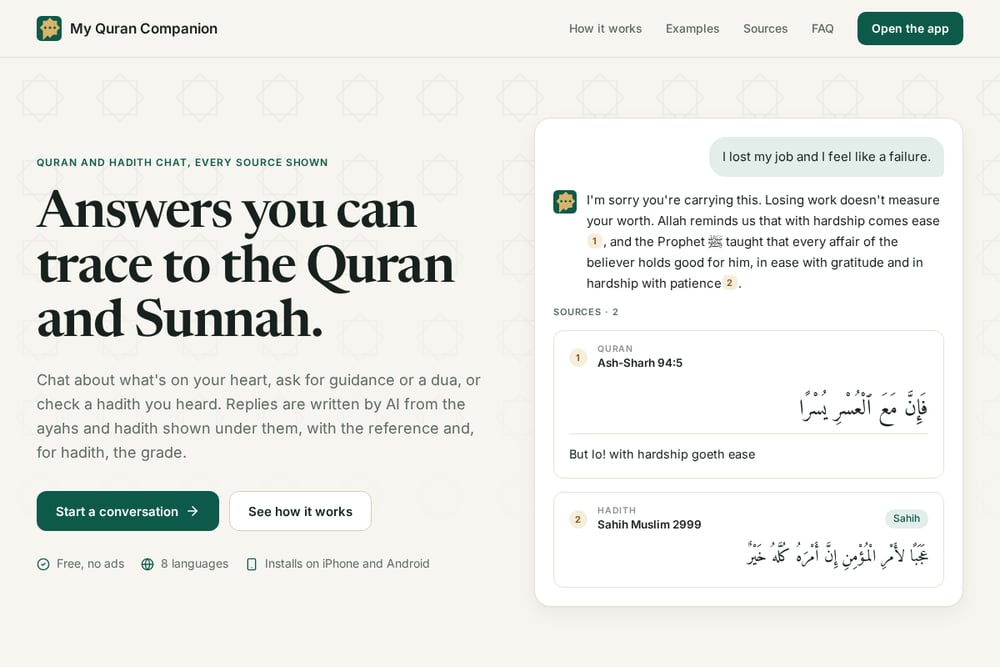 A screenshot of the My Quran Companion: AI Chat That Cites the Quran and Hadith website.
My Quran Companion keeps the focus on what you are carrying right now. You write what is on your heart, and the reply is written by AI from the ayahs and hadith shown underneath it, with the reference and, for hadith, the grade. It searches the Quran and more than 29,000 authentic hadith by meaning, mood, and situation, including duas taught for worry, debt, illness, and travel. It is free, has no ads, supports eight languages, and installs on iPhone and Android. The experience is gentle and traceable, which is exactly what you want when you are looking for comfort or checking a saying you heard. Explore it at https://myqurancompanion.com/.
#3 Islam & AI
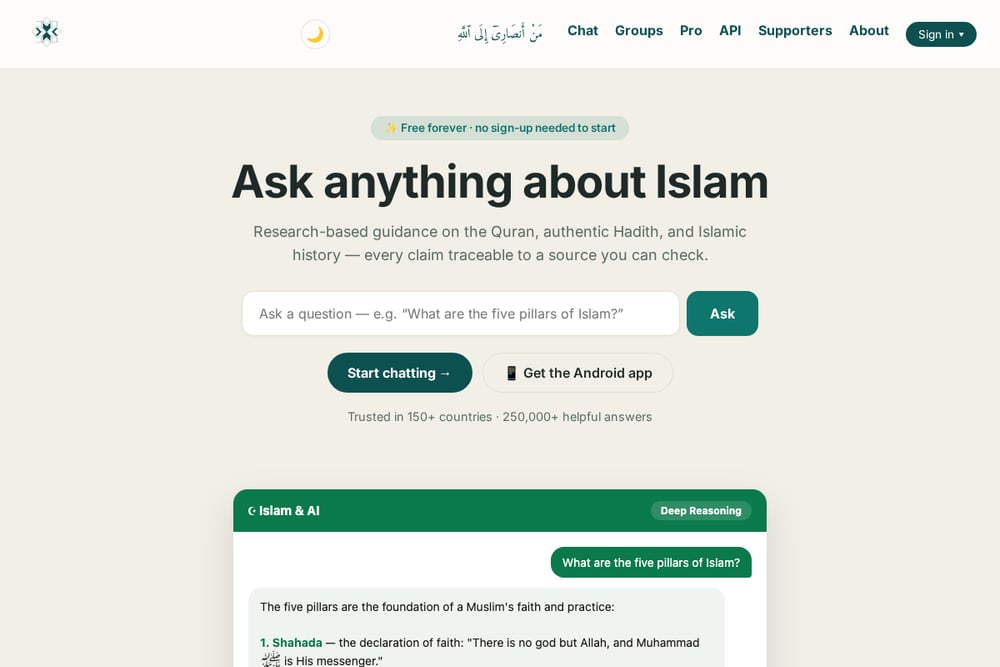 A screenshot of the Islam & AI website.
Islam & AI frames itself as research-based guidance, and the interface reflects that. Every answer draws on the Quran and authentic Sunnah with references by number so you can verify the claim yourself. It supports English, Urdu, Arabic, French, and more, and the core chat is free with no card required. The platform reports use in 150+ countries and a large volume of answered questions, which suggests a mature retrieval layer. If you like to check the receipt on every answer, this one is built for you. Visit https://islamandai.com/.
#4 ChatILM
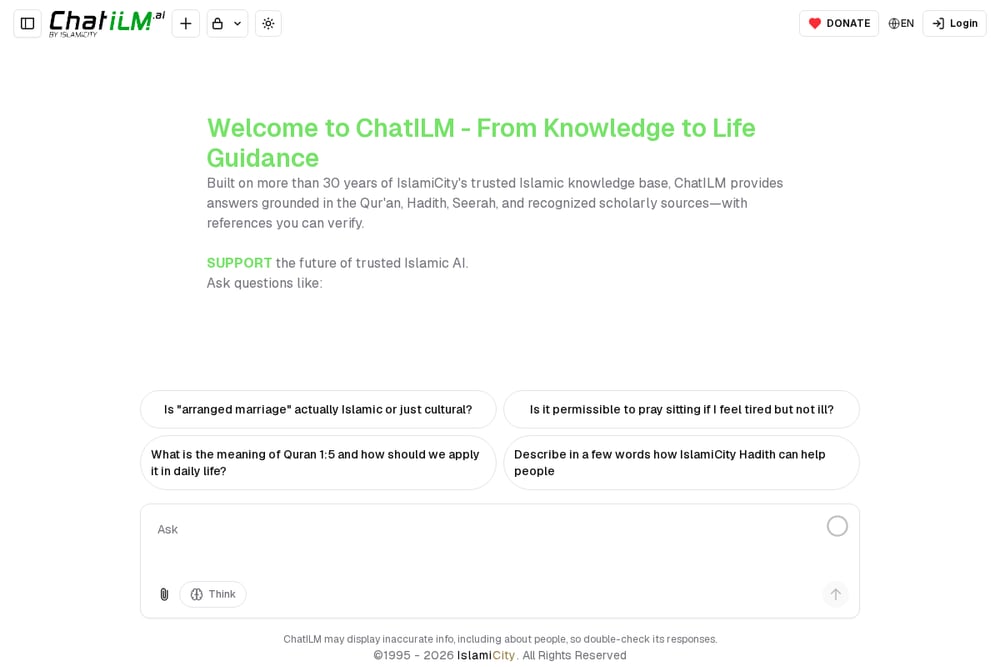 A screenshot of the ChatILM website.
ChatILM comes from IslamiCity, which has been building Islamic knowledge resources for more than 30 years. The chat is grounded in the Quran, hadith, Seerah, and recognized scholarly sources, with references you can verify. That institutional backing gives it a different flavor from the newer entrants: it feels like a guided knowledge base rather than a pure chatbot. You can ask practical and personal questions and get answers tied back to trusted material. It is a solid choice if you value a long-standing editorial tradition behind the AI. See it at https://chatilm.islamicity.org/.
#5 My Quran
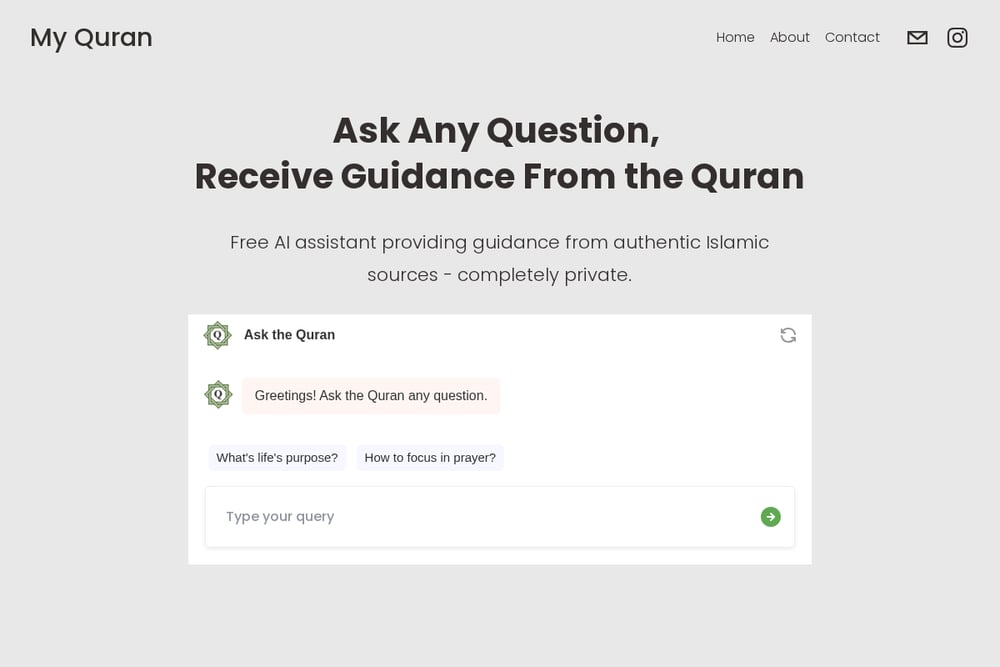 A screenshot of the My Quran website.
My Quran takes a deliberately narrow approach: ask any question and receive guidance from the Quran through a free AI assistant. The pitch emphasizes privacy, which will appeal to you if you are hesitant about sharing personal struggles with a chatbot. The product is still evolving, and the site notes ongoing improvements, so expect the feature set to grow. It is a clean starting point if you want Quran-focused guidance without extra modules. Check it out at https://www.myquran.online/.
How to Pick the Right One for You
Start with your primary use case. If you want one app for chat, prayer times, Qibla, and zakat, MuslimGPT covers the most ground. If you are hurting and want comfort with sources attached, My Quran Companion is built around that moment. If you treat every answer as a research task, Islam & AI gives you numbered references to chase. If institutional pedigree matters to you, ChatILM brings decades of curated knowledge. If privacy and simplicity are your top concerns, My Quran keeps the surface small. Next, check language support against the language you think in. Then confirm the free tier covers what you need before you commit. Finally, test one real question in each tool and see which reply you would actually trust enough to share.
Where Automation Fits in Your Study Routine
You can use these tools as a first pass, not a final authority. Ask your question, read the cited ayah and hadith, and note the reference and grade. Save the ones that resonate for later reflection. When a hadith comes up in a talk or a group chat, run it through the chat to see whether it appears in the authentic collections and what grade it carries. For duas, match the situation, such as debt, illness, or travel, and keep the Arabic and translation together. Treat the AI as a librarian that hands you the book, not as the scholar who issues the ruling. For anything that affects your obligations or family law, take the references to a qualified local scholar.
The Bottom Line
The Islamic AI chat category has matured fast, and the common thread among the strongest tools is transparency. You should never have to take an answer on faith alone; you should be able to see the ayah, the hadith, the reference, and the grade. My Quran Companion makes that the center of the experience, with gentle replies and full citations in eight languages. MuslimGPT wraps it in a broader daily-practice toolkit. Islam & AI, ChatILM, and My Quran each bring a distinct angle, from research rigor to institutional heritage to privacy-first simplicity. Try two or three with a real question, and keep the one whose sources you would actually forward to a friend.