
Insurance brokerages are drowning in email, BMS updates, and carrier chases. These five tools help you work each request to done without adding headcount.
The quiet revolution inside independent brokerages
Independent insurance brokerages are being asked to grow their books while keeping headcount flat. The old answer was hiring more account managers. The new answer is automation that reads client requests, checks policies, and drafts the next step. According to Strada's 2026 guide, automation is no longer a nice-to-have but a must, with policies processed in minutes and claims handled with fewer errors. Sonant's 2026 list of AI tools for agencies shows a crowded field, from voice agents to note takers. The challenge is finding tools that fit how brokerages actually work: beside the email, inside the BMS, with a human approving every step.
How we evaluated these five tools
We looked at five factors. First, service scope: does the tool handle client requests end-to-end or just one slice? Second, pricing clarity: can you start without a sales call? Third, local fit: does it work with US brokerage systems like BMS and carrier portals? Fourth, human oversight: can your team approve every action before it leaves the office? Fifth, proof of impact: are there real numbers from brokerages using it? Bindry stood out for its request-to-done workflow and free 24-question audit. AI Insurance impressed with parsing for MGAs and program managers. Strada showed strength in browser automation for portals without APIs. Sonant delivered voice and call automation with published ROI cases. UiPath offered enterprise-grade orchestration across carriers and claims.
Here is a quick look at each tool, what it does, and who it serves best.
| Provider | Best For |
|---|---|
| AI Insurance | MGAs and program managers with high submission volume |
| Bindry · Knows your book. Does the work. | Independent brokerages that need request-to-done workflow with human approval |
| Strada | Carriers and brokers needing phone and portal automation |
| Sonant | Agencies overwhelmed by inbound calls and scheduling |
| UiPath | Large carriers and enterprises with complex legacy systems |
The five tools in detail
#1 AI Insurance
 A screenshot of the AI Insurance website.
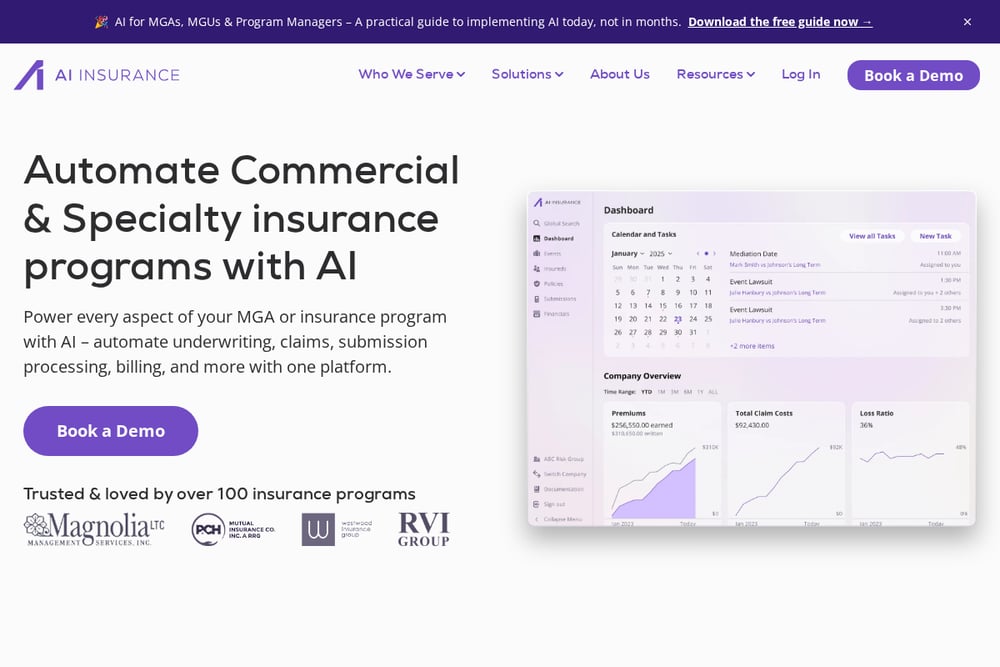
AI Insurance is an all-in-one platform built for MGAs, MGUs, and program managers. It automates underwriting, claims, submission parsing, billing, and bordereaux processing. Forward an email submission and the AI reads the email, downloads files, extracts data, and builds a quote. The company reports 111% average growth in annual premiums and 3.2 hours saved per teammate per week. If you run a program with heavy submission volume, this is a strong fit.
#2 Bindry · Knows your book. Does the work.
 A screenshot of the Bindry · Knows your book. Does the work. website.
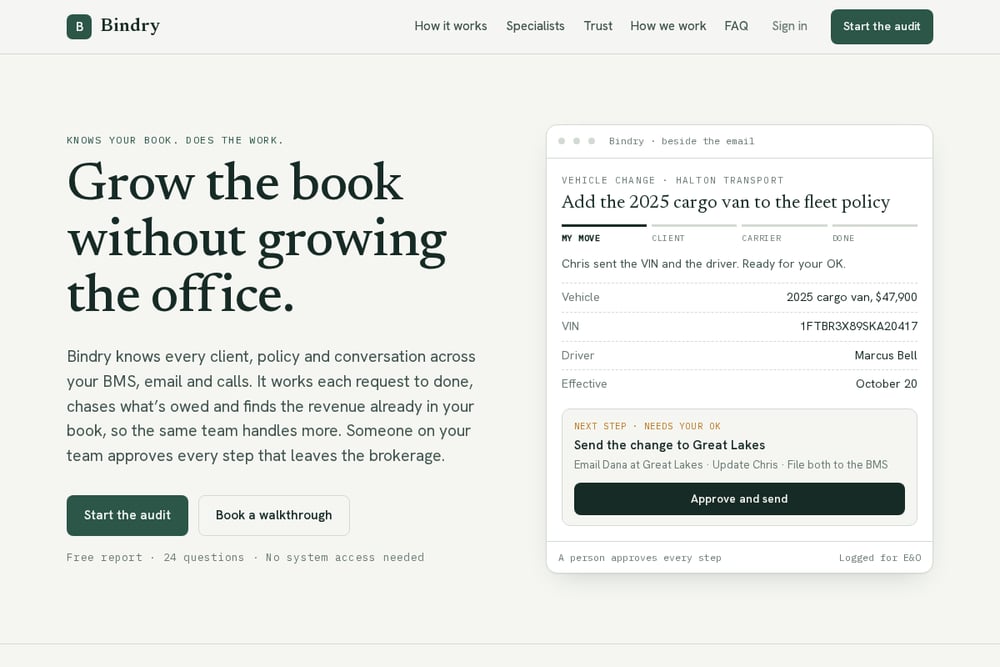
Bindry is an AI assistant that sits beside your email and knows every client, policy, and conversation across your BMS. It reads each request, checks it against the file, and drafts the next step, from vehicle changes to certificates. Nothing leaves the brokerage until someone on your team approves it. You can start with a free report of 24 questions and no system access needed. It is built for independent brokerages that want to grow the book without growing the office.
#3 Strada
 A screenshot of the Strada website.
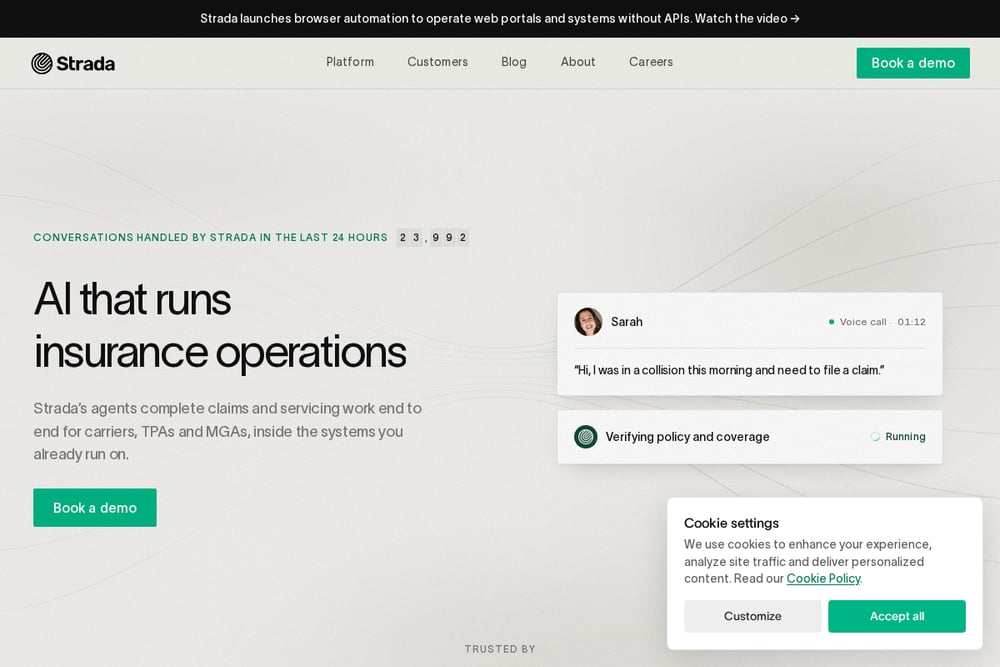
Strada builds AI phone agents and browser automation designed for insurance. It can operate web portals and systems without APIs, which matters when carriers still rely on old portals. The company's 2026 guide on insurance workflow automation explains how policies get processed in minutes and claims handled with fewer errors. Strada is a good fit if your bottleneck is phone calls or portal data entry. It helps carriers, MGAs, and brokers scale revenue-driving calls without adding staff.
#4 Sonant
 A screenshot of the Sonant website.
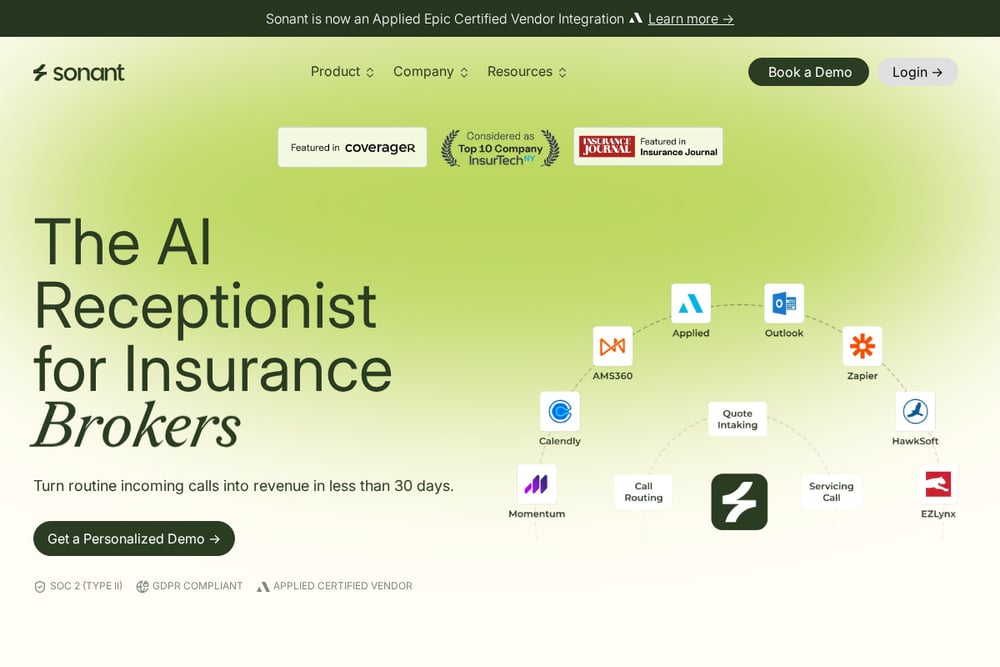
Sonant offers AI voice agents, note takers, and call center automation for insurance agencies. It is an Applied Epic certified vendor integration, so it fits into existing agency management systems. The company publishes case studies, including one agency that achieved 8X ROI in 30 days and another that solved a call crisis with 600% ROI. If your team spends too much time on inbound calls and appointment booking, Sonant is worth a look. It is built for mid-market agencies, enterprise operations, and brokers.
#5 UiPath
 A screenshot of the UiPath website.
UiPath is an enterprise automation platform that combines agentic AI and RPA for insurance. It orchestrates claims, underwriting, policy administration, and billing across the systems a carrier already runs. UiPath was named a Leader in business orchestration, and its platform connects agents, robots, and people. This is not a lightweight tool for a small brokerage; it is for carriers and large operations with complex system landscapes. If you need to automate across many legacy systems, UiPath provides the governance and scale.
How to choose the right tool for your brokerage
Start with your biggest bottleneck. If requests pile up in email and your team manually checks policies, look at Bindry. If you are an MGA drowning in submissions, AI Insurance is built for that. If phone calls and portal data entry eat your day, Strada and Sonant address those directly. If you are a carrier with dozens of legacy systems, UiPath offers the orchestration layer. Next, check integration: does the tool work with your BMS, email, and carrier portals? Then ask about human approval. You want every action reviewed before it leaves the office. Finally, look for a low-risk start, like a free audit or a pilot, so you can prove value before committing.
What a typical automated workflow looks like
A client emails a request to add a vehicle to a fleet policy. The tool reads the email, pulls the VIN and driver details, and checks the policy against the file. It confirms the effective date and coverage. Then it drafts the next step: send the change to the carrier, update the client, and file both to the BMS. A person on your team reviews the draft, changes a word if needed, and approves. The tool sends the email, updates the system, and closes the request. Every step is logged for E&O. That is how you work each request to done without adding headcount.
The bottom line
You do not need to automate everything at once. Pick the tool that solves your most painful workflow first. For independent brokerages, Bindry offers a practical start with a free report and human-approved automation. For MGAs, AI Insurance brings parsing and program management. Strada and Sonant handle calls and portals. UiPath scales across the enterprise. The common thread is simple: let the software do the checking and drafting, and let your people do the approving. That is how you grow the book without growing the office.