Insiders know their companies better than anyone. If you want to follow their money, you need a service that turns raw SEC filings into a signal you can act on.
The Insider-Data Landscape
Insider-trading intelligence has moved from quarterly PDFs to daily, automated feeds. Retail investors now expect the same Form 4 and 8-K coverage that institutions pay six figures for. The result is a crowded field of trackers, screeners, and research desks, each slicing the same public filings in a different way.
How We Evaluated These Services
We looked at four things: coverage of official filings, how quickly data reaches you, how clearly pricing is presented, and whether the tool fits a solo investor or an institutional desk. We also weighed the depth of context, like cluster-buy detection and crypto money-flow data, because raw filings alone rarely tell the whole story.
Here is a quick look at the five services, ordered by how well they balance daily usability with depth of data.
| Provider | Best For |
|---|---|
| The Washington Service | Institutional and quantitative data buyers |
| WhaleWatch | Daily insider and crypto briefings for retail investors |
| SecForm4 | Self-directed research on insider and institutional filings |
| InsiderInsights | Structured insider ratings and alerts on a budget |
| Insider Screener | Global insider tracking across multiple markets |
The Five Services in Detail
#1 The Washington Service
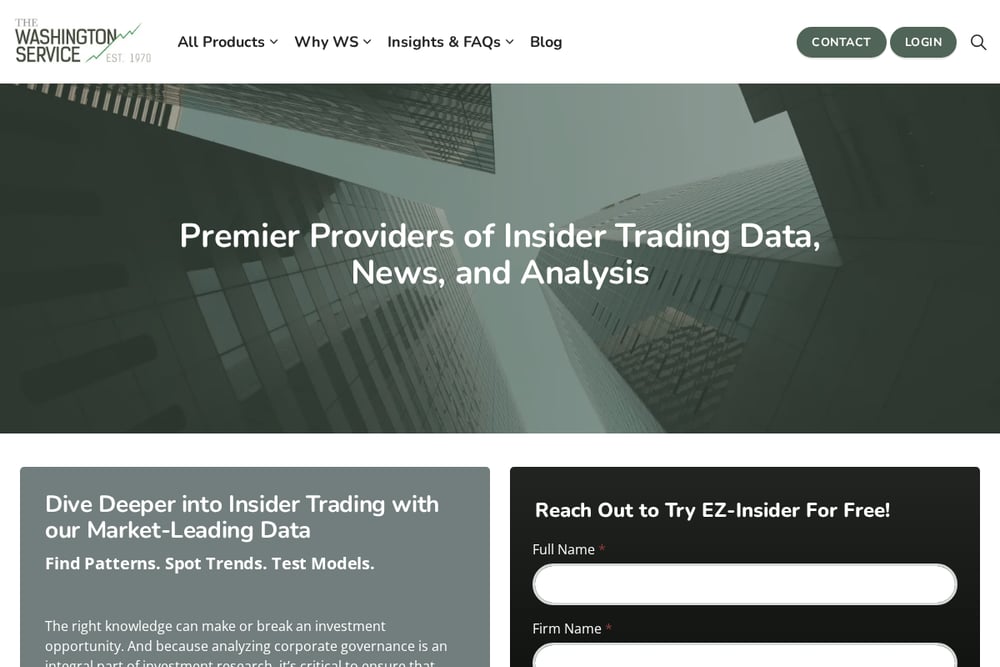 A screenshot of the The Washington Service website.
The Washington Service is the institutional standard for insider data, with roots going back decades. It offers EZ-Insider, insider data feeds, an API, Snowflake access, and a Rule 10b5-1 plan database. You can pull EDGAR feeds, institutional ownership data, and custom research, all from one vendor. It is built for funds, brokerage firms, and legal teams that need clean, licensed data at scale. If you are a solo investor, the depth may be more than you need, but the accuracy is hard to beat.
#2 WhaleWatch
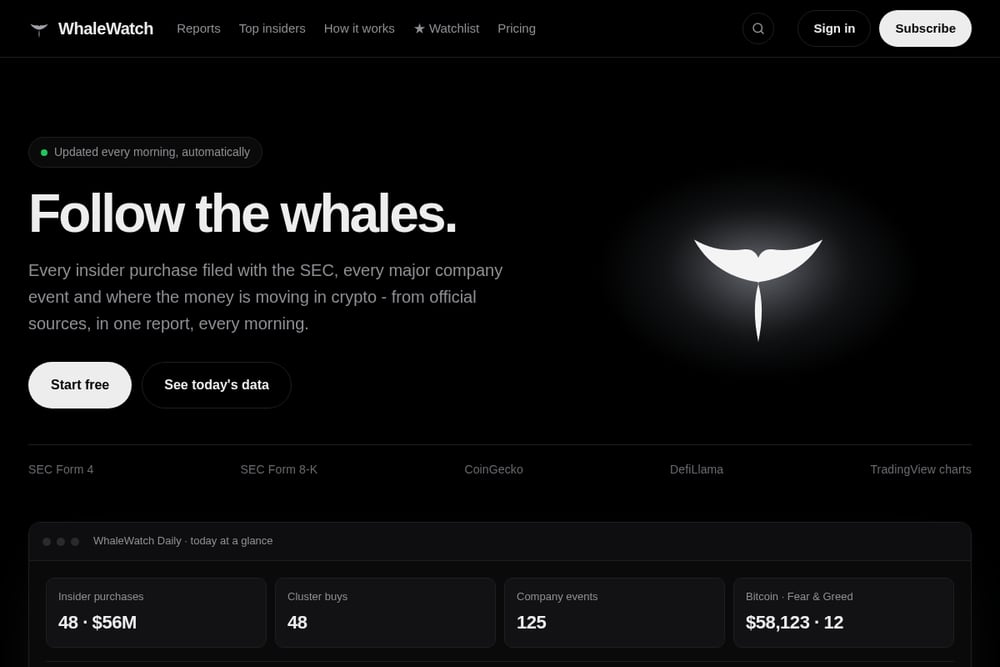 A screenshot of the WhaleWatch website.
WhaleWatch turns SEC Form 4 and 8-K filings into a single morning report you can read in minutes. It ranks insider purchases by size, flags cluster buys where several insiders bought within two weeks, and sorts company events like takeovers and CEO changes by type. The crypto money-flow radar adds stablecoin supply, futures leverage, and which public companies are adding bitcoin. You get a free tier, a watchlist, filtered news, and a weekly summary. It is the easiest entry point for a retail investor who wants daily signal without a terminal.
#3 SecForm4
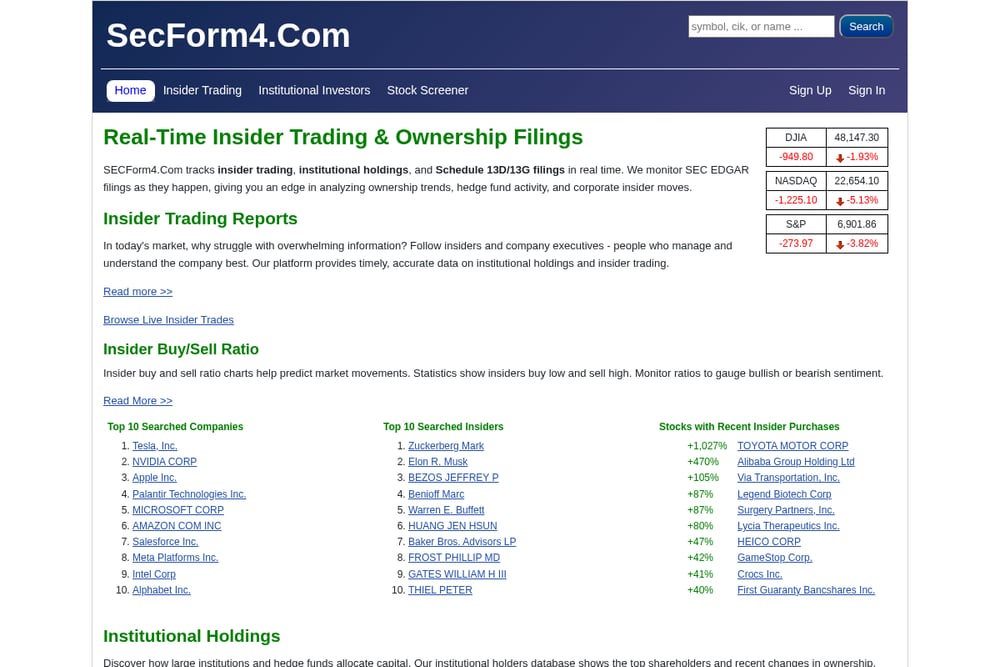 A screenshot of the SecForm4 website.
SecForm4 tracks insider trading, institutional holdings, and Schedule 13D/13G filings in real time. It monitors EDGAR as filings hit, so you can browse live insider trades, buy/sell ratios, and top searched companies. The site also includes hedge fund lists, quarterly top-bought stocks, and a stock screener. It is a broad, free-to-access research hub with a lot of surface area. If you like to dig through data yourself, this is a solid starting point.
#4 InsiderInsights
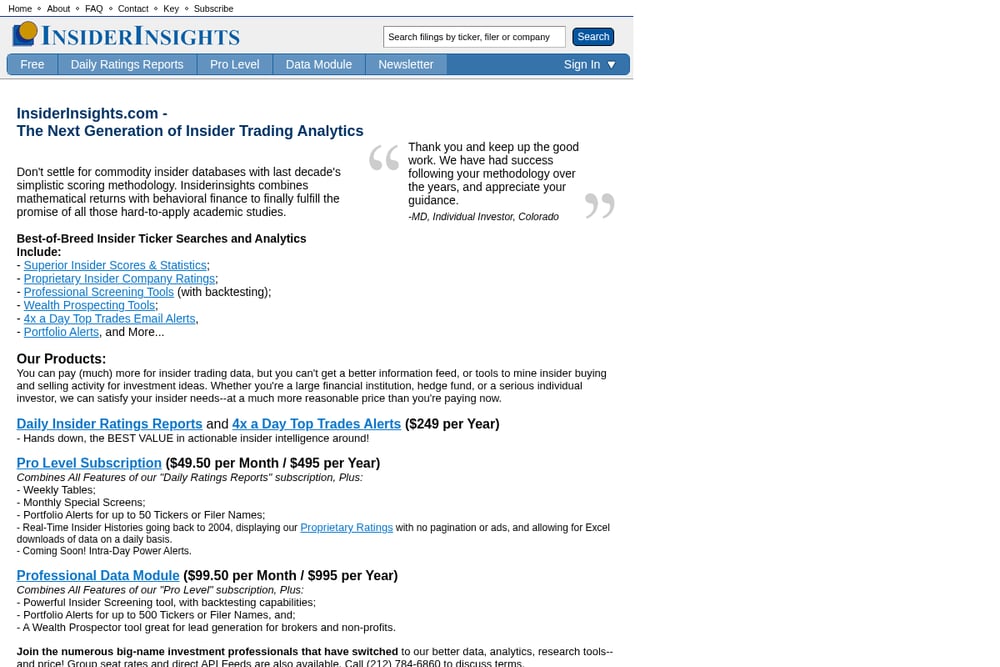 A screenshot of the InsiderInsights website.
InsiderInsights offers daily ratings reports, Excel files, and four-times-a-day top-trade alerts. Its entry-level plan runs $249 per year and includes a portfolio of up to 50 stocks with real-time SEC alerts. Higher tiers add professional search, screening tools, and wealth-prospect search. The company ratings make it easy to fold the insider factor into your routine. It is a good fit if you want structured ratings rather than raw filing lists.
#5 Insider Screener
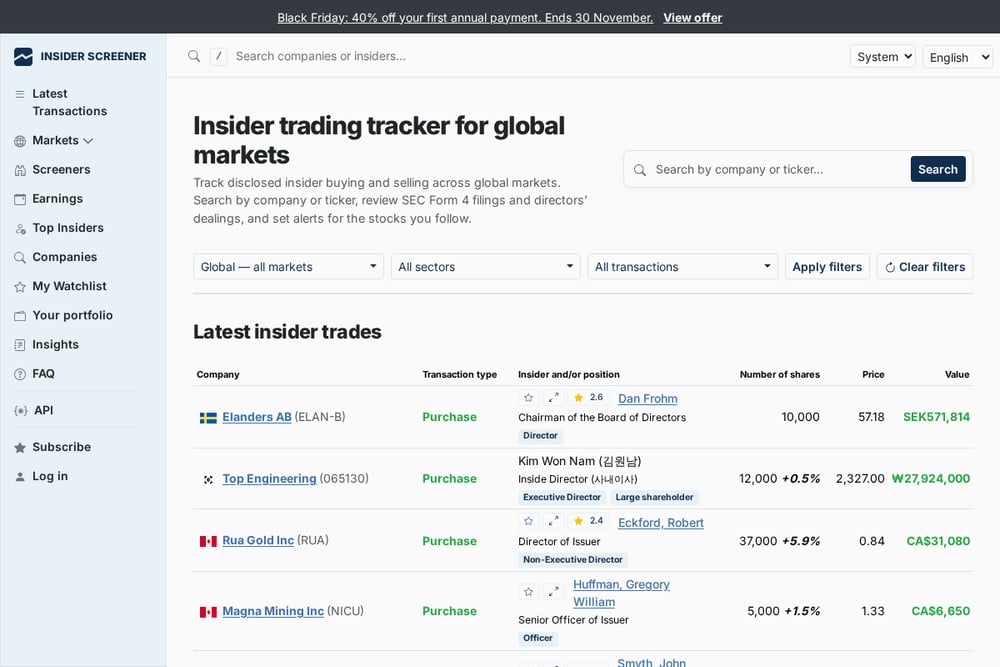 A screenshot of the Insider Screener website.
Insider Screener covers global markets, including the US, Canada, Europe, India, Australia, and South Korea. You can search by company or ticker, review SEC Form 4 filings and directors' dealings, and set alerts for stocks you follow. The interface is clean and filter-driven, with sector and transaction-type filters. It is a strong choice if your watchlist spans more than one country. The trade-off is less editorial context than a daily report provides.
How to Pick the Right Service
Start with your workflow. If you want a five-minute morning read, pick a daily report. If you want to build models, pick a data feed or API. If you want to screen global markets, pick a tracker with broad country coverage. Then check pricing clarity and whether the free tier gives you enough to test the data quality. Finally, confirm the source: every serious service links back to the original SEC filing.
Automating Your Insider Workflow
You can automate most of this. Set alerts for cluster buys and 8-K events, pipe the daily report into your notes app, and use a watchlist to filter out noise. If you need programmatic access, look for an API or Snowflake feed. The goal is to let the service scan filings every morning while you focus on the handful of names that matter to your portfolio.
The Bottom Line
Insider data is public, but the edge comes from how fast and how clearly it reaches you. The Washington Service gives institutions licensed depth, WhaleWatch gives retail investors a daily briefing, and the other three fill gaps in research, ratings, and global coverage. Pick the one that matches your time budget, and let the filings do the talking.