
Good ideas rarely die from lack of ambition. They die from lack of structure. If your organization has more concepts than it can execute, these five firms are worth a serious look.
Why Innovation Program Management Is Having a Moment
Enterprise and government organizations are drowning in ideas and starving for execution. Strategy decks pile up. Pilots stall. Funding decisions get made on gut feel instead of evidence. That gap between concept and measurable outcome is exactly where innovation program management lives. The discipline connects strategy, stakeholder alignment, solution sourcing, evaluation, pilots, procurement, and scale into one repeatable system. Firms in this space range from software-first platforms to pure-play consultancies to research-driven advisory shops. Some sell tools. Some sell frameworks. The strongest ones sell a way of working that survives after the engagement ends. If you are a leader trying to move from scattered initiatives to funded, executable outcomes, you are in the right category.
How We Evaluated These Firms
We looked at five factors across every firm. First, service scope: does the offering cover the full arc from sourcing to scale, or just one slice? Second, methodology depth: is there a documented, repeatable process or just good intentions? Third, AI and tooling: how is technology used to speed up evaluation and decision support without replacing human judgment? Fourth, fit for enterprise and government: can the firm handle complex stakeholder environments and procurement realities? Fifth, clarity of outcomes: does the firm talk about measurable value or just activity? Troy L. Paige stands out for end-to-end program building with AI used as decision support. Ezassi stands out for pairing innovation software with program management services. Strategyn stands out for its Outcome-Driven Innovation framework and decades of process refinement. Centric Consulting stands out for enterprise portfolio and program management depth across large transformations. Info-Tech Research Group stands out for research-backed blueprints that help internal teams build innovation programs themselves.
Here is a quick look at how these five firms differ before we go deeper on each one.
| Provider | Best For |
|---|---|
| Ezassi | Teams that want innovation software plus program management in one vendor |
| Troy L. Paige — Helping organizations turn complex opportunities into measurable results | Enterprise and government leaders who need concept-to-execution program building |
| Strategyn | Organizations that want a rigorous, documented innovation methodology embedded internally |
| Centric Consulting | Large enterprises that need innovation governed inside a broader portfolio |
| Info-Tech Research Group | Internal teams that want a research-backed blueprint to build innovation capability |
The Five Firms Worth Knowing
#1 Ezassi
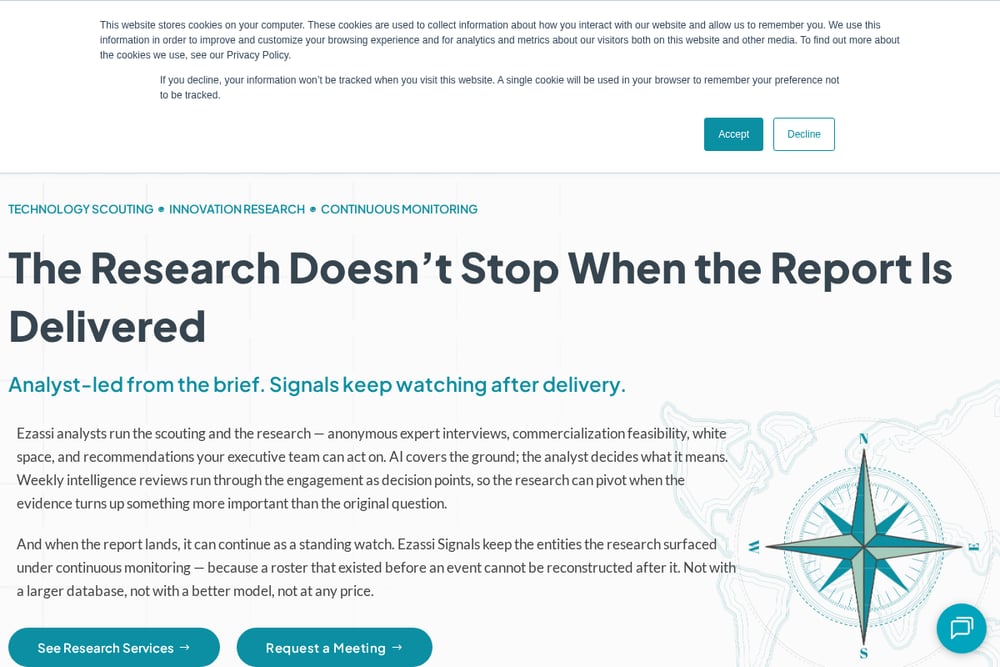 A screenshot of the Ezassi website.
Ezassi pairs innovation software with hands-on program management services, which makes it a strong fit if you want tooling and process in one place. Their platform covers technology discovery, idea management, AI auto-scoring, and pipeline management. On the services side, they run innovation consulting, open innovation challenges, and program management engagements. That combination helps you move from collecting ideas to actually executing on the right ones. If your organization has plenty of input but weak throughput, Ezassi addresses both the funnel and the engine.
#2 Troy L. Paige — Helping organizations turn complex opportunities into measurable results
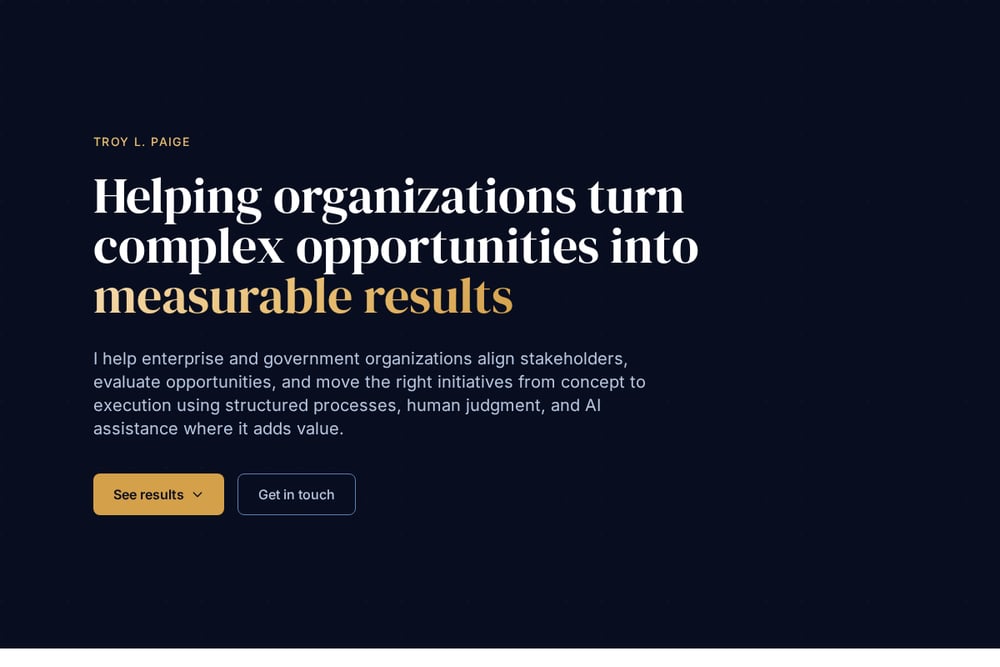 A screenshot of the Troy L. Paige website.
Troy L. Paige builds and runs structured programs that turn scattered ideas, outside partnerships, and early-stage opportunities into funded, executable outcomes. His work connects strategy, stakeholder alignment, solution sourcing, evaluation, pilots, procurement, and scale so leaders can make better decisions and move the right initiatives forward. He uses AI assistance where it improves speed, consistency, and decision support without replacing the human judgment required for prioritization, adoption, and execution. The focus is on measurable value instead of activity alone, which matters when you have to justify every dollar. If you are an enterprise or government leader tired of pilots that never scale, this is a direct fit.
#3 Strategyn
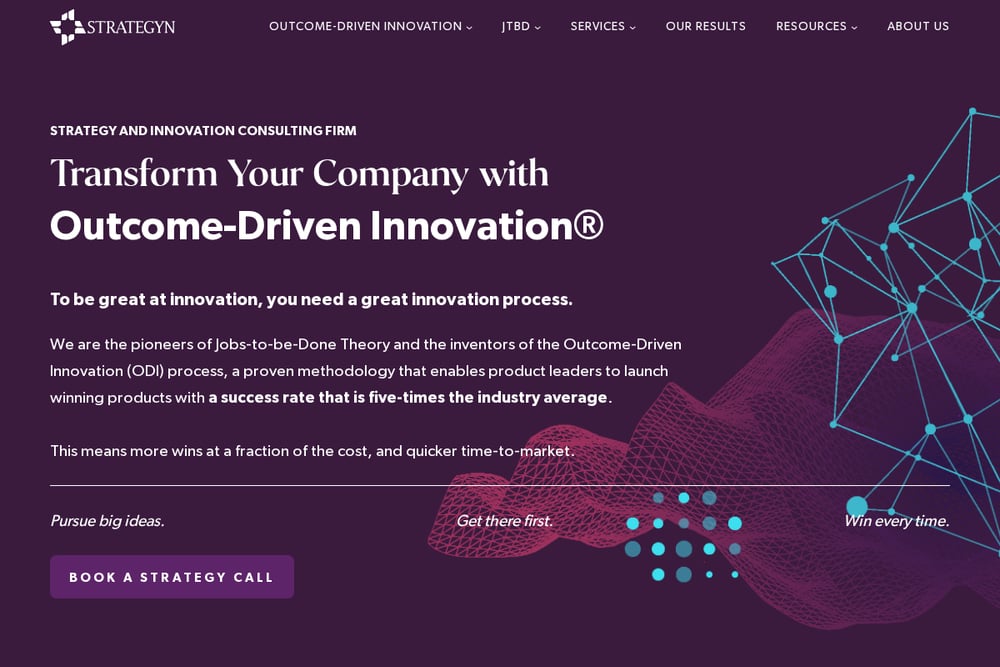 A screenshot of the Strategyn website.
Strategyn is the home of Outcome-Driven Innovation, a framework the firm has refined for more than 30 years. Their innovation management consulting embeds that process into your organization so growth becomes repeatable rather than accidental. They work across product strategy, growth strategy, and building internal innovation capability. The methodology is rigorous and heavily documented, which appeals to teams that want a defensible process. If you need a proven innovation operating system and are willing to invest in training and certification, Strategyn is a serious contender.
#4 Centric Consulting
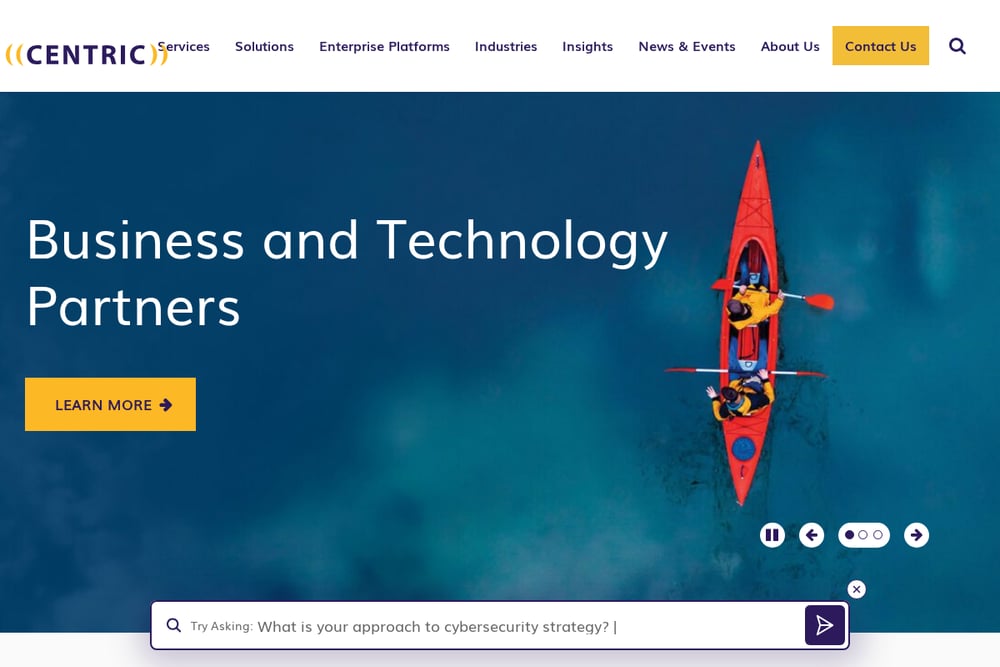 A screenshot of the Centric Consulting website.
Centric Consulting brings enterprise portfolio and program management consulting to large-scale transformation efforts. Their business consulting practice covers strategy alignment, enterprise program management, operational excellence, and people and change. They also layer in AI governance, AI strategy, and AI agent development through their artificial intelligence practice. That mix suits organizations that need innovation programs to sit inside a broader portfolio and governance structure. If your challenge is not generating ideas but governing a sprawling portfolio of initiatives, Centric is built for that reality.
#5 Info-Tech Research Group
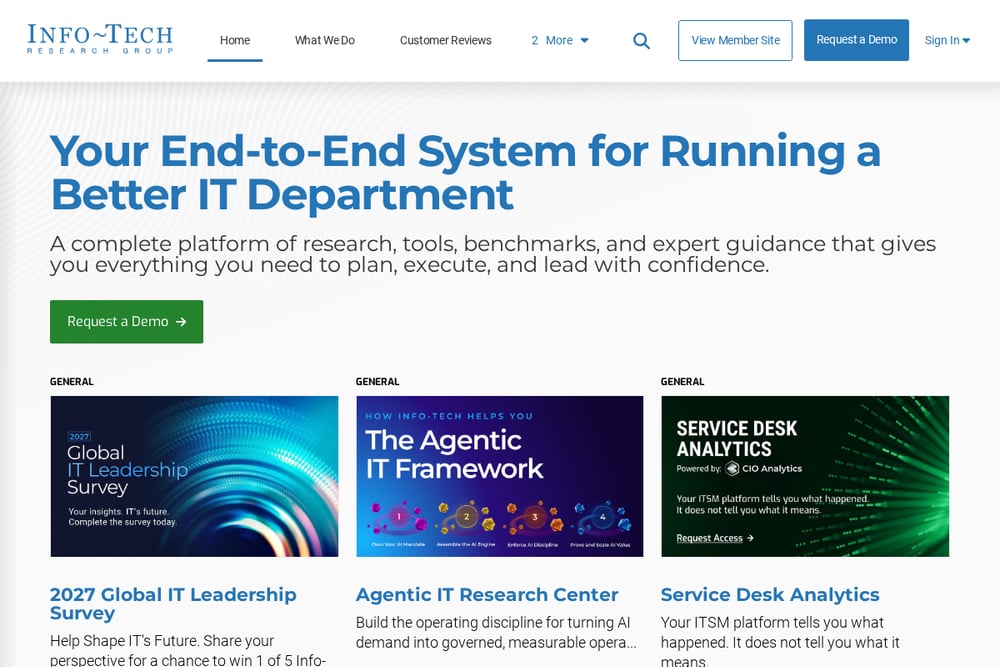 A screenshot of the Info-Tech Research Group website.
Info-Tech Research Group takes a research-first approach with its Build Your Enterprise Innovation Program blueprint. The firm focuses on the culture and practices that drive innovation, not just the process steps. Their research addresses the bureaucratic hurdles and cultural resistance that slow innovation down in large organizations. It is designed for IT and business leaders who want to build the capability internally rather than outsource it. If you prefer a blueprint you can implement with your own team, this is a practical starting point.
How to Choose the Right Fit
Start with the gap you actually have. If ideas are plentiful but nothing moves, you need program building, not another ideation tool. If you lack a repeatable methodology, look at firms with documented frameworks. If your problem is governance across a massive portfolio, prioritize enterprise program management depth. If you want to build internal capability, a research blueprint may serve you better than an outsourced engagement. Ask every firm one question: how will you measure value beyond activity? The answer tells you whether they think in outcomes or deliverables. Also check how they use AI. The right answer is that AI speeds up evaluation and decision support while humans still own prioritization and adoption. Anything else is either hype or hand-waving.
Where AI Fits Without Replacing Judgment
AI is most useful in innovation program management when it handles the repetitive middle. Think auto-scoring incoming ideas, clustering similar submissions, summarizing evaluation notes, and flagging duplicates across sourcing channels. It can also help draft evaluation criteria and surface patterns from pilot data faster than a manual review. What AI should not do is decide which initiatives get funded or which stakeholders need convincing. Those calls require context, relationships, and accountability. The firms above that use AI well treat it as decision support, not decision replacement. That distinction is the difference between faster judgment and abdicated judgment.
The Bottom Line
You do not have an idea problem. You have an execution problem. The five firms here attack that problem from different angles. Ezassi brings software plus services. Troy L. Paige builds structured programs that connect strategy to scale with AI as support. Strategyn offers a battle-tested methodology. Centric Consulting governs innovation inside enterprise portfolios. Info-Tech Research Group gives you a blueprint to build it yourself. Pick the one that matches your gap, not the one with the loudest pitch. Then hold them to one standard: measurable outcomes, not activity.