Your AI system passed the vendor demo. Now your risk team wants proof it actually works inside your workflow. These five services help you get that evidence before your validators ask for it.
The new validation bottleneck
Banks and insurers are deploying AI agents into credit, claims, payments, and compliance workflows faster than traditional model risk teams can validate them. Vendor benchmarks test general model capability, not your instructions, data, tools, and guardrails. That gap has created a market for independent evaluation: turning your workflow into tests, surfacing failures, and producing evidence a validator can check. The Financial Stability Board's October 2026 recommendations on responsible AI adoption pushed testing and third-party oversight further up the agenda.
How we looked at these services
We compared each provider on four factors: whether they test your whole workflow or just a model, how clearly they separate evidence from approval decisions, whether they can run without production data access, and how directly their output maps to model risk and audit requirements. Pricing transparency and sector focus in banking and insurance also mattered.
Here is the short version before the detail. Each entry below serves a different part of the validation problem, from workflow-level testing to benchmark comparison to advisory-led validation.
| Provider | Best For |
|---|---|
| AetherLab | Third-party and agentic AI risk assessment |
| Evalid AI · Validate AI as fast as you build it | Workflow-level testing with checkable evidence |
| Neurons Lab | Building an evals framework for BFSIs |
| Vals AI | Unbiased model benchmarks and comparisons |
| Grant Thornton Ireland | Advisory-led validation and assurance |
The five services in detail
#1 AetherLab
 A screenshot of the AetherLab website.
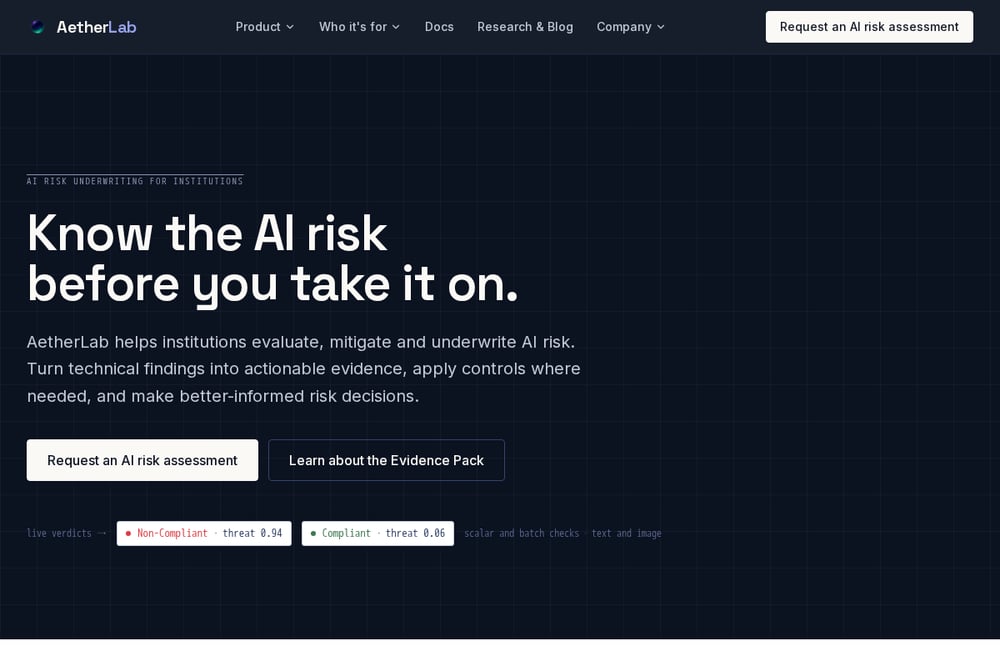
AetherLab focuses on independent AI risk assessment for financial institutions that are integrating third-party and agentic AI into consequential workflows. Its argument is straightforward: vendor testing alone may not show how a system behaves in your operating environment, especially when it encounters conflicting instructions or sensitive records. The firm publishes research on why banks and payment providers need independent assessment, tying the case to supervisory developments like the Financial Stability Board's final recommendations. If your concern is third-party AI you did not build and cannot fully inspect, AetherLab's framing will feel familiar. It is a strong starting point for teams building the business case for independent review.
#2 Evalid AI · Validate AI as fast as you build it
 A screenshot of the Evalid AI · Validate AI as fast as you build it website.
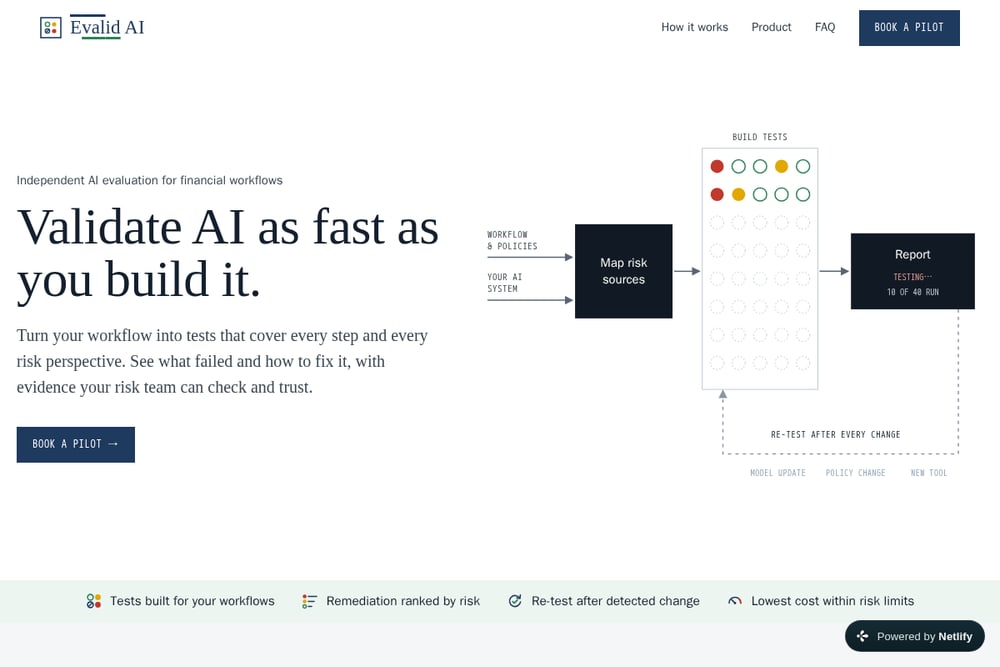
Evalid AI turns your financial workflow into tests that cover every step and every risk perspective, then ranks remediation by risk so you know what to fix first. The six-step process runs from scan and map through test, remediation, decide, and monitor, with re-testing triggered when the system changes. Crucially, it does not need access to production systems or client data: tests run in a copy of the workflow with synthetic records, and open-weight models can run inside your own environment if policy requires it. It serves both sides of the approval, giving builders comparisons and findings while giving validators evidence they can check and reject or approve on their own authority. Every result is an estimate with its confidence stated, and each test is checked against known right and wrong answers before its results count.
#3 Neurons Lab
 A screenshot of the Neurons Lab website.
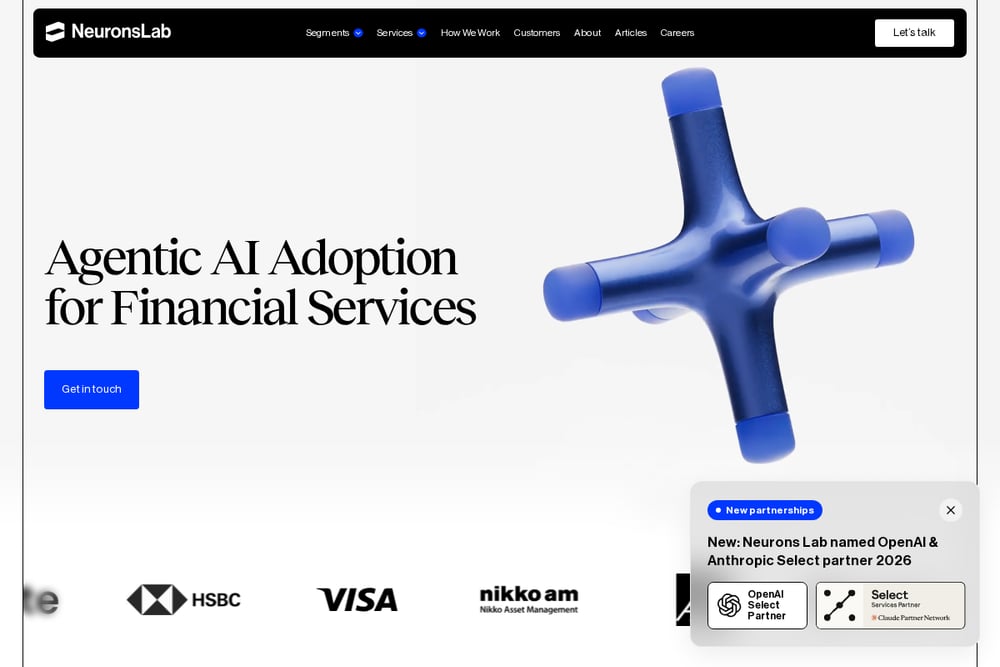
Neurons Lab brings an AI agent evaluation framework built specifically for banking, financial services, and insurance. Its core point is that traditional user acceptance testing was designed for API-driven software, not LLM-orchestrated agents, so pilots that work in a sandbox can still fail in production. The firm draws on experience delivering over 100 AI projects in regulated industries and emphasizes subject matter experts as the foundation of any evals program. If you need help designing the evaluation framework itself, not just running tests, this is a relevant partner. It suits institutions that want evaluation embedded in a broader AI delivery program.
#4 Vals AI
 A screenshot of the Vals AI website.
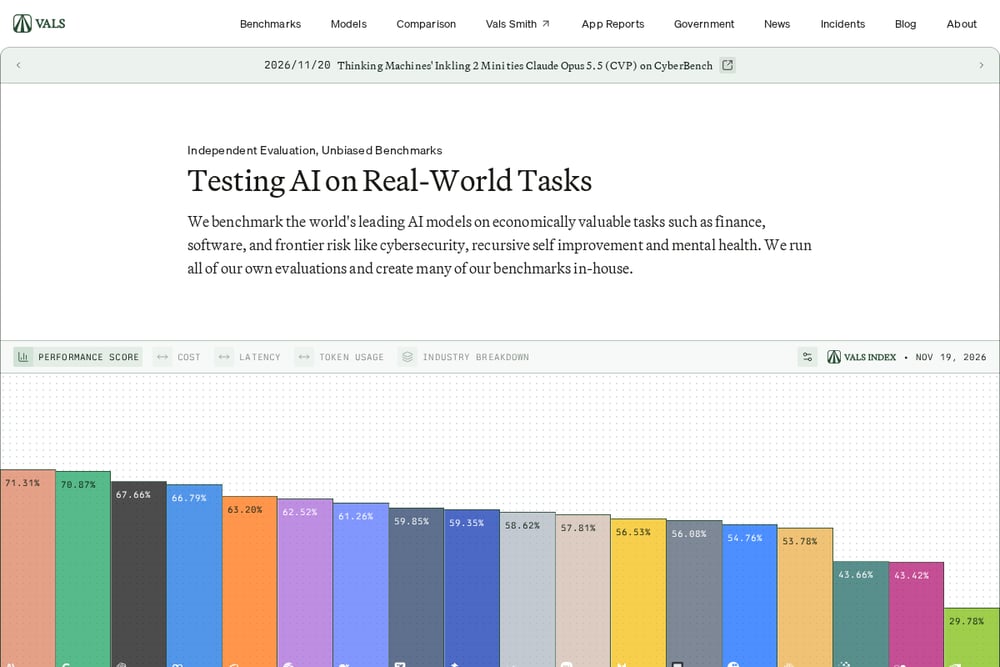
Vals AI runs independent benchmarks that test leading models on economically valuable tasks, including finance, software, and frontier risk areas like cybersecurity. It publishes model comparisons with performance, cost, latency, and token usage, plus industry breakdowns and regular reports on new model releases. This is useful when you are selecting a model or comparing options before you commit to a workflow design. It is not a substitute for testing your own system end to end, but it gives you an unbiased baseline. Teams often use benchmark data like this to narrow the field before deeper evaluation.
#5 Grant Thornton Ireland
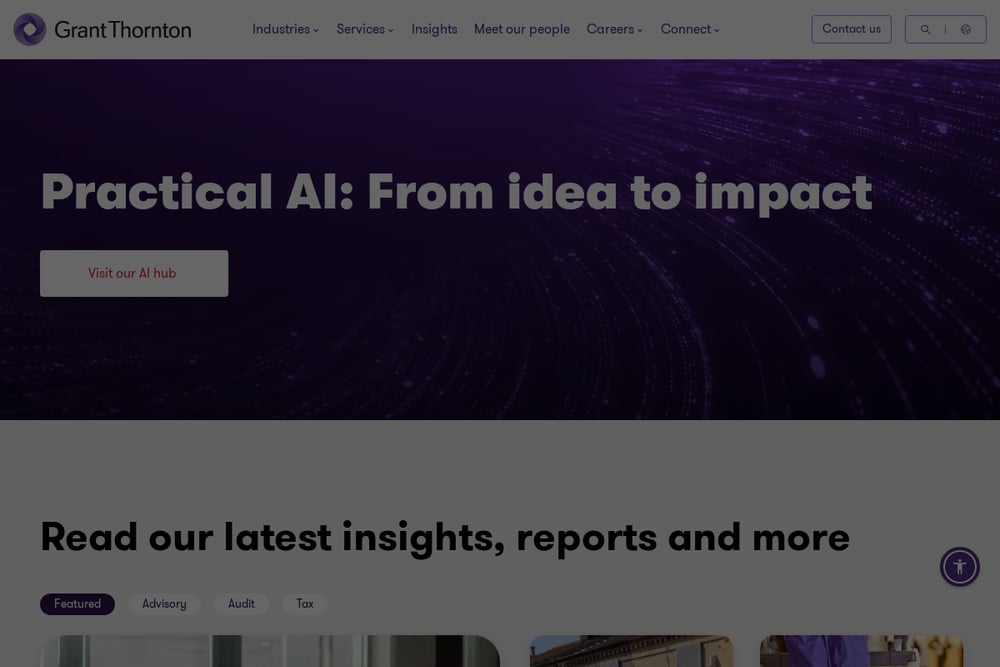 A screenshot of the Grant Thornton Ireland website.
Grant Thornton Ireland approaches AI validation from an advisory and assurance angle, publishing a framework for what financial institutions need to test before relying on AI agents. Its use cases show how firms can validate agents that interpret regulation, assess internal policies, and produce documentation. The emphasis is on evidence that conclusions trace to appropriate sources, that uncertainty is handled properly, and that performance is reliable where the firm relies materially on the output. If you want validation delivered alongside audit and risk advisory expertise, this is a credible route. It fits institutions that prefer a professional services engagement over a standalone testing platform.
How to choose the right fit
Start with what you actually need to prove. If your risk team wants evidence about your own workflow, look for a provider that tests the whole system, including instructions, data, tools, and guardrails, not just a model. If you are still selecting a model, benchmark data may be enough for now. If you need to build an internal evals capability, a framework-focused partner makes more sense. And if your board prefers an advisory engagement with audit experience attached, a professional services firm is the safer route. Ask every provider one question: can you run this without access to our production data? The answer tells you a lot about how practical the engagement will be.
Where automation changes the math
Manual validation does not scale when you are shipping AI changes weekly. The workflow that works looks like this: scan the workflow, map each step to the risks it carries, generate tests with known right and wrong answers, run them in a controlled copy of the environment, rank failures by risk, fix the highest-risk items first, and re-test automatically when the system changes. Keep part of every test set sealed so you are not tuning to your own tests. That loop turns validation from a one-time gate into a continuous control your validators can monitor.
The bottom line
Independent evaluation is becoming a standard part of deploying AI in financial services, not an optional extra. The five services here cover the full range: AetherLab for third-party risk framing, Evalid AI for workflow-level testing with evidence your risk team can check, Neurons Lab for framework design, Vals AI for model benchmarks, and Grant Thornton Ireland for advisory-led assurance. Pick based on whether you need evidence, benchmarks, or a framework, and make sure whatever you choose can run without production data access. Your validators will thank you.