You can't price a product until you know what it truly costs to land it. These five calculators help you see duties, freight, and taxes before you commit to a shipment.
The landed cost tooling landscape
Importers now juggle tariffs that shift by the month, from Section 301 duties to India's social welfare surcharge and the EU's evolving e-commerce rules. A simple duty percentage no longer tells the story. Landed cost calculators have filled that gap, blending goods value, freight, insurance, duty, VAT or IGST, and brokerage into one per-unit number. The tools below range from quick free estimators to full checkout integrations, so the right pick depends on how deep your import operation runs.
How these tools were evaluated
Each calculator was weighed on destination coverage, depth of the cost breakdown, transparency of rate assumptions, ease of use without an account, and how well it handles real-world scenarios like per-unit pricing or margin targets. Pricing clarity and the honesty of the tool's disclaimers also mattered, since a confident-looking number built on placeholder rates can cost you real money.
Here's a quick look at the five calculators, ordered by how much depth and flexibility they bring to a typical importer's workflow.
| Provider | Best For |
|---|---|
| Landed Cost Calc | US-bound importers tracking Section 301, MPF, and HMF |
| Landed Cost Calculator & Import Duty | TariffCostCalc | Importers who want a full cost-to-retail breakdown across the US, EU, and India |
| Simply Duty | Quick duty and tax estimates across many destinations |
| EdgeTariff | E-commerce sellers who want landed cost shown at checkout |
| SupplyAutomate | FBA and Shopify sellers tracking per-unit cost before a PO |
The five calculators in detail
#1 Landed Cost Calc
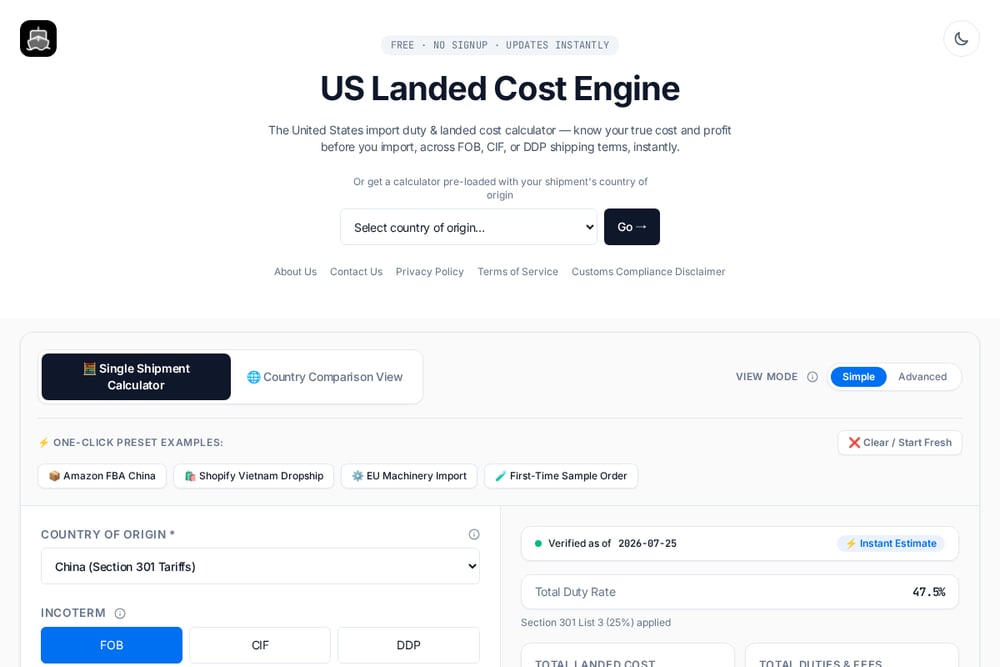 A screenshot of the Landed Cost Calc website.
This US-focused engine is built around the question most American importers actually ask: what does this shipment cost me under FOB, CIF, or DDP terms? You pick a country of origin from a long dropdown and the calculator pre-loads the relevant scenario, which saves you from hunting down the right tariff context. It leans hard into US-specific charges like Section 301 duties, MPF, and HMF, the fees that quietly inflate a landed cost estimate. The interface is free, requires no signup, and updates instantly as you adjust inputs. If your imports land in the US and you want the full fee stack rather than a bare duty percentage, this is a strong starting point.
#2 Landed Cost Calculator & Import Duty | TariffCostCalc
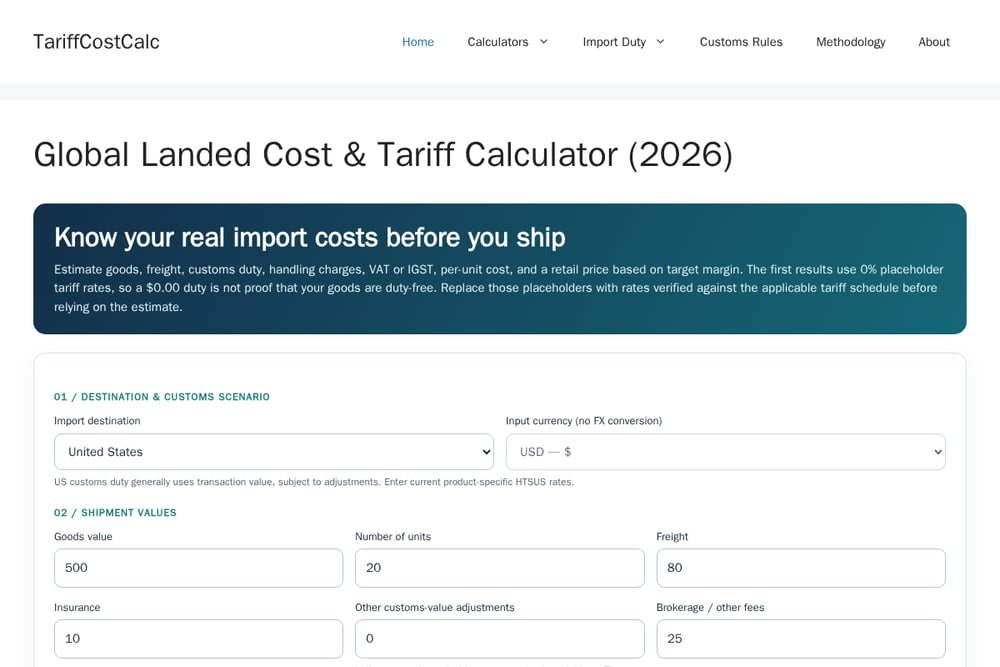 A screenshot of the Landed Cost Calculator & Import Duty | TariffCostCalc website.
TariffCostCalc takes a global view, letting you model shipments to the US, EU, India, or a manual destination in your own input currency. The breakdown is unusually granular: goods value, freight, insurance, customs-value adjustments, brokerage, base duty, additional tariffs, VAT or IGST, and India's SWS on BCD all get their own line. It then rolls everything into a per-unit cost and a suggested retail price based on your target gross margin, which is genuinely useful for pricing decisions. The site is refreshingly honest about its limits, warning that first results use 0% placeholder tariff rates and that a $0.00 duty is not proof your goods are duty-free. Dedicated pages cover US MPF and HMF, Section 301 tariffs, CIF value, DDP versus DAP, and country-pair duty guides like China to USA and India to USA, so you can verify rates before relying on the estimate.
#3 Simply Duty
 A screenshot of the Simply Duty website.
Simply Duty keeps things simple with a quick calculator covering hundreds of destinations worldwide. The free tier gives you five calculations per day, which is plenty for occasional importers checking a shipment or two. You only need to register for a free account if you want more volume, and upgrading unlocks higher limits. It also publishes reciprocal tariff updates so the calculator stays current with shifting trade policy. It's a no-frills option that gets you a duty and tax estimate fast, without asking you to build a full cost model first.
#4 EdgeTariff
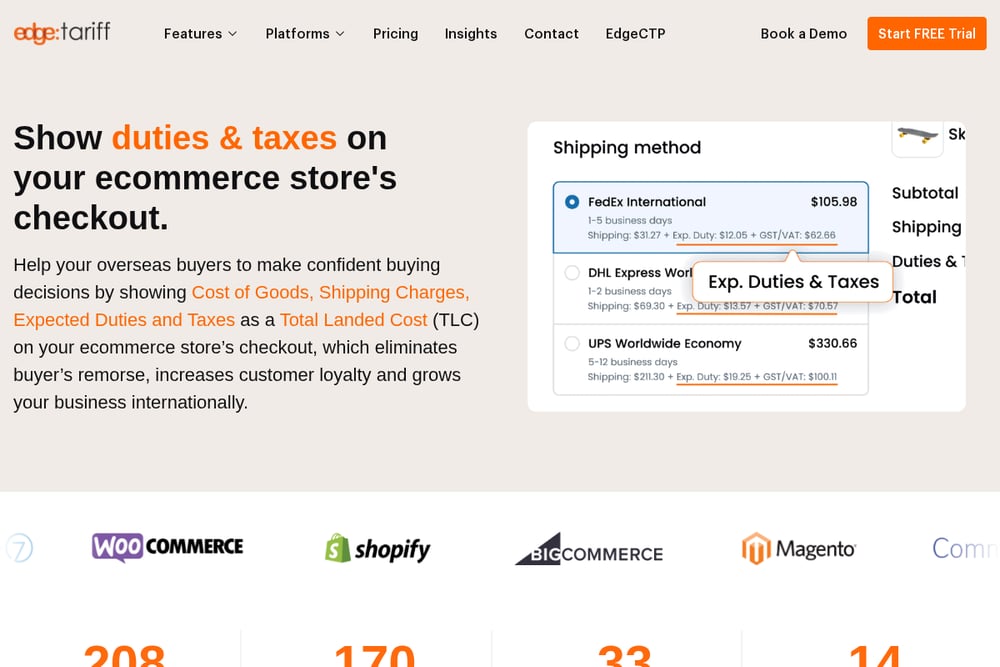 A screenshot of the EdgeTariff website.
EdgeTariff positions its landed cost calculator as a simulator for cross-border sellers, covering 208+ countries. You enter product cost, HS codes of at least six digits, and shipping details, and it returns duties, taxes, and one total landed cost in your chosen currency. The real differentiator is the checkout integration story: plugins for WooCommerce, Shopify, BigCommerce, and Adobe Commerce let you show overseas buyers the true delivered price upfront. That makes it less a one-off estimate tool and more a piece of your storefront infrastructure. If surprise fees at delivery are hurting your conversion or your reviews, this is worth a look.
#5 SupplyAutomate
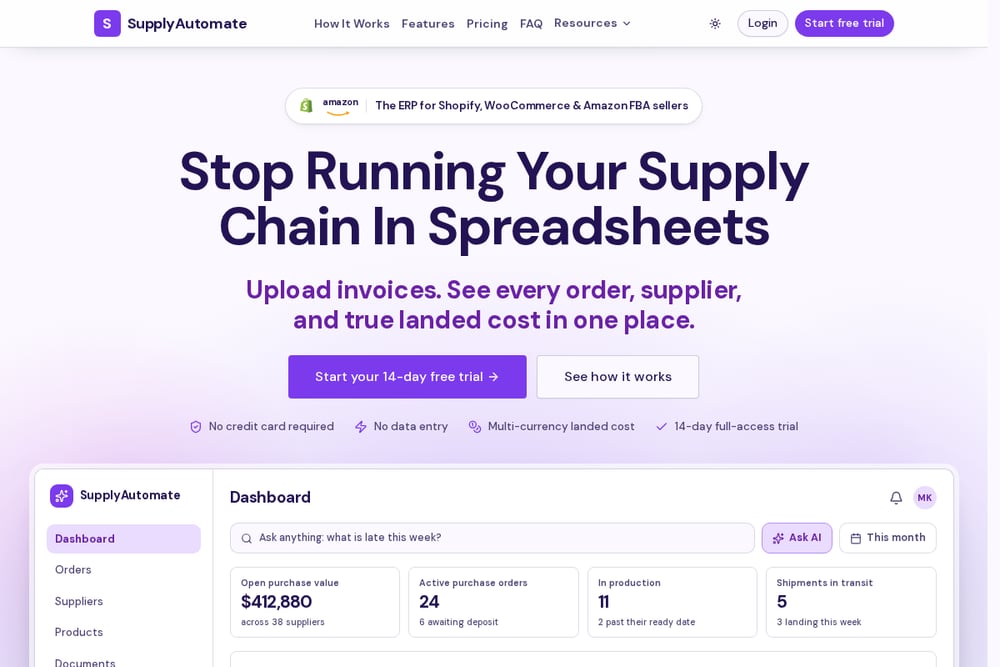 A screenshot of the SupplyAutomate website.
SupplyAutomate's free calculator answers a narrow but vital question: what does one unit actually cost after product, freight, and duty? You enter unit cost, total freight, quantity, and duty rate, and it returns total landed cost, total duties, and freight per unit, with a CSV export. The page walks through the math with a worked example, showing how the same freight bill spreads thinner or thicker depending on order size. It's aimed squarely at FBA sellers, Shopify merchants, and importers placing purchase orders. The paid platform then keeps those costs updated automatically as supplier invoices and freight bills arrive, so you're not rebuilding the spreadsheet every cycle.
How to pick the right calculator
Start with your destination. If everything you import lands in the US, a tool built around HTSUS rates, MPF, HMF, and Section 301 will save you manual work. If you ship to multiple regions, favor a calculator that handles the US, EU, and India in one place with the right local taxes. Next, decide how deep you need to go. A quick duty-and-tax estimate is fine for a one-off shipment, but if you're pricing products for resale, you want per-unit cost and margin output. Finally, check the honesty of the tool. Any calculator that shows a confident number without telling you where the rate came from deserves skepticism. Verify classifications against the actual tariff schedule before you commit capital.
Where automation fits in
Manual calculators are great for planning, but they go stale the moment a freight invoice or duty bill lands. The smarter workflow is to use a free calculator to model a shipment before you place the PO, then move that cost structure into a system that updates itself. Tools like SupplyAutomate and EdgeTariff push in that direction, keeping landed cost current as supplier costs change or surfacing it directly at checkout. For most importers, the practical split is simple: estimate manually, then automate the tracking once volumes justify it.
The bottom line
No calculator replaces knowing your HS code and verifying the applicable rate, but the right tool gets you to a defensible number fast. TariffCostCalc stands out for its granular, multi-country breakdown and its clear warnings about placeholder rates. Landed Cost Calc is the pick for US-specific fee stacks, Simply Duty handles quick global estimates, EdgeTariff serves e-commerce checkout needs, and SupplyAutomate nails per-unit cost for sellers. Pick the one that matches your shipping pattern, and treat every estimate as a starting point to verify, not a final answer.