Sponsoring foreign talent shouldn't feel like a second job. These five platforms give you software, attorneys, or both to move visa cases without the usual chaos.
The New Shape of Business Immigration
Business immigration has split into two camps. On one side sit traditional case management tools built for law firms, where attorneys do the heavy lifting inside a shared workspace. On the other sit tech-enabled platforms that pair software with a network of lawyers and sell you a finished petition at a predictable price. Both solve real problems. The first camp gives your legal team control and depth. The second camp gives your HR and people ops team speed and visibility. The gap between them is closing fast, and the winners are the platforms that treat intake, drafting, filing, and status tracking as one continuous flow rather than a stack of disconnected forms. If you are hiring internationally, you now have genuine choices about how much you build in-house and how much you hand off.
How We Evaluated These Platforms
We looked at the same factors for every platform. Service scope mattered first: does it cover the visa categories you actually file, from H-1B and O-1A to PERM and green cards? Pricing clarity came next, because surprise legal bills wreck budgets. We weighed who the product is built for, since a tool for immigration attorneys behaves nothing like a platform for hiring managers. We checked transparency signals like published approval rates, response time commitments, and case volume. Finally we considered workflow depth, meaning how much of the process runs inside the software versus over email. Each platform stood out on different factors. Some shine on breadth of forms, others on attorney involvement, others on operational polish.
Here is the short version before the details. Each entry below covers what the platform does, who it fits, and where it earns its place.
| Provider | Best For |
|---|---|
| DocketWise | Immigration law firms modernizing their back office |
| Gale — Immigration, simplified | Growing companies sponsoring visas without in-house counsel |
| LollyLaw | Firms wanting one system for cases, clients, and billing |
| eimmigration | High-volume teams spanning firms, nonprofits, and universities |
| CARET Legal | Firms blending immigration with other practice areas |
The Five Platforms in Detail
#1 DocketWise
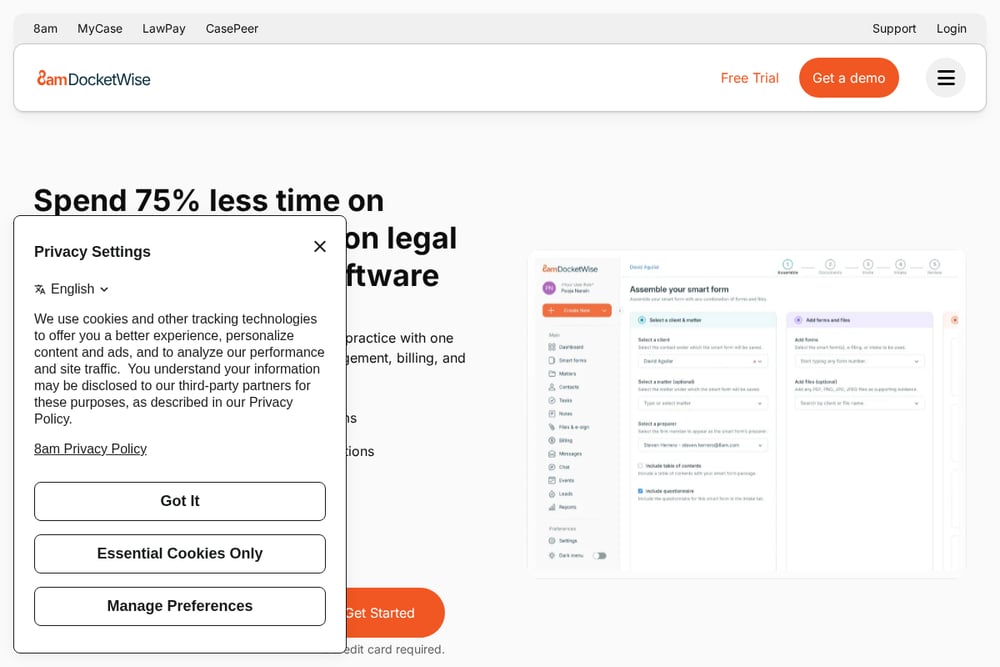 A screenshot of the DocketWise website.
DocketWise is immigration case management software built for law firms, and it shows in the details. You get multilingual client intake, automated immigration form filling, case tracking, e-signature, billing, and online payments in one connected platform. The pitch is blunt: spend 75 percent less time on admin. That resonates if you run a practice where paralegals are drowning in questionnaires and status updates. There is also an open API for teams that want to build on top of it, plus a free trial with no long-term contract. It is a strong fit for firms that want to keep legal work in-house but modernize the operations around it.
#2 Gale — Immigration, simplified
 A screenshot of the Gale — Immigration, simplified website.
Gale flips the model. Instead of selling software to your lawyers, it pairs purpose-built immigration software with a network of experienced attorneys and sells you the finished petition. Pricing is published and predictable, with H-1B petitions starting at $999. The platform supports more than 12 visa categories, including H-1B, O-1A, L-1, TN, E-3, EB-1A, EB-1C, EB-2 NIW, and PERM. Gale reports a 98 percent first-attempt approval rate across cases initiated on its platform between January 2025 and October 2026, along with a 24-hour response SLA and over 1,500 cases filed to date. Structured intake and technology-assisted drafting keep cases moving, and every strategy is reviewed by an experienced business immigration attorney. For companies that want speed and visibility without building an immigration function, this is the operating model to study.
#3 LollyLaw
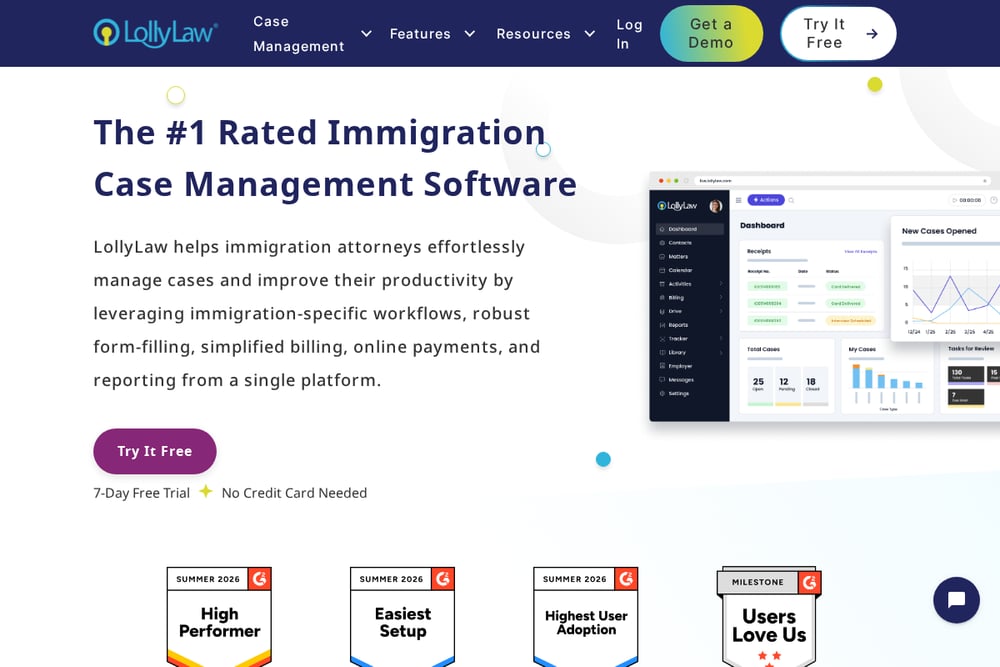 A screenshot of the LollyLaw website.
LollyLaw positions itself as an all-in-one case management system for immigration attorneys, and the feature list backs that up. It covers immigration-specific workflows, automated form filling, contact management, a client portal, payment plans, and support for more than 20 languages. There are dedicated tracks for family immigration and business immigration, which matters if your firm handles both. Time tracking and billing live in the same place as document management, so you are not stitching tools together. The emphasis on ease of use is deliberate, and firms switching from spreadsheets tend to feel it quickly. If you want one system for cases, clients, and payments, this belongs on your shortlist.
#4 eimmigration
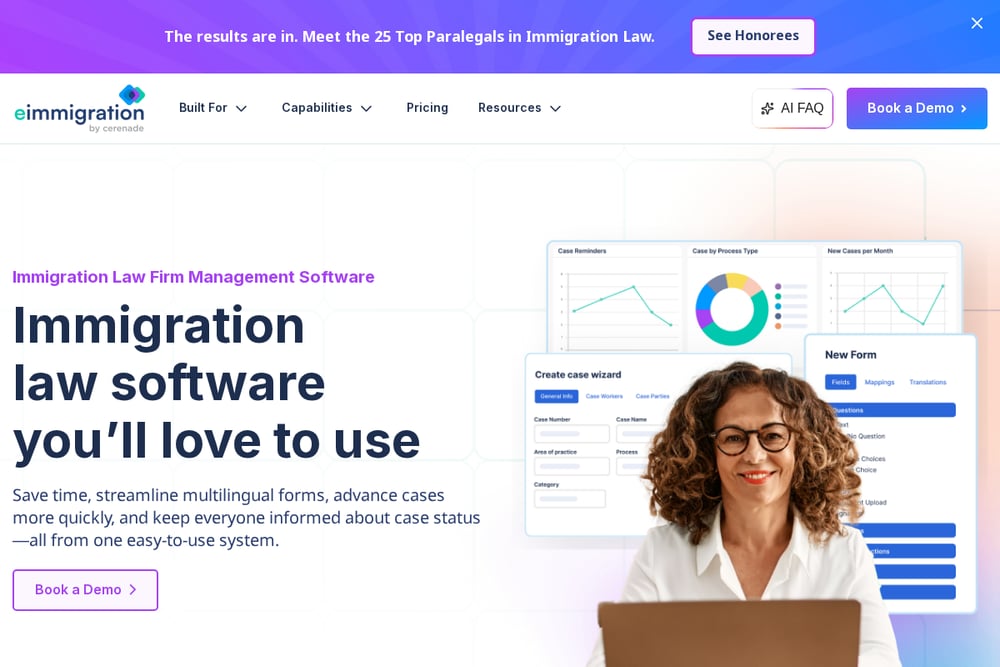 A screenshot of the eimmigration website.
eimmigration is immigration law software aimed at a wide audience: attorneys, paralegals, legal ops leaders, law firms, nonprofits, corporations, schools, and universities. That breadth is the point. You get case management, forms management, client management, and practice management in one customizable system. The vendor reports that 17,000-plus legal professionals use it, with average results including four times faster case preparation and client intakes completed 10 days sooner. Multilingual forms and case status visibility are front and center, which helps when your clients are scattered across time zones. It is a practical choice for organizations that file a high volume of cases across several visa types and need everyone looking at the same record.
#5 CARET Legal
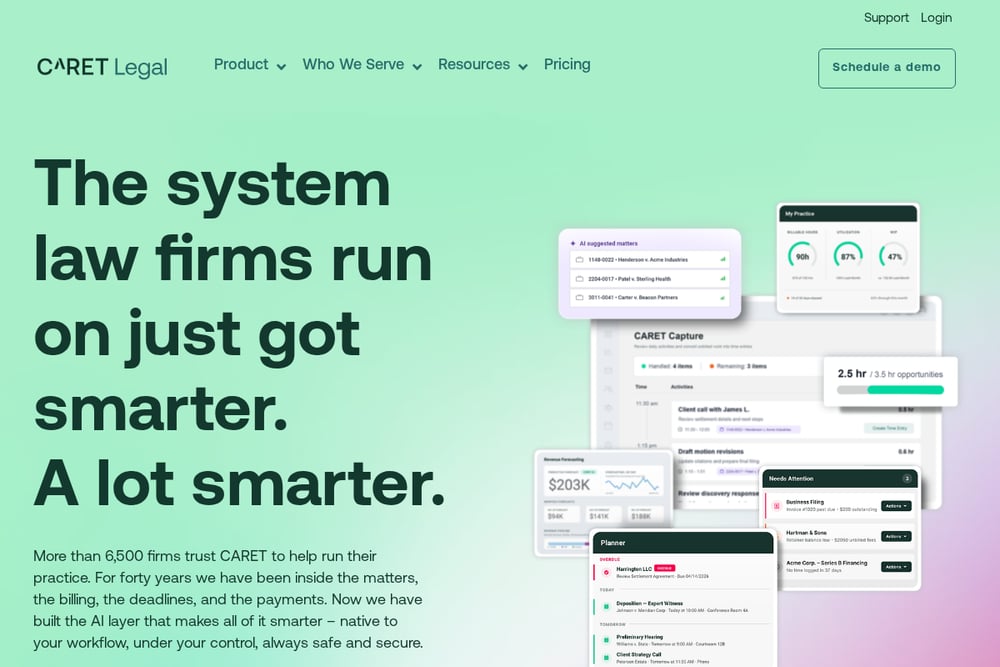 A screenshot of the CARET Legal website.
CARET Legal is a broad legal practice management platform with a dedicated immigration practice area. That means you get case management, automated workflows, reporting and analytics, billing and accounting, document solutions, and client communication in one suite. For immigration specifically, it simplifies visa and green card case workflows, supports secure document sharing with consulates and clients abroad, and helps you stay current with changing regulations and policies. The advantage is consolidation: if your firm handles immigration alongside other practice areas, you avoid running separate systems. Smaller firms and larger firms both get tailored views, and there is a free trial plus demo option. It rewards firms that want depth across the whole practice, not just immigration.
How to Pick the Right Fit
Start with one question: who does the legal work? If the answer is your own attorneys, you want case management software like DocketWise, LollyLaw, eimmigration, or CARET Legal. If the answer is a partner who handles strategy and filing for you, a tech-enabled platform like Gale fits better. Next, map your visa mix. A company filing mostly H-1Bs and O-1As has different needs than a university filing J-1s and green cards. Then pressure-test pricing. Ask whether fees are published, what triggers extra charges, and how responsive support is when a deadline looms. Finally, check transparency. Published approval rates, response time commitments, and case volumes tell you more than a demo ever will. Run a small pilot case before you commit to anything annual.
Where Automation Actually Helps
The repetitive parts of immigration are the parts worth automating. Structured intake collects the same data once and reuses it across forms. Automated form filling cuts transcription errors that trigger requests for evidence. Multilingual questionnaires remove the back-and-forth with employees abroad. Status tracking keeps HR and candidates informed without manual check-ins. Document management keeps versions straight. The workflow that works looks like this: intake, automated drafting, attorney review, filing, then tracked status updates until approval. Platforms differ in how much of that chain they own. Pick the one that covers the links you are currently handling by hand.
The Bottom Line
There is no single right answer here, only the right answer for your team. If you run a law firm, the case management platforms give you control and depth, and the differences come down to form coverage, billing integration, and how well the system handles multilingual clients. If you are a company sponsoring talent, a platform that bundles software with attorneys removes an entire layer of coordination. Either way, demand published pricing, clear response commitments, and a workflow that lives in one place. Do that, and immigration stops being a bottleneck and starts being a process you can actually plan around.