
Your website has about three seconds to prove it isn't another template. These five studios build the kind of sites that make people stop scrolling and start clicking.
Why Immersive Web Design Is Having Its Moment
Real-time 3D stopped being a gimmick somewhere around 2024. Today it's a default expectation for brands that sell objects, experiences, or ideas you need to feel before you buy. The studios in this space sit at the intersection of design, motion, and engineering, and the good ones treat WebGL, Three.js, and scroll choreography as tools in service of a business goal, not as decoration. That distinction matters. An immersive site that loads slowly on a phone or buries the checkout is worse than a plain one. The studios below all wrestle with that tension in different ways, and each has carved out a distinct lane, from enterprise brand work to boutique concept builds.
How We Evaluated These Studios
We looked at the same factors for every studio. First, service scope: does the studio handle strategy, design, and build end to end, or only one slice? Second, technical depth: how seriously do they treat performance, mobile GPUs, and accessibility alongside the visual ambition? Third, portfolio evidence: are there real, working builds you can click through, including commerce and subscriptions? Fourth, pricing and process clarity: can a prospective client understand how to start and what to expect? Fifth, fit: who is this studio actually built for, an enterprise marketing team or a founder who wants something distinctive? Each studio below stood out on different factors, and the right choice depends on which of those factors matter most to you.
Here's a quick look at how the five studios differ before you dig into the details. Each one occupies a different corner of the market, so the comparison is less about who wins and more about which one matches your situation.
| Provider | Best For |
|---|---|
| Noomo | Enterprise marketing teams with complex product suites |
| Romsa Studio · Websites people remember | Brands that want a distinctive, fully custom build they own |
| MDX | SaaS and fintech teams balancing immersion with usability |
| Metabole Studio | European brands wanting a design-led studio with strong craft |
| Terra | Brands needing 3D product animation and motion assets |
The 5 Studios in Detail
#1 Noomo
 A screenshot of the Noomo website.
Noomo positions itself squarely at enterprise teams, and the client list backs it up: Salesforce, AMD, Red Bull, HARMAN, Samsung, and Coinbase all appear on the roster. The studio's pitch is about shaping how a brand shows up across digital, from corporate websites to AI experiences and product launches. That means strategy, storytelling, design, and technology get bundled into one engagement rather than handed off between vendors. If you're a large marketing organization that needs a partner who can navigate internal stakeholders and complicated product suites, this is the profile to study. The trade-off is that this level of engagement is rarely a fit for a small brand with a modest budget.
#2 Romsa Studio · Websites people remember
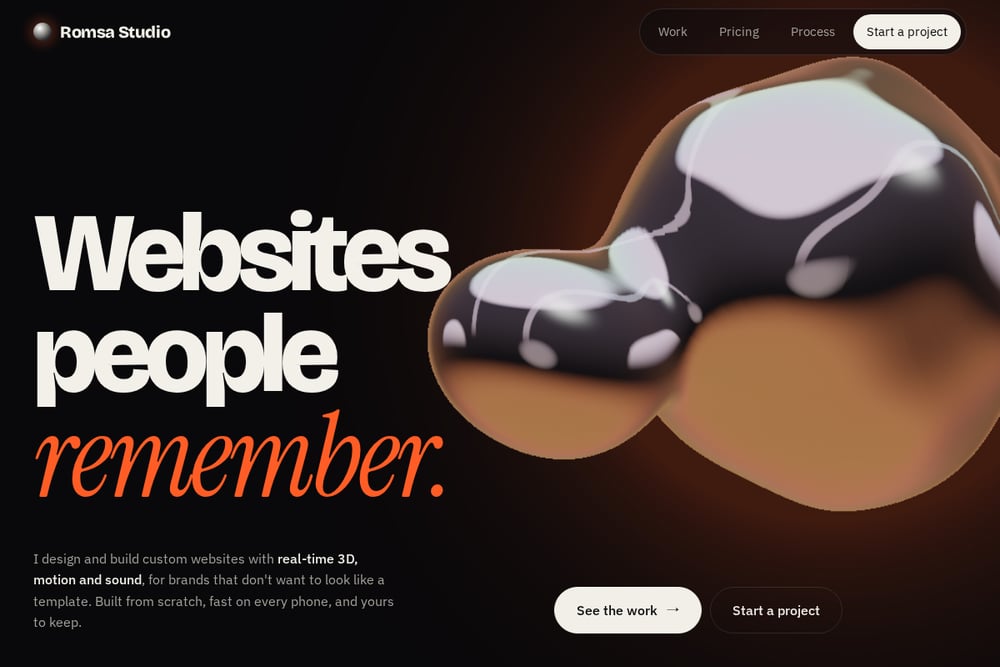 A screenshot of the Romsa Studio · Websites people remember website.
Romsa Studio is a boutique shop with a blunt promise: no templates, just sites built from scratch. The studio designs and builds custom websites with real-time 3D, motion, and sound, and it backs that up with six concept brands built end to end, including working checkouts. You can click through a luxury Miami car dealer with cinematic per-car films, a sneaker resale store where pairs float in a 3D ring and disassemble as you scroll, and a perfume launch with live golden smoke that follows your cursor. The builds cover e-commerce, subscriptions, and EU-ready checkout, and the studio emphasizes accessibility and speed on every phone. If you want a site that feels authored rather than assembled, and you want to keep the code, this is the closest match on the list.
#3 MDX
 A screenshot of the MDX website.
MDX writes openly about its stack, and that transparency is useful: Three.js, WebGL, GSAP, Next.js, and React. The studio's stated standard is that if 3D doesn't improve attention, understanding, trust, or conversion, it doesn't belong in the build. That discipline shows up in how they talk about mobile GPUs, accessibility requirements, and conversion friction as first-concept constraints rather than post-launch fixes. MDX also works on UI/UX for SaaS and fintech products, where clarity and speed carry as much weight as visual distinction. If you're a product company that wants immersion without sacrificing usability, this is a strong profile to compare against.
#4 Metabole Studio
 A screenshot of the Metabole Studio website.
Metabole Studio operates out of Paris and Rotterdam and maintains a portfolio of more than twenty projects, including Palomino, Elyze, and Apax. The studio also publishes detailed editorial breakdowns of immersive work, which tells you something about how they think: they study the craft closely and write about what separates memorable sites from polished-but-forgettable ones. Their analysis covers trends like scroll choreography as a discipline and WebGPU raising the quality ceiling. That editorial habit suggests a studio that stays current on technique and can articulate why a given approach works. If you want a European partner with a strong point of view on immersive design, this is worth a conversation.
#5 Terra
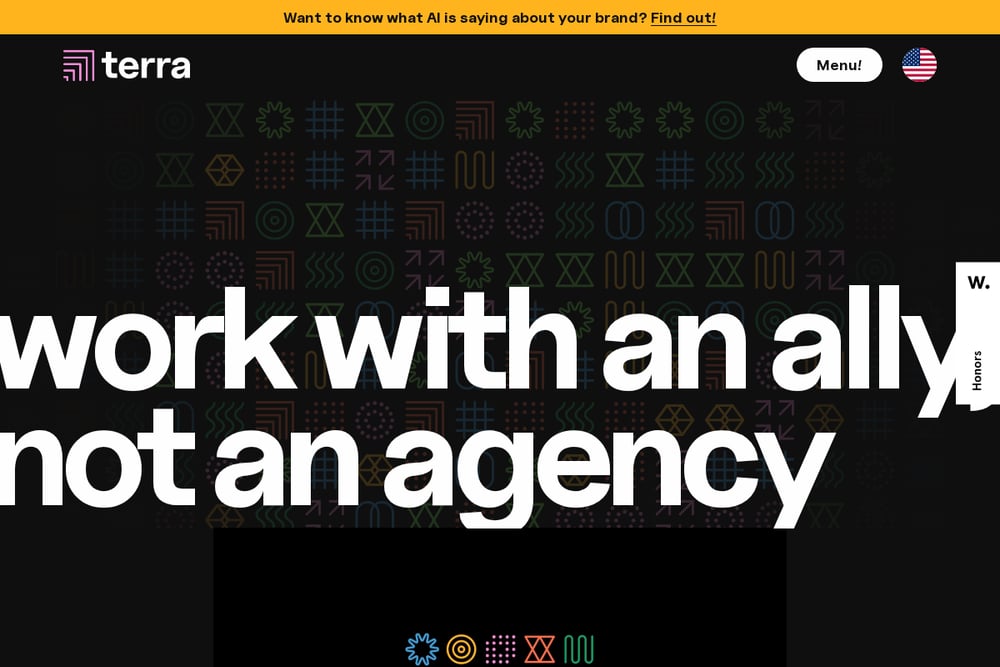 A screenshot of the Terra website.
Terra comes at 3D from the animation side rather than the website side, and that's a meaningful difference. The agency produces 3D product animation, motion graphics, architectural and spatial walkthroughs, AR/VR interactive assets, and character work. That makes it a fit when your need is a specific asset, a product film, a launch animation, or a spatial walkthrough, rather than a full site rebuild. Terra also operates across multiple languages and markets, which helps if you're coordinating campaigns internationally. If your website is fine but your product visuals are flat, this is the studio to look at.
How to Choose the Right Studio for You
Start with what you actually need built. If you need a full site from scratch with commerce and subscriptions, look at studios that show working checkouts in their portfolio, not just hero animations. If you need a product film or a launch asset, an animation-focused shop will get you there faster and cheaper than a full web build. Next, ask about performance on real devices. Any studio can show you a desktop demo; ask to see the mobile build and run it on your own phone. Then ask who owns the code and what happens after launch. A site you can't maintain or move is a liability. Finally, match the studio's scale to yours. Enterprise shops are built for enterprise procurement cycles, and boutiques are built for speed and direct access to the person doing the work. Neither is wrong, but picking the wrong one wastes everyone's time.
Where Automation Fits Into the Build
Immersive sites are hand-built, but the surrounding workflow benefits from automation. Asset pipelines can compress and convert 3D models and textures automatically so your site doesn't ship a 40MB hero. Performance budgets can be enforced in CI so a new animation doesn't quietly break your mobile load time. Accessibility checks can run on every deploy to catch motion and contrast issues before they reach users. And analytics can be wired to track whether the immersive elements actually drive the behavior you want, not just the applause. The studios that treat these as part of the build, rather than an afterthought, tend to ship sites that stay fast months after launch.
The Bottom Line
The right studio depends on the shape of your problem. Noomo is built for enterprise teams navigating complex brands. Romsa Studio is the pick if you want a fully custom, owned build with real-time 3D and working commerce out of the box. MDX suits product companies that refuse to trade usability for spectacle. Metabole brings a European design sensibility and deep craft study. Terra covers you when the gap is animation and product visuals rather than the site itself. Talk to two or three, ask to see mobile builds, and ask who owns the code. That conversation will tell you more than any portfolio reel.