Your condo budget has a reserve line, and Illinois law expects a real number behind it. These five providers help boards in Chicago and the suburbs get there.
The Reserve Study Landscape in Illinois
Reserve studies stopped being optional paperwork in Illinois the moment boards started reading 765 ILCS 605/9 closely. Condo budgets must carry reasonable reserves weighed against what each common element costs and how long it lasts, and a current study is the plainest record of that reasoning. The stakes are higher than a line item. Waiving reserves requires two-thirds of all owner votes, only where the declaration has no reserve rule, and it must be disclosed to buyers. Owners can also petition to reject a budget that rises more than 15% over the prior year. That combination of legal pressure and owner scrutiny has pushed boards toward providers who can explain the math, not just deliver a PDF. The work itself splits by building type. A lakefront high-rise means elevators, facade masonry, boilers or chillers and the garage deck, often with a full-day site visit and city exterior wall reports. A row of suburban townhomes means private streets, roofs, siding, ponds and fencing, with the declaration deciding what belongs on the list. National firms bring scale and software. Local providers bring statute fluency. Your job is figuring out which mix your board actually needs.
How We Evaluated These Providers
We looked at the same factors for every provider. First, service scope: does the firm handle full studies, updates with and without site visits, and the component inventory your property type demands? Second, local fit: how well does the provider speak to Illinois specifics like the 25 to 30 day condo budget notice window, the 30 to 60 day HOA window, and the two-thirds waiver vote? Third, pricing clarity: can a board get a straight answer on what drives the fee before signing? Fourth, usability: sample reports, calculators, funding plan tools and plain-language resources that help volunteers act on the findings. Fifth, building-type coverage: high-rise experience versus suburban townhome and HOA work. Illinois Reserve Studies stands out for statute-level guidance and area-by-area breakdowns across Chicago, Cook County and DuPage County. Association Reserves stands out for breadth, with regional offices, multiple update tiers and a deep resource library. Reserve Advisors stands out for a service menu that extends into structural integrity studies, insurance appraisals and preventative maintenance reports. Reserve Study Group stands out for a straightforward proposal process and a reserve fund calculator. PropFusion stands out for a software-backed workspace that keeps the study alive after delivery.
Here is the short version. Five providers, five different strengths, one shared goal: a reserve figure your board can defend at the next budget meeting.
| Provider | Best For |
|---|---|
| Association Reserves | Boards that want national scale and a deep resource library |
| Illinois Reserve Studies for Condo and HOA Boards | Illinois boards that want statute-level guidance and local area expertise |
| Reserve Advisors | Boards that need reserve studies plus appraisals or maintenance planning |
| Reserve Study Group | Boards that want a simple process and self-serve planning tools |
| PropFusion | Boards that want software to keep the study usable after delivery |
The Five Providers in Detail
#1 Association Reserves
 A screenshot of the Association Reserves website.
Association Reserves is the scale player, with regional offices covering most of the country and a Midwest presence that reaches Illinois boards. The firm separates full reserve studies from updates with a site visit and updates without one, plus a loyalty update plan that keeps costs down on repeat cycles. That tiering matters for you because it lets a board budget for the cadence rather than treating every study as a fresh expense. The resource library is unusually deep, with webinars, ebooks and a guide to reserve funds written for volunteer directors rather than accountants. If your board wants a familiar name and a documented process, this is a comfortable starting point.
#2 Illinois Reserve Studies for Condo and HOA Boards
 A screenshot of the Illinois Reserve Studies for Condo and HOA Boards website.
Illinois Reserve Studies is built around one state and one problem: the reserve line in an Illinois condo or HOA budget. The site walks through the statute section by section, including the 25 to 30 day notice window for condo owners before the board adopts a budget and the 30 to 60 day window for townhome and other HOA budgets. It also spells out the two-thirds vote needed before a condo can waive reserves and the 15% threshold that lets owners petition to reject a budget. The area breakdowns are genuinely useful, separating Chicago high-rise work like elevators, facade masonry and garage decks from suburban townhome items like private streets, ponds and fencing. Expect a full-day site visit on a high-rise and a careful read of your declaration before anything else. If you want a provider who speaks Illinois law fluently, start here.
#3 Reserve Advisors
 A screenshot of the Reserve Advisors website.
Reserve Advisors brings a broader service menu than most reserve study firms. Alongside standard reserve studies, the company offers structural integrity reserve studies, insurance appraisals, preventative maintenance reports and energy services. That range helps if your board is juggling several capital planning questions at once and would rather not coordinate three vendors. The firm organizes by region, with a Great Lakes footprint that covers Illinois, and it publishes sample reports so you can see the deliverable before you commit. Recent legislation trackers for other states show a habit of following regulatory change closely, which is the instinct you want in a provider watching Illinois rules evolve.
#4 Reserve Study Group
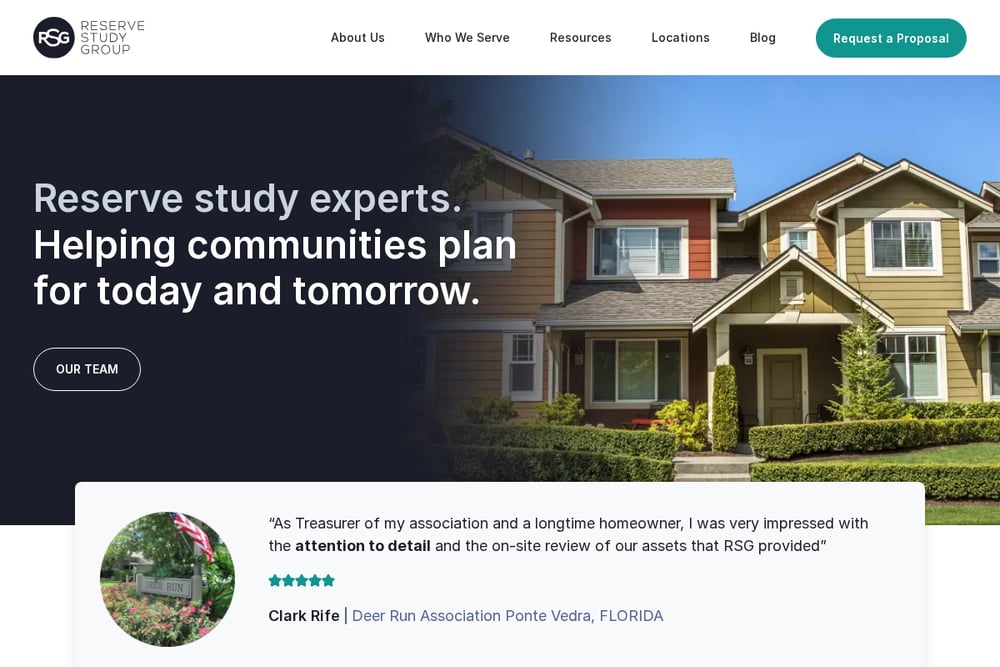 A screenshot of the Reserve Study Group website.
Reserve Study Group keeps the process simple and the deliverables visible. The firm serves homeowner associations, condominium associations, association management companies and commercial property owners, with a Great Lakes region that includes Illinois. Its site publishes a sample reserve study report and a reserve fund calculator, both of which help a board sanity-check projections before the first call. The proposal request flow is direct, and the firm recommends updating studies every three to five years based on industry standards. For a board that wants a clean, no-drama engagement with useful self-serve tools, this is a solid fit.
#5 PropFusion
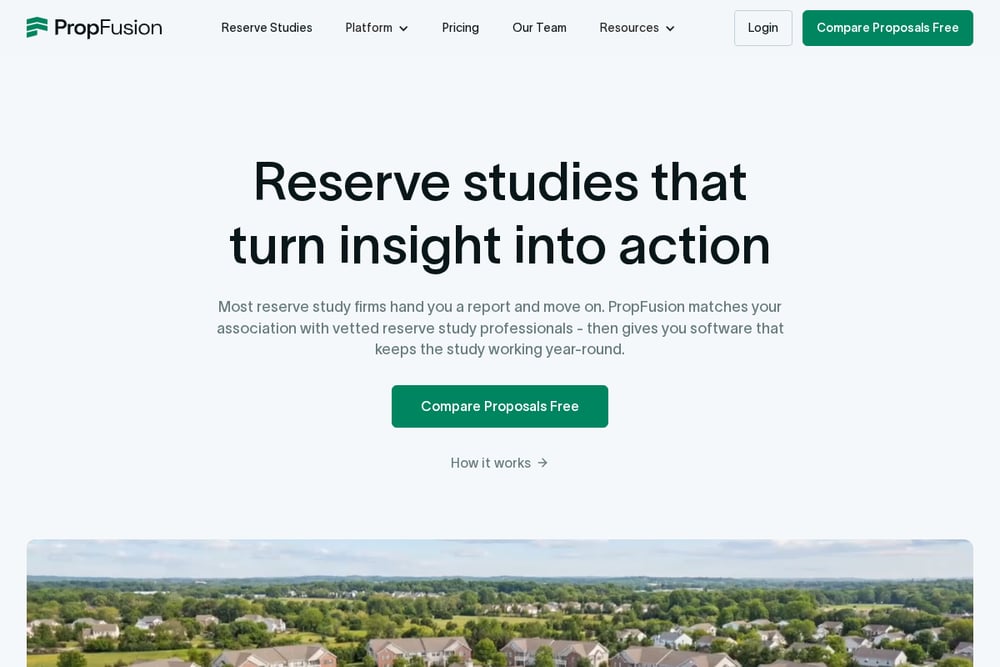 A screenshot of the PropFusion website.
PropFusion approaches reserve studies as a software problem as much as a consulting one. The platform matches boards with vetted reserve study companies and then gives them a live workspace to manage reserves long after the report lands. The firm is led by a licensed Reserve Specialist with more than 20 years in the field and over 5,000 studies performed, so the vetting has real experience behind it. Level 1, 2 and 3 studies with 30-year funding plans are available, and the proposal comparison tool lets you line up quotes side by side. If your board has watched past studies collect dust, the ongoing workspace is the differentiator worth testing.
How to Choose the Right Provider for Your Board
Start with your building, not the brochure. A Chicago high-rise with elevators, facade masonry and a garage deck needs a provider comfortable with full-day site visits and city exterior wall reports. A suburban townhome association needs someone who will read the declaration first and confirm whether private streets, ponds and fencing are actually the association's responsibility. Next, ask how the provider handles Illinois specifics. Can they explain the notice windows, the two-thirds waiver vote and the 15% petition threshold without looking it up? If not, keep looking. Then get pricing clarity. Fees follow the building, so ask what drives the number: square footage, component count, site visit length, number of buildings. Finally, check what happens after delivery. A study that sits in a drawer does nothing for your budget. Ask whether updates are discounted, whether a funding plan tool is included, and whether the provider will present findings to owners. That last point matters more than you think when a 15% increase is on the table.
Where Automation Fits Into Your Reserve Workflow
Reserve planning is repetitive by nature, which makes it a good candidate for light automation. Set calendar reminders for your study update cycle, typically every three to five years, and add a separate reminder for the 25 to 30 day condo budget notice window so you never miss it. Store your component inventory and useful-life assumptions in a shared spreadsheet or platform workspace so each update starts from real data instead of a blank page. Use a reserve fund calculator to run funding scenarios before the board meeting, then save the outputs alongside the study. When a budget crosses the 15% threshold, trigger a checklist that covers owner notice, the petition window and attorney review. If your provider offers a live workspace, like the one PropFusion builds around its studies, use it as the system of record. Automation will not make the reserve decision for you, but it will keep the deadlines and the math from surprising you.
The Bottom Line for Illinois Boards
Illinois gives you a clear framework and leaves the hard judgment to the board. Reasonable reserves, a documented basis for the number, a two-thirds vote if you waive, and disclosure to buyers. The provider you pick should make that framework easier to navigate, not harder. Illinois Reserve Studies is the natural first call for boards that want statute-level guidance and area-specific expertise across Chicago, Cook County and DuPage County. Association Reserves and Reserve Advisors bring scale and service breadth. Reserve Study Group keeps things simple with useful self-serve tools. PropFusion keeps the study alive with software. Whichever you choose, get the site visit, read the declaration, and put the funding plan in front of owners early. Your reserve line is only as defensible as the work behind it.