
Finding care that actually understands hypermobility can feel impossible. These five services are changing that for patients across the country.
The Hypermobility Care Gap
Hypermobility spectrum disorders and Ehlers-Danlos syndromes affect connective tissue and often involve a complex mix of joint instability, chronic pain, fatigue, and immune dysregulation. The problem? Most clinicians receive little to no training on these conditions, so patients bounce between specialists for years without answers. That gap has fueled a new wave of remote coaching and advocacy services designed to translate research into practical, personalized guidance. These services don't replace medical care, but they help you navigate it with evidence and confidence.
How We Evaluated These Services
We looked at five factors: service scope (what they actually offer), pricing clarity (can you find costs without a sales call?), local fit (do they understand regional healthcare challenges?), evidence base (is the guidance grounded in research?), and lived experience (does the provider personally understand hypermobility?). Each service brings something different to the table. Some lean heavily on clinical expertise, others on research literacy or movement coaching. Your best fit depends on whether you need help understanding your symptoms, preparing for appointments, or building a safe movement routine.
Here's a quick look at five services that stand out for different reasons.
| Provider | Best For |
|---|---|
| Hypermobility MD (Bendy Bodies) | One-on-one coaching with a physician who gets it |
| Connecting with Hypermobility | Research-driven coaching and self-advocacy support |
| Rachel Lee Patient Advocacy Consulting | Practical advocacy resources and consulting |
| Linda Bluestein MD Bendy Bodies LLC | Teleadvocacy and appointment preparation |
| Evolve To Fit | Structured movement coaching for EDS and hypermobility |
The 5 Services in Detail
#1 Hypermobility MD (Bendy Bodies)
Led by Dr. Linda Bluestein, a physician with lived experience of hEDS, Hypermobility MD offers EduCoaching that combines personalized information with one-on-one sessions. You can work directly with Dr. Bluestein or Rebecca Gluck, PA-C, both of whom specialize in complex conditions like EDS, HSD, POTS, and MCAS. The service also includes small group sessions limited to 3-5 participants, making it a more affordable entry point. They are clear that coaching is not medical care, but it fills a massive gap for patients who have been dismissed by traditional providers. If you need help making sense of conflicting advice and connecting with knowledgeable providers, this is a strong option.
#2 Connecting with Hypermobility
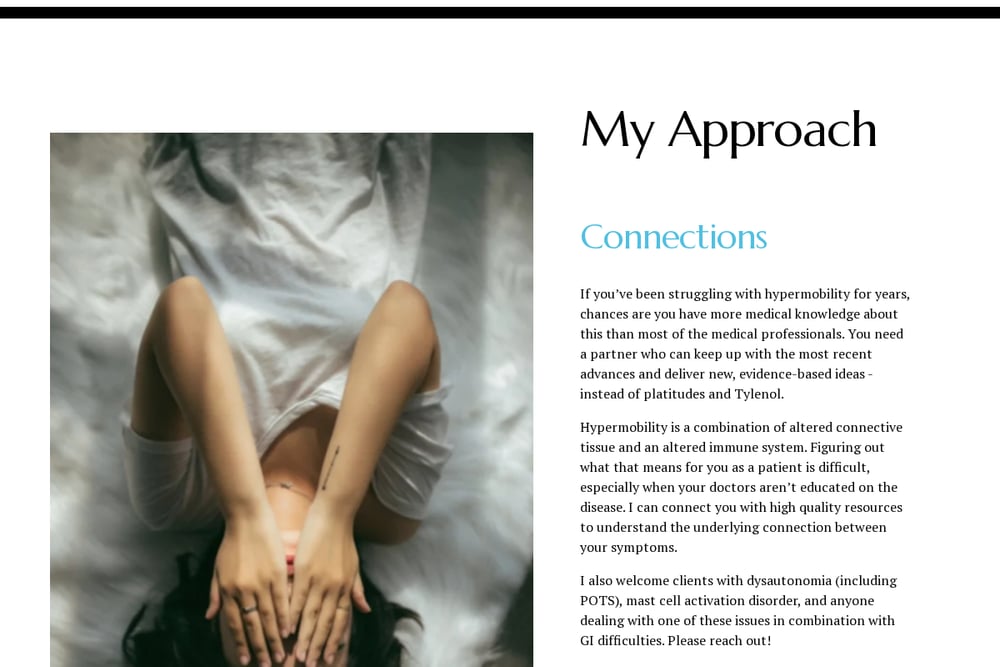 A screenshot of the Connecting with Hypermobility website.
Run by PhD research scientist Michelle Engle, Connecting with Hypermobility bridges the gap between research and daily symptom management. Michelle lives with hypermobility herself, so she understands the frustration of navigating a disorganized evidence base hidden behind paywalls. Her coaching focuses on research literacy, self-advocacy, and practical strategies you can discuss with your healthcare team. Based in North Carolina, she offers personalized guidance that helps you connect the dots between altered connective tissue and immune system involvement. If you want a partner who can keep up with the latest advances and deliver evidence-based ideas instead of platitudes, this service is for you.
#3 Rachel Lee Patient Advocacy Consulting
Rachel Lee offers patient advocacy consulting with a focus on EDS, hypermobility spectrum disorders, and related conditions like autism and mast cell activation. Her resource library is a treasure trove of practical handouts, including guides on fascial health, movement, and histamine intolerance. She emphasizes that language is power, and her advocacy principles help you communicate more effectively with your care team. While she doesn't provide medical care, her consulting services are designed to help you navigate the system and find the right practitioners. If you need help organizing your thoughts and building a case for better care, Rachel's approach is invaluable.
#4 Linda Bluestein MD Bendy Bodies LLC
This listing on Greater National Advocates highlights Dr. Linda Bluestein's advocacy services separate from her coaching practice. As a physician with hEDS, she offers teleadvocacy and paid consultations to help you make sense of confusing advice and connect with knowledgeable providers. She can help you prepare for appointments, prioritize next steps, and feel supported by someone who truly understands conditions like tethered cord syndrome, cervical instability, and gastroparesis. The focus here is on advocacy and navigation rather than ongoing coaching. If you need a one-time consultation to get unstuck, this is a solid choice.
#5 Evolve To Fit
Evolve To Fit takes a movement-first approach to EDS and hypermobility. Based in Arlington, Virginia, they offer online coaching, private sessions, and a free EDS & Hypermobility library with educational guides and videos. Their EDS Blueprint is a self-paced course and workbook that helps you build readiness, movement dosage, and recovery observations into a connected framework. They are clear that coaching is not clinical care, and they encourage you to discuss any movement strategy with your own care team. If you want to feel stronger and more stable in your body, their structured movement programs are worth exploring.
How to Choose the Right Support
Start by identifying your biggest bottleneck. Is it understanding your symptoms? Preparing for appointments? Building a safe movement routine? If you need research translation and advocacy, Connecting with Hypermobility or Rachel Lee are strong fits. If you want clinical expertise, Hypermobility MD or Linda Bluestein's advocacy services may be better. For movement, Evolve To Fit offers a structured path. Also consider your budget and whether you prefer one-on-one or group settings. Most services offer free resources or consultations, so you can test the waters before committing.
What Automation Can and Can't Do
Automation can help you track symptoms, organize medical records, and set reminders for appointments or medications. But it can't replace the nuanced, human guidance these services provide. Use tools to reduce administrative burden, then invest your energy in working with a coach or advocate who understands hypermobility. The combination of smart systems and personalized support is where real progress happens.
The Bottom Line
Hypermobility and EDS are complex, and the healthcare system isn't built for them. But you don't have to figure it out alone. The five services here offer different paths to better care, whether you need research-backed coaching, advocacy, or movement guidance. Start with the one that matches your most pressing need, and don't be afraid to combine approaches. Your health is worth the investment.