
Why rent a game server for 730 hours when your group only plays 40? Hourly billing flips the script, and these five hosts are leading the charge.
The Rise of Pay-Per-Hour Game Hosting
Game server hosting used to mean a flat monthly fee, whether your friends showed up or not. That model is fading. Communities now expect to pay only for the hours their server actually runs. Hourly billing, prepaid credit, and on-demand wake-ups are becoming standard. The shift is driven by small groups who play a few evenings a week, not round-the-clock. Hosts are responding with flexible plans, monthly caps, and instant deployment. The result: less waste, more control, and servers that match real play patterns.
How We Evaluated These Hosts
We looked at five factors. First, billing flexibility: can you pay by the hour, and is there a monthly cap? Second, game coverage: does the host support the titles your community actually plays? Third, pricing clarity: are rates and caps easy to find and understand? Fourth, setup and management: how quickly can you deploy, and can friends start the server? Fifth, regional fit: are there server locations near your players? Each host below stands out in different ways. TickToad offers a clear hourly model with a low monthly cap. ServerFlex emphasizes instant deployment and a global network. Pixly focuses on minute-level billing and sleeping servers. RespawnHost combines pay-per-use with a broad game library. AleForge bills by the minute for RAM, CPU, and disk. Use these factors to match a host to your group's habits.
Here is a quick look at five hosts that let you pay by the hour, with the key details that matter for small communities.
| Provider | Best For |
|---|---|
| ServerFlex | Groups that want instant, on-demand servers with global locations |
| TickToad — game server hosting | Small friend groups that want a predictable monthly cap |
| Pixly | Minecraft groups that play in short, irregular sessions |
| RespawnHost | Communities that play multiple games and want one host |
| AleForge | Tinkerers who want minute-level resource billing |
The Five Hosts in Detail
#1 ServerFlex
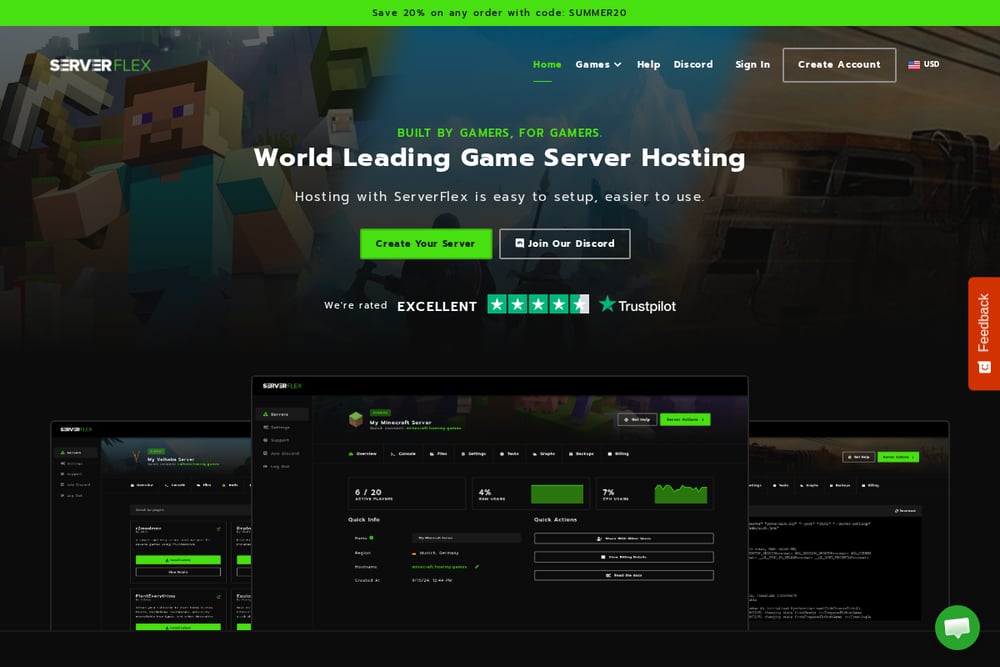 A screenshot of the ServerFlex website.
ServerFlex built its reputation on speed. You choose a game, pick a plan, and select hourly billing. The server deploys in under 10 seconds. That instant spin-up is ideal for impromptu sessions. The platform supports Minecraft, Valheim, Factorio, Rust, Palworld, and more. You add credit upfront, with a $5 minimum, and pay only for the hours you use. A 100% uptime guarantee backs the service. If you want a server that feels like flipping a switch, ServerFlex delivers.
#2 TickToad — game server hosting
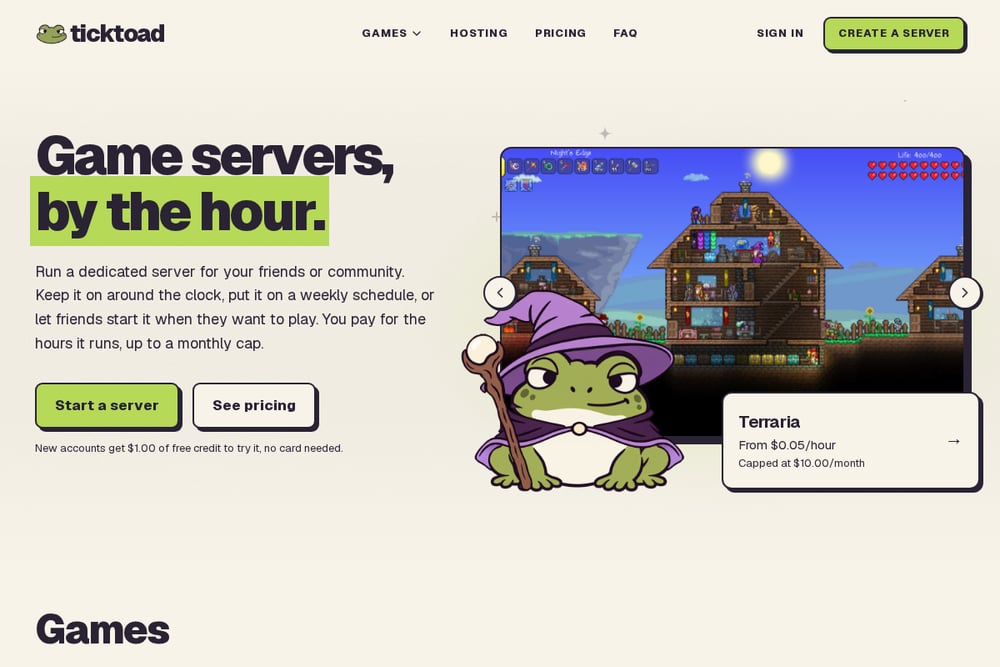 A screenshot of the TickToad — game server hosting website.
TickToad keeps it simple: game servers by the hour, with a monthly cap. You can run your server always on, on a weekly schedule, or on demand. Rates start at $0.05 per hour for Terraria and Minecraft, capped at $10 per month. Factorio, Valheim, and Necesse are also $0.10 per hour, capped at $10. Palworld runs $0.18 per hour, capped at $16. The cap means you never pay more than a flat monthly fee, no matter how many hours you rack up. Friends can start the server when they want to play, and it saves and shuts down automatically. It is a straightforward fit for small communities that play on their own schedule.
#3 Pixly
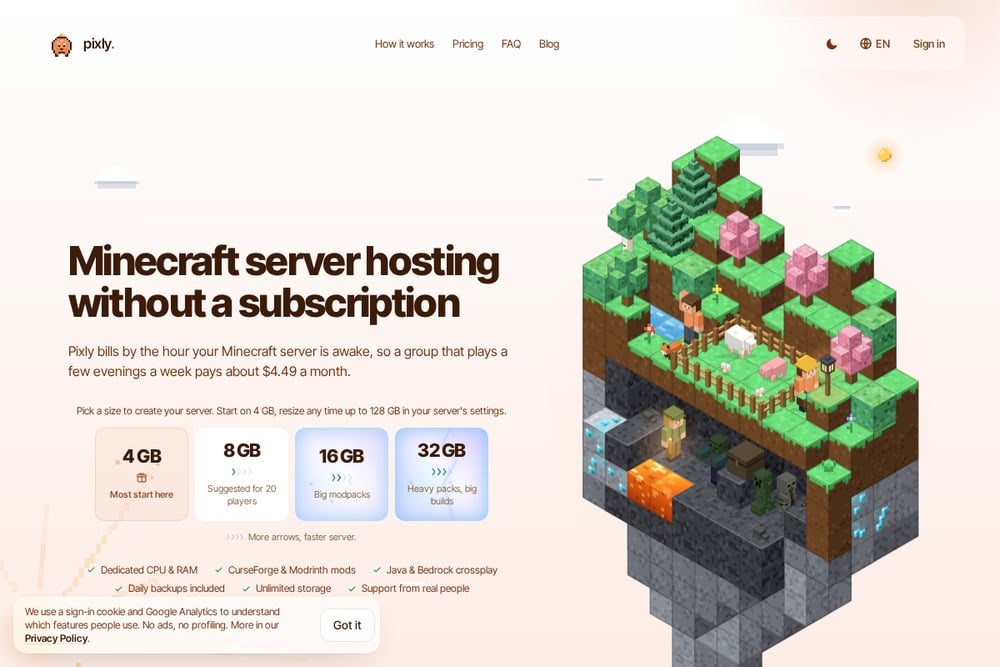 A screenshot of the Pixly website.
Pixly rents Minecraft servers by the hour, with a twist: your server sleeps five minutes after the last player leaves. That means you only pay for active play time. The smallest size starts at $0.10 per hour awake. There is no subscription, no setup fee, and nothing to cancel. You top up a balance in advance, and billing is counted by the minute, not rounded up. Pixly also offers a free trial of about eight hours with no card required. If your group plays a few evenings a week, the savings add up fast.
#4 RespawnHost
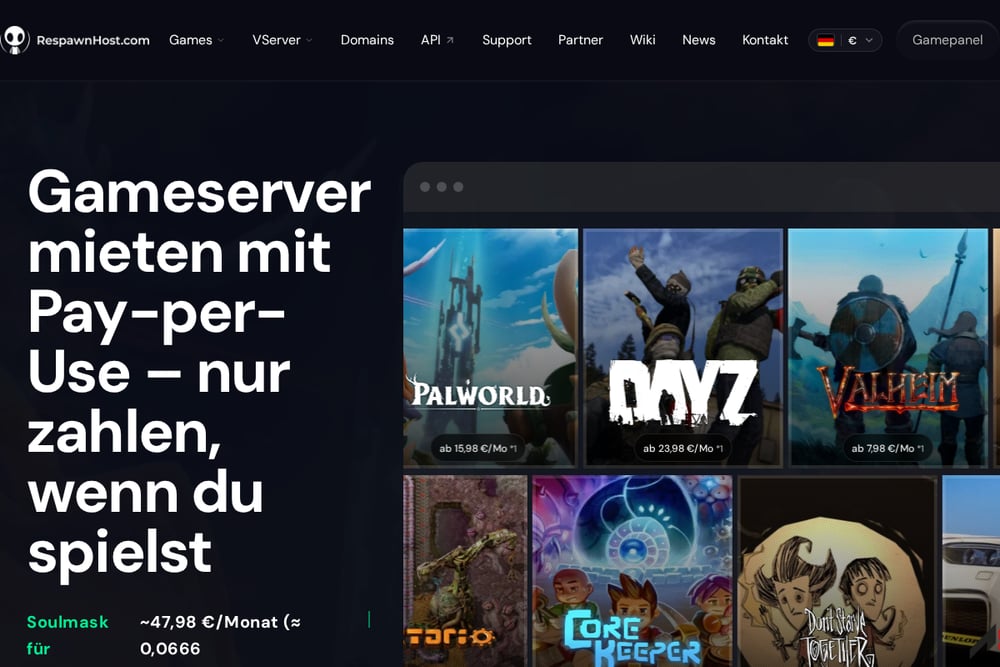 A screenshot of the RespawnHost website.
RespawnHost markets itself as pay-per-use, with the tagline 'only pay when you play.' The platform covers a wide range of games, including Minecraft, Palworld, Valheim, Rust, Satisfactory, and Hytale. Prices are shown as monthly equivalents based on 24/7 usage, but the pay-per-use model means you can scale back. The service also offers VPS options and a game panel. If you want a host that can grow with your community and support many titles, RespawnHost is worth a look. Just check the hourly details for your specific game.
#5 AleForge
 A screenshot of the AleForge website.
AleForge takes a different angle: pay-as-you-go hosting billed by the minute. You add prepaid credit, set resource limits, and pay only for the RAM, CPU, and disk your server uses. When the server is stopped, you still pay for disk, but CPU and RAM billing pause. The minimum deposit is $5, and one balance covers all your pay-as-you-go servers. AleForge supports popular titles like Minecraft, Valheim, Terraria, and Factorio. It is a good fit if you want granular control over resources and costs. The trade-off is a bit more setup than a flat hourly rate.
How to Choose the Right Hourly Host
Start with your play pattern. If your group plays most evenings, an always-on server with a monthly cap like TickToad's may be simplest. If you play sporadically, a sleeping server like Pixly's or a pay-per-use model like RespawnHost's could save more. Next, check game support. Make sure the host offers the exact titles your community plays. Then look at billing details: is there a minimum deposit? Are there caps? How is time counted? Finally, consider location. A server near your players means lower ping. Read the fine print on what happens when the server is idle. The right host is the one that matches how you actually play.
Automating Your Server Schedule
You can automate server uptime to match your group's schedule. Use the host's scheduling tools to start the server at a set time each week. For on-demand play, grant friends permission to wake the server. Set a monthly cap to avoid surprise bills. If the host supports it, configure the server to save and shut down after a period of inactivity. This workflow keeps costs low and ensures the server is ready when you are. Review your usage dashboard monthly to adjust limits. Automation turns hourly billing into a hands-off, predictable expense.
The Bottom Line on Hourly Game Hosting
Hourly game server hosting is no longer a niche experiment. It is a practical way for small communities to run dedicated worlds without paying for empty hours. The five hosts here each approach it differently. ServerFlex leads with speed and global reach. TickToad offers a clean hourly rate with a low monthly cap. Pixly focuses on Minecraft and minute-level billing. RespawnHost covers many games with pay-per-use. AleForge gives you resource-level control. Pick the one that fits your group's rhythm, and you will spend less while playing more.