When a patient leaves the hospital, the handoff is where outcomes are won or lost. These five physician groups are built to make that handoff seamless.
The post-acute coverage landscape
Hospital medicine and post-acute care have quietly become the backbone of American healthcare for older and medically complex adults. Patients move from an inpatient bed to a skilled nursing facility or subacute rehab unit faster than ever, and every transition is a chance for medication errors, missed follow-ups, and avoidable readmissions. Physician groups that cover both sides of that divide are increasingly in demand from hospitals, facilities, and health plans alike. The field rewards organizations that can staff consistently, document thoroughly, and communicate across settings.
How these groups were evaluated
Each group was looked at on service scope across the hospital-to-home continuum, depth of post-acute and SNF experience, continuity and handoff practices, transparency of the partnership model, and overall fit for facilities and health systems seeking reliable attending coverage. The detail on each organization lives in the write-ups below.
Here is a quick look at the five groups, ordered to help you compare scope and fit before you dig into the details.
| Provider | Best For |
|---|---|
| TeamHealth Post-Acute Care | Large multi-facility operators wanting national scale |
| Hospitalist & SNF Physician Group | Stonewater Medical Group | Southeast Michigan facilities wanting continuity across settings |
| Inhospital Physicians | Hospitals seeking a physician-owned, locally led partner |
| General Medicine Post-Hospitalist Services | Facilities wanting dedicated on-site attending programs |
| US Acute Care Solutions | Health systems integrating hospital and acute care lines |
The five groups in detail
#1 TeamHealth Post-Acute Care
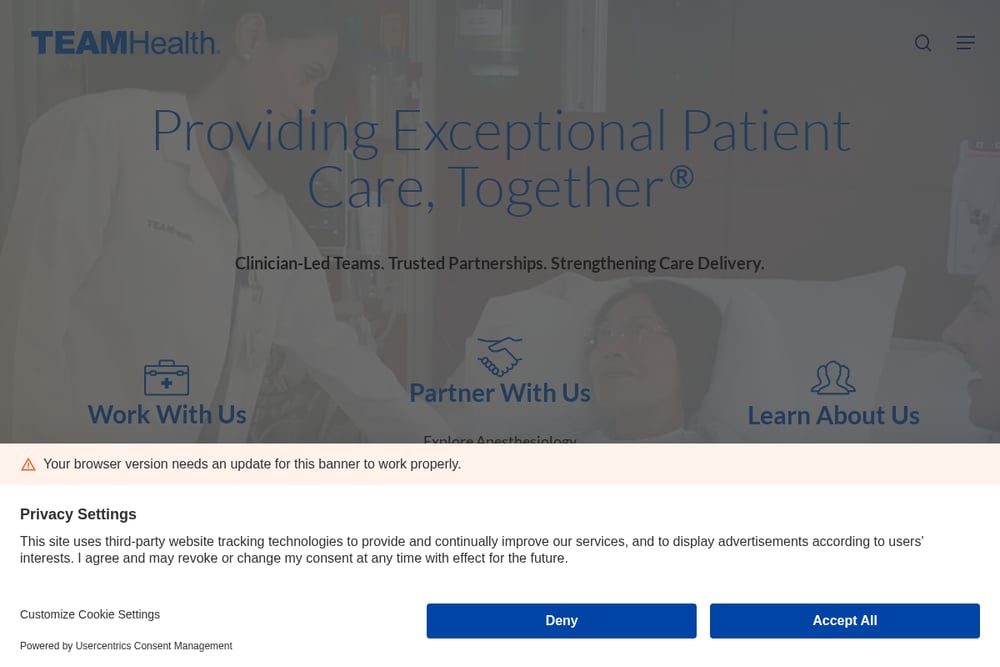 A screenshot of the TeamHealth Post-Acute Care website.
TeamHealth is one of the largest clinician organizations in the country, and its post-acute division extends that scale into skilled nursing, rehab, long-term care, and assisted living settings. The group emphasizes safer transitions and readmission reduction through collaboration between facility staff and integrated care teams. You get access to clinical services spanning primary care, behavioral health, cardiac care, wound care, and palliative care under one partnership. For a multi-facility operator that wants a single national vendor, the breadth is hard to match. The tradeoff is that scale can feel less personal than a smaller, physician-owned group.
#2 Hospitalist & SNF Physician Group | Stonewater Medical Group
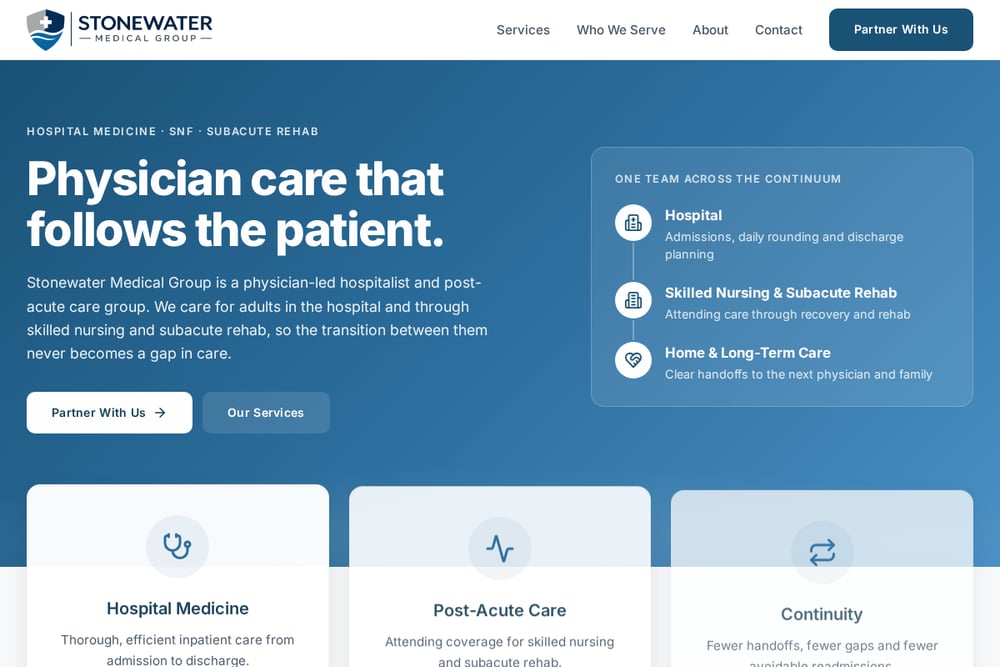 A screenshot of the Hospitalist & SNF Physician Group | Stonewater Medical Group website.
Stonewater Medical Group is a physician-led, independent group built around a simple promise: physician care that follows the patient. The team covers inpatient hospital medicine, skilled nursing facility attending care, and subacute rehab, with explicit physician-to-physician handoffs designed to prevent gaps and avoidable readmissions. You also see services many groups treat as an afterthought, including medication reconciliation with deliberate deprescribing and documented goals-of-care conversations. Clinicians bring board-certified internal medicine, ICU and hospital medicine, and nursing home and LTACH experience to the bedside. For Southeast Michigan facilities that want one accountable team across the continuum, this is a strong fit.
#3 Inhospital Physicians
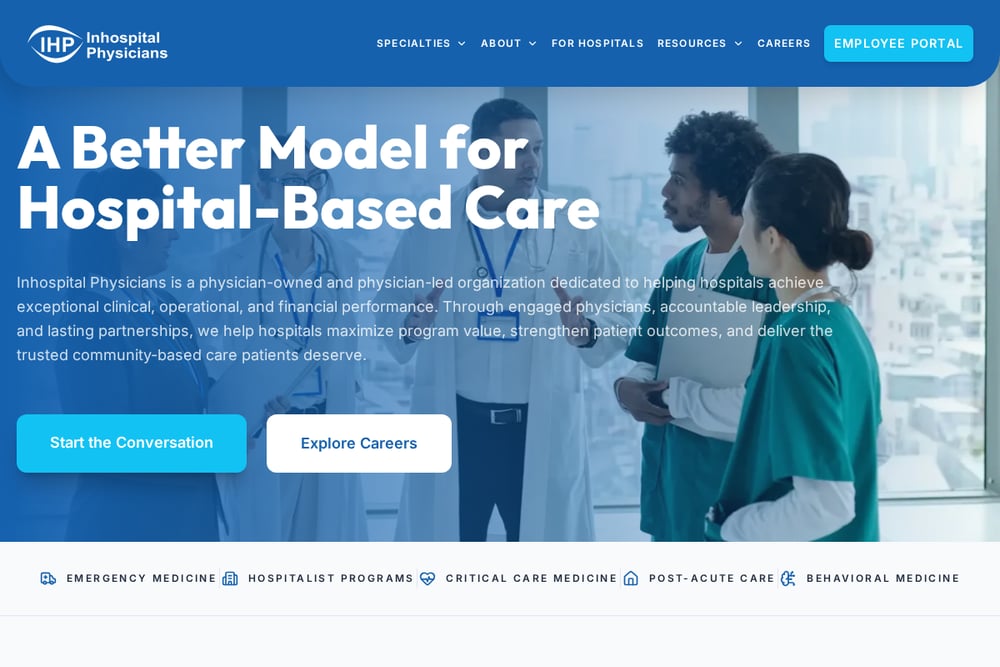 A screenshot of the Inhospital Physicians website.
Inhospital Physicians is a physician-owned and physician-led organization focused on hospital-based care, with service lines spanning emergency medicine, hospitalist medicine, critical care, post-acute care, and behavioral health. The model is built on engaged physicians and accountable local leadership rather than a distant corporate layer. Hospitals get customized coverage and management solutions tailored to their operational and clinical needs. The provider-first culture is a selling point if you are recruiting in a competitive market. It is a good match for hospitals that want a partner aligned with their own clinicians.
#4 General Medicine Post-Hospitalist Services
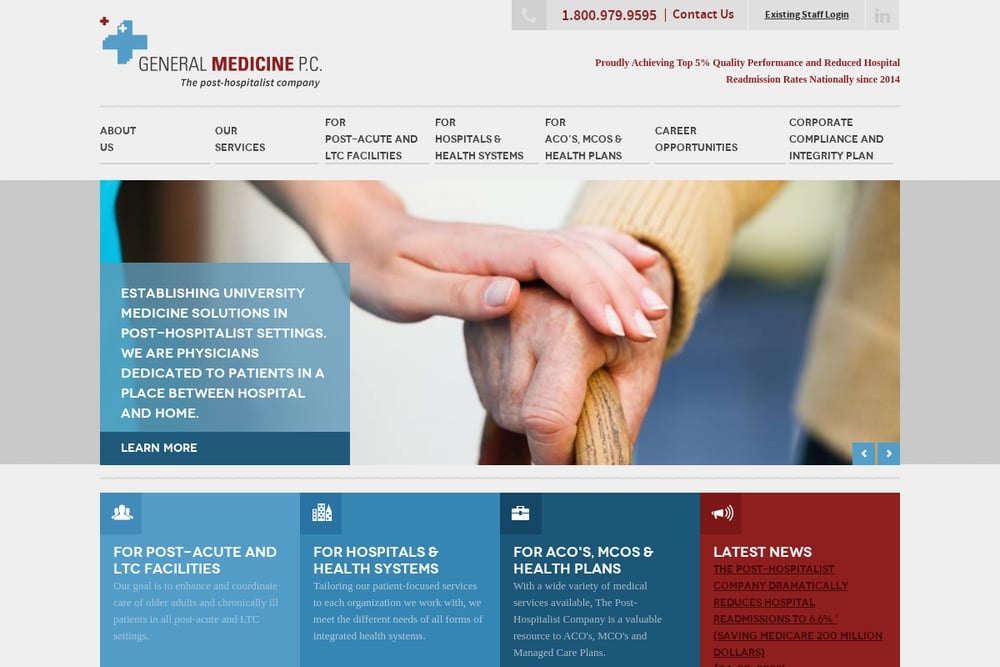 A screenshot of the General Medicine Post-Hospitalist Services website.
General Medicine has built its identity around the post-hospitalist model, a specialized approach to medicine in post-acute and long-term care settings where patient acuity keeps rising. The group provides attending physician, nurse practitioner, and medical director services exclusively on-site in facilities. Its model leans on regularly scheduled daily on-site hours, multidisciplinary follow-up, and consistent providers for continuity of care. The organization also highlights top-tier quality performance and reduced readmission rates nationally since 2014. If your priority is a dedicated facility-based attending program, this is a focused option.
#5 US Acute Care Solutions
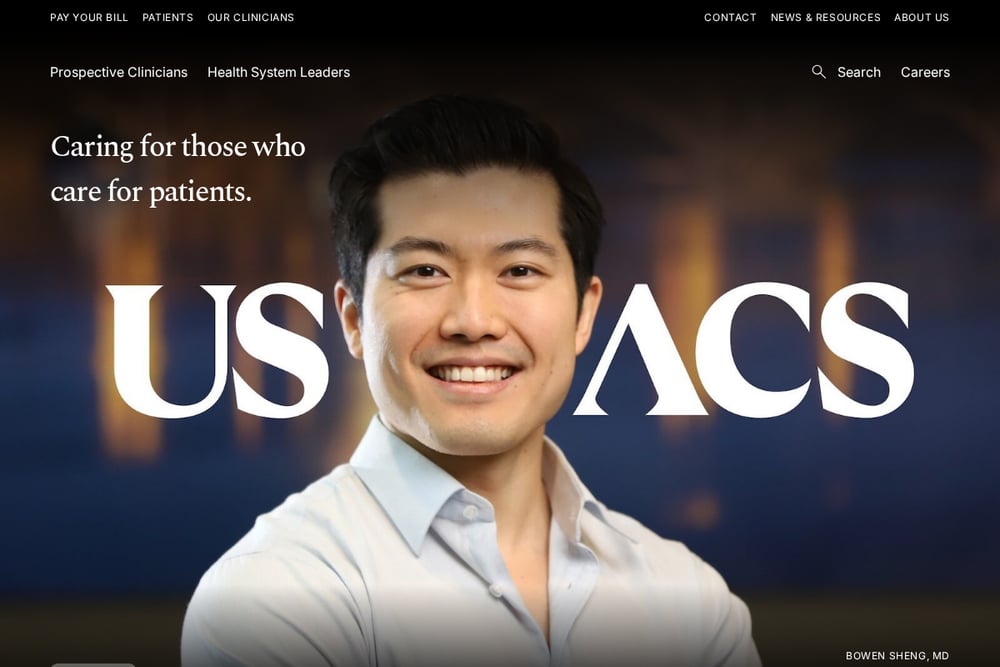 A screenshot of the US Acute Care Solutions website.
US Acute Care Solutions is a clinician-owned acute care group with management services across emergency medicine, hospital medicine, critical care, and observation medicine. Ownership matters here: physicians hold equity in the organization, which shapes how engaged they tend to be in program performance. The group pairs clinical staffing with leadership development, executive coaching, and case-study-driven quality improvement. For health systems that want hospital medicine integrated with emergency and critical care under one partner, the model is compelling. Post-acute coverage is less of a centerpiece than in the groups above, so weigh that against your needs.
Choosing the right partner
Start with your geography. A regional group like Stonewater can offer tighter physician-to-physician relationships in Southeast Michigan, while national players bring scale and standardized infrastructure. Next, ask how handoffs actually work. Who takes the call at 2 a.m.? Who reconciles medications at discharge? Ask for readmission data and how it is measured. Then look at the contract model: independent, physician-owned, or equity-based structures each change the incentives. Finally, talk to facility administrators who already work with the group. Their answers about responsiveness will tell you more than any brochure.
Where automation fits into the workflow
Automation will not replace a rounding physician, but it can remove the administrative drag around one. Think of it as a support layer: automated admission and discharge notifications that ping the attending and the next provider, medication reconciliation prompts at every transition, and scheduled reminders for required regulatory visits in SNF and SAR settings. Documentation templates can capture goals-of-care conversations so every team sees the same plan. Readmission risk flags can surface the patients who need a follow-up call within 48 hours. The goal is fewer dropped handoffs, not fewer clinicians.
The bottom line
The right partner depends on what you are solving for. If you need national scale and a wide clinical menu, TeamHealth and US Acute Care Solutions are built for that. If you want a physician-owned hospital partner, Inhospital Physicians makes a strong case. If dedicated on-site attending coverage in facilities is the priority, General Medicine has focused there for years. And if continuity across hospital, SNF, and subacute rehab in Southeast Michigan is the goal, Stonewater Medical Group is designed around exactly that handoff.