
Your monitor won't talk to your dock, your printer lives on another Wi-Fi network, and the cable situation under your desk is a genuine hazard. Here are five services that fix exactly that.
The New Concierge Layer for Home and Small Office Tech
Remote and hybrid work turned the home office into real infrastructure. But most people never got a proper setup — they got a laptop, a spare monitor, and a router shoved behind a couch. That gap created a category of service that sits between the big-box store and the enterprise IT department: the technology concierge.
These providers plan your workspace, pick compatible equipment, install it, organize the cables, and walk you through how it all works. Some also handle smart devices, security cameras, and ongoing support. The model is personal, on-site, and built around your actual room rather than a generic checklist.
Pricing structures vary widely. Some charge hourly, some use flat assessments credited toward the project, and some bundle everything into a quote. Knowing which model fits your situation is half the decision.
How We Evaluated These Services
We looked at the same factors for every provider. First, service scope: does the company handle planning, sourcing, installation, and follow-up, or just one slice? Second, pricing clarity: are rates published, and do you know what an assessment costs before you call?
Third, local fit: can they actually show up at your desk, and do they understand the housing and office stock in their market? Fourth, specialization: some are built for seniors and non-technical households, others for small teams that need documentation and handoffs.
Finally, transparency of process. Providers that explain their scope and next steps up front stood out. So did those with a defined starting point — an assessment, a consultation, or a published hourly rate — rather than a vague "call us."
Here's the quick comparison. Each of these five brings a different strength to the table, from flat-fee assessments to decades of hands-on experience.
| Provider | Best For |
|---|---|
| Concierge Home Tech Services | Non-technical households that want patient, plain-English help |
| MariSpaces — Your space. Working beautifully. | Home offices and small teams that want a planned, documented setup |
| GEEK-AID Home Office Setups | Households that need secure, work-grade network integration |
| David's Tech Concierge | People who want product sourcing plus hands-on training |
| Geeks on Site | Broad residential and small-business tech needs under one roof |
The Five Services, Up Close
#1 Concierge Home Tech Services
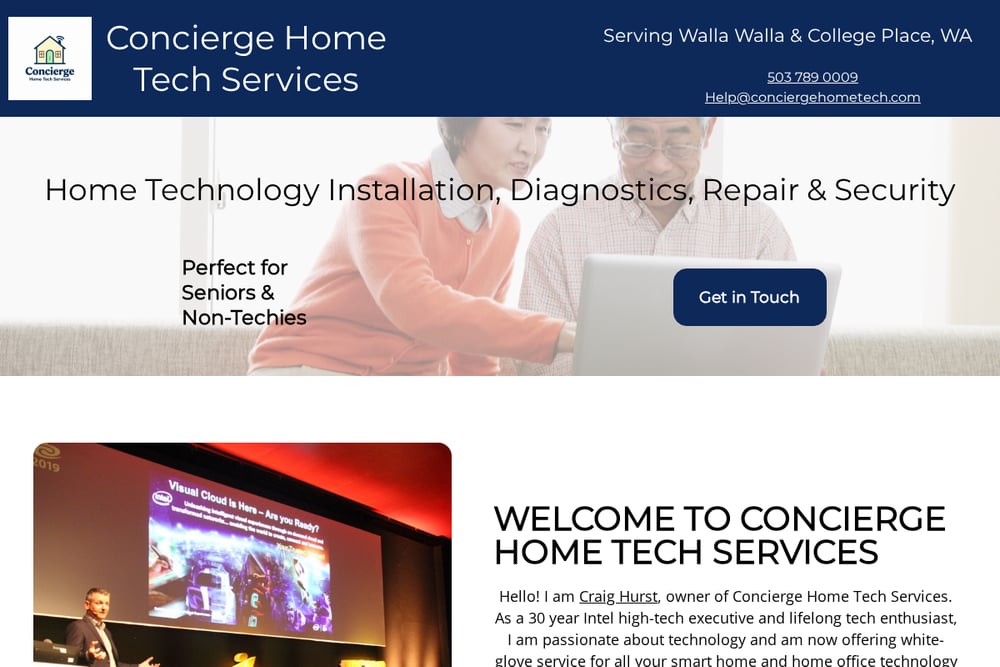 A screenshot of the Concierge Home Tech Services website.
Craig Hurst spent 30 years as an Intel high-tech executive before launching this white-glove service in Walla Walla and College Place, Washington. The pitch is patience: no jargon, no rush, clear explanations for people who would rather not think about technology at all. Services span PC and Mac setup, antivirus and security patches, password managers, printers, cameras, smart TVs, streaming devices, video doorbells, thermostats, and home theater consulting. Pricing is refreshingly simple at $99 per hour with a one-hour minimum, billed in 15-minute increments after that, and no minimum for remote follow-ups. It's a strong fit if you want one trusted person who handles everything and explains it in plain language. See the full service list at Concierge Home Tech Services.
#2 MariSpaces — Your space. Working beautifully.
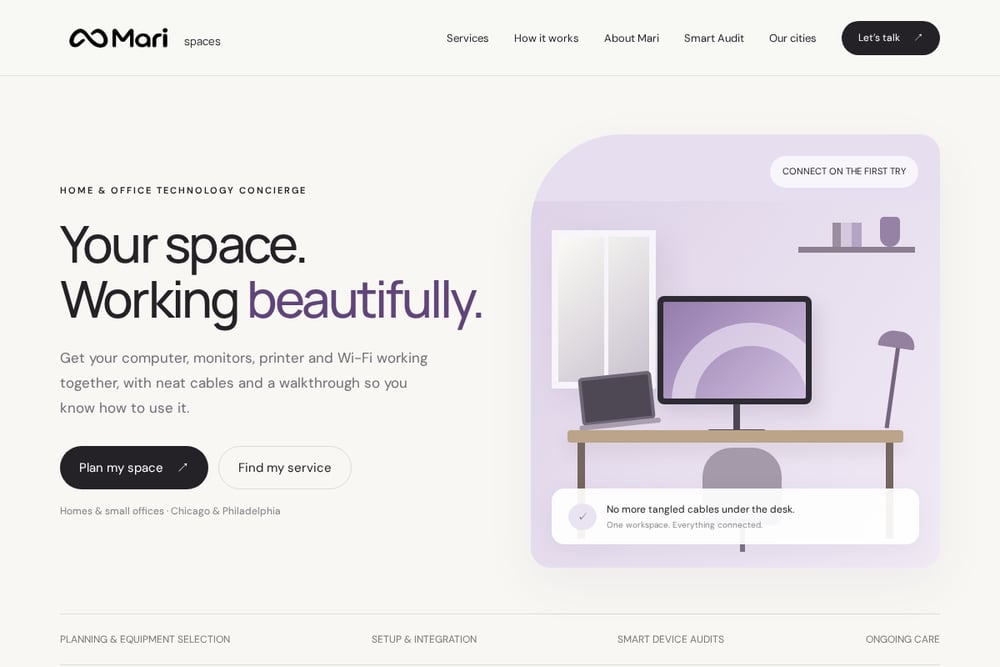 A screenshot of the MariSpaces website.
MariSpaces is a home and office technology concierge built around a simple promise: get your computer, monitors, printer, and Wi-Fi working together, with neat cables and a walkthrough so you actually know how to use it. The service covers planning and equipment selection, setup and integration, smart device audits, and ongoing care — for homes and small offices in Chicago and Philadelphia. What makes it easy to start is the structure: a $149 assessment and plan for home offices, or $299 for one small-office location with up to three users, both credited toward your complete project. Installation and new equipment are quoted separately, so you know exactly what you're paying for at each stage. The Smart Audit is a practical review for anyone who has accumulated smart devices and lost track of what's connected to what. Explore the services at MariSpaces.
#3 GEEK-AID Home Office Setups
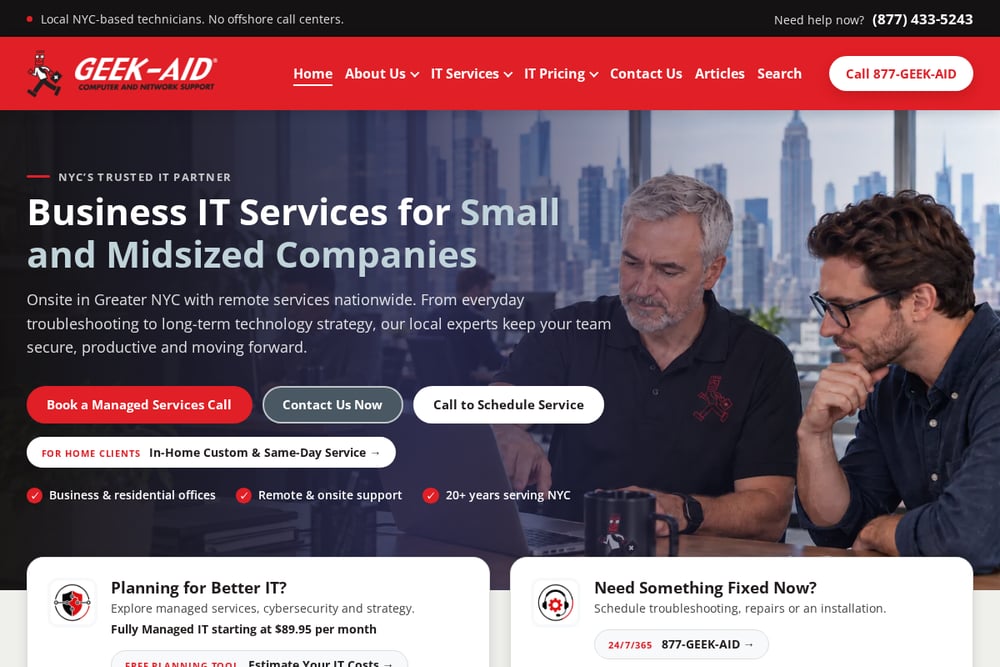 A screenshot of the GEEK-AID website.
GEEK-AID is an NYC-based operation with local technicians and no offshore call centers, which matters if you want someone physically at your desk. Their home office practice is built around productivity and communication goals: they design and install new systems or improve the speed, function, and integration of an existing remote office network. They're particularly useful if your work-from-home setup was thrown together hastily and now runs on outdated or incompatible gear. Technicians can update devices, secure them, and connect you seamlessly to a company network. They also support student home learning and remote classroom access, which makes them a fit for busy households with mixed needs. Details are at GEEK-AID.
#4 David's Tech Concierge
David runs a one-person concierge practice in New York with a clear motto: personalized service to meet all your technology needs. He selects products, finds the best prices, installs hardware and software, and trains you on what he set up. The scope is broad — computers, printers, home networks, home office design, additional monitors, Wi-Fi upgrades that reach every corner of the house, streaming devices, audio/video control systems, and even website and blog setup. He also offers business workflow design, which is unusual for a residential-focused provider. If you want a single person who will both buy the right gear and teach you to use it, this is the model. Ongoing support is available by email, phone, or in person. Learn more at David's Tech Concierge.
#5 Geeks on Site
Geeks on Site is the largest operation on this list, with 24/7 service and a deep menu that stretches well beyond the desk. On the residential side they handle smart home installation, computer and network repair, virus and malware removal, wireless network installation, data recovery, printer repair, and TV mounting. For commercial clients they cover security cameras, printer services, outsourced IT, and POS systems. That breadth is the appeal: if your home office needs a new router and your small business needs a camera system, one call covers both. The tradeoff is that you're working with a larger service organization rather than a single named concierge, so expectations around personal continuity differ. Their blog also offers practical guidance on building a productive home office. See the full range at Geeks on Site.
How to Pick the Right One for Your Space
Start with what's actually broken. If your problem is a tangle of cables and a monitor that won't wake up, you need setup and integration. If your problem is that you own eleven smart devices and understand none of them, you need an audit.
Next, decide how you want to pay. Hourly rates suit small, unpredictable jobs. Flat assessments suit projects where you want a defined starting point before committing to installation. Ask whether the assessment fee is credited toward the work — that detail changes the math considerably.
Then check geography. A concierge service only works if someone can stand in your room. Confirm your city is served before you fall in love with a service menu.
Finally, think about who you are as a client. If you want patient explanations and zero jargon, prioritize that. If you want documentation and a clean handoff for a team, prioritize that instead. The right provider is the one whose process matches your temperament.
Where Automation Fits In
A good concierge doesn't just plug things in — they leave you with a setup that maintains itself. That means automated backups configured and tested, security patches scheduled, and a password manager in place so you're not resetting credentials every month.
On the smart device side, an audit should map what's connected, what's redundant, and what's running on an app you no longer use. Consolidating that reduces the number of things that can fail.
For small teams, documentation is the automation layer. A written record of which workstation has which dock, which printer is shared, and how the network is segmented saves hours the next time someone joins or moves desks. Ask any provider whether you'll receive that documentation at handoff.
The Bottom Line
You don't need to become a network engineer to have a workspace that works. You need someone who plans it, installs it, labels the cables, and shows you how to use it.
If you're in Chicago or Philadelphia and want a structured starting point with a credited assessment, MariSpaces is built for exactly that. If you're elsewhere and want patient, hourly help, Concierge Home Tech Services and David's Tech Concierge offer two flavors of the same personal model. GEEK-AID suits secure work-grade integration, and Geeks on Site covers the widest range of residential and small-business needs.
Pick based on your problem, your budget style, and whether you want a person or a company. Then get the cables off the floor.