Patients pick a provider after a quick search, a glance at the reviews, and a look at the website. If your practice is invisible in that moment, the appointment goes to someone else.
Why Local Search Decides Who Gets the Appointment
Healthcare search is overwhelmingly local. When someone types "chiropractor near me" or "physical therapy in [city]," the map pack gets the calls. Practices that show up there win the booking before a single phone call happens.
The problem is that most independent practices are built to treat patients, not to manage listings. Incomplete Google Business Profiles, inconsistent details across directories, and unanswered reviews quietly push you out of view. Thin service pages that never explain what you treat, who you are, or how insurance works send visitors straight back to the search results.
That gap has created a category of agencies focused on healthcare local SEO. Some are solo operators who handle one plan at a time. Others are full-service shops with content teams, paid media, and web design under one roof. The right fit depends on how much you want handled and how much you want to stay involved.
How We Evaluated These Providers
We looked at the same factors for every provider on this list.
Service scope. Does the provider cover the full local picture, including Google Business Profile management, listings, reviews, and website content? Or does it focus on one slice?
Pricing and contract clarity. Month-to-month arrangements and plain-language reporting matter for independent practices watching overhead. Long contracts and bundled retainers are a different trade-off.
Healthcare fit. Some providers work almost exclusively with medical, dental, and therapy practices. Others serve healthcare as one industry among many. Both can work, but the depth of specialization shows in how they talk about compliance and patient privacy.
Local execution. Map pack visibility, citation consistency, and review handling are the daily mechanics of local search. We weighed how explicitly each provider addresses them.
Transparency. Free audits, checklists, and diagnostic offers give you a way to see the work before you commit.
Here is a quick look at the five providers, ordered for this roundup. Each one approaches healthcare local SEO from a different angle, so scan for the model that matches how you want to work.
| Provider | Best For |
|---|---|
| MedcoShare | Practices wanting local SEO plus a regional practice-services partner |
| Nearwell Healthcare SEO | Independent practices that want steady, hands-on local SEO without contracts |
| Arcane Marketing | Healthcare organizations wanting local SEO inside a full-service digital stack |
| Direction | Practices ready to pair organic SEO with paid acquisition |
| Thrive Agency | Growing groups that want one agency across many channels |
The 5 Providers in Detail
#1 MedcoShare
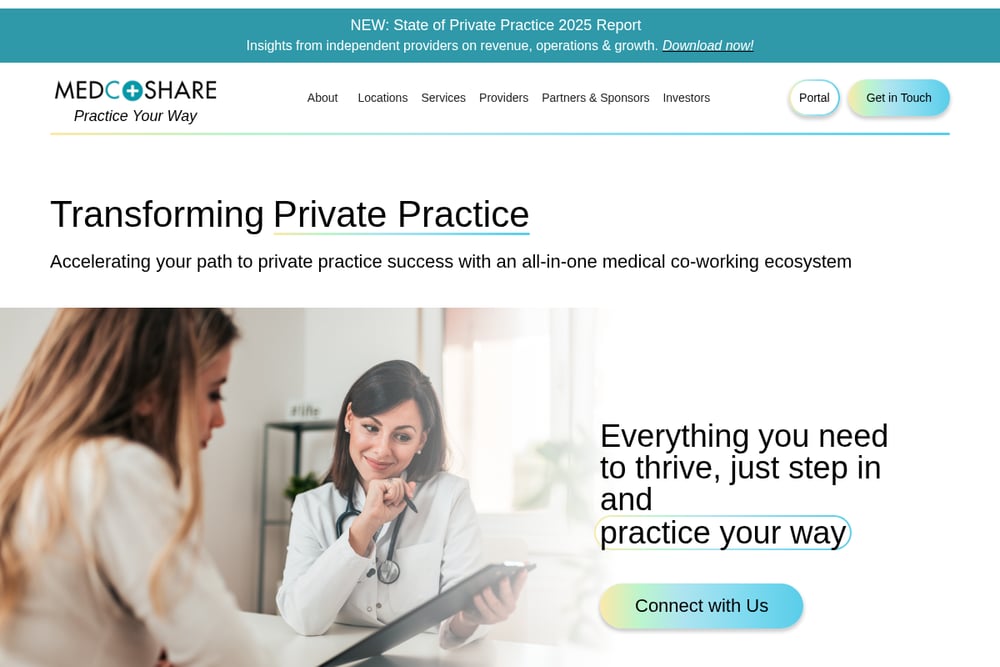 A screenshot of the MedcoShare website.
MedcoShare runs a healthcare SEO practice aimed at medical practices that want visibility in Google search and the map pack. The team frames its work around high-intent searches like "doctor near me" and "dermatologist near me," with a stated timeline of three to six months to meaningful results. Local SEO, Google Business Profile optimization, and citation building sit at the center of the offer, backed by on-page and off-page work. It also operates physical locations across Pennsylvania, New Jersey, Texas, and Massachusetts, which gives it a regional footprint unusual for an SEO shop. If you want a provider that pairs local search with a broader practice-services relationship, this is worth a conversation.
#2 Nearwell Healthcare SEO
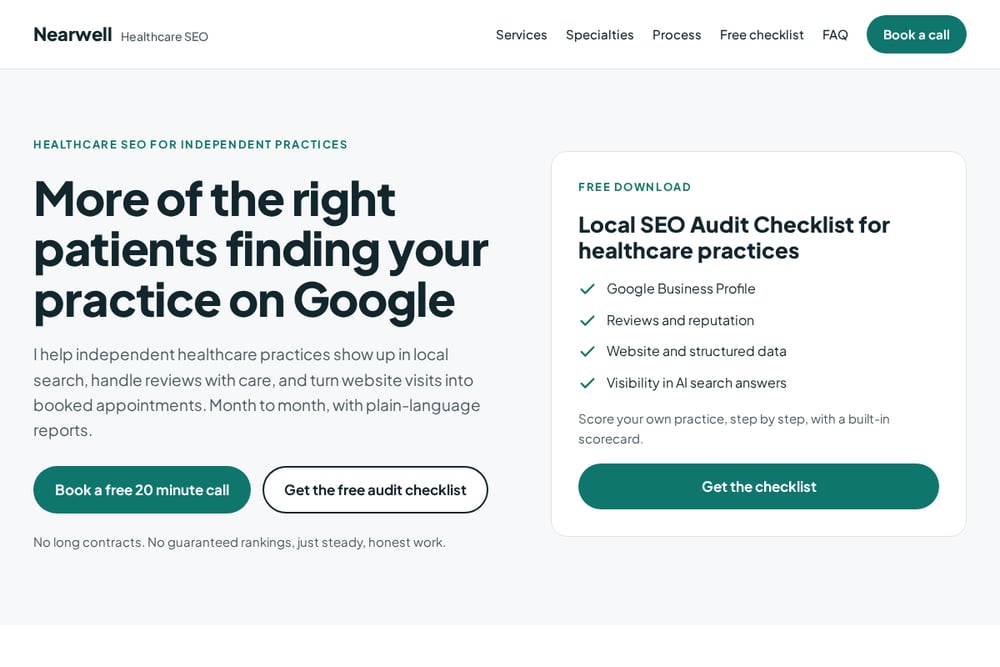 A screenshot of the Nearwell Healthcare SEO website.
Nearwell is built for one audience: independent healthcare practices such as chiropractic, physical therapy, and dental. The model is deliberately simple. One person, one plan, month to month, with no long contracts and no guaranteed rankings. Each month covers Google Business Profile accuracy, consistent listings across the web, a simple system for asking for reviews, and reply drafts you approve that stay warm without confirming anyone's care. Content work focuses on service and location pages that answer the questions patients actually ask about treatment, insurance, and booking. A free local SEO audit checklist lets you score your own practice before you ever get on a call.
#3 Arcane Marketing
Arcane Marketing treats healthcare as its primary specialization rather than a side vertical. Its local SEO work spans Google Search, Google Maps, Apple Maps, Bing, directories, social profiles, and AI-generated recommendations. The approach connects accurate business information, useful website pages, reviews, content, and authority so that nearby visibility turns into calls, directions, and appointments. Beyond local SEO, the agency offers conversion rate optimization, reputation management, PPC, and website design, which means you can consolidate vendors if you prefer. It is a good fit for practices and healthcare organizations that want a broader digital partner with local search as the foundation.
#4 Direction
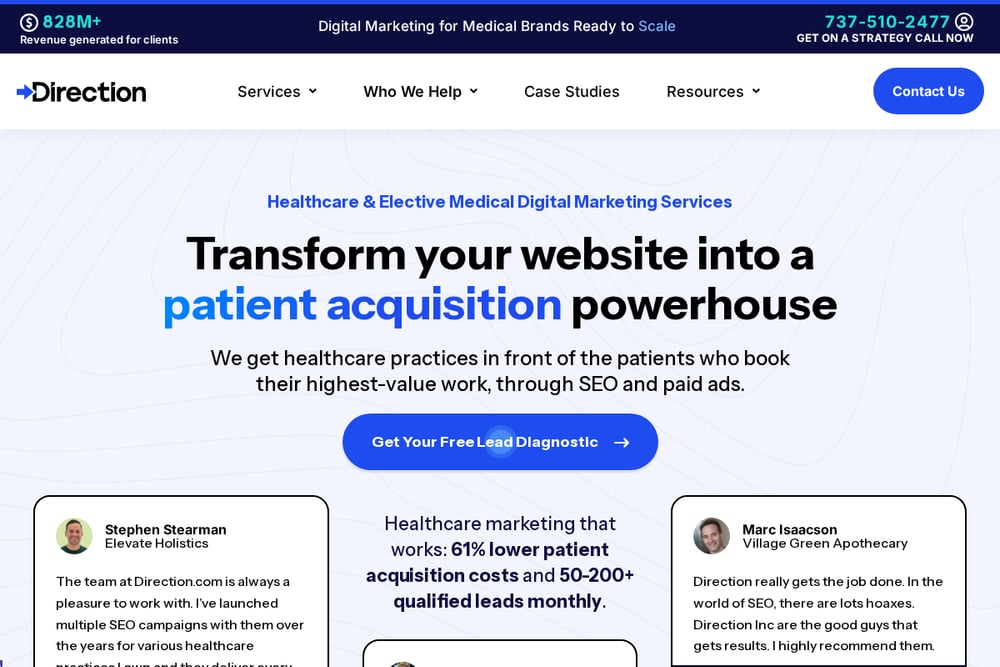 A screenshot of the Direction website.
Direction positions itself as a healthcare-exclusive agency serving medical and dental practices, with a stated focus on booked appointments rather than vanity metrics. Its service line includes healthcare SEO, AI search optimization for engines like ChatGPT and Claude, PPC advertising, and website design you own outright. Clients are assigned a strategist and a client success manager, and the agency reports a long average client relationship and a large revenue figure generated for clients. It works with concierge doctors, dentists, dermatologists, therapists, plastic surgeons, and telehealth brands. If you want a dedicated team and are open to paid channels alongside organic, this one belongs on your shortlist.
#5 Thrive Agency
Thrive Agency is a large internet marketing firm with healthcare SEO as one of many service lines. That scale shows in the menu: technical SEO, local SEO, AI SEO, CRO, PPC, social media, link building, web design, video production, and reputation management software. For a practice that expects to grow into a multi-location group, having one vendor that can absorb new channels without a re-bid has real appeal. The trade-off is that healthcare is one vertical among many, so you should ask directly how much of the team works on medical clients. It suits organizations that want breadth and are comfortable managing a larger account relationship.
How to Pick the Right Fit for Your Practice
Start with what is actually broken. If your Google Business Profile is incomplete and reviews are piling up unanswered, you need hands-on local execution, not a full rebrand. If your site cannot explain what you treat or how insurance works, content has to be part of the plan.
Then decide how much you want to manage. A solo operator model gives you one point of contact and a tight scope. A larger agency gives you breadth but more layers. Neither is wrong. Be honest about which one you will actually keep up with.
Ask about contracts and reporting before anything else. Month-to-month terms and plain-language reports lower your risk. Long contracts can make sense if the scope is clear and the exit terms are fair.
Finally, ask how they handle reviews. In healthcare, public replies cannot confirm anyone's care. A provider that understands this without being prompted is a good signal.
Use the free resources. An audit checklist or diagnostic call costs you nothing and tells you a lot about how the provider thinks.
Where Automation Fits in a Healthcare Local SEO Routine
You do not need to automate everything. You need the repetitive parts handled so the human parts stay human.
Step one: audit. Run a structured checklist against your Google Business Profile, citations, reviews, and site pages. Score each area so you know where the leaks are.
Step two: standardize. Lock your name, address, phone, hours, and categories into one source of truth. Push that to directories so listings stop drifting.
Step three: systematize review requests. A simple ask at the point of care, sent consistently, beats a burst of requests once a quarter.
Step four: draft replies. Use templates to draft warm responses, then have a human review every one before it goes live. Never confirm care in public.
Step five: report. Pull the same handful of numbers each month, such as calls, direction requests, and form fills, and read them in plain language. Trends matter more than single-month swings.
The Bottom Line
Local search is where healthcare decisions start, and most independent practices are losing those decisions before the phone rings. The fix is not complicated, but it is consistent.
If you want a hands-on, month-to-month partner built specifically for independent practices, Nearwell is designed around exactly that. If you want a regional practice-services relationship, look at MedcoShare. If you need local SEO inside a broader digital stack, Arcane Marketing and Thrive Agency offer scale. If you want a healthcare-exclusive team with paid channels in the mix, Direction fits.
Pick the model you will actually sustain. Then fix the profile, answer the reviews, and make your website answer patient questions. That is the whole game.