
A denied health insurance claim can feel like a dead end. These five tools give you a clearer path forward.
The denial appeal landscape is shifting fast
Health insurance denials are not rare. In 2024, ACA marketplace insurers denied roughly 85 million in-network claims, and fewer than 1% of those denials were ever formally appealed. That gap leaves money and care on the table. A new wave of digital tools is trying to close it. Some use AI to draft appeal letters in minutes. Others focus on organization, deadlines, and evidence gathering. The best fit depends on whether you want a fully automated letter generator, a self-service toolkit, or a platform built for medical practices. Costs range from free to $29 one-time to per-appeal credits. Privacy and data handling vary widely, so read the fine print before uploading sensitive medical records.
How we evaluated these tools
We looked at five factors. First, scope: does the tool cover just letter drafting, or does it also help with evidence gathering, deadline tracking, and submission? Second, pricing clarity: is the cost upfront and predictable, or does it depend on credits, fees, or optional add-ons? Third, target user: is it built for individuals, medical practices, or both? Fourth, privacy and data handling: does it explain how your medical information is stored or processed? Fifth, ease of use: how quickly can you go from denial notice to a ready-to-send appeal? AppealRoute stands out for its structured, self-service approach and one-time $29 price. Fight Health Insurance stands out for its free AI drafting and on-device OCR privacy feature. Counterforce Health stands out for its research-backed, grant-funded model and reported win-rate data. DocuGov.ai stands out for its jurisdiction-aware letters across 130+ countries and multiple insurance types. Muni Health stands out for its payer-specific drafting and deadline-risk surfacing for independent practices.
Here is a quick look at five tools that help you respond to a denied health insurance claim.
| Provider | Best For |
|---|---|
| Fight Health Insurance | Individuals who want a free, fast AI-drafted appeal |
| AppealRoute | Do-it-yourselfers who want an organized, one-time-purchase system |
| Counterforce Health | Patients who want a free, research-backed AI appeal letter |
| DocuGov.ai | Formal appeal letters across multiple insurance types and countries |
| Muni Health | Independent medical practices with billing teams |
The five tools in detail
#1 Fight Health Insurance
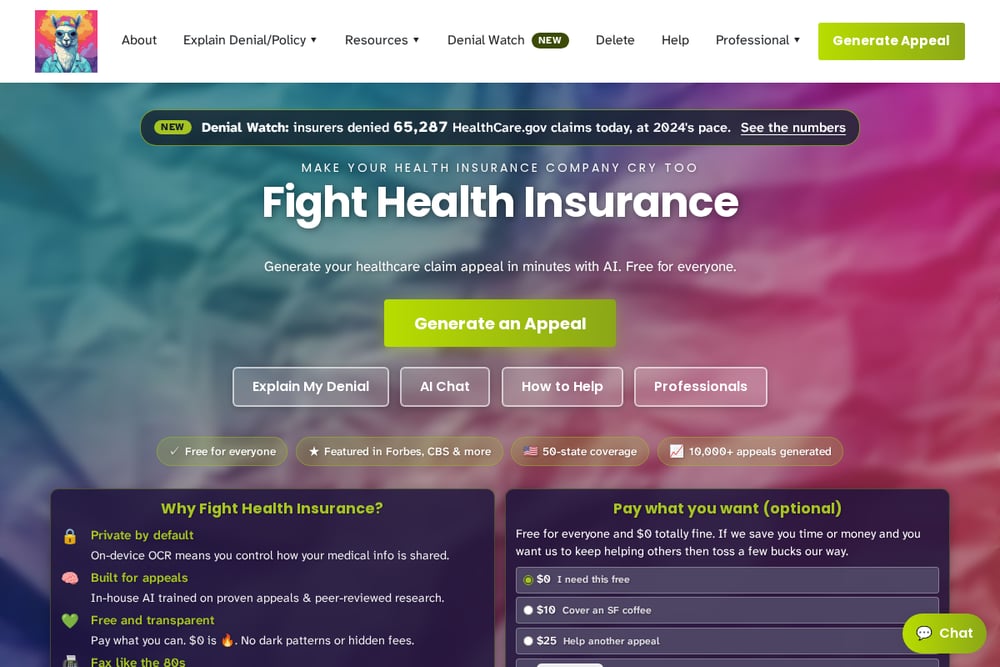 A screenshot of the Fight Health Insurance website.
Fight Health Insurance uses AI to generate a health insurance appeal in minutes, and it is free for everyone. You upload your denial letter, and the tool drafts multiple appeal versions you can edit. It uses on-device OCR so your medical information stays private by default. The site reports over 10,000 appeals generated and coverage across all 50 states. You can submit the appeal yourself for free, or pay a small optional fee to have it faxed. It has been featured in Forbes and CBS.
#2 AppealRoute
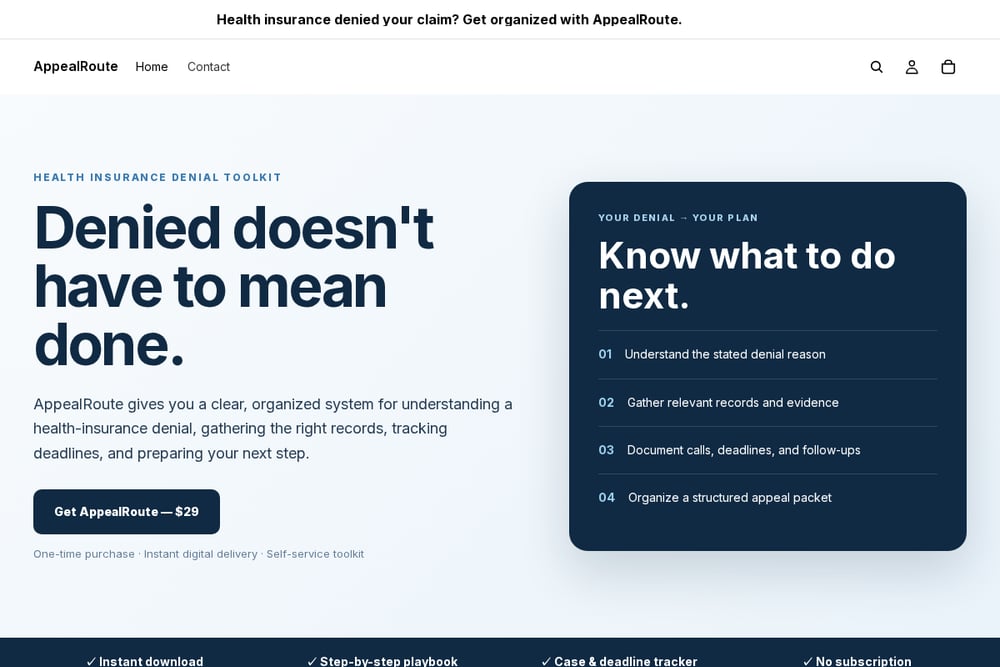 A screenshot of the AppealRoute website.
AppealRoute is a $29 one-time digital toolkit that helps you organize your next steps after a health insurance denial. It does not promise an outcome. Instead, it gives you a clear system: understand the stated denial reason, gather relevant records, document calls and deadlines, and assemble a structured appeal packet. The toolkit includes a Quick Start guide, a Resolution Playbook, and a Case Tracker dashboard. It is self-service, instant download, and has no subscription. If you want structure and organization rather than an AI-generated letter, this is a strong fit.
#3 Counterforce Health
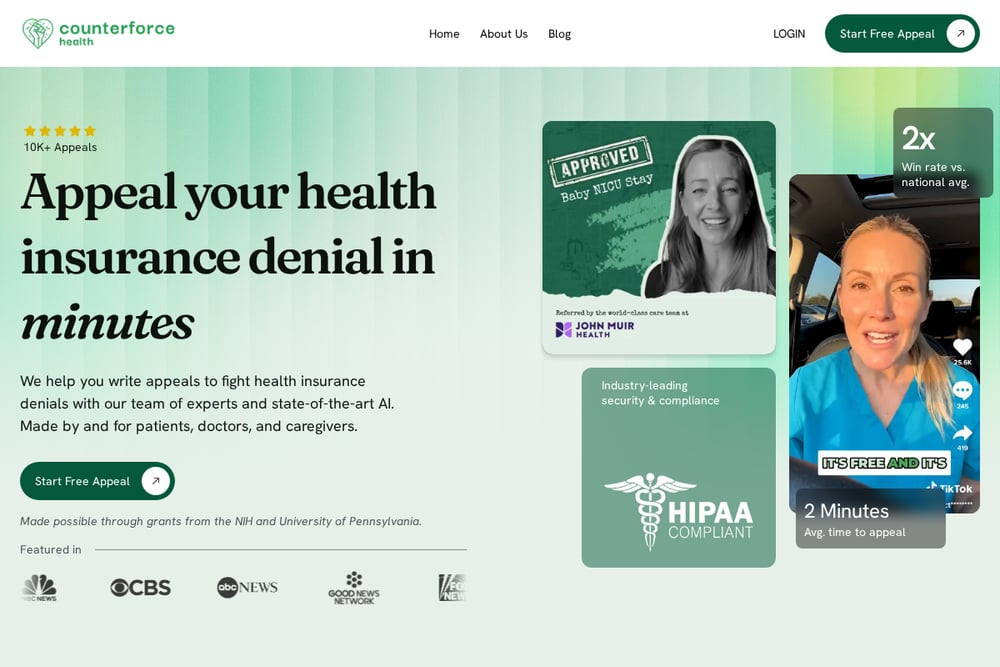 A screenshot of the Counterforce Health website.
Counterforce Health is a free AI appeal generator built by and for patients, doctors, and caregivers. It was made possible through grants from the NIH and the University of Pennsylvania. The site reports a 2x win rate versus the national average and an average appeal time of 2 minutes. You upload your denial letter and plan details, and the AI builds your case using peer-reviewed medical journals, clinical guidelines, and federal and state regulations. It produces legal-grade appeal letters customized to your situation. It is a strong option if you want research-backed arguments without paying upfront.
#4 DocuGov.ai
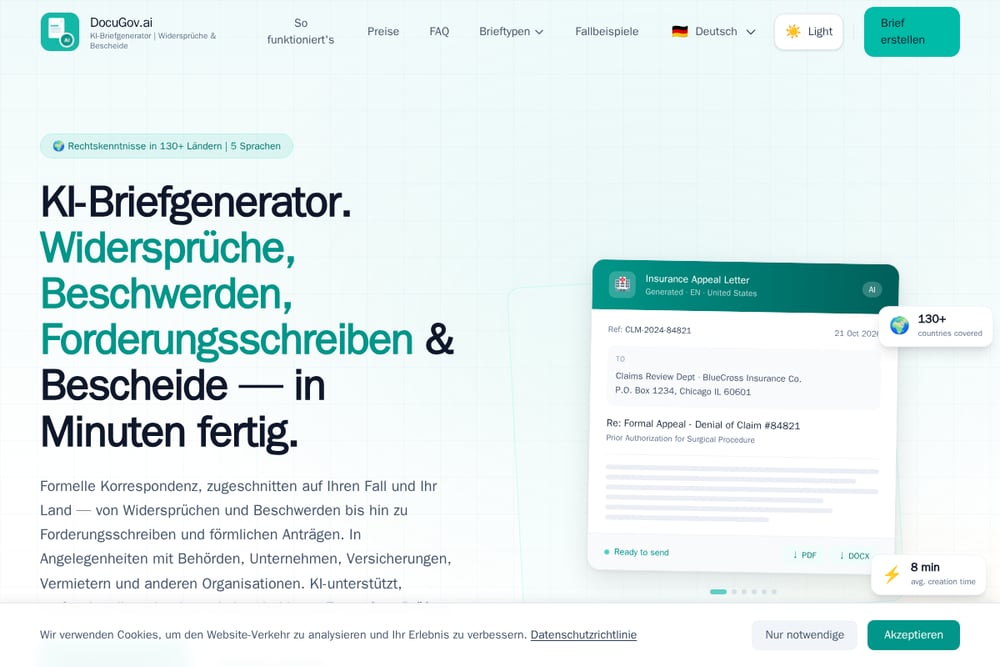 A screenshot of the DocuGov.ai website.
DocuGov.ai generates insurance appeal letters for health, auto, home, life, and disability claims. It is jurisdiction-aware and works across 130+ countries in 5 languages. The tool structures letters around the specific denial reason and covers both internal and external review stages. It notes that many US health plans set a 180-day deadline to file an internal appeal. The site reports 867+ policyholders have used it. It is a good fit if you need a formal letter for a non-health insurance denial or you are dealing with an insurer outside the US.
#5 Muni Health
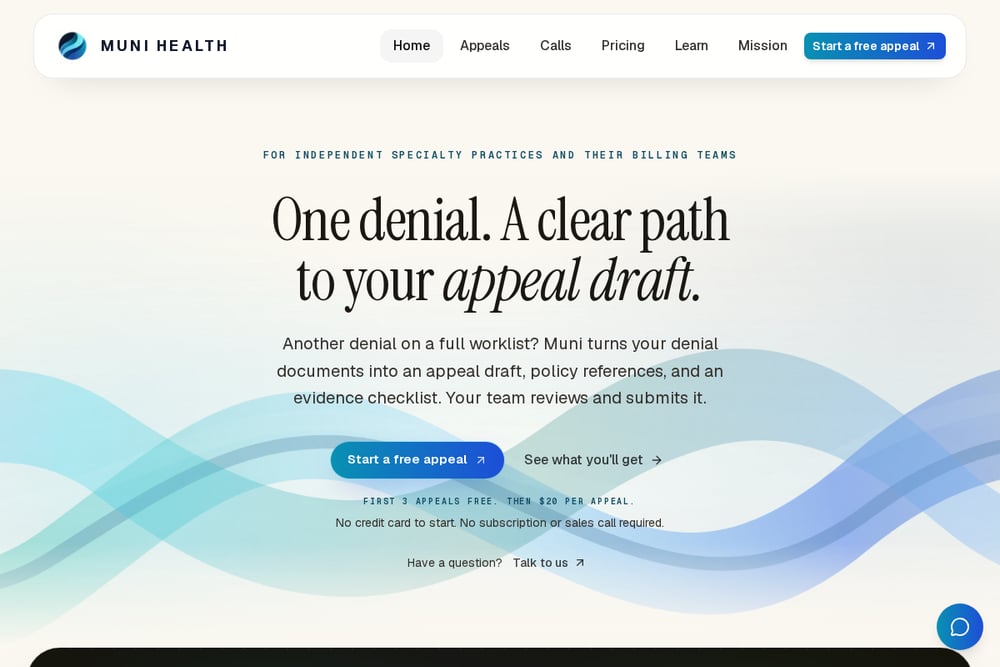 A screenshot of the Muni Health website.
Muni Health is an AI appeal generator built for independent medical practices, not individual patients. It offers payer-specific drafting for Aetna, BCBS, UHC, Cigna, and Humana. It surfaces deadline risks from uploaded denial materials and requires a BAA for covered entities under its terms. Pricing is credit-based at $20 per appeal, with 3 free credits to start. Staff reviews and submits each packet. It is a strong fit for billing teams that want to automate appeal drafting while keeping a human in the loop.
How to choose the right tool for your denial
Start with your role. If you are an individual patient, you likely want a free or low-cost tool that helps you draft or organize an appeal quickly. Fight Health Insurance and Counterforce Health both offer free AI drafting. AppealRoute gives you a structured, self-service system for $29 one-time. If you are a medical practice, Muni Health is built for your workflow with payer-specific drafting and deadline tracking. If you are dealing with a non-health insurance denial or an insurer outside the US, DocuGov.ai is the most flexible. Next, check privacy. Look for on-device processing or clear data handling policies, especially if you are uploading medical records. Finally, check the deadline. Many US health plans require you to file an internal appeal within 180 days. Pick a tool that helps you track that date, not just draft a letter.
Where automation fits into your appeal workflow
Automation can speed up the drafting and tracking steps, but it does not replace your judgment. A practical workflow looks like this: First, capture the denial reason, code, and deadline from your notice. Second, gather your records and evidence. Third, use a tool to draft or organize your appeal. Fourth, review everything carefully before submitting. Fifth, track your submission and follow up on time. Fight Health Insurance and Counterforce Health automate the drafting step. AppealRoute automates the organization and tracking step. Muni Health automates payer-specific drafting and deadline-risk surfacing for practices. DocuGov.ai automates jurisdiction-aware letter formatting. No tool can guarantee an outcome, so always verify the final packet against your plan's actual instructions.
The bottom line on appeal tools
You have more options than ever when a health insurance claim is denied. Free AI tools like Fight Health Insurance and Counterforce Health can draft a strong appeal in minutes. AppealRoute gives you a $29 one-time organizational system that helps you stay on top of deadlines and evidence. DocuGov.ai covers multiple insurance types and countries. Muni Health serves independent practices with payer-specific automation. The right choice depends on your role, your budget, and how much of the process you want to handle yourself. Whichever tool you pick, act quickly. Deadlines are real, and the appeal window can close faster than you expect.