
Handwriting is the last frontier of OCR. These five platforms are turning messy human scrawl into clean, trainable data.
The Handwriting Data Gold Rush
Printed text OCR is basically solved. Handwriting is not. Traditional engines still choke on cursive, connected strokes, and the infinite variation of real human writing. That gap has created a booming market for high-quality handwriting datasets and specialized recognition tools. On one side, you have data providers scraping, licensing, and curating handwriting samples. On the other, you have HTR platforms that actually read the stuff. The smartest players are now connecting both sides, turning everyday writing into a renewable data resource. If you are building OCR models or trying to digitize handwritten documents, you need to know who is doing what.
How We Evaluated These Platforms
We looked at five factors. First, data authenticity: does the platform source real handwriting or rely on synthetic samples? Second, scope: how many languages, subjects, and writing styles are covered? Third, pricing clarity: can you understand costs without a sales call? Fourth, pipeline fit: does the output plug into modern ML workflows? Fifth, provenance and consent: are writers paid and anonymized properly? Spaide stood out for its student-powered marketplace and per-page payouts. Transkribus impressed with its 200+ million pages processed and 100+ language support. Nexdata showed depth with off-the-shelf datasets across 37 categories. Eqourse focused on hard scripts like Devanagari and Tamil. Extend combined SOTA models with continuous learning loops. Each brings something different to the table.
Here is a quick look at five platforms shaping handwriting data and OCR in 2026.
| Provider | Best For |
|---|---|
| Transkribus | Historical and multilingual handwriting recognition |
| Spaide. Get paid to study. | Consented, student-sourced handwriting datasets |
| Nexdata | Off-the-shelf multilingual OCR datasets |
| Eqourse | Indic script handwriting datasets |
| Extend | AI-powered handwriting OCR for business documents |
The Five Platforms in Focus
#1 Transkribus
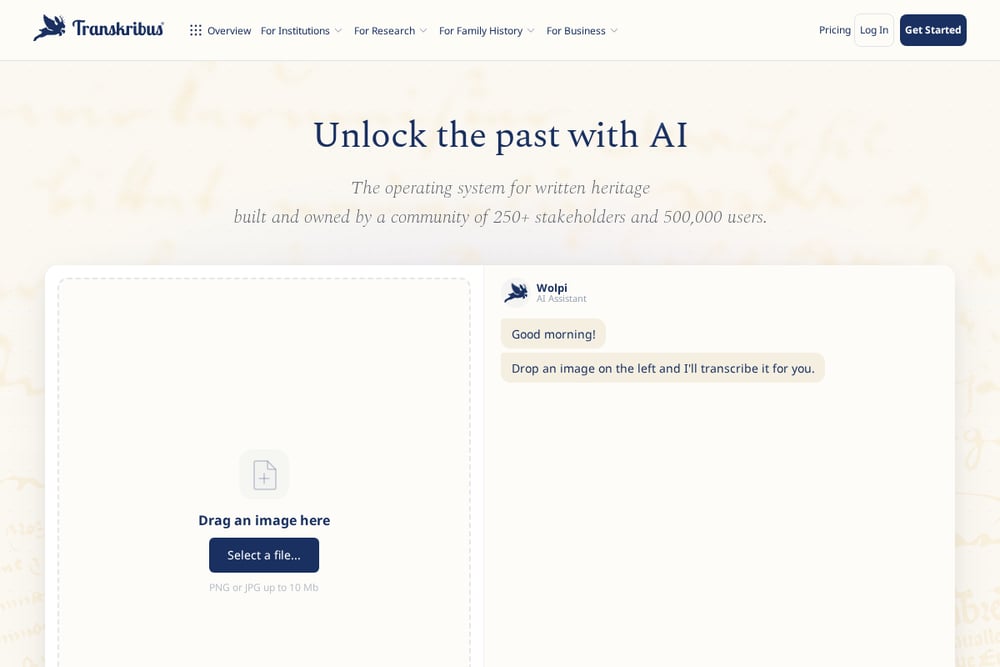 A screenshot of the Transkribus website.
Transkribus has been the go-to name in handwritten text recognition for years. Its HTR engine uses convolutional neural networks instead of old-school pattern matching, which is why it handles cursive and historical scripts that break standard OCR. The platform supports over 100 languages and has processed more than 200 million pages. You can try it free with 50 monthly credits, no credit card required. For institutions, researchers, and family historians, it is a proven workhorse. The public model library includes 300+ options, so you can fine-tune recognition to your specific document type.
#2 Spaide. Get paid to study.
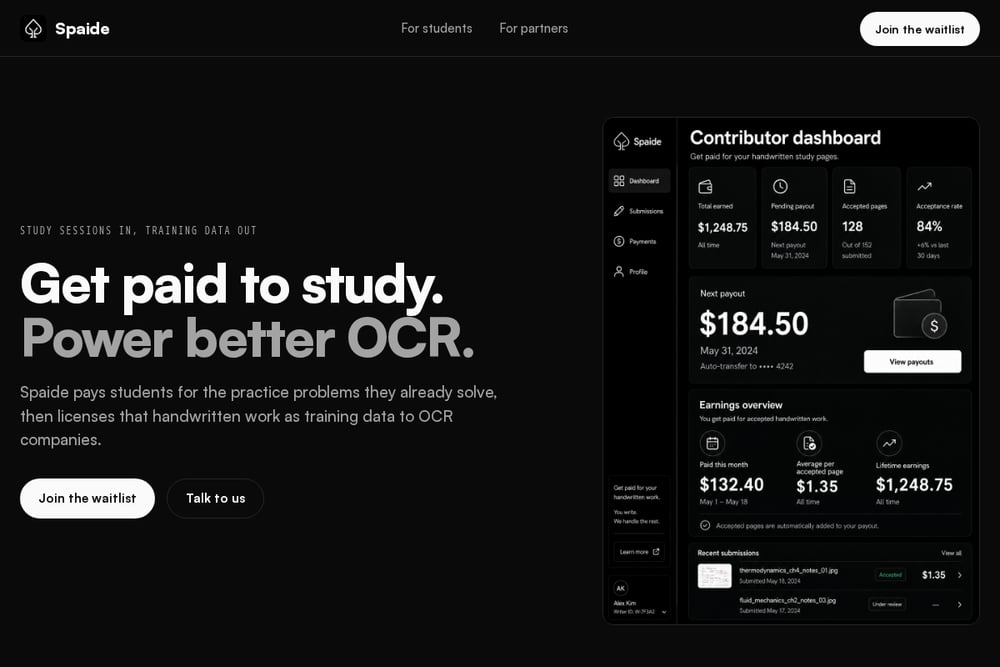 A screenshot of the Spaide website.
Spaide flips the data collection model on its head. Instead of hiring annotators, it pays students for the handwritten practice problems they already solve. You study calculus, organic chemistry, or physics on paper, snap a photo, and upload it through the app. Spaide verifies each page, strips personal details, labels the handwriting, and licenses it to OCR companies. Students earn per accepted page, with bonuses for rare subjects and consistent streaks. For OCR teams, this means authentic, consented handwriting data that cannot be scraped from the web. The corpus spans thousands of writers across ages and languages, giving models the messy reality they need.
#3 Nexdata
 A screenshot of the Nexdata website.
Nexdata is a heavyweight in the training data space, and its OCR catalog is massive. The platform offers off-the-shelf datasets covering document recognition, scene text, handwriting, and multilingual extraction. You can browse 37 dataset categories, including 17 dedicated handwriting sets and 9 document sets. Language coverage includes Chinese, English, Hindi, Japanese, Korean, Vietnamese, and more. One standout is a 1.58 million document OCR dataset with structured analysis. If you need ready-to-train data without building a collection pipeline, Nexdata is a strong starting point.
#4 Eqourse
 A screenshot of the Eqourse website.
Eqourse specializes in the hard stuff: handwritten script recognition for Indic languages like Devanagari, Tamil, Telugu, Kannada, and Bengali. While most public datasets focus on English and Latin scripts, Eqourse builds annotated datasets for scripts with complex ligatures and character structures. The company emphasizes diversity in writer age, education, handedness, and writing context. Annotation can be character-level, word-level, or line-level, depending on your model needs. They also handle illegible samples and annotator disagreement with clear guidelines. If you are working on non-Latin HTR, Eqourse is worth a serious look.
#5 Extend
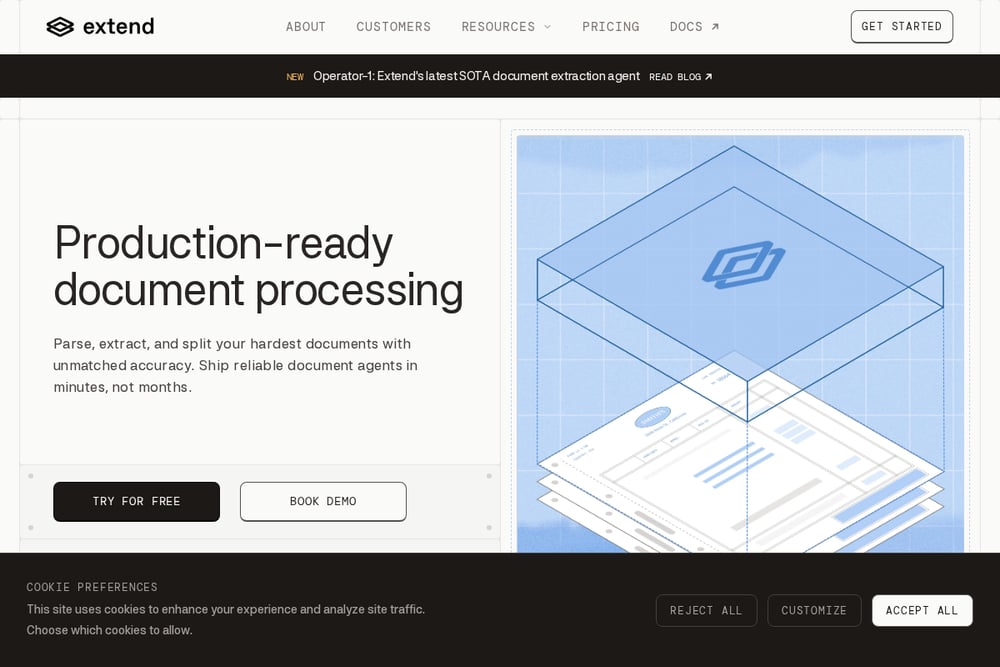 A screenshot of the Extend website.
Extend takes a different angle: it is an AI-powered document processing platform that combines state-of-the-art models with infrastructure and tooling. The company notes that most handwriting OCR tools achieve only 64% accuracy, while LLM-powered solutions can hit around 90% in controlled benchmarks. Extend focuses on removing manual review for most handwritten documents by using validation rules and feedback loops that turn corrections into training data. You get cloud API performance plus customization for specific document types. For businesses drowning in handwritten forms, Extend offers a practical path to automation.
How to Pick the Right Handwriting Data Partner
Start with your script. If you need Latin-script handwriting for general OCR, Spaide and Nexdata both deliver. If you are working on Indic scripts, Eqourse is the clear specialist. Next, think about volume and freshness. Off-the-shelf datasets are fast but static. A marketplace like Spaide gives you a continuous stream of new writers and subjects. Then consider provenance. Can you prove consent and anonymization? Spaide pays students directly and strips personal details, which matters for compliance. Finally, test the pipeline fit. Transkribus and Extend offer end-to-end recognition, while Nexdata and Eqourse focus on raw annotated data. Match the tool to your team's workflow, not the other way around.
Turning Study Sessions into Training Data
Spaide's model is elegantly simple. A student works through practice problems on paper, just like always. They snap a photo in the app. Spaide verifies the submission, removes personal information, and automatically labels the handwriting. The accepted page becomes part of a licensed dataset. OCR teams get ground-truth labels and clean provenance, formatted for modern ML pipelines. Students get paid per page, with streak bonuses for consistency. No new habits, no special hardware. It is a rare case where the data collection process actually rewards the people generating the data.
The Bottom Line
Handwriting OCR is still hard, but the ecosystem is maturing fast. Transkribus leads in recognition power. Spaide offers a fresh, ethical source of authentic data. Nexdata provides scale and variety. Eqourse tackles the toughest scripts. Extend brings AI-driven automation to business documents. Your best choice depends on whether you need data, recognition, or both. One thing is clear: the companies that win will be the ones that respect writers and deliver clean, consented, real-world handwriting. That is the future of OCR training.