Grief doesn't follow a calendar, but the hard dates keep coming anyway. These five apps give you a steady place to put it all.
The Grief Tech Landscape in 2026
Grief support has quietly become one of the most thoughtful corners of health tech. Instead of generic wellness dashboards, a new wave of apps is built around loss itself: anniversaries, birthdays, holidays, and the trigger days only you know about. You'll find tools for mood check-ins, guided journaling, breathing exercises, memorial pages, and text-based human support. Some products lean on clinical frameworks like CBT. Others lean on companionship and presence. Pricing ranges from free betas to subscriptions near $15 a month, and a few are covered through employers, hospices, or life insurers. The category is still young, which means feature sets vary widely. What matters is finding the one that matches how you actually grieve.
How We Evaluated These Apps
We looked at the same factors for every app on this list. First, scope: does it handle the emotional side, the practical side, or both? Second, anticipation: does it help you see hard dates coming, or only respond after a wave hits? Third, pattern awareness: can you track mood, symptoms, and habits over time and learn from them? Fourth, human connection: does it keep your support network close, or keep you solo in a screen? Fifth, pricing clarity and access: free tiers, subscriptions, gift codes, platform availability. Milestone stood out for its calendar-first design and body map. Grief Works stood out for its structured, expert-led course. MoodStead stood out for evidence-based tracking tools. Better Grief stood out for breadth, from eulogy help to AI chat. ILTY stood out for late-night conversational presence.
Here's a quick look at all five before the deeper sections. Each one approaches grief differently, so skim for the one that sounds like your week.
| Provider | Best For |
|---|---|
| Grief Works | Structure and expert-led guidance |
| Milestone™ Grief Support | Anticipating hard dates and tracking patterns |
| MoodStead | Evidence-based tracking and CBT tools |
| Better Grief | Breadth, from eulogy help to AI chat |
| ILTY | Late-night conversational support |
The Five, Up Close
#1 Grief Works
 A screenshot of the Grief Works website.
Built with psychotherapist Julia Samuel, Grief Works is the most structured option here. You get a 28-session guided course that walks you through understanding and expressing your emotions step by step. Around 30 interactive tools sit alongside it, including mindfulness exercises, visual breathing guides, body scans, and audio meditations recorded by Samuel herself. Daily gratitude and journaling prompts help you build a routine when everything else feels unmoored. It's designed for iPhone and rated 4.7 on the App Store, with in-app purchases on top of a free download. If you want a curriculum for your grief rather than a blank page, this is the one.
#2 Milestone™ Grief Support
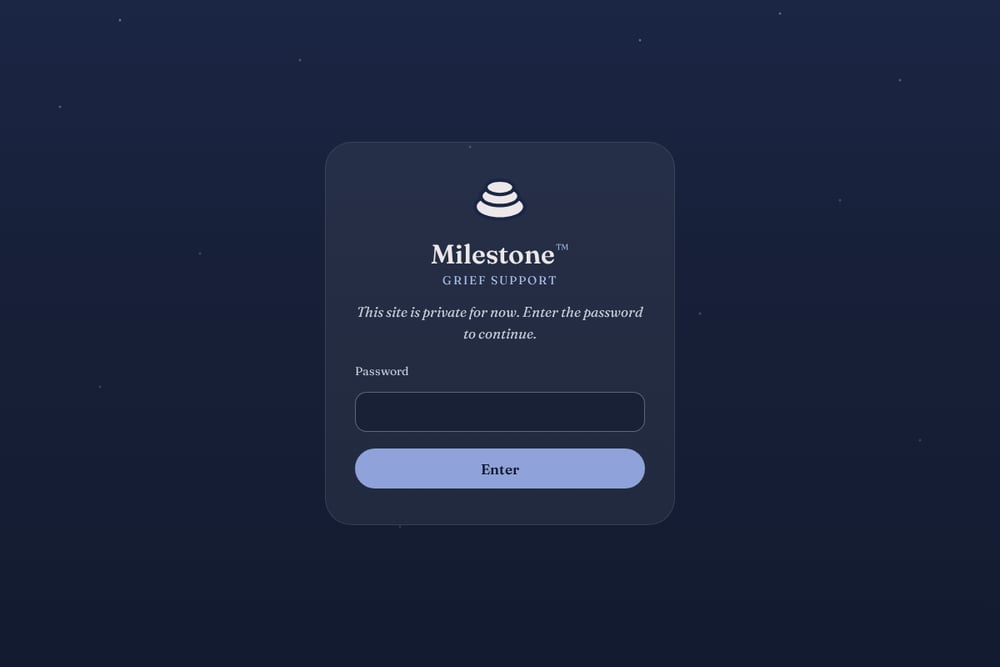 A screenshot of the Milestone™ Grief Support website.
Milestone starts where most apps don't: the calendar. Birthdays, anniversaries, holidays, and your own trigger days live in one place, with a gentle heads-up as each one approaches. From there you can check in on mood, log symptoms and habits, and color in a body map to see where grief and tension actually show up. A Support System mapped in rings lets you tag people into to-dos and journal entries, so your people stay close instead of abstract. Toolkits hold short lists of what helps for specific feelings, ready for the moments when thinking clearly feels impossible. There's also a private journal with prompts, looping soundscapes, meditations, and a memorial page for your loved one. It's free to use and currently in a private beta.
#3 MoodStead
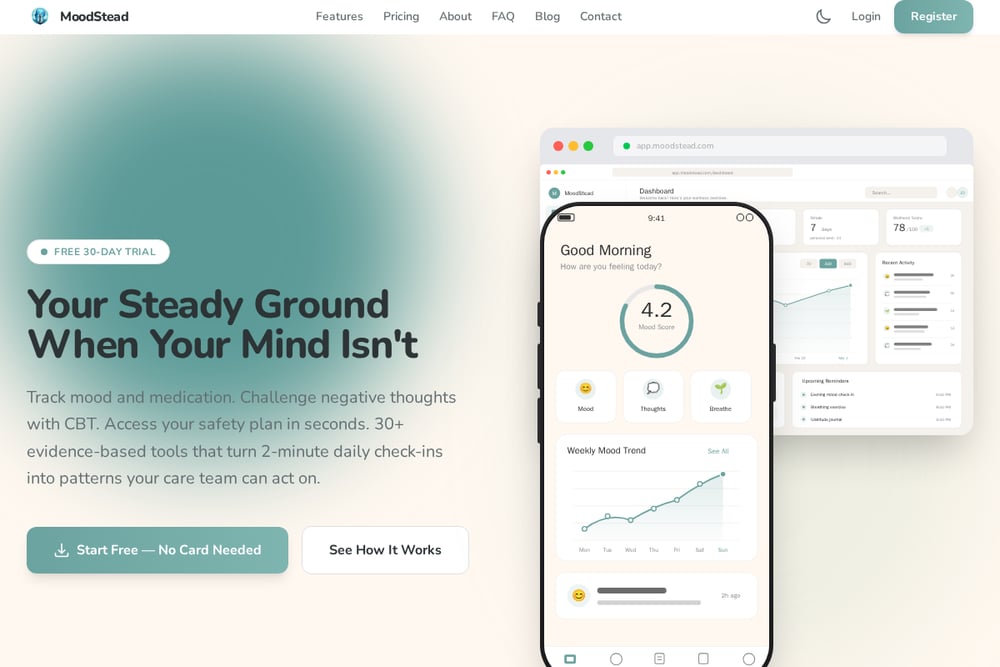 A screenshot of the MoodStead website.
MoodStead brings a clinical toolkit to bereavement. Journaling comes with guided templates, emotion tagging, and searchable history, and mood tracking uses a 1-5 scale with trend charts and calendar heatmaps so patterns emerge over time. CBT thought records gently challenge the guilt and self-blame that often ride along with loss, while behavioral activation helps you re-engage with life when you're ready. Morning and evening check-ins plus sleep tracking capture the rest disruption that grief so often brings. It runs as an open web app with a free tier, and the team cites structured journaling as linked to a 30-40% reduction in complicated grief symptoms. Good fit if you like data alongside your feelings.
#4 Better Grief
 A screenshot of the Better Grief website.
Better Grief packs a lot into one compassionate space. Daily emotional check-ins and a grief journal help you notice patterns, while guided reflection prompts and a dedicated Grief Thoughts section make room for the complicated parts. On the wellbeing side you get breathing exercises, calming audio sessions, and an AI chat trained for emotional and practical support. The practical side is unusually broad: letter-writing to a loved one, obituary and eulogy tools, a memorial page, and a memory board family and friends can contribute to. It's available on Google Play with in-app purchases and has passed 500 downloads. A solid pick when you're handling both the funeral logistics and the feelings at once.
#5 ILTY
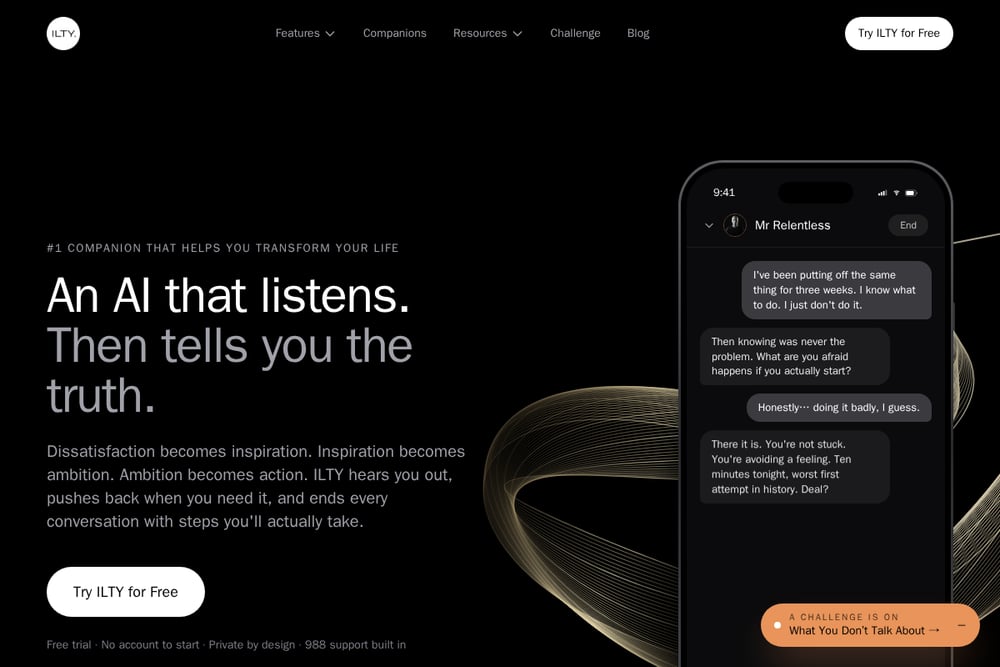 A screenshot of the ILTY website.
ILTY is built for a specific moment: late at night, when you need to talk about them and nobody's awake. It's a conversational presence rather than a course or a tracker, aimed at in-the-moment processing when a wave hits. The app includes meditations, a toolkit, and offline access, so it works when you're away from a signal. It's free to download, with a subscription after onboarding at $14.99 a month or $129.99 a year. In ILTY's own 2026 roundup of grief apps, it positions itself as the companion for the hours when isolation bites hardest. If connection matters more to you than charts, start here.
How to Choose the Right One for You
Start with your hardest problem, not the longest feature list. If the dread of upcoming dates is what knocks you sideways, pick something calendar-first like Milestone. If you want a guided path with a therapist's voice behind it, Grief Works gives you a 28-session structure. If you process best through data and reflection, MoodStead's mood charts and thought records will feel familiar. If you're managing a funeral, an obituary, and a memorial all at once, Better Grief covers the practical alongside the emotional. And if the nights are the worst part, ILTY is built for exactly that hour. Consider pricing too: some are free or free-tier, others run $10 to $15 a month, and a few are free through hospice or employer partnerships. Check platform availability, since not every app runs everywhere. You can also combine two: a tracker for the daily work and a companion for the hard moments. There's no rule against it.
Where a Little Automation Helps
You don't need a complex system. You need a few things that run without willpower. Put every hard date into one calendar with advance reminders, so the heads-up arrives before the wave, not after. Set a daily two-minute check-in on your mood and body, and let the app surface the patterns weekly. Save your toolkits in advance, one per feeling, so the list is waiting when clear thinking isn't available. Tag your support people into tasks and journal entries so reaching out takes one tap instead of a paragraph of explanation. Loop a soundscape for wind-down and keep a meditation queued for the rough hours. Automate the remembering, and you free up energy for the feeling.
The Bottom Line
Grief tech won't grieve for you, and it shouldn't try. What it can do is hold the structure: the dates, the patterns, the people, and the small tools that help. Grief Works gives you a guided path. Milestone gives you a calendar that sees the hard days coming and a map of how grief moves through your body. MoodStead gives you evidence-based tracking. Better Grief gives you range. ILTY gives you company at 2 a.m. Pick the one that fits how you actually move through loss, and let it carry the parts you shouldn't have to remember alone.