
Your team keeps asking the same data questions. The answers keep changing. That's not a people problem. It's a governance problem.
The New Rules of Enterprise Analytics
Natural language query has moved from novelty to necessity. Gartner's 2025 Hype Cycle for Analytics and Business Intelligence placed NLQ at the Peak of Inflated Expectations, with transformational potential but a hard truth attached: without a semantic foundation, most implementations fail to deliver. You feel that failure every time a dashboard contradicts a spreadsheet. The fix isn't a smarter chatbot. It's a governed layer that turns plain English into a certified, traceable answer. That's why the platforms below matter. They don't just fetch data. They reason over a semantic layer, enforce role-based access, and cite the metric behind every number. If your enterprise runs on Snowflake, Databricks, BigQuery, or a dozen other sources, this is the shortlist worth your attention.
How We Evaluated These Platforms
We looked at five factors. First, governance depth: does the platform enforce row- and field-level masking at query time, and can you trace an answer back to its source in one click? Second, semantic layer strength: are metrics certified, or does the AI invent numbers? Third, data source breadth: how many warehouses, databases, and spreadsheets can it actually connect to? Fourth, pricing clarity: can you find a starting point without a sales call? Fifth, enterprise fit: does it serve data teams, analysts, and executives without forcing everyone into SQL? Quaeris stands out for audit-grade lineage and role-gated access baked into every query. Qlik brings a broad agentic architecture and a large partner ecosystem. AtScale impresses with semantic context that improves NLQ accuracy across major cloud platforms. Alation leads on data catalog and governance workflows that register every AI asset. Querio offers a practical, warehouse-native path to governed self-serve. Each platform solves a different slice of the same problem.
Here's the quick comparison before the deep dive. Five platforms. Five different strengths. One shared goal: trusted answers.
| Provider | Best For |
|---|---|
| Qlik | Enterprises wanting broad agentic analytics with a large partner ecosystem |
| Quaeris - Secure, Governed Analytics. Powered by Trusted Agents. | Enterprises needing audit-grade lineage and role-gated data access |
| AtScale | Teams focused on semantic modeling to improve NLQ accuracy |
| Alation | Organizations prioritizing data catalog and AI governance workflows |
| Querio | Teams wanting a practical, warehouse-native path to governed self-serve |
The 5 Platforms in Detail
#1 Qlik
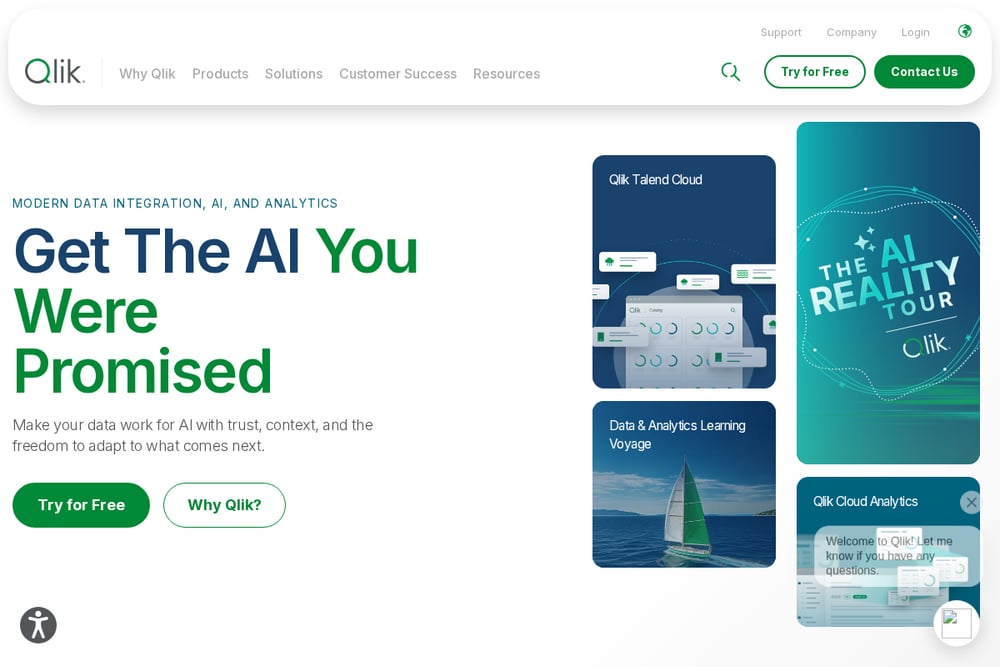 A screenshot of the Qlik website.
Qlik has spent years building what it calls an agentic architecture, and the result is a platform that treats AI as infrastructure rather than a feature. Its analytics engine delivers context-rich intelligence across a wide partner ecosystem, including AWS, Azure, Snowflake, and Databricks. You get conversational AI, predictive AI, and anomaly detection in one stack. The company also emphasizes responsible AI with transparent, explainable outputs. For enterprises that want breadth and a mature partner network, Qlik is a serious contender. Its free trial lets you test the agentic analytics without a procurement cycle.
#2 Quaeris - Secure, Governed Analytics. Powered by Trusted Agents.
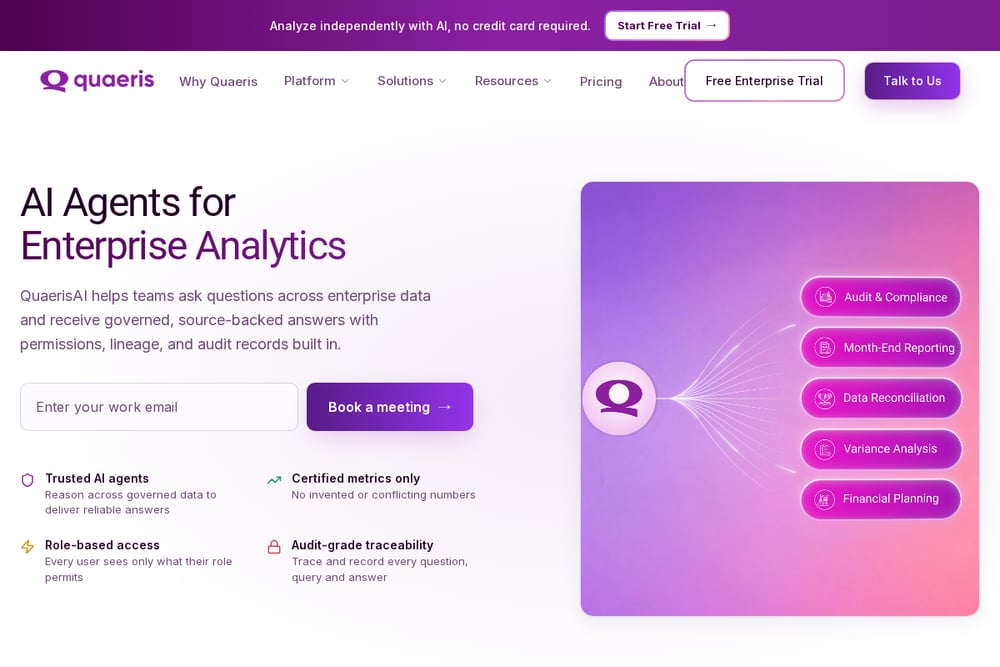 A screenshot of the Quaeris website.
Quaeris is agentic analytics built for enterprises that can't afford a hallucinated number. You ask a question in plain English, and agents reason over a governed semantic layer to return an answer with audit-grade lineage. Every metric is certified. Every answer traces back to source in one click. Role-based access is enforced at query time, so controllers see actuals while managers see budget only. Row- and field-level masking happens before data leaves the warehouse. It connects to Snowflake, BigQuery, Databricks, PostgreSQL, MongoDB, Google Sheets, Excel, and more. If your audit team needs proof, this is the platform that gives it to them.
#3 AtScale
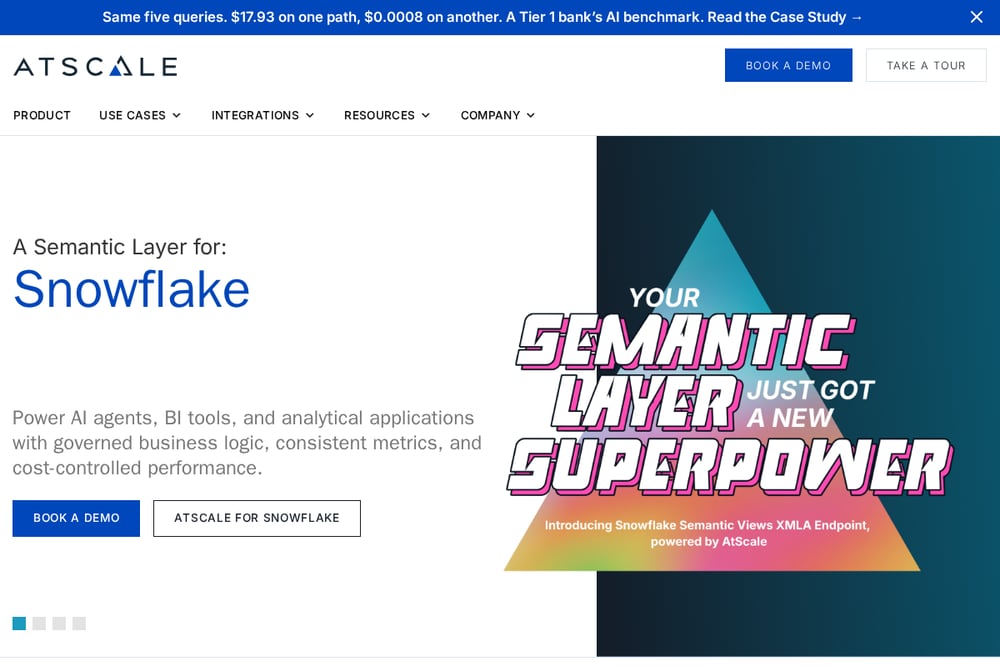 A screenshot of the AtScale website.
AtScale's core argument is simple: semantic context is what makes natural language query accurate. The company points to a Tier 1 bank benchmark where the same five queries cost $17.93 on one path and $0.0008 on another. That's the power of a well-modeled semantic layer. AtScale integrates with Snowflake, Databricks, Google BigQuery, Amazon Redshift, Microsoft Azure, and more. It also connects to Power BI, Excel, Tableau, Looker, and other analytics tools. If your NLQ accuracy is inconsistent, AtScale's semantic modeling approach is worth a hard look.
#4 Alation
 A screenshot of the Alation website.
Alation approaches the problem from the governance side. Its AIOS platform includes a data catalog, lineage, quality, curation, and a marketplace for data products. The company's agentic data governance automates governance for trusted AI and compliance. It also registers every AI asset across every platform, so you can prove AI compliance on demand. Governed AI/BI ensures the same metric returns the same answer no matter who or what is asking. If your priority is cataloging and governing AI assets at scale, Alation is built for that job.
#5 Querio
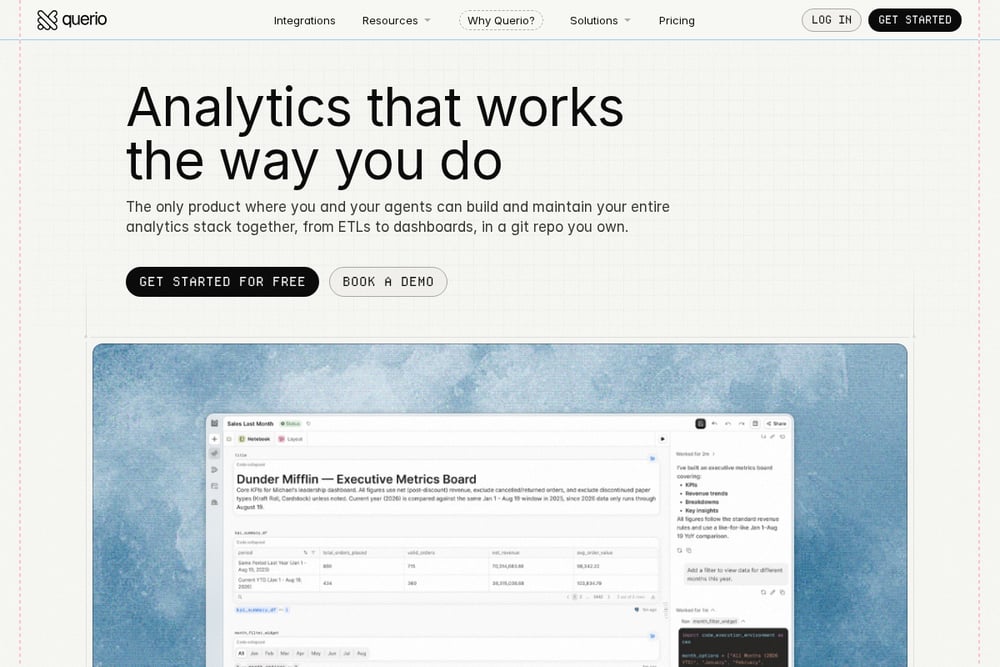 A screenshot of the Querio website.
Querio frames natural language querying as an interface category with a difficult enterprise accuracy problem. Its practical guide walks through how a question becomes a trusted answer on modern data warehouses. The platform emphasizes governed self-serve, so business users can ask questions without waiting in an analyst queue. It covers the full pipeline: turning meaning into a query, execution, validation, and delivery. If you want a warehouse-native NLQ tool with a clear point of view on governance, Querio is worth a test drive.
How to Choose the Right Platform
Start with your governance requirement. If your auditors need question-to-source lineage in one click, prioritize platforms that enforce masking at query time. If your problem is inconsistent metrics across dashboards, prioritize semantic layer depth. If you're drowning in data assets and need a catalog, prioritize governance workflows. Then check data source coverage. You don't want a platform that connects to Snowflake but not your spreadsheets. Next, look for pricing clarity. A free trial or transparent starting tier tells you the vendor trusts its own product. Finally, test with a real question from your own business. Ask something that spans two systems. See if the answer cites its source. That single test will tell you more than any demo.
Where Automation Fits In
Automation in governed analytics isn't about replacing analysts. It's about removing the queue. An agent receives a natural language question, translates it into a governed query against the semantic layer, enforces role-based access, executes against the warehouse, validates the result against certified metrics, and returns an answer with lineage attached. That workflow runs in seconds. No ticket. No rebuild. No hallucinated number. The platforms above automate different parts of that chain. Some focus on the semantic layer. Some focus on governance. Some focus on the interface. The strongest setups combine all three so your team gets speed without losing trust.
The Bottom Line
You don't need another dashboard. You need answers you can defend. The five platforms here each attack that problem from a different angle. Qlik brings breadth and a mature ecosystem. Quaeris brings audit-grade lineage and role-gated access as first principles. AtScale brings semantic context that makes NLQ accurate. Alation brings catalog and AI governance at scale. Querio brings a practical, warehouse-native path to self-serve. Pick the one that matches your biggest gap. Then test it with a question that matters. Trust is built one cited answer at a time.