
Google Play's 12-tester rule has quietly become the biggest bottleneck between you and a live app. These five services exist to get you past it without losing two weeks to guesswork.
Why Closed Testing Became a Business
Since Google began enforcing its closed-testing requirement for newer personal developer accounts, every indie publisher faces the same wall. You need at least 12 opted-in testers who stay continuously engaged for 14 days before you can even request production access. Emulators and automated bots don't count, and Google's reviewers can spot them. That gap created a cottage industry of managed testing providers. Most promise the same core deliverable: real humans, real Android devices, a full two-week engagement trail, and help with the production access questionnaire. The differences show up in device fleets, reporting depth, pricing transparency, and how much QA expertise sits behind the testing itself. Some are lean, low-cost tester pools. Others position themselves as full QA labs with compliance documentation, security certifications, and web auditing on the side. Knowing which model fits your app matters more than the sticker price.
How We Evaluated These Services
We looked at the same factors across every provider. First, service scope: does the offering stop at tester recruitment, or does it extend into diagnostics, reporting, and post-testing guidance? Second, device authenticity and fleet breadth, since physical OEM hardware is what Google's policy actually rewards. Third, pricing clarity, including whether plans are published, tiered, and free of hidden fees. Fourth, compliance support, meaning how much help you get with the production access questionnaire and rejection recovery. Fifth, track record signals such as published app counts, success rates, and verifiable reviews. Finally, local and regional fit, since some providers price in euros, some in dollars, and some lean heavily on one market. Each service below stood out on a different combination of these factors.
Here's a quick side-by-side look at how the five services compare on scope, pricing model, and the type of publisher each one suits. Use it as a starting map, then read the deeper notes below before you commit.
| Provider | Best For |
|---|---|
| Testers Community | Budget-conscious indie developers who want speed |
| CloseTesters — Google Play 14-Day 20 Testers Closed Testing & Enterprise Web QA Lab | Teams that want documented, enterprise-grade QA |
| 12Testers.io | Developers who want tiered plans with room to scale |
| 12 Testers for 14 Days | Developers recovering from a prior rejection |
| TesterBee | First-timers who need to understand the policy |
The Five Services in Detail
#1 Testers Community
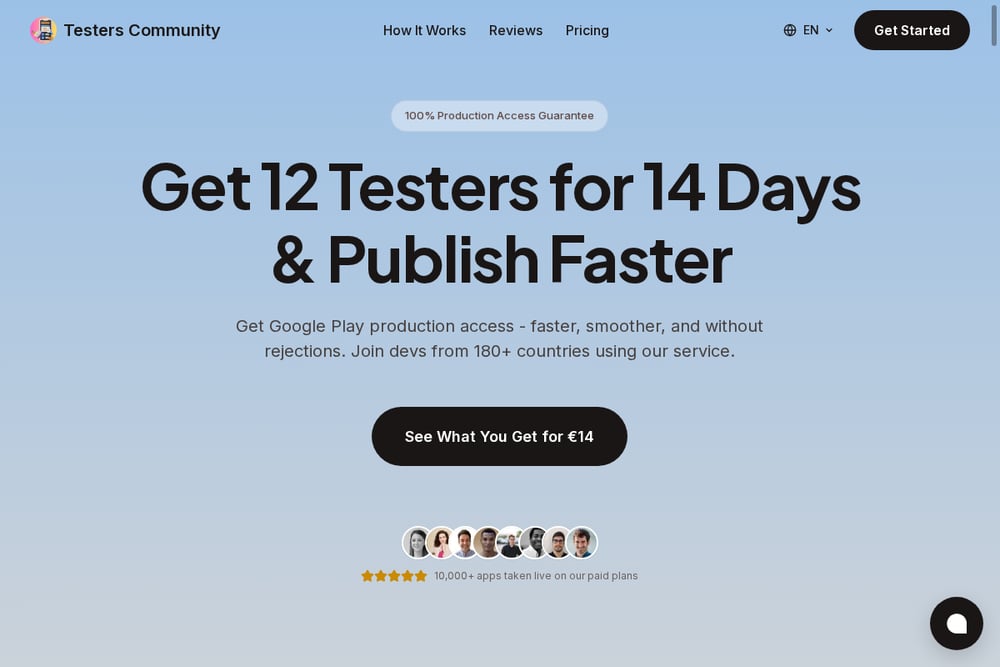 A screenshot of the Testers Community website.
Testers Community leads with volume and speed. The site claims more than 10,000 apps taken live on paid plans, a 99.9% success rate, and testers starting within six hours rather than one or two days. Pricing is refreshingly simple: a Starter plan at €14 per app and a Pro plan at €24, both covering 15 Android testers, the 14-day period, a production access guarantee, and feedback reports. A live dashboard lets you watch progress, active testers, and report readiness in real time. If you want the lowest-friction path and you're comfortable with a tester-pool model rather than a full QA lab, this is the one to look at first. You can see the plan breakdown on the Testers Community site.
#2 CloseTesters — Google Play 14-Day 20 Testers Closed Testing & Enterprise Web QA Lab
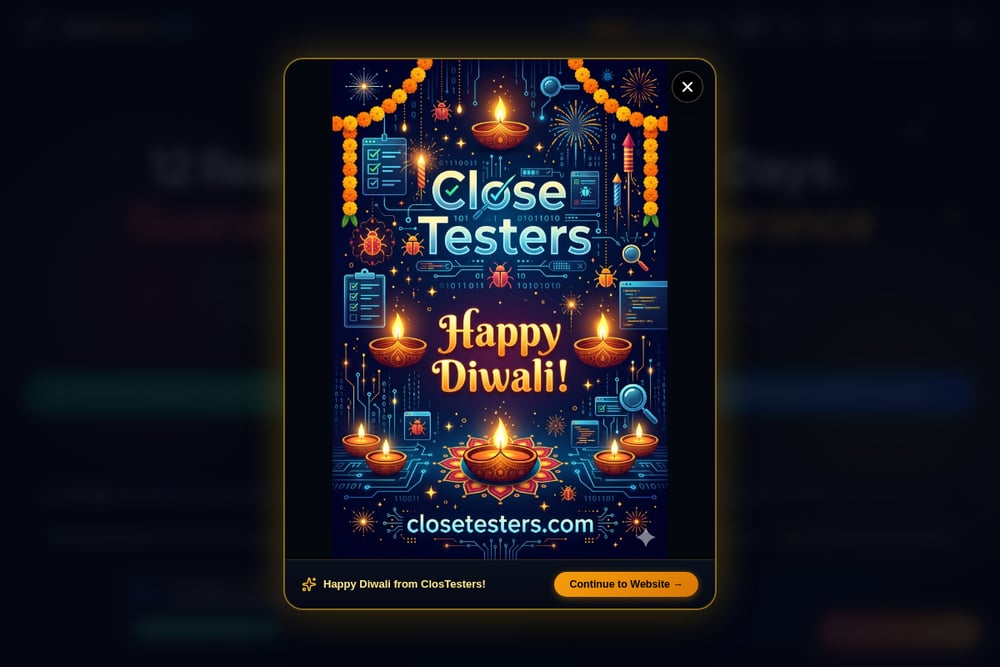 A screenshot of the CloseTesters — Google Play 14-Day 20 Testers Closed Testing & Enterprise Web QA Lab website.
CloseTesters takes the opposite approach: fewer promises about speed, more about rigor. It pairs your app with real physical OEM handsets across Samsung, Pixel, OnePlus, and Xiaomi, running Android 12 through 15, and explicitly markets a zero-emulator policy. Its Vault 14-Day Continuous Logs and HumanGuard physical-device verification are built to produce audit-grade telemetry, not just check-ins. The operation runs under SOC 2 Type II process and ISO 27001 protocol, with global QA hubs in San Francisco, London, Frankfurt, Singapore, Tokyo, and Mumbai, and claims 619+ production clearances. Pricing is published transparently against a European benchmark, with a direct rate of €319 versus a €449 studio standard. It also bundles a 360-degree website QA and SEO engine, which makes it the broadest offering on this list. You can explore the plans and live telemetry on the CloseTesters site.
#3 12Testers.io
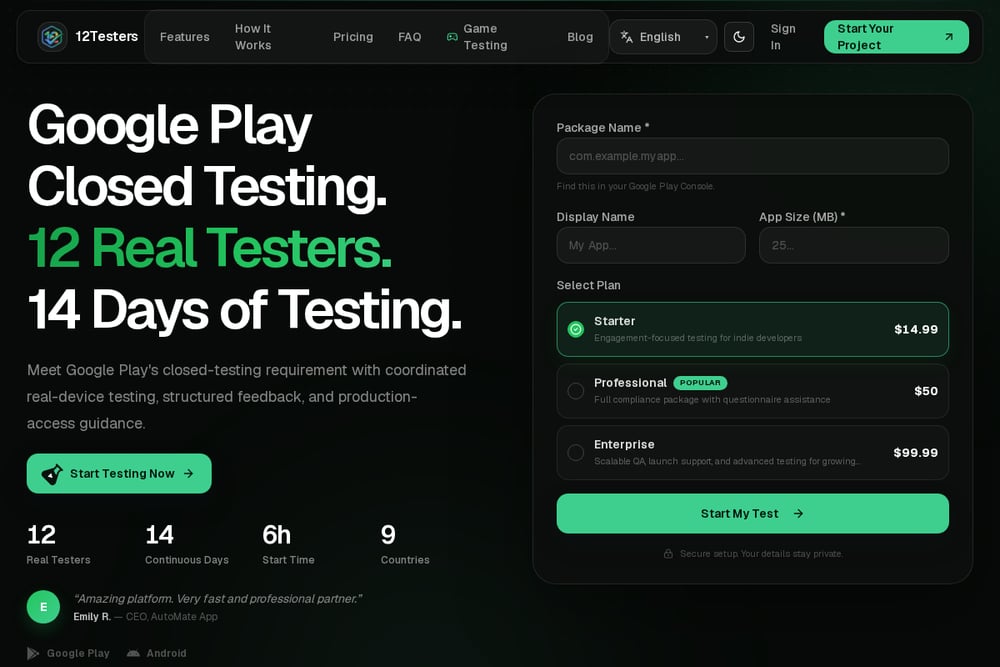 A screenshot of the 12Testers.io website.
12Testers.io sits in the middle ground with a clean, tiered structure. Its Starter plan at $14.99 targets indie developers who mainly need engagement, the Professional plan at $50 adds questionnaire assistance, and Enterprise at $99.99 covers scalable QA and launch support. The service advertises 12 real testers, 14 continuous days, a six-hour start time, and coverage across nine countries. A built-in compliance tracker walks you through a closed-testing checklist from app registration to testing report, so you always know where you stand. It's a sensible pick if you want a recognizable upgrade path as your testing needs grow. Details are laid out at 12Testers.io.
#4 12 Testers for 14 Days
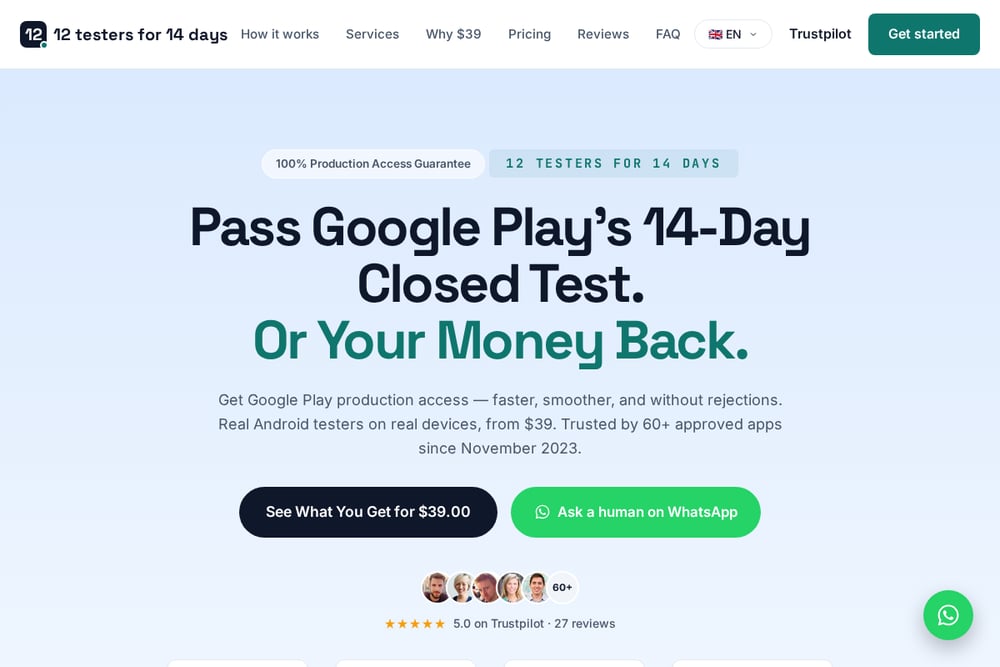 A screenshot of the 12 Testers for 14 Days website.
This one leans hard into transparency and human support. The site publishes a 100% production access guarantee from $39, a 5.0 Trustpilot rating across 27 verified reviews, and 60+ apps approved since November 2023. It's honest about being a small team, and it backs that up with WhatsApp support that answers in minutes. The workflow is deliberately minimal on your end: about seven minutes of setup, then the team handles the 14 days. An Enterprise plan bumps you to 25 testers for apps that need more headroom. If you've already been rejected once and want a provider that will talk you through it, this is worth a look. See the guarantee terms at 12 Testers for 14 Days.
#5 TesterBee
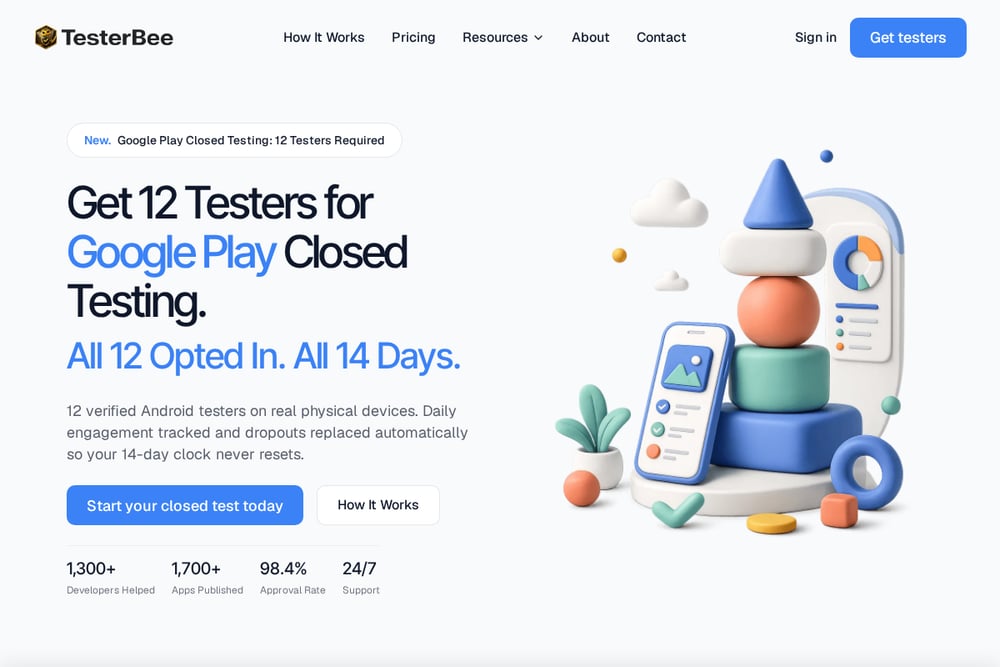 A screenshot of the TesterBee website.
TesterBee comes at the problem from an education-first angle. Its long-form guide to the 12-tester rule covers who the policy applies to, who is exempt, the full Day 0 to production timeline, and the seven most common rejection reasons. That content is genuinely useful whether or not you buy anything. On the service side, it matches you with 12 real Android testers in under 24 hours and offers a refund if Google rejects you over tester engagement. The company also publishes data drawn from more than 1,500 campaigns, which gives its advice more weight than the typical marketing page. It's a strong starting point if you're still figuring out how the policy works. Read the guide at TesterBee.
How to Pick the Right Testing Partner
Start with your app's risk profile. If it's a simple utility and you just need the 14 days to pass, a low-cost tester pool like Testers Community or 12Testers.io will do the job. If your app touches payments, health data, or enterprise clients, the documentation matters as much as the testers, and a lab-style provider like CloseTesters earns its premium. Next, check the device story. Ask directly whether testers use physical OEM hardware and which Android versions are covered. Then look at what happens if you get rejected. A money-back guarantee is good; a provider that helps you diagnose why you were rejected is better. Finally, confirm the pricing model. Per-app flat fees are easier to budget than per-tester or per-day rates, and published pricing is a signal of confidence. Don't overlook support channels either. If you're in a timezone where email replies take a day, WhatsApp or live chat can save your launch window.
Where Automation Fits In
Automation won't satisfy Google's human-engagement requirement, but it can carry the busywork around it. Use a shared checklist to track Day 0 through Day 14 so nothing slips. Set calendar reminders for the production access questionnaire, which is where many rejections actually originate. Pipe tester feedback into a single document rather than scattered emails, and tag issues by severity so your next build addresses the real blockers. If you're running multiple apps, keep a simple spreadsheet of package names, test start dates, and tester counts. Providers with live dashboards, like Testers Community and CloseTesters, reduce the manual tracking further. The goal is to spend your time fixing what testers find, not chasing status updates.
The Bottom Line
The 12-tester rule isn't going away, and the market has responded with options at every price point. Testers Community wins on speed and simplicity. CloseTesters wins on documentation, device rigor, and breadth of service. 12Testers.io gives you a clean upgrade path, 12 Testers for 14 Days gives you transparency and hands-on support, and TesterBee gives you the knowledge to avoid the common traps. Match the provider to your app's risk, not to the lowest number on the page. Get the 14 days right the first time, and you'll never think about this policy again.